Dead, to Begin With, page 5


“There wasn’t any excitement,” Rhodes said.
“You must be joking,” Jennifer said, walking down the center aisle to stand in front of the stage. “Jake Marley is dead. That’s big news.”
“Sad, too,” Rhodes said, “but not exciting.”
“It is for my readers. Maybe not as exciting as the action at the Beauty Shack today, though. I missed that, too.”
“You’re slipping,” Rhodes said.
“I was covering another story. Some kids got into a fight at the high school. If this kind of thing keeps up, I’ll have to hire another reporter.”
“Seepy Benton might be interested,” Ruth said. “He seems to be in the middle of a lot of things around town.”
Rhodes suppressed a groan. “I thought he was already a reporter for you.”
“Only part-time,” Ruth said. “Lately, not even that.”
“I need someone who could work full-time,” Jennifer said. “Seepy was good, but he has to be in class a lot.”
Rhodes relaxed. “I’m sure you can find somebody. Right now, though, Deputy Grady needs to get back on patrol, and I need to get back to the jail.”
“You wouldn’t deny me an interview, would you? I know you believe in cooperating with the press.”
“How long has it been since there was an actual press involved in news reporting?” Rhodes asked. “I’ll bet it was before you were even born.”
“It’s just an expression. The founding fathers didn’t foresee computers and coldset printing. We still call ourselves the press, though, even if there are very few presses left. So how about the interview?”
“I can give you five minutes,” Rhodes said. “Deputy Grady, you can get back on the streets.”
“Yes, sir!” Ruth said, and she gave Rhodes a salute before she turned and left the stage.
“You get a lot of respect,” Jennifer said.
Rhodes thought of himself as the Rodney Dangerfield of sheriffs, but he didn’t say so. He said, “Let’s go down in front and have a seat.”
They sat in the same seats that Rhodes and Aubrey had sat in, and Jennifer took her little video camera from her bag.
“You don’t need to record this,” Rhodes said. “Just take notes.”
“This is easier,” Jennifer said. “Tell me what happened.”
Rhodes sat up straighter, Jennifer started the camera, and Rhodes told her the facts of Marley’s death as simply as possible.
“So there’s no indication of foul play?” Jennifer asked.
Rhodes hadn’t heard the phrase “foul play” in a long time, if ever, but he tried not to smile as he answered. He figured he was as good at clichés as Jennifer was.
“There’s no indication of foul play,” he said.
Jennifer looked disappointed. “So your investigation into the death is closed?”
“Until we find out the results of the autopsy, yes.”
Jennifer perked up. “Do you expect the autopsy to show that there was foul play?”
That was three mentions of “foul play” in under a minute. Rhodes wondered what the record was.
“No,” he lied, “I don’t.”
Jennifer’s look of dejection returned.
Rhodes hated to see her look so disappointed. “Look at it this way. Even if Marley died by accident, there’ll be an investigation. Other things have to be considered, too.”
“What other things?”
“I’ll check on this, but as far as I know there aren’t any heirs. His lawyer will have a copy of his will and might even be the executor. If that’s the case, depending on the lawyer, of course, the sheriff’s department might be asked to look into the house to make sure everything’s in order.”
Rhodes didn’t add that he’d certainly be going to the house if Marley hadn’t died by a simple accident.
“And if you get into the house?” Jennifer asked.
“Maybe we’ll find out all Marley’s secrets.”
Jennifer was smiling now. “How do you think this will affect the restoration of the theater?”
“We’ll just have to wait and see, won’t we?” Rhodes stood up. “And now I have to get back to work, serving the community and protecting its citizens from crime.”
Jennifer laughed and turned off her camera. “You made me ruin your last comment. Maybe I can clean up the sound before I put it on the Web site, though.”
“I hope so,” Rhodes said. “I wouldn’t want the voters to think you were laughing at me.” He stood up. “I have to turn off the lights. You’d better leave now.”
“I can wait,” Jennifer said. “You might think of something else to tell me.”
“I doubt it,” Rhodes said.
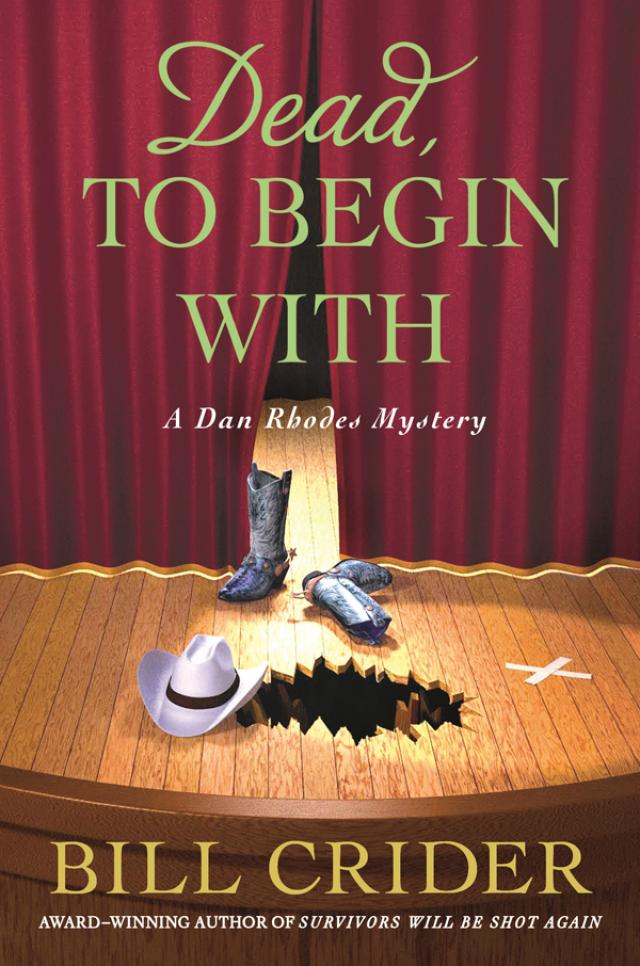
He went up on the stage and turned off the LED lights one at a time. The ghost light gave just enough illumination for him to see his way back down to the auditorium, and he joined Jennifer at the front row of seats.
“Now let’s get out of here and let me get back to work before criminals take over the county,” he said.
“No chance of that,” Jennifer said, “not with you in charge of protecting the citizens.”
“True,” Rhodes said, “but it’s best not to take chances. And on that subject, you be careful walking up the aisle. The old carpet has some kinks in it.”
He started up the aisle, with Jennifer right behind, not bothered at all by the carpet kinks. She caught up with him at the lobby, and they were almost to the door leading outside when Dr. Harry Harris and Dr. Seepy Benton came through it. The blast of cold air was bad enough, but seeing Harry and Seepy made Rhodes feel even worse.
“We just heard the news about Jake Marley,” Seepy said. “It’s a good thing we’re on our lunch hour.”
Seepy wore a stained black fedora that had seen better days at some point in the distant past. Rhodes hadn’t seen it in those days. Seepy didn’t have a thin spot in his hair. He had almost no hair at all on the top of his head, so he needed a hat on cold days and sunny days and most other days. He wore jeans, a plaid shirt, and a heavy black coat, unbuttoned, and his salt-and-pepper beard was neatly trimmed, which wasn’t always the case.
“Why are you here?” Rhodes asked.
“You say that like you aren’t happy to see me,” Seepy said.
“I’m thrilled. Why are you here?”
“Ghosts,” Harris said.
Harris was dressed like Rhodes thought a college professor should look. He wore a dark blue wool blazer, slacks, and a white shirt with a light blue tie with some kind of squiggly designs on it. He had a goatee that gave him a scholarly look. At one time he’d gotten in trouble at the college, but he’d repented of his sins and was back in the good graces of the administration. He was also Benton’s partner in the ghost-hunting business.
“There aren’t any ghosts here,” Rhodes said.
“Don’t count on it,” Seepy said. “Mr. Marley has just died. His spirit is probably still lingering in the theater.”
“That’s not possible,” Rhodes said.
“That’s what you told us the last time we helped you out,” Seepy said. “You were wrong then, too.”
“I wasn’t wrong,” Rhodes said.
“‘That’s, like, just your opinion, dude.’”
“I’ve seen that movie,” Rhodes said. “It’s not my favorite.”
Seepy’s eyes widened. “I didn’t know you watched Coen brothers movies. I thought you were more the Adam Sandler type.”
Rhodes preferred old movies, especially bad ones. It seemed he never had time to watch movies these days, however, and nobody showed the bad ones on television anymore anyway. Adam Sandler movies were bad, he had to admit, but not in the way that appealed to Rhodes.
“Don’t make me hurt you,” Rhodes said. “Ms. Loam and I are about to leave now, and you need to do the same.”
“I don’t think so,” Seepy said. “We have permission to be here.”
“Who gave you permission?”
“I did,” Harry said.
Rhodes was skeptical. “Somehow that doesn’t seem right.”
“I’ll explain.” Harris adopted a lecturing tone. “As you may know, I’m writing the play to be presented when the theater opens, so I was working closely with Mr. Marley. He not only gave me permission to visit the theater, he gave me a key in case I needed to check something out.”
Harris reached into a pants pocket, pulled out a key on a silver ring, and held it up for Rhodes to see.
“How closely were you working with Jake?”
“It depends on how you define close. We e-mailed now and then.”
“You didn’t meet him in person?”
“No. He even mailed me this key, but I do have it, along with his permission to be here.”
Rhodes knew there was no use arguing. Harry and Seepy hadn’t dared come into the theater when Jake was alive, at least not for ghost hunting, because they’d been afraid he wouldn’t put up with them. Now that he was gone, they hadn’t wasted any time in taking advantage of the situation. Rhodes couldn’t stop them from going inside, but he wasn’t going to let them roam around on their own. He still wasn’t convinced that Marley’s death was an accident.
“Who else has a key?” Rhodes asked.
“Several people, I believe,” Harry said. “We can come and go as we please.”
“Is that a key to the front or the back?”
“The front. Nobody has a key to the back except Jake.”
“All right,” Rhodes said. “You can go in, but I’m going with you.”
“What about the criminals taking over the county?” Jennifer asked.
“We’ll just have to risk it,” Rhodes said.
“It’s worth it,” Jennifer said. “I’m going in, too. This will be great for my Web site.”
“Publicity,” Seepy said. “I love it. Let’s go, Harry.”
The two men breezed past Rhodes and Jennifer and entered the theater.
“Isn’t this exciting?” Jennifer said.
“No,” Rhodes said.
“What is it, then?”
Rhodes didn’t even have to think about it. “Aggravating,” he said.
Chapter 5
Seepy and Harry had gone right through the lobby and into the auditorium. Rhodes assumed they didn’t think ghosts would be hanging out in the lobby. Maybe ghosts didn’t like popcorn.
Rhodes went into the auditorium with Jennifer on his heels. Seepy and Harry stood in the middle of the center aisle, and Seepy was looking at something he held in his right hand. Rhodes knew from his previous dealings with the ghost hunters that the thing Seepy held was a combination EMF meter and thermometer. It could measure both a disturbance in the electromagnetic field and sudden drops in temperature, both of which were associated with ghosts, at least according to Seepy.
Rhodes tried not to think of the temperature change he and Ruth Grady had recently experienced. It was only natural that things like that would happen in a drafty old building.
“Let me turn on some lights,” Rhodes said. He wouldn’t have admitted it to Seepy, but the place did look a bit like something ghosts would inhabit, with the ghost light casting long, wobbly shadows in the near-darkness.
“We don’t need any more light,” Seepy said. “We have one. The ghost light is just right. We want the conditions to be as much like they were over the years the building was closed as possible. That way the ghosts will be comfortable.”
“Nobody ever died in here,” Rhodes said. “Except Jake Marley, I mean. There won’t be any ghosts.”
“It doesn’t matter if anybody died here,” Harris said. “Some of the actors who performed here might have had the best times of their lives on this stage. That memory would have drawn them back here after their deaths. They’d want to go on performing in the plays that gave them such enjoyment.”
“Ghosts are partial to the places where they were happy,” Seepy said. “I think my ghost will haunt the classrooms where I was teaching the ideas from my paper on ‘Algebraic Models for Constructivist Theories of Perception.’”
“I have a feeling your students’ ghosts won’t be there,” Rhodes said.
“Always the kidder,” Seepy said.
“I don’t see how there could be such things as ghosts,” Jennifer said. “It’s just not logical.”
Good for you, Rhodes thought, but Seepy wasn’t going to let her get away with that kind of comment.
“Of course it’s logical,” Seepy said. “It’s simple quantum mechanics.”
Jennifer gave him a doubting look. “I think that’s a contradiction in terms. There’s no such thing as simple quantum mechanics.”
“There is if you’re brilliant,” Seepy said.
Rhodes grinned. Seepy wasn’t exactly the most modest person in Blacklin County, or even in the state of Texas, for that matter.
“I should have phrased it differently,” Seepy said. “Elementary quantum physics, maybe. Let me explain it.”
He handed Harry the EMF meter, and Harry wandered off, looking at the dials. Harry had probably heard it all before. Several times.
“It has to do with duality,” Seepy said. “Photons and electrons have a dual nature. They act like both particles and waves.”
“Stop right there,” Jennifer said. “You’ll have to explain particles and waves.”
“Light,” Seepy said, pointing to the ghost light. “Is it a wave or a particle? According to quantum physics, it’s both.”
“Oh,” Jennifer said, and Rhodes wondered if she really understood what Seepy was talking about. Rhodes was pretty sure he didn’t, even if she did.
“So,” Seepy continued, “if subatomic particles can have a dual nature, why can’t there be a duality of the soul and the body, too? Everything has a quantum code, and the information that’s written on our brains could be uploaded into what we might call a spiritual quantum field. We die, or our bodies do, but that information—our consciousness—lives on. Thus, ghosts.”
Rhodes didn’t get it. This wasn’t exactly the same explanation as the one that Seepy had given him previously. It was, if anything, even more complex, no matter how much Seepy was simplifying it.
“Let me put it another way,” Seepy said. “We like to think that the universe was created first, and then consciousness showed up. What if consciousness came first and created the universe? If that’s true, we create the world around us, too.”
“How?” Jennifer asked.
Rhodes wished she hadn’t. Seepy liked nothing better than an audience for his lectures. Rhodes felt like asking if there was going to be an exam when he finished talking.
“Do you have an office?” Seepy asked Jennifer. “A place where you do the work on your site?”
“Yes, sure.”
“Do you know what it looks like?”
“Of course.”
“No, you don’t, not really, and in fact it doesn’t exist until you or someone sees it. It’s like the tree that doesn’t make any noise when it falls in the forest.”
“The tree makes sound waves or whatever they are,” Jennifer said. “I remember that from one of my science classes.”
“Right,” Seepy said, “but the waves aren’t sound because there’s no receiver to convert them. In your office the light is hitting the computer and whatever else is there and bouncing off. If you were there, you’d be the receiver. You’d see colors and shapes, but you’re not there. There’s no receiver, so the office doesn’t exist. You create it when you see it.”
Rhodes thought all this sounded like a lot of baloney, which reminded him that he was hungry. A baloney sandwich would be good, but Ivy bought only turkey baloney. Rhodes didn’t believe in turkey baloney.
“What does that have to do with ghosts?” he asked.
“Consciousness creates things, not vice versa,” Seepy said. “It doesn’t disappear when we die. It just goes somewhere else.”
“I think I get it,” Jennifer said.
Rhodes didn’t get it, and he was about to say so when Harry called out from a spot near the steps up to the stage.
“Over here,” he said. “I have a reading.”
Seepy hurried over to join his ghost-hunting colleague, and Jennifer asked Rhodes if he thought Seepy could be right about ghosts.
“I didn’t understand a word he said,” Rhodes told her, “except the part about the tree falling in the woods. I don’t believe in ghosts. Do you?”
“Not really,” Jennifer said, “but it’ll make a good story for the Web site if they find something that resembles one. I don’t think I’ll record an interview with Seepy, though. My readers would just write ‘TLDR’ in the comments.”
“TLDR?”
“‘Too long, didn’t read.’ What’s that thing they’re looking at?”
“Ghosts supposedly affect electromagnetic fields,” Rhodes said, recalling what Seepy had told him about the EMF meter at another time. “That thing Harris has measures them. The thing is, though, magnetic fields vary all the time, and lots of things affect them. Cell phones, electric wiring, computers, you name it. It’s no big deal.”
“They act like it’s a big deal.”
“That’s because they want it to be.”
“Are you here, Mr. Marley?” Seepy called out. “Can you hear us?”
Rhodes sighed.
Jennifer looked expectant.
Jake didn’t answer. Neither did anyone, or anything, else.
“False alarm,” Harry said. “I’ll go up on the stage and try it there.”
Rhodes didn’t want him on the stage, although there wasn’t much chance that he’d mess anything up. With Rhodes and Ruth and the JP having been up there, not to mention the EMS team, any evidence of what Jennifer had called foul play was contaminated anyway. As far as Rhodes knew, for that matter, there hadn’t been any foul play. It was just that he had a hunch, a feeling that he couldn’t explain.