

Worzel Gummidge, page 7
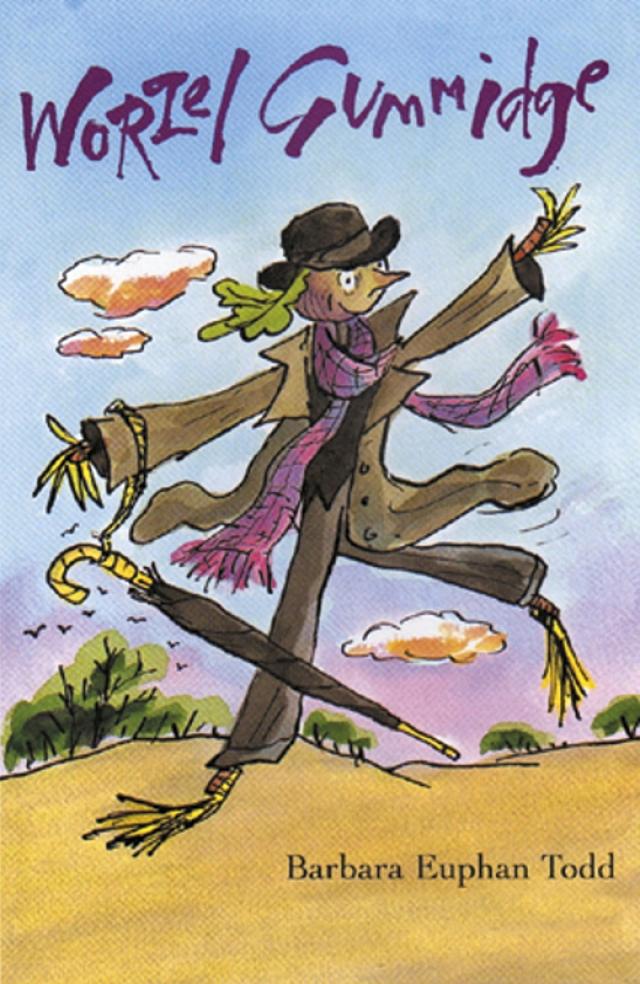


Emily Goodenough told them that the annual fair always came very early to Scatterbrook.
‘The place’ll be half daft,’ she grumbled. ‘What with all the merry-go-rounds and swing-boats and such-like rubbish, there’ll be no work done for a week. And, as if that wasn’t enough, Mrs Bloomsbury-Barton is arranging a village baby show. There’s to be a whist drive at the vicarage too. It all means that there won’t be a lass to help with the spring cleaning. I don’t know what the world’s coming to.’
‘I wish we could take Gummidge to the fair,’ said Susan as soon as Emily Goodenough had turned her back. ‘I’m sure a ride on a merry-go-round would be a treat for him.’
‘It would only make him giddy,’ said John wisely. ‘And then he’d probably sulk, and we should have to pay for all his turns until he had stopped being cross.’
‘Well, I think we ought to tell him about the fair,’ persisted Susan. ‘Let’s go and look at him.’
When they reached Mrs Kibbins’s garden wall and peeped over it, they saw at once that something had happened to Gummidge. His coat-sleeves were flapping more limply than usual, and, instead of standing straight out from his shoulders, they hung down. His trousers sagged dismally.
‘What has happened to him?’ asked John.
‘I don’t know,’ replied Susan. ‘But he looks quite different, doesn’t he?’
Suddenly she gave a little cry and clutched John’s arm.
‘Isn’t his hat twiddling about very queerly? And look, there’s a gap between it and his coat collar. He hasn’t got a neck at all! Somebody’s taken his head away. How very, very, very horrid of them!’
She burst into tears.
‘Nobody would take his head away,’ said John. ‘Nobody would want it; it isn’t pretty enough.’
All the same he felt rather frightened himself, as he looked at the length of polished broomstick that bridged the space between Gummidge’s hat and collar.
‘I can’t bear it!’ sobbed Susan. ‘If he’s been executed, it means that he is dead.’
‘Scarecrows are never executed.’
‘You never know what might happen to a person like Gummidge,’ wailed Susan. ‘And I’d got so fond of him. I even loved his knobbles and his toothy grin and the bit of mud where his ear ought to have been. I’d got used to his sulks and everything. He’s the first grown-up friend we’ve ever had who didn’t order us about.’
If Mrs Kibbins hadn’t chanced to come out of her door at that moment, the children would certainly have gone into the garden to look more closely at Gummidge. But Mrs Kibbins’s bonnet feathers were waving rather fiercely, and her nose looked so hooky, that Susan, who could not see very clearly through her tears, sobbed: ‘I think she’s a witch! I think she’s done something very, very beastly to my darling Gummidge!’ Then, before John could stop her, she turned and ran like a rabbit up the village street. She only stopped for breath when she reached the corner of Ten-acre field. Then she flung herself down on to the grass and sobbed miserably.
John felt rather choky himself. He tried to think that everything was all right, and that the disappearance of the head was only one of Gummidge’s queer ways.
‘After all,’ he said. ‘After all, Gummidge may have pocketed his head!’
‘Why should he?’ asked Susan.
‘To keep it warm, perhaps.’
‘How silly you are,’ said Susan. Then she shivered, and whimpered, ‘I’m most dreadfully cold.’
‘Let’s go home,’ suggested John.
‘I don’t want to go home. And I don’t want to see anyone,’ wailed Susan. ‘If we hadn’t known Gummidge so well, we might have enjoyed having a funeral with him. But now everything is perfectly beastly.’
‘Perhaps somebody is making a new face for Gummidge,’ said John.
‘He wouldn’t be the same with a new face. He couldn’t be the same without that knobbly nose.’
Susan stood up and rubbed her wet face with her muddy hand. Then she trailed dismally along the little lane that led to the foot of the hills.
‘I’d like to make him a wreath,’ she said. ‘Do worzels have flowers? I’m sure he would like a wreath of worzel blossom better than anything else.’
‘You don’t think a cow could have eaten his head, do you?’ asked John. ‘Cows do eat turnips, you know, and Gummidge’s face was very turnipy.’
‘There aren’t any cows in Mrs Kibbins’s garden,’ replied Susan. ‘I’m so afraid that she has boiled his head.’
They were passing the little empty, single-roomed cottage that stood at the foot of the Beacon Hill as Susan spoke, and she stopped to gather a sprig of the woodruff that grew by the tumbledown gate.
Suddenly she heard a cough—a queer, husky cough that could only belong to a sheep or to Gummidge.
‘He’s there!’ she cried. ‘Perhaps he’s put himself together again.’
‘He couldn’t have done that,’ objected John. ‘It can’t really be Gummidge; perhaps it’s a tramp.’
‘Listen!’ said Susan again, and she held up her finger. From inside the cottage there came the most peculiar crooning sound and presently they were able to make out the words—
‘Hushaby Scarey,
Don’t be contrary!
Turnips will nip you unless you are good!
Worzels will worzel,
And furzles will furzle;
Bogles will fetch you, unless you are good.’
‘Gummidge!’ shouted John. ‘That’s Gummidge’s voice!’ He burst open the door and rushed inside.
There was no furniture in the cottage, but only a wooden packing-case. Gummidge was sitting on this. In his arms was a small baby, as raggedy and disreputable looking as himself. Gummidge was dressed even more peculiarly than usual. Instead of a coat, he wore starched blue overalls that had gone limp in patches, brown cotton stockings, and real boots, but his face was unchanged and his grin was as wide as ever.
‘Hush!’ said Gummidge, and he held up a reproving finger. ‘Don’t wake the baby.’
‘We thought you were dead,’ cried Susan.
‘Not I!’ said Gummidge. ‘I don’t do things like that in a hurry. I’m a slow mover, I am.’
‘But we saw you in Mrs Kibbins’s garden about half an hour ago,’ said John. ‘Your head was gone.’
‘Of course it were,’ said Gummidge. ‘It were on me, and I’ve been here all the morning. I don’t go leaving my head about. I were brought up to be tidy, I were.’
‘Were you really?’ asked John. Susan felt angry with him; she wanted to find out all about the baby, but she daren’t interrupt for fear Gummidge would sulk.
‘Well, in some ways I were brought up to be tidy,’ said Gummidge modestly. ‘I mayn’t be extra tidy. My old nurse said to me, years an’ years ago, she said, “Don’t you go leaving your head and arms and legs about. It causes trouble and makes it difficult to sort yourself afterwards.” ’
‘Why are you dressed like that?’ asked John, though Susan kicked him hard.
‘Just to make a nice change!’ said Gummidge airily. ‘And to give the robin a rest. Mrs Kibbins left the overall in the wash-house. It fits me a treat.’
‘That was stealing,’ said Susan primly.
‘I left the straw boots behind instead,’ said Gummidge. ‘And I got these boots and trousers from a friend.’ He stuck out his legs and looked at his boots proudly. ‘Leastways he might have been a friend, if we’d ever got to know him. But it seemed a shame to wake him up, when he was sleeping so soundly. We can see about being friends later!’
The baby stirred and opened its rather muddled-looking eyes. Its face, like Gummidge’s, was remarkably turnipy-looking, for all its features seemed to have melted into one another. Susan noticed with relief that it did not wear bottle straws on its grubby little feet.
‘Whose is it?’ she asked.
‘Well,’ said Gummidge, slowly. ‘I call it mine.’
‘But is it yours?’ asked Susan. Really, she would not have been surprised to hear anything.
‘Now you’re asking,’ said Gummidge. ‘I don’t know, and you don’t know, and it doesn’t know. I found it in the wood.’
‘Was it growing there?’ asked Susan curiously. She felt that Gummidge’s baby had probably sprung up in the night like a mushroom, so singularly root-like was its face. It puckered it now in the most dreadfully ugly manner. Gummidge snatched a wisp of straw from his neck and began to tickle its face until it giggled. He certainly had a way with babies.
‘Was it growing!’ persisted Susan.
‘Now, how should I know?’ asked Gummidge pettishly. ‘They grow so slow, you can’t seem to catch them at it. And how they grow beats me! I can understand a snake; that casts its skin when it grows out of it. But your sort might be made of elastic, the way they stretches out into men and women. You’ll do it yourselves!’
‘Is it a baby scarecrow?’ asked John.
‘It’ll scare the crows all right when it yells,’ said Gummidge, and he held the baby up. ‘Like to hear it?’ he asked.
‘No!’ shouted John. ‘What are you going to do with it?’
‘Eddicate it,’ replied Gummidge firmly. ‘Eddicate it, until it’s a nice companion for me.’
‘But you can’t keep a baby out in the fields all night,’ said Susan.
‘Can’t I?’ said Gummidge defiantly. ‘Can’t I? That’s all you know about it.’
‘It’ll die,’ said John.
‘Shan’t let it,’ said Gummidge. ‘This baby’s got to learn to do as it’s told, same as the rabbits do.’ He rocked it violently backwards and forwards in his arms as he spoke. ‘Anyway,’ he added. ‘Anyway, I’ve finished with rook-scaring for the present. I’m going to take a bit of holiday. Ooh aye. Now give over, Scarey,’ he said, as the baby began to pucker its face again.
‘Let me nurse it,’ begged Susan, and she sat down on the floor and spread out her skirts to make a lap.
Rather reluctantly, Gummidge laid the baby in her arms. It had a very queer face and the tufts of hair that stuck up from its head were rather like Gummidge’s own green sprouts.
‘Is it a boy?’ asked John.
‘I dare say,’ replied Gummidge indifferently.
‘How old is it?’ asked Susan.
‘Maybe eight months, but it’s difficult to tell unless you’ve been with them all along.’
‘You can’t keep it out all night in Mrs Kibbins’s garden,’ said Susan anxiously.
‘I wasn’t going to,’ replied Gummidge. ‘Young Mrs Kibbins’s daughter might take a fancy to it and change it over for her own. I like the colour of this one best, though hers is all right. There’s cows hereabouts. I can get a drop of milk for it when it wants it, and there’s straw here to make it a bed.’ He looked round the cottage with a beaming smile.
‘It’s rather a rough sort of place,’ said Susan.
‘This baby’s got to be brought up rough,’ said Gummidge.
All the same, the children noticed that he handled the baby quite gently as he took it from Susan’s lap.
‘Let me have it,’ said Susan. ‘I’m sure I know much more about babies than you do.’
A slow, sulky expression came over Gummidge’s face. He put the baby behind his back and looked at her defiantly.
Susan guessed from its yells that it was being held upside-down, and she sprang to her feet rather angrily.
‘Now see here,’ said Gummidge. ‘See here; if you want a baby, you must go and find one for yourself. There’s lots about.’
‘But you’ll hurt it,’ objected John.
‘It’s more likely to hurt itself, the way it’s going on,’ replied Gummidge. But all the same he whisked the baby round again on to his lap, and began to tickle its face.
‘Do let me,’ pleaded Susan.
‘Now see here,’ said Gummidge. ‘See here. You’ll make me desert if you go on like that. A lot of birds would have given up long ago.’
‘But you aren’t a bird,’ argued John.
‘In a manner of speaking, I am,’ retorted Gummidge. ‘I’m a special sort of crow—a scare-crow, just as a hedge-sparrow is a special sort of sparrow. One scares and t’other one hedges. Where’s the difference?’
‘I’m quite sure there is a difference,’ said Susan, who was feeling most dreadfully muddled.
Gummidge’s face went pale green with temper.
‘You’ve drove me to it,’ he said. ‘I will desert!’ And, still clutching the baby, he rose to his feet.
‘Oh, please don’t,’ said Susan. ‘We’ll go away and leave you.’
Gummidge sat down jerkily.
‘Goodbye,’ he said. ‘You can come and see me again when the baby’s fledged.’
‘Fledged!’ repeated John.
‘Haired, then,’ said Gummidge. ‘Haired and unwrinkled, since you’re so particular.’
Then, because he looked very angry again, the children ran out of the cottage and home to tea.
Chapter 9
The annual Fair was a feast day in Scatterbrook, and on the morning before it began the village common looked like the green-carpeted nursery of some untidy baby giant who had left his playthings—tents, games, and toy people—littered about all higgledy-piggledy.
Early in the morning John and Susan had set out to pay a visit to Gummidge, but when they turned to look back on the village and saw all the excitement of preparation and heard the thrilling sound of tent-pegs being hammered into hard ground, and the ring and jingle of the merry-go-rounds, they decided to leave Gummidge to his sulks.
Mysterious things seemed to be happening on the common. Susan decided that the gypsies didn’t look as excited as they ought to do. They were standing about in little groups and clusters. One of the women was talking to the policeman, who was scratching his head a great deal, as he always did when worried. One little girl was standing near, and she interrupted every now and then by whimpering, ‘I couldn’t help it, could I now?’
Susan knew exactly how she was feeling, as soon as she heard her speak, and, when she saw the child’s very dirty face was streaked with the tracks of clean tears, she went up to her, and asked, ‘What’s the matter?’
However, the child only scuffled her feet on the grass, repeated, ‘I couldn’t help it, could I?’ turned her back on Susan, and began to bite her nails.
Before there was time to ask any more questions, Emily came bustling across the common. She beckoned to the children, and as they could see at once that she was in a good temper, they rushed to meet her.
‘There’s a treat for you,’ said Emily in her most mysterious voice.
‘For me!’ asked John.
‘No, not for you.’
‘For me! For me!’ said Susan, dancing about as she always did when she was excited.
‘You’re going to the baby show this afternoon, and what do you think—?’
‘Baby! Baby!’ interrupted John. ‘I always said Susan was a baby!’
Emily took no notice of him; she went on talking to Susan. ‘There is going to be a baby show in the village hall, and Mrs Bloomsbury-Barton is going to be the judge, and give the prizes away.’ Susan looked puzzled, and John was just going to interrupt again, when Emily gave him one of her don’t-try-to-be-so-silly glances.
‘Mrs Parsons has just been round to say that she would like you to present the bouquet to Mrs Bloomsbury-Barton.’
‘What bouquet?’ asked Susan.
‘The bouquet.’ Emily sounded very important. Secretly she was rather proud of John and Susan, though she didn’t often let them know it, and she was very pleased because Susan had been chosen by Mrs Parsons to take part in the show.
‘You’ll have to have dinner early,’ she continued. ‘Because the baby show begins at half-past two, and I shall have to get you into your best dress. It’s lucky you’ve lost your cough.’
Poor Susan felt dreadfully disappointed; she had hoped the treat would be a real treat and not something that meant wearing a best dress and party manners.
‘But I don’t like Mrs Bloomsbury-Barton,’ she argued, ‘and I don’t want to give her anything.’
‘I’m sure Mrs Bloomsbury-Barton is a very nice lady.’ Emily sounded quite huffy. ‘Now come along and don’t be a rude, ungrateful little girl.’
‘I don’t see why I should be grateful when Mrs Bloomsbury-Barton’s having the present!’ argued Susan.
‘And what am I going to do?’ asked John.
‘You’re going too,’ said Emily firmly.
It took quite a long time to get the children ready for the baby show, and they were so cross about it all that they weren’t very helpful. Susan’s arms were as stiff as Gummidge’s when Emily made her try on the best dress, and John made a great fuss about washing the inside of his hands.
The tuck had to be let out of Susan’s dress, and some chocolate stains had to be sponged off John’s best coat.
When the baby show actually began, Susan rather enjoyed it. All the babies were so very pink and plump and clean and gurgly. Most of them enjoyed being put into the weighing baskets. But they didn’t enjoy Mrs Bloomsbury-Barton at all. When she looked at them, they puckered their faces into pleats, and yelled.
‘Babies are cleverer than I thought,’ muttered John.
Then, when the last baby had been weighed, the door of the hall opened, and in walked Mrs Kibbins. Behind her came her daughter pushing a perambulator.
Now, Mrs Kibbins was the proudest woman in the village. She thought that her little granddaughter was the finest baby in the county, just as she thought that her garden was the best in all Scatterbrook. She looked rather fiercely at all the other mothers and babies before she stooped over the perambulator and began to remove the blanket that covered the baby. Certainly the perambulator was the grandest in Scatterbrook; it had a white coverlet embroidered with blue forget-me-nots, and the blanket was as downy as young chickens. Mrs Kibbins shook it out proudly and folded it up very, very slowly.
‘Let me help,’ begged Mrs Bloomsbury-Barton, who was in a hurry for her tea.
‘It’s a baby show, not a blanket show,’ whispered the mother of the thinnest baby. Mrs Kibbins’s daughter did nothing at all. Her name was Mrs Turnpike, and she was frightened of her mother.


