

Worzel Gummidge, page 1
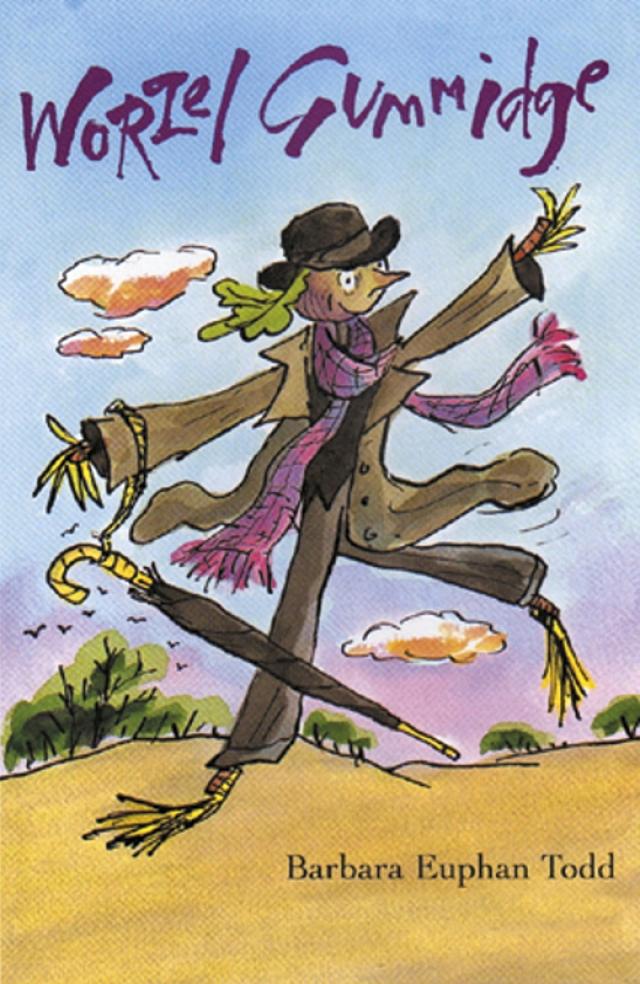


Chapter 1
Probably if it had not been for whooping-cough, John and Susan would never have seen the scarecrow who stood in the middle of Ten-acre field.
They had been sent down to the country at a time when the place was all muddy and slushy, almost empty of flowers and very full of lambs. All the excitement of being ill—meals in bed, blackcurrant jelly, and unexpected presents—was over, and nothing remained except what Emily Goodenough called ‘the tag end of a cough’. Emily had been their nurse, but now she lived with her sister who was married to a farmer in Scatterbrook, and she always invited the children down to the village for part of the summer holidays. They enjoyed those visits when even the farm kitchen smelled of hay and clover and honey, and when the tortoiseshell cat basked on the wall until his fur was as hot as sun-baked bricks, but the country was disappointing in early spring.
Whooping-cough had left them cross and quarrelsome. They weren’t allowed to go near other children because they were still infectious, and all the grown-up people of the place were too busy to be bothered with them. They couldn’t spend much time in the lofts because the dry hay-dust got into their throats and made them cough. They weren’t allowed to play in the farm kitchen except on soaking days, because Emily said, ‘Fresh air is the best doctor.’ So every morning, after breakfast, they were bundled into overcoats and mufflers and wellington boots, and told to go for a nice brisk walk and to keep out of mischief and to turn their heads away and try not to cough if they happened to meet any other children.
At first it had been rather fun, but after they had walked as far as they could in every direction, and had explored most of the ditches and hedges, and found some new and a lot of old birds’ nests, they began to get rather tired of everything and particularly of each other.
John said he didn’t want to have to go for walks every day with a girl of twelve who thought she knew everything, and Susan said she didn’t want to have to go for walks with a boy of ten who didn’t know anything at all.
One morning when they were in the middle, or perhaps it may have been nearly at the end of a particularly long quarrel, they came to a gap in a hedge, and decided to go through it because they were tired of the road.
‘We’d better not!’ said Susan, as a tiresome bramble tugged at her coat. ‘We’d better not go across the field. There’s a man in the middle of it, and he’s waving his arms at us.’
‘That’s not a man!’ said John when he had peeped over the hedge. ‘That’s a scarecrow.’
‘It’s a man. I saw him pointing at us, and then he waved his arms about. We’d better go back.’
‘Let’s look!’ said John, and he pushed his way through the gap in the hedge, and past Susan.
When he had looked, he laughed in the sort of way he always did when Susan was making as much room for cows as was possible in a narrow lane, or when she was walking very, very quickly past the farmyard geese.
‘That’s a scarecrow,’ said John, ‘and if you’re frightened of it, you must be a crow. Scared crow! Scared crow! Scared crow!’
‘I’m not a crow and I’m not scared!’ Susan pulled her coat away from the bramble, and followed John into the field. ‘But he did move. I saw him. He stood still as soon as you looked at him. Now he’s begun again. Look!’
The children stood quite still, and stared at the figure in the middle of the field. It was a good long way away from them, so they could not see it very distinctly, but they saw that it was dressed in an old black coat and long trousers, and that its hat was tilted on to the back of its head. Its arms were stuck straight out from its shoulders.
While they waited, the rain began to fall, slowly at first, and then very fast indeed.
‘We’d better shelter under the hedge,’ said Susan.
John answered crossly, ‘There’s no shelter under that silly little bit of hedge. We’d better take a short-cut across the field.’
‘It may be a long-cut. We don’t know the way.’
It can’t be a long-cut. The road’s a long-cut: it’s so winding. Wait till I get my compass out.’ John began to unbutton his overcoat, and got very wet indeed as he was doing it, because he forgot to turn his back to the rain.
By the time the compass had been dropped several times in the mud, Susan didn’t particularly mind which way she went home, and she felt sure that even the most angry man wouldn’t be more angry, even if they did take a short-cut across a private field.
So John had his way, and they began to run as quickly as possible over the deeply ploughed furrows. They could scarcely see the creature in the middle of the field because the rain was beating down so heavily.
Their wellington boots stuck between the furrows so often that it took quite a long time to cross even a quarter of the field.
Once or twice Susan said she was quite sure that she had seen the man coming towards them, but John, who was shorter in the leg and shorter in the wind than she was, seemed too breathless to answer.
At last, when they had very nearly reached the middle of the field, one of John’s boots came right off, and they had to wait for some time, because when he tried to push his foot into it again the boot sank deeper and deeper into the sticky soil, and when he stood on one leg and pulled, he tumbled over. By this time they were standing almost opposite to the scarecrow, and Susan saw that he had a most friendly and pleasant face. It was cut out of a turnip, and one or two green leaves stuck out from under his black bowler hat.
‘Oh!’ cried Susan, ‘he’s got an umbrella. He’s holding it in his, his—’ She looked more closely, and saw that the scarecrow hadn’t got a hand. The round, polished end of a broom-handle showed beyond his ragged cuff. ‘It’s sticking out from his arm!’ she ended.
‘Let’s take it,’ said John. ‘My neck’s as wet as anything and muddy.’
He looked almost as much of a scarecrow as the scarecrow itself, for he had fallen down twice, and all one side of him was plastered with wet earth.
‘I don’t think we ought to take the umbrella,’ said Susan.
‘Why not?’
‘It belongs to him.’
‘It’s not a he; it’s an it!’
‘S’sh!’ said Susan, for somehow, though she could see that the scarecrow’s face was made out of a turnip and that his nose was just a knobble and his mouth only a slit, he looked as though he might come to life any moment.
‘Let’s see if the umbrella works,’ said John, and he gave another tug at his boot, and then walked towards the scarecrow.
And then, just as he was nearly in reach of the broomstick arm, something whirred past his head.
‘Ooh!’ said Susan.
‘A robin!’ shouted John. ‘It came out of the scarecrow’s pocket. There must be a nest in it. Look, I can see the bits of hay and stuff sticking out of his pocket.’
‘Don’t touch it,’ said Susan. ‘Don’t touch it. Robins desert if you touch their eggs. Emily told me. There’s a rhyme about it—
‘“The robin and the red-breast, the robin and the wren,
If you take out of their nests you’ll never thrive agen!” ’
‘All right!’ replied John. ‘We won’t touch, but we’ll look.’
Both children walked right up to the scarecrow. John had to stand on tiptoe before he could peep down into the tiny nest of the breast pocket of the coat, but the top of Susan’s head was nearly on a level with the scarecrow’s round, turnipy chin.
‘Four eggs!’ said John. ‘P’raps there’ll be another one tomorrow.’
Susan stepped closer to the scarecrow and as she did so, she trod on something that was quite stiff and crunchy.
‘Oh! I’m sorry!’ she said.
‘What’s the matter?’ asked John.
‘I trod on his foot,’ explained Susan. ‘I trod on his straw boot.’
John looked down at the bottle straws that stuck out from each of the scarecrow’s trouser legs.
‘Those aren’t boots,’ he said. ‘They’re the things that bottles are packed in. Come on. Let’s go home. I’m simply sopping.’
He lifted the umbrella from the scarecrow’s stiff arm, and began to put it up. It wasn’t much of an umbrella, but it was better than nothing even though two of its ribs were quite bare, and though there were jagged holes in the stuff that covered the rest of it. The wind tried to tug it out of John’s hand, and the rain beat fiercely down on to the shabby, green silk.
‘I don’t think you ought to take it,’ protested Susan. ‘It belongs to him.’
She looked up into the scarecrow’s face as she spoke, and was glad to see that he was still grinning. The rain had washed his face almost clean, and several drops were trickling down his face. He looked like someone who was unhappy, but trying to be cheerful.
‘He’s crying,’ said Susan. ‘He doesn’t want us to take his umbrella. P’raps he puts it up at night when nobody’s looking.’ John grasped the umbrella more firmly, and walked away.
‘He doesn’t deserve to have an umbrella if he doesn’t use it in this rain. Besides, he’s only a scarecrow.’
By this time Susan felt so very cold and wet that she turned to follow John.
‘We’ll bring it back in the morning,’ she said.
‘Ooh aye!’
‘What did you say?’
‘I didn’t speak,’ answered John, who was trying to prevent the umbrella from turning inside out.
‘You did!’
‘I didn’t!’
‘Someone did.’ Susan sounded rather fright
She turned round several times to look at him, but he seemed to be standing quite still. Susan felt rather glad that his back was turned to them. When she looked for the last time, she saw that the robin had returned, and was preening herself on the top of the bowler hat.
The children had a long, uncomfortable walk home. The umbrella behaved as badly as umbrellas always do when the wind is blowing. Little trickles of rain ran down its rusty ribs, and rain spurted through the big holes and ran down Susan’s neck, and John’s arm. Presently she took the umbrella, and soon her sleeve was dripping wet too.
Some of the rain found its way into the tops of the wellington boots, so that after a time the children’s feet made squelchy noises with every step they took.
Long before they reached the end of the field, Susan and John were so breathless that they began to cough rather badly. Every time they coughed, they whooped.
‘That’s the danger signal again,’ said Susan. ‘That shows we’re still infectious.’
Emily Goodenough had told them that whoops were danger signals, and that until they had not coughed in that uncomfortable way for at least a week, it would not be safe for them to play with other children.
‘Can’t help it,’ said John, and he whooped again, rather more loudly than he need have done, because he was proud of the noise he made.
‘Let’s hurry!’ gasped Susan. ‘We mustn’t catch cold or Emily will be in a rage.’
But it wasn’t easy to hurry, even when they left the field and began to walk down the muddy lane that led to the village. Their clothes were heavy with rain, and they seemed to be carrying pounds of mud on each boot. Susan didn’t mind the walk so much as John did, for she had an excited feeling inside, though she didn’t know why.
At last they reached Mrs Kibbins’s cottage that stood at the end of the village street, and presently they passed the red house where Mrs Bloomsbury-Barton lived. She was the one person in the place who didn’t seem to belong to it. She wore London clothes even in the morning, and on Sundays she wore kid gloves and high-heeled shoes and a hat with a great many bows on it. The children generally met her on days when they were particularly messy and untidy, and she always looked at them in such a way that they felt as though their faces were growing dirtier and dirtier and the holes in their stockings bigger and bigger.
‘She won’t be out today,’ panted John. ‘That’s one good thing.’
Five minutes later, they were slushing through the mud of Mr Braithewaite’s farmyard, and ten minutes after that they were standing in their dressing-gowns by the kitchen fire while Emily scolded, and rubbed their hair, and told Mrs Braithewaite to hurry up with the blackcurrant tea. It was all very warm and comforting.
Chapter 2
That evening, John was sent to bed early because he was rather shivery and because he had whooped six times running, but Susan was allowed to sit up, and have her bread and milk by the fire.
It was very still in the room, but every now and then the silence was disturbed by some comforting country sound: there was the rattle and splosh of Susan’s spoon as she dipped it in and out of the bread and milk, the click of Mrs Braithewaite’s knitting needles, and the whistling noise of Farmer Braithewaite’s pipe. Then the kettle began a little bubbling sound, and the tortoiseshell cat, not to be outdone, yawned, stretched herself, and purred a tune that rhymed with the bubbling. And all the time the wind rattled the windows.
Susan jiggled her spoon, and thought about things. She was careful not to make a noise, for that might remind Mrs Braithewaite that it was long past bed-time. Emily had gone to a social in the village, and her sister had promised to look after the children. Mrs Braithewaite was a thin, rather fussy little woman; she wasn’t at all like the pictures of farmers’ wives in any book that Susan had ever seen. They were always fat, pleasant-looking people, but Mrs Braithewaite had a face that was rather like an angry weasel’s. She had red hair, too, just the colour of a weasel’s, and she had pale blue eyes. All the same, she was generally quite nice.
Mr Braithewaite looked exactly like a farmer; he was red and fair and fat, and he wore leggings that smelled of oil, and breeches that were too tough to be torn by any bramble. Mr Braithewaite began all his sentences with ‘HEY!’ and he talked a great deal about the weather. He had lived in Scatterbrook all his life, but he did not seem to know very much about it, though Susan had asked him a lot of questions. She was sure that there was something magic about the place even in the wintertime.
It was not that Scatterbrook looked particularly different from all the other villages that struggled up the hillsides, or huddled their red roofs together in the green lap of the downs. The golden weather-cock on Scatterbrook’s spire was no brighter than the burnished bird on Dimden’s steeple. The stream that wound its tinkling way through Penfold and stirred the rushes in the Fairfield meadows ran no more joyously over the stepping-stones in Scatterbrook. Perhaps it even hushed its tumultuous jubilation just a little when it had passed the mill, but that may have been because it was nearing the sea, and so dreamed a little fearfully of the grey, hedgeless furrows that were soon to take the place of the friendly plough-lands.
Susan found it difficult not to believe that most things were alive. She thought the windows of houses were eyes, and she was particularly fond of cottages in Scatterbrook because they nearly all had thatched eyebrows. She felt quite certain too, that the scarecrow must be alive, or very nearly.
As she was thinking about him the latch of the door rattled, then dropped, and then rattled again.
Farmer Braithewaite, who had been drowsing over his pipe, woke with a jerk, glanced at the clock, stood up, and said, ‘Hey! I’ll go up to the lambing pens now, and see if the shepherd’s wanting any help.’
When he had finished speaking, Susan heard a rustling movement outside the window and, after the farmer had opened the door, a sharp scent of turnips drifted into the room.
‘I’ll make the barn ready,’ said Mrs Braithewaite, ‘in case you bring some lambs back with you.’ For once, she forgot Susan; lambs in Scatterbrook were more important than little girls. And for once Susan didn’t beg the farmer to take her with him. She had the sense to know that if she spoke she would be noticed, and that if she were noticed she would be sent to bed.
When the farmer and his wife had left the kitchen, the latch rattled again.
The tortoiseshell cat stopped washing her ears, and glanced over her shoulder. Then the door opened very slowly, and a strange-looking visitor shambled into the kitchen.
Susan recognized him almost at once.
‘Evenin’!’ said the scarecrow and Susan wondered where she had heard his voice before. He stared round the room, then he coughed as sheep do on misty autumn nights. Presently he said, ‘Evenin’!’ again.
‘Good evening!’ said Susan politely.
‘You needn’t be scared,’ he told her. ‘It’s only me!’
‘I’m not scared. Only just at first, before I remembered. I thought you might be a tramp.’
‘Not me!’ he replied. ‘I’m a stand still, that’s what I am. I’ve been standing still, rain and fine, day in and day out, roots down and roots up.’
He began to walk crab-wise across the kitchen; one arm was stretched out sideways, and the other one was crooked at the elbow. As he walked, his bottle-straw boots made scratching noises on the stone floor.
‘You’ll wonder what I’ve come for!’ he said.
But Susan didn’t particularly wonder, for it seemed perfectly natural for him to be there. She stared at him, and decided that his straw boots could not be really comfortable for walking in.
‘I’ve come to save you a journey,’ said the scarecrow. ‘At least, partly to save you a journey and partly to save myself from missing it.’
‘From missing what?’ asked Susan.
‘The umbrella. Where is it?’
Susan was so astonished that she could only point to the row of pegs on the door. The farmer’s coat hung on one, and Mrs Braithewaite’s overall was on another. The third peg held a cap and the scarecrow’s umbrella, or what was left of it.
‘I’m so sorry,’ said Susan at last, ‘but you didn’t seem to be using it and so—’




