

The Year of the Puppy, page 1


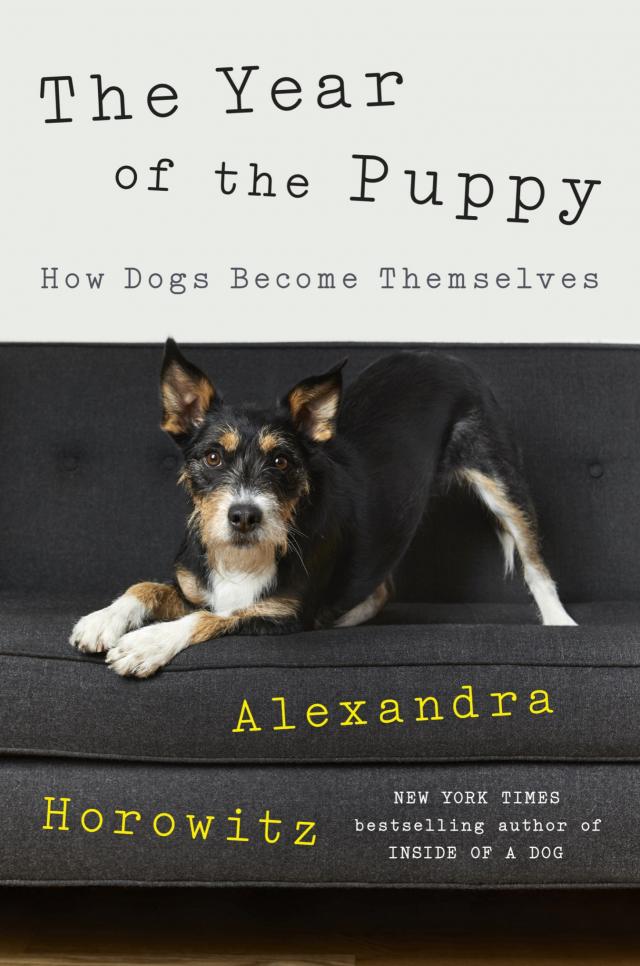
Also by Alexandra Horowitz
Inside of a Dog
On Looking
Being a Dog
Our Dogs, Ourselves
VIKING
An imprint of Penguin Random House LLC
penguinrandomhouse.com
Copyright © 2022 by Alexandra Horowitz
Penguin Random House supports copyright. Copyright fuels creativity, encourages diverse voices, promotes free speech, and creates a vibrant culture. Thank you for buying an authorized edition of this book and for complying with copyright laws by not reproducing, scanning, or distributing any part of it in any form without permission. You are supporting writers and allowing Penguin Random House to continue to publish books for every reader.
Drawings on this page and this page by Ogden Horowitz Shea.
library of congress cataloging-in-publication data
Names: Horowitz, Alexandra, author.
Title: The year of the puppy: how dogs become themselves / Alexandra Horowitz.
Description: First edition. | New York: Viking, an imprint of Penguin Random House LLC, [2022] | Includes bibliographical references and index.
Identifiers: LCCN 2022015113 (print) | LCCN 2022015114 (ebook) | ISBN 9780593298008 (hardcover) | ISBN 9780593298015 (ebook)
Subjects: LCSH: Puppies. | Puppies—Growth. | Dogs—Behavior.
Classification: LCC SF426.5 .H6725 2022 (print) | LCC SF426.5 (ebook) | DDC 636.7/07—dc23/eng/20220706
LC record available at https://lccn.loc.gov/2022015113
LC ebook record available at https://lccn.loc.gov/2022015114
Cover design: Colin Webber
Cover photograph: Shaina Fishman
Designed by Cassandra Garruzzo Mueller, adapted for ebook by Cora Wigen
pid_prh_6.0_140874740_c0_r0
for Ammon, at last
Not to have known him as a frisky young dog, to have missed his entire puppyhood! I don’t feel just sad, I feel cheated.
Sigrid Nunez, The Friend (of dog Apollo)
Contents
PART 0: GESTATION
PART 1: A PUP IS BORN
Week 0: Dear God, that’s a lot of puppies
Week 1: Sweet potatoes
Week 2: Young blue eyes
Week 3: The week of poop
Week 4: Professional wag
Week 5: Mouths with tails
Week 6: Little bruisers
Week 7: Adventure pups
Week 8: Your choice of models
Week 9: Calm before the storm
PART 2: SECOND BIRTH
Arrival of the storm
nicknames used with the puppy in her first week with us
(Im)perfect puppy
some things the puppy has eaten/chewed that are not for eating/chewing: an observational study
Ghosts
fifty things you should notice about your puppy
Puppy’s point of view
In and up
height puppy can jump: an alarming growth curve
The troubles
To sleep, perchance
PART 3: QUID YEARS
Longing
Gale force ten
Seeing us
beliefs and knowledge of an eight-month-old puppy
The thing about sleds
ear semaphore code
Face-first
Lick, memory
Postscript
Acknowledgments
Notes
Index
PART 0
Gestation
I peek in the rearview mirror and see her asleep in the back seat. She’s outgrown the little donut-shaped dog bed she first used and now she is more lying on it than in it: her head and shoulders are fully on my son, O.’s, lap.
It’s slowly changing with her. It’s that she folds her ears back against her head as she greets me. It’s her new, rabbit-legged sitting posture. It’s her sitting beside me in the car en route to the city, just the two of us in wordless conversation. It’s that she will now jump fully onto my lap, and then snuffle pig-like for a kiss. She chases her tail. She digs into the shoebox of toys and takes everything out, batting a ball around and flipping the long-legged and spindly Grinch around her head, banging herself on her sides. She has a way with each of us in the morning: aroooo! she calls, when we enter the room where she’s sleeping. She has a way with each of the dogs. She and the cat are working it out, licking each other in turns. It’s that even as she outgrows her dog bed she is fitting into the family.
I met her right after she was born.
Our family did not need a puppy. We are three humans, two dogs, and a cat; our days are rich with interactions, and our home is replete with animal fur. Sometimes, though, an idea grips me. It appears from thin air, as though I simply walked into it and breathed it in. And once I’ve taken it in, it circulates in my mind, gradually and then relentlessly breaking through the hum of my brain’s background noise. This time, the idea was simple: puppy.
It’s a popular idea, puppies. But it was as distant a notion to me as the prospect of hand-raising a snow leopard. As attracted as I am to puppies’ guileless manner, to their clumsy gait, and to the bigness of their excitement to see a person or their alarm at a bird taking flight, I was not attracted to the idea of living with one. For one thing, there are plenty of puppies about. I need only walk out of our apartment in New York City to see puppies—to see people with puppies, the people blearily standing in attendance with an over-long leash waiting for a puppy to remember to pee. For another, one of the satisfactions of adopting dogs from shelters, as our family has always done, is knowing we are taking home a dog who needs a home. Often, that dog is not a young puppy, but a dog who has already lived some life. I did not want to be implicated in making a dog who would need a home.
So a new puppy was off the table—or so I thought. Our last adoption, eight years earlier, was of three-and-a-half-year-old Upton, already eighty pounds of hound, candor, and goofiness when we met him. He arrived at our home needing ACL surgery for an injury long suffered and never addressed. And he arrived with a mysterious set of fears—of noises, of his shadow—and with, it seemed, no experience at all of the things that were to become the substance of his life with us: walking on leash, sidewalks, elevators; people wanting to pet him, dogs wanting to sniff him. We met him at a shelter to which he had been returned as a three-year-old (Reason for return: have too many dogs) after having been adopted from the same place as a puppy. Thus, included in the paper trail of his life that was delivered to us was a photo of baby Upton, all ears and smile.
I think that is when I first breathed in the idea. Who was he as a puppy? I wanted to know. The only sorrow of coming to know Upton was the great mystery of his life before us: of where those fears came from; and of not being able to reach back in time and make it right. This sentiment is not uncommon. Few of us meet our dogs at Day One. The dog who will, eventually, become an integral part of our family, our constant companion and best friend, is born without us, into a family of her own. Her parents contribute genetically and, in the case of the mother, substantially after birth, to what kind of dog this young wiggly grub of a puppy will become. Her littermates, the world around her, the sounds and smells and sensations she is exposed to, all will influence her personality. By eight weeks of age, she is developmentally equivalent to a year-old human baby—with all the walking, chattering, world-exploring milestones in her past—and she still won’t be meeting her human family for weeks or months. When she first sniffs the human visitors who pack her into the car at the breeder’s, or whisk her off from a shelter and bring her home, she is already partly who she will be.
Years went by, and the puppy idea was displaced by louder and more urgent ideas. But it bubbled up again as our dogs passed their eleventh and twelfth birthdays, officially well into “geriatric,” in veterinary terms. We could not avoid the inevitable ending of their lives, but we might let them influence the next dog we got to know. Who better to teach a new dog about the world—about our world—than our crazy wonderful dogs? My son and husband made approving noises when I let the idea float out of my mouth and into the room.
I have no dearth of dogs in my life. Not only do I live in a city bursting with dogs—many of them so completely socialized to urban living that they will not even break stride if you reach down to tickle their head as they pass—but I live with two already. In addition to Upton, our family includes Finnegan, a charming and endearing character who has endured the introduction of a child, another dog, and a cat with only the rare dagger-filled glare at us for so ruining his life. And I am a scientist of dogs: I study their behavior to try to understand their minds. I founded and run the Dog Cognition Lab at Barnard College, where researchers and I observe dogs who come onto campus with their people to participate in our experiments, or who submit to our gaze at their homes or in the parks. As a scientist and author, I have surely typed the word “dog” tens of thousands of times.
As this nascent idea was bouncing around in my consciousness, I found myself thinking of Jean Piaget. As a father of three, as well as the father of developmental psychology, he famously observed his own children while wearing the hats of both parent and scientist. While I can bear no puppies, it occurred to me that I might bring a scientific eye to puppy development. As a bonus
I had trepidations. Committing to taking on a lifetime of responsibility for another creature is no casual matter. Moreover, I was hesitant about a puppy’s untrammeled enthusiasms disrupting the dynamic between us and our current dogs. At the same time, though, I wanted in on this mystery: if I couldn’t know my own dogs as puppies, perhaps I could at least know this puppy into doghood.
The mysteriousness of this period of dogs’ lives is accidental—an artifact of our society’s way of thinking about dogs. Two hundred years ago, we had a different relationship with dogs. They were rarely living inside people’s homes: more likely on the farm or on the street or underfoot than in our beds. The business of purebreeding dogs had not developed, and neither had the idea of a young puppy as something to be bought at a store (with accessories to match). Unchecked breeding had not yet led to severe overpopulation, necessitating the development of dog pounds, then shelters and rescue groups, which usually negotiated the re-homing of a dog whose puppy days were waning or past. Two hundred years ago, people knew puppies. They witnessed births. The life course of animals, from beginning to end, was woven into humans’ lives (not always to the animals’ advantage).
No longer. And a secondary result of how we live with dogs now is that most people miss not only the birth and first weeks of life of their puppies, but also effectively miss the first months of their puppy’s life with them. The quick development of the dog—from underdeveloped newborn to overdeveloped teenager in a year—happens while their person is simply trying to both acclimate the dog and be acclimated to them. We get caught up in the housetraining, walk training, bite training, don’t-chew-everything training that is the typical contemporary approach to a dog’s first months of life with a new family. In focusing on training a dog to behave, though, we mostly miss the radical development of puppies into themselves—through the equivalent of infancy, childhood, young adolescence, and teenagerhood—until it’s already happened.
Most books about puppies are instructional: Here’s a complicated, furry, adorable piece of machinery you just carried into your home; how do you get it to run? Instead of following an instruction manual for a puppy, I wanted to follow the puppy: through introductions to a new world, meeting suspicious older dogs, a playful feline with long claws, and an adolescent boy who, in his enthusiasms and energy, bridges the world between dog and human. By slowing down to observe the changes in our new charge from week to week, I hoped to make new sense of the dog’s behavior in a way that is missed in a focus only on training. I wanted to keep a lens firmly on the puppy’s point of view—how they begin to see and smell the world, make meaning of it, and become themselves. And at each moment and developmental stage, I stepped back to consider what the science or history of dogs tells us that can shed light on the behavior of puppies. I wanted to compare our puppy’s early days to those of wolf pups, and to compare her development to that of another group of pups being raised among people, but with the aim of becoming working dogs: professional detection dogs. The ample research into young humans also helps make sense of what was happening with this new young creature. In other words, this puppy was to be my subject and my dog; her actions experienced, scrutinized, and contextualized. Should we all get through it, I hoped to know her as I have never known a dog before.
She is here with me now; come meet her. In following that idea, I became a witness to the transformation of a mewling splodge of fur into an exquisitely sensitive, preternaturally agile, sweet, loving creature. Into a member of our family.
PART 1
A pup is born
WEEK 0:
Dear God, that’s a lot of puppies
Time is moving in an irregular, disconcerting way now that we no longer have the regular cadence of leaving the house every day. During the pandemic, whether it’s Friday or Monday hardly matters. But time moves apace in the season and in the puppy. She’s our circadian rhythm now, as she races through the long day that is a puppy’s first year. Against the sameness of our Groundhog Days, she is different every day, sometimes even from morning to night. I could measure time by her ears, which have been inching ever up, and then, one morning, dropped under their own weight, becoming floppy triangles again. I could track time in the speed of her behavior changes: first she comes when we call her, then she doesn’t come. She learns to sit in a place; she learns to sit right near but not on the place. She stays on the first floor, then she learns about stairs, then she learns of the fun of running up and down stairs. She learns about squirrels, she learns about trees, she learns about squirrels in trees. She loves the water, she retreats from the water. The only thing that doesn’t change is that every single day she seems surprised about the cat.
The young dog was surrendered to a shelter when her owners realized she was pregnant. “Surrendered,” as in given up, handed over, abandoned. The dog herself has not given up. She wears the expression that many pregnant dogs seem to: of vigilance. Her amber eyes follow the motion of people nearby, while she keeps her back against a wall. Catching a glimpse of her head-on, I note the blaze of white between her eyes, the merle, mottled coat; the ears that aim up but fall down. She is winsome, her bearing stolid. In profile her belly is swollen downward, making her legs look unnaturally short. Inside are unknown numbers of pups, visible on X-ray as a cacophony of snaky vertebrae overlapping one another and round nuggets of skulls. The dog was probably due several days ago, Amy suggested, but held out while being transported from Georgia. Amy is her foster mom, one of the many miraculous folks who agree to house dogs in the interstices: going from homeless to homed, from scared to sociable. She is tall, dressed practically, with a shy smile and glance that mirror some of her charges. The dog she has named Maize. Not only has Amy agreed to take in Maize, she’s taking in indeterminately many Maize puppies, committed to raising them all to be dogs who will not be surrendered to a shelter.
Maize arrived in the middle of a rainstormy night, having been driven up the Hudson Valley, in New York, traveling against the current of the river just to the west, working against her body’s drive to birth her pups. From the car she was walked in the rain to the house, where, though it was full of the smells and sounds of several other dogs and birds, she finally found a warm, dry spot and collapsed, relaxing into sleep.
The next morning Amy was due at work early, so she left Maize in a comfortable setup with plenty of room to move around, soft spots to lie, water to drink. We cannot know, but it is likely that even with her stress at being in a new place, with new faces, canid and human, the sensations of her body began to take prominence, and she paced, panting and restless, finding no place to quell the tremors of muscular contractions beginning to ripple through her. She might have felt at once hot and cold, and as her cervix began to dilate, she worked to find a place to nest, digging into one surface after another until she finally settled.
What we do know is that when Amy returned several hours later she found Maize settled on a soft bed placed in a plastic kiddie pool, her body curled around six small furry forms. Strictly speaking, of course, people don’t need to be present for the birth of a litter. Most dogs are born without human assistance. Of course, dogs also get ill in delivery, bleed to death, fail to aid their puppies after birth. When people are present, they are there to help in case of one of these emergencies, and to be a redundant mother, in a sense. Watching a dog deal with a handful of puppies suddenly appearing from her bum, it is hard not to wonder how she does it. But she does, whether we assist or not.
Six puppies: still just suggestions of dogs, with all the parts but not yet themselves, their fur sleek with the remnants of the amniotic sac that had been Saran-wrapped to them, keeping them alive in utero. Amy settles down outside the pool, talking admiringly to the mother, and lifts up one after the other, each one fitting comfortably in her hand, legs dangling, toes sprawled, as her hand envelops the belly. She towels each one in turn and replaces them by their mother, setting them near her belly, encouraging their mouths to a nipple with her finger. Everyone dried and at a spigot, she leaves the room to gather more supplies. When she returns, another pup has joined the six. An hour later she steps out again, and returns to an eighth puppy.


