

Amanat, page 1


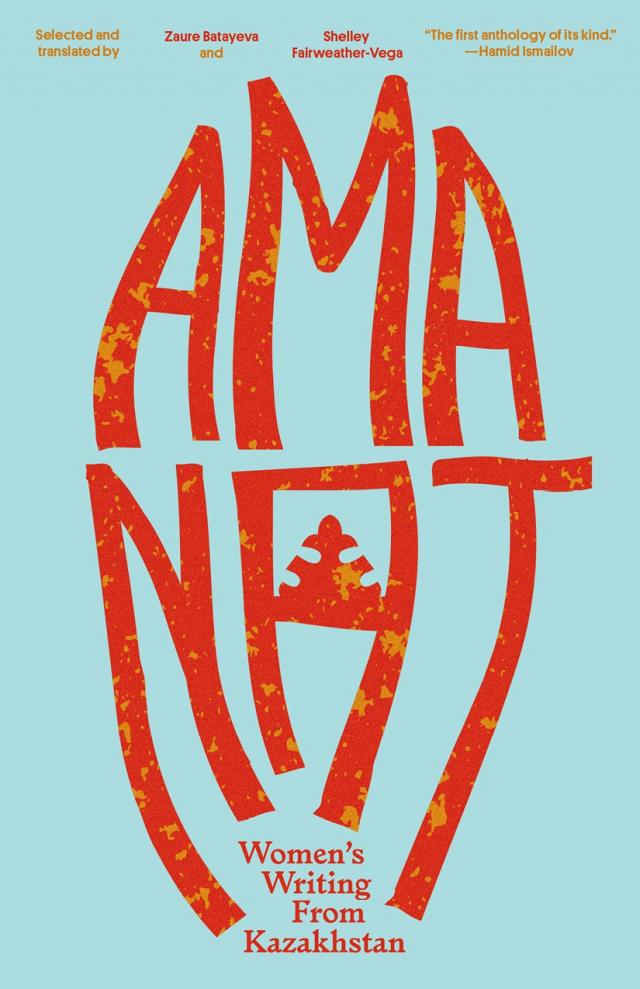
Amanat
Women’s
Writing
from
Kazakhstan
AMANAT
Women’s
Writing
from
Kazakhstan
selected and translated by
Zaure Batayeva and
Shelley Fairweather-Vega
with contributions by
Sam Breazeale and Gabriel McGuire
stories by
Oral Arukenova, Raushan Baiguzhayeva, Zaure Batayeva, Nadezhda Chernova, Lilya Kalaus, Aigul Kemelbayeva, Ayagul Mantay, Olga Mark, Zira Naurzbayeva, Asel Omar, Madina Omarova, Aya Ömirtai, and Zhumagul Solty
Collection and introduction copyright © 2022 Zaure Batayeva, Shelley Fairweather-Vega
Foreword copyright © 2022 Gabriel McGuire
Text copyright individual contributors. Copyright and permissions are on pages 263–267.
Gaudy Boy Translates, published by Gaudy Boy LLC,
an imprint of Singapore Unbound
www.singaporeunbound.org/gaudyboy
New York
For more information on ordering books, contact jkoh@singaporeunbound.org.
All rights reserved. No part of this publication may be reproduced or transmitted in any form or by any means without the prior written permission of the publisher, except for brief excerpts for the purpose of criticism and review.
eISBN 978-1-958652-10-7
Cover design by Flora Chan
Interior design by Jennifer Houle
Foreword
I remember how when I first became interested in Central Asia I went to a university library, eagerly searching for novels or short stories from the region and returning home with a great pile of books by Chingiz Aitmatov. At the time, there was little else to be found in Western libraries for those of us unlucky enough to be limited to English translations. Things are better now. There are fine new translations of novels by Abdulhamid Cho’lpon and Hamid Ismailov from Uzbekistan, of oral literary texts from Kyrgyzstan, and of poetry from across the region. And yet I cannot think of anything quite like Zaure Batayeva and Shelley Fairweather-Vega’s new book of translations, Amanat: Women’s Writing from Kazakhstan.
Forming the background of many of these stories are the great tragedies of Kazakhstan in the 20th century, the famine and purges of the 1930s, the astonishing casualties of the Second World War, and the violence of the Jeltoqsan protests. The plots of the stories often reverberate with one another in strange and unexpected ways. In Asel Omar’s “The French Beret,” we see a young man arrested for the seemingly trivial offence of a single typo in an article about Stalin published in the newspaper he manages, in her “Black Snow of December,” we see a young boy struggling to understand what his grandparents—survivors of purges, exiles, and wars—might think about the Jeltoqsan protests of 1986. In Lilya Kalaus’s extraordinary “Operatic Drama,” this becomes the stuff of black comedy, as two young men sit at a table drunkenly trying to prove whose grandparents suffered more under Stalin, only to realize that their host, the aged daughter of an NKVD agent, is looking at them in bewildered horror. In Nadezhda Chernova’s strange and unsettling “Aslan’s Bride,” there is even a peculiar kind of comfort in the trauma of war, as the ‘Bride’ seemingly happily trades the uncertainties of life as an unmarried middle-aged woman for the identity of widow of a man lost to the Second World War.
In many of these stories, the dislocations that trouble the protagonists the most are not the self-evident traumas of wars and purges, but rather the pain that followed moves from the villages into the new cities of Soviet Kazakhstan. This is not to say that the stories here romanticize life in the village—Zhumagul Solty’s “An Awkward Conversation” and Ayagul Mantay’s “Orphan” show the claustrophobia and loneliness of the village as much as the comforts. Other stories, however, show the social and economic uncertainties of life in the city. In Raushan Baiguzhayeva’s “Propiska,” a young woman leads a precarious life in Almaty in the 1980s, as her lack of official documents forces her into trading household work for a marginal life in the apartments of relatives. In Aigul Kemelbayeva’s “Hunger,” another young woman finds herself in a similar situation in Moscow in the 1990s, remembering her village as a space of fantastic plenty, with “milk flowing in rivers.” Aya Ömirtai’s “18+” examines the precarious life of a young woman searching for work and forced to fend off the increasingly explicit sexual demands of a potential employer. The eclectic and moving portraits of old women in Zira Naurzbayeva’s “The Beskempir” begin with the unsettling image of a woman on an apartment balcony wailing for her lost life in the village, but also gives us the tragicomedy of her “Nyanya-apa” setting out to visit her by taking buses at random, then asking people for directions, apparently unwilling to concede that, in a city like Almaty, not everyone will know everyone else.
In other stories, we see the frustrations that followed the crumbling of the Soviet system. Zaure Batayeva’s “School” offers a disquieting look at the life of a teacher in a private school as she struggles to act with honor while her employers flatter her, expect her to negotiate bribes for them, and rarely remember to pay her. Zhumagul Solty’s “Romeo and Juliet” offers a more lighthearted and optimistic vision, as a hastily arranged performance of Shakespeare’s play for the benefit of foreign visitors becomes an unexpected triumph despite (or perhaps because of) its hurried staging. The 1990s were also a time when foreigners—guest workers, journalists, and academics—suddenly began to arrive in Kazakhstan in great numbers. Oral Arukenova’s “Precedent” shows the bleak side of this, as a woman gradually realizes what it is exactly her Italian boss has been shouting at her. This history reappears in her “Procedures Within” as part of the gossiping conversation of two old friends who meet unexpectedly in an airport café, a story that also shows the dizzying pace of change in contemporary Kazakhstan. As the two women trade stories about friends and former co-workers, the conversation bounces from Atyrau to New York, from the kitchen of the Italian restaurant to the board rooms of Big Five accounting firms.
Amidst all the sharp edges of these stories, there are also moving accounts of Kazakh music and literature. In many of the stories, characters play the dombyra, the traditional lute-like stringed instrument of the Kazakhs. Zira Naurzbayeva’s “The Rival” offers in its few pages an entire doctoral dissertation on the instrument, telling us how it is made, its place in mythology, what life in a music conservatory is like for students, but above all, telling us about the bond between a musician and an instrument and the artistry of traditional Kazakh songs. In one moment, a character who has been awakened to the beauty of this music describes the pain of walking down a city street, forced to hear “foul, filthy words and voices, timbres and tunes” spilling out of the cafes around her. Again, this is a moment when reading one story suddenly illuminates another, allowing one to understand the significance of the final scene in Oral Arukenova’s “Amanat,” with its young man glimpsed through a kitchen door playing the dombyra to his girlfriend as she peels potatoes, or the moment in Zaure Batayeva’s “The Anthropologists” when a school director grabs another musician’s dombyra in order to show off his own skill.
In talking about these stories, I have committed the sin of treating them as though they matter because of what they tell us of Kazakh history and culture, of talking about them as though they were encyclopedias or guidebooks rather than works of fiction—and remarkably beautiful ones at that. This is a disservice to the craft of these writers, and it has also had the unfortunate side effect of making me neglect the stories that don’t lend themselves easily to that kind of analysis. Stories like Lilya Kalaus’s “A Woman Over Fifty” and “How Men Think” are at once remarkably granular in their sense of how people inhabit their homes and lives and yet also seem to float free of any particular time or place. In her “The Stairwell,” we hear an entire lifetime of trips up and down the stairs of an old apartment block, of “percussive rappings, two steps at a time, elegant glides, a flickering cha-cha-cha, now much more even, slower, calmer, now careful.” We could be anywhere, and yet somehow we also know exactly where we are, in the poured concrete stairwell of an old Soviet block of apartments, with their steps worn smooth and their blue and white paint. And we know, too, that it might be almost any one of the women we have met in these stories whose footsteps we overhear on their endless trips up and down the stairwells leading to their homes.
Gabriel McGuire Professor of Literature, Astana, Kazakhstan
Translators’ Introduction to Amanat
This collection features the stories of women writers from Kazakhstan over the past thirty years, and it is the first anthology of its kind to make the attempt. Their country is the world’s ninth largest by landmass, but it is also a relatively young nation, independently existing as the Republic of Kazakhstan only since December 1991. That is just thirty years ago, a single generation, in a land where tradition dictates that people must know and honor the names of seven generations of their ancestors. One goal of this anthology is to collect what women have written during and about this relatively short period of time, now that the dust has largely settled from the latest cataclysmic change in Kazakh history.
As a title for this diverse collection, we chose Amanat, a Kazakh word with many meanings. An amanat is a promise entwined with hope for the future. It is frequently a task that comes with moral obligation, and often i
We know that women writers are underrepresented in translation from all languages into English, and this is certainly true for Kazakhstan. Of the three major translations from Kazakhstan published in the United States in the past several years, two are novels by men of the Soviet generation (Talasbek Asemkulov’s A Life at Noon and Rollan Seisenbayev’s The Dead Wander in the Desert) and one is a poetry collection by a woman (Aigerim Tazhi’s Paper-Thin Skin). The last attempt we know of to collect Central Asian women’s writing, as a matter of fact, was the 2008 Russian-language anthology Solovei v kletke, edited by Lilya Kalaus, an author who contributed several pieces of her own to this volume. The Kazakhstani government has been funding huge volumes of translation into and out of the languages of Kazakhstan lately, but those grants and contracts go overwhelmingly to male authors and to those of older generations who were well entrenched in the official Soviet writing bureaucracy and who remain in those positions today. Those projects also tend to funnel all the writing through Russian translation, even if it was not written in Russian or intended to be read that way. Amanat pays both its Kazakh- and Russian-language stories the respect of translation directly into English. And it spotlights a different kind of writer, the ones passed over for government support and making their own way in a decentralized—but still hierarchical, patriarchal, and occasionally authoritarian—political and cultural system. We want to make sure that writing by women since the end of the Soviet era, from any language and any region, has a chance to be read and considered as part of the ancient and still-evolving culture of Kazakhstan.
One more point on the duality of languages represented in Amanat: we strove to include an equal number of Russian-language and Kazakh-language authors. With the exception of Aya Ömirtai, our youngest author and an immigrant to Kazakhstan, both sets of women were mostly educated in the Soviet system, where Russian language and literature held pride of place; with that system officially discarded, they are more free to creatively build on—or disregard entirely—the Russian literary traditions they learned. Kazakhstan is still a bilingual country, though many people, proudly or stubbornly, speak only either Kazakh or Russian; some writers lament a visible divide in the country’s literature between people who read and write in one language or the other. Yet there are cracks in that wall, chiseled out, to a noticeable extent, by women. Fully half the authors in this collection translate literature as well as writing their own, a proportion that would be hard to replicate in any English-speaking country. Translating these stories into English, in turn, is yet another way to honor the work these women do.
A Reader’s History of Kazakhstan
As we assembled and translated the stories in Amanat, we realized that readers who are unfamiliar with the places and events discussed might benefit from a brief introduction to Kazakh history.
Most of the stories in this collection are set in the late Soviet period or since independence, yet Kazakh writers cannot avoid grappling, in one way or another, with a much longer history. People called Kazakhs have inhabited the steppes of Central Asia since at least the sixteenth century. Theirs was a nomadic society organized along family and clan lines, the biggest divisions being between hordes, or jüz, who occupied various areas of the region at different times.
Explorers and military expeditions from the Russian Empire appeared in Kazakhstan early in the eighteenth century and expanded deep into the region for the next hundred years, building forts and forging alliances. Starting in the late nineteenth century, settlers from the European part of the Russian Empire began moving en masse into Kazakh territory, a trend that only intensified after the Bolshevik Revolution in 1917. After several years of relative autonomy during the Russian Civil War, Kazakhstan was officially incorporated into the Soviet Union in 1920, first as part of the Kyrgyz Autonomous Soviet Socialist Republic. The Kazakh Soviet Socialist Republic would come into being officially with an administrative reshuffling in 1936, with its capital in Almaty.
The early Soviet years were a time of upheaval, often with disastrous consequences. Soviet economic policies and social engineering projects caused catastrophic famine in the Kazakh steppes, where agricultural collectivization outlawed traditional ways of life, and civil war and arrests (see “The French Beret”) severed family and community ties, frequently beyond repair. Soviet activists and officials moved into the region to supervise economic and educational projects; other ethnic groups were forcibly exiled to various parts of Kazakhstan, some as whole communities (including the population of the village Milochka discovers in “Aslan’s Bride”), some as prisoners in the GULAG system. These huge population shifts resulted in the mix of languages and ethnic groups that coexist in Kazakhstan today. Russian was handed down as the language of power and civilization, demoting the Kazakh language and culture to second-class status; soon new generations were being educated completely in Russian, without seeing a need to learn Kazakh at all. The long essay “The Beskempir” explores the personal stories of several older women who lived through these drastic changes in Kazakh society.
As elsewhere in the Soviet Union, the Second World War hit Kazakhstan hard. Men of fighting age were drafted and disappeared, many never to return—“Aslan’s Bride” directly addresses this aspect of the long aftermath of World War II. The start of the Cold War brought nuclear testing to Kazakhstan, centered near Semipalatinsk (Semey in Kazakh), with catastrophic consequences for the environment and human health. As the Soviet economy began to recover during the relative political stability of the 1950s to 1970s, more Kazakhs moved away from rural villages and into the cities, where they received a Soviet education and worked in modern industrial or administrative jobs. This emptying of the villages had its effects, seen in stories like “Romeo and Juliet.” Those who stayed behind in the villages were largely workers at collective farms, as in “Orphan.” City life also had its challenges: “Propiska,” “Hunger,” and “The Lighter” all address the social and economic difficulties faced by Kazakhs who move to or grow up in the big city, while the stories by Zaure Batayeva, Oral Arukenova, Aya Ömirtai, and Madina Omarova explore new types of interpersonal relationships generated by apartment living, modern careers, and urban poverty from the late Soviet period to the present day.
As perestroika gathered steam in the Soviet Union in the mid-1980s, another wave of disruption swept across Central Asia. As the central authorities loosened, then tightened, their grip on Kazakhstani politics, tragedy sometimes resulted. The unrest depicted in “Black Snow of December” brought ethnic tensions in Kazakhstan to the foreground, and resulted in the ethnically Kazakh Nursultan Nazarbayev rising quickly through the ranks of the Soviet government. Nazarbayev was the top official in Kazakhstan when it declared independence on December 16, 1991. Kazakhstan was the last of the Soviet Union’s fifteen republics to do so, and Nazarbayev personified that tendency to cling to the Soviet past: he remained in power for nearly thirty years, reigning over a system of political cronyism, quashing political dissent, habitually running for reelection almost unopposed, and ordering the construction of a new capital city, Astana (renamed Nur-Sultan in 2019). Although he recently stepped down in favor of his handpicked successor, he retains the title of Leader of the Nation and is considered the de facto top authority, although the protests of January 2022 made his future less certain.
All this political upheaval caused not just an existential crisis for the country, but immediate practical problems for ordinary people, most of all thanks to the collapse of the USSR and Kazakhstan’s abrupt independence in 1991 (see “Hunger”). As the country entered a new post-Soviet era, some writers took the opportunity to revisit Kazakh history and begin a new reckoning with the past (“The Beskempir,” “Operatic Drama,” “Black Snow of December”). Informed and shaped by this history are the big cultural issues Kazakhstan currently faces. Many of our authors comment on the disparities in wealth that erupted with independence (“Hunger”); others focus on the new relationships now being negotiated between the generations (“Amanat”), between the sexes (“An Awkward Conversation,” “18+,” and “A Woman Over Fifty”), and between urban and rural populations.


