

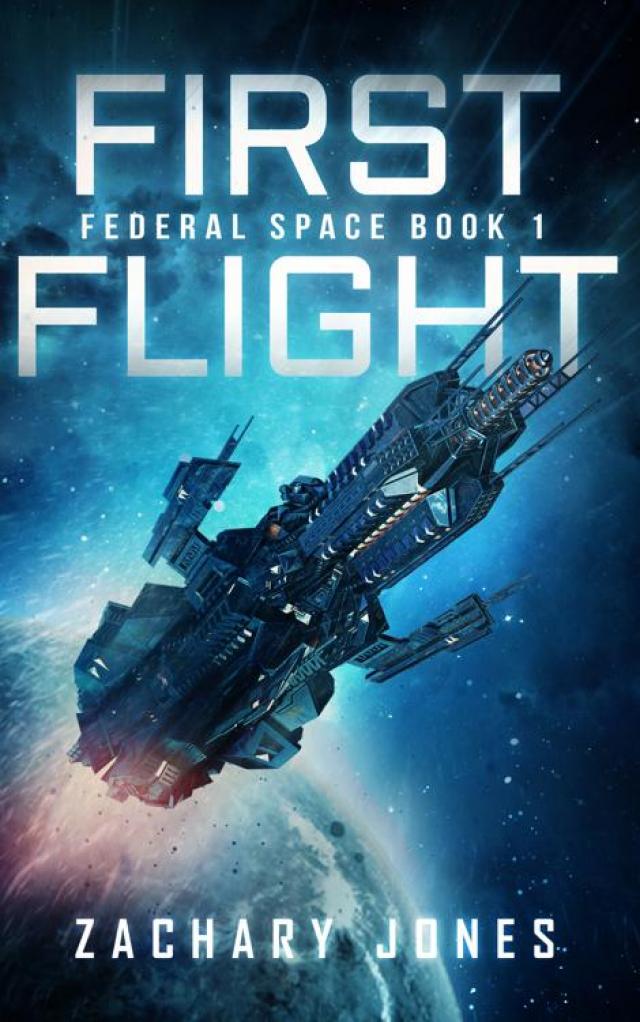
First Flight: Federal Space Book 1, page 1


Copyright © 2019 Zachary Jones
All rights reserved. No part of this novel can be reproduced or used in any manner without the written permission of the copyright owner, except for quotations in a book review.
Seasons
Acknowledgements
Prologue
Chapter 1
Chapter 2
Chapter 3
Chapter 4
Chapter 5
Chapter 6
Chapter 7
Chapter 8
Chapter 9
Chapter 10
Chapter 11
Chapter 12
Chapter 13
Chapter 14
Chapter 15
Chapter 16
Chapter 17
Chapter 18
Chapter 19
Chapter 20
Chapter 21
Chapter 22
Chapter 23
Chapter 24
Chapter 25
Chapter 26
Chapter 27
Chapter 28
Epilogue
Acknowledgements
First Flight was written by yours truly, a man who became a science-fiction writer because he didn’t know any better.
Because I don’t know any better, it’s good to enlist help from people who do, starting with a good editor. First Flight was edited by Gary Smailes of Bubblecow.com, who provided the kind of honest and thorough feedback that is essential for turning a raw manuscript into a polished novel.
Speaking of polish, I would like to thank my proofreader, Deborah N. Siegel, for giving First Flight one last pass and making my work look just that much more professional.
As part of my continuing effort to improve the quality of my novel, I enlisted the help of the folks over at Global English Editing to do another proofread to correct errors pointed out by my readers. I greatly appreciate the work they did cleaning up mistakes that my own sloppiness allowed to slip through.
To the reader, I hope you enjoy the adventure waiting for you on the next page. If you enjoy the novel, or think there is something that I can improve on, feel free to leave a review on the novel’s Amazon.com page, Goodreads, or both!
Happy hunting,
Zachary Jones
Prologue
Oliver Ferris was not the kind of captain who commanded starships; he was the kind who built them, and he was damned good at it. Federal Command wouldn’t have assigned him to oversee the construction of the most powerful warship ever built otherwise. Not when they went through so much trouble to keep her construction a secret.
The nearly complete starship rested easily inside the 200-meter-deep, 500-meter-diameter tube cut straight down into the ice and dust of Amalthea, a reddish potato-shaped body that orbited close to Jupiter. It was one of the gas giant’s inner satellites. The construction chamber was bigger than was needed, even for a vessel as large as Independence. That was because the chamber was not officially dug to serve as the construction site of a starship, but as a housing for a pressurized habitat cylinder for the low-orbit luxury resort that would provide the closest place on which to look down upon the bands of Jupiter’s upper atmosphere, all the while being protected from the gas giant’s deadly radiation belts.
Oliver glanced up as far as his spacesuit’s helmet allowed him, the rim of his visor blocking the very top of the starship’s pointed bow. Sixteen hundred meters from the tip of her armored bow to the bottom of her five expansive engine bells, the warship stood like an armored tower. Her shape reminded Oliver of the old chemical rockets that had first carried humans into space a thousand years ago. It was largely cylindrical, before tapering down to a sharp point, as was typical of Federal starship design.
Given that starships were still essentially gigantic rockets, powered by nuclear fusion rather than chemical combustion, it was no wonder that their general layout didn’t deviate far from the crude contraptions that carried the first intrepid humans into the void. However, the super-firing pairs of massive gun turrets mounted on the dorsal and ventral sides of the ship did make it clear that Independence was no simple booster rocket. Each main gun turret sported a pair of terajoule-class kinetic cannons, each capable of hurling kinetic kill vehicles to frightening velocities. They weren’t the only weapons on display, merely the most obvious. Small towers, each topped with smaller secondary and point-defense turrets, sprouted like thorns from the battlecarrier’s hull. Along the sides, circular hatches for dozens of missile tubes were arranged in neat rectangular blocks, like troopers standing in formation. Just below the main gun turrets were two rings of large doors covering Independence’s fifty smallcraft bays. Each bay could house one fighter, bomber, or assault shuttle, depending on her mission profile.
She was, in Oliver’s humble opinion, the ultimate warship. One that, once he got her off this miserable excuse of a moon and into the fight against the League, would make all existing capital ships obsolete. A smile pulled at his face, and pride warmed his chest. His name was going into the history books.
An icon appeared on his HUD for an incoming call from the command center. When he accepted the call, the voice of his XO piped through his brainset. <“Captain Ferris, the hauler from Starport Gagarin is fifteen minutes out.”>
“Understood. I’m on my way up,” Oliver said, turning for the airlock.
One airlock cycle later and Oliver was bouncing down the narrow corridors, passing military and civilian workers going about their duties as they got Independence ready for launch, the helmet of his space suit tucked under his left arm.
He stopped by his quarters to doff his space suit, take a quick shower, and put on a civilian business suit. As far as the hauler pilots were concerned, the containers their vessel was carrying were filled with polished granite from quarries back on Earth, rather than thousands of rounds of point-defense ammunition, and Oliver intended to keep that fiction intact.
The elevator doors parted at the surface level and he stepped out into a different world. Where the base below was industrial and bare, the lobby was opulent, as befitting the lobby of a luxury resort. The floor was polished tile rather than coarse rubber matting, the walls smooth stone rather than naked insulation foam.
Across from the main elevator was an overly decorated hatch leading to the main airlock. Oliver passed the airlock and followed the signs leading to the hangar bay.
The hauler had already rolled into the hangar and was being off-loaded by the time he arrived. The hauler pilots, a man in a light-red pressure suit and a woman in green, towered over his dockmaster as they spoke to her with pronounced Jovian accents.
The man was taller and darker than the woman. Lanky in build, his thinning black hair cut short. The woman had fair hair flecked with grey, which fell to the nape of her neck, her face so pale it reminded Oliver of snowdrifts.
They noticed his approach. His dockmaster, who was in reality a lieutenant in the Federal Space Forces, moved to salute but stopped when Oliver fixed her with a hard look.
“Well, you look like you’re in charge,” the male hauler pilot said.
“Administrator Martin, at your service,” Oliver said, making a conscious effort not to say “Captain Ferris” by accident. “How was the flight from up orbit?”
“Uneventful, save for all the patrols we had to fly by. Can’t imagine what the Space Forces are so worried about this far down the well.”
Oliver could imagine just fine, the reason being directly below their feet. He made a dismissive shrug. “It is wartime. I wouldn’t put it past the Space Forces if they’re worried about a League fleet rising out of the clouds of Jupiter.”
The male pilot smiled. “Belts and zones—that would be a sight.”
“From high orbit, I would hope, honey,” said the female pilot, taking the male pilot’s hand and squeezing it.
“You two married?” Oliver asked, noticing the rings on their fingers.
“We just celebrated our thirty-second anniversary,” the female hauler pilot said with a bright smile.
The male pilot smiled. “Been co-pilots for just as long.”
Oliver nodded. Jovian haulers were often family operations. “Got any kids ready to take over?”
The male pilot grimaced. “Maybe after he finishes his little detour in the Space Forces.”
“You have a son in the Space Forces? You must be very proud,” Oliver said.
The male pilot was about to say something to the contrary, but his wife interrupted him. “Oh, yes. Though we’re also worried sick. War and all.”
“Yes, I can understand that.” Oliver didn’t have anything else to say of the matter. Telling them their son would be fine would be disingenuous. He accepted a dataslate from his dockmaster and signed off on the cargo. “Will your ship require a propellant top off?”
The male pilot shook his head. “That won’t be necessary. With your permission, Administrator, we would like to launch as soon as possible. We have other contracts that need to be fulfilled.”
“Of course,” Oliver said, thankful he wouldn’t have to babysit a pair of civilian pilots any longer than necessary. “As soon as we’re done off-loading your cargo, we’ll return your hauler to the surface for launch.”
Both pilots nodded and turned to return to the hangar.
Oliver nodded to his dockmaster to follow them to make sure that the pilots didn’t go anywhere that wasn’t back to their hauler, and then he returned to the elevator. Halfway down, just after h
“This is Captain Ferris. What have you got for me, Troyer?”
“Captain, our scopes just detected a large number of unscheduled inbound jump flashes just outside Jupiter’s jump limit.”
“Send it to my HUD, Troyer,” Oliver said.
A constellation of icons showed where the jump flashes had occurred, twenty million kilometers above Jupiter’s north pole, but there wasn’t a single ship corresponding to the jump flashes. Oliver’s brow furrowed. “Commander, patch us into the Jovian TacNet. The radiation belt seems to be interfering with our own sensors.”
“I already did, Captain. None of the sensors in the network picked up anything other than the jump flashes.”
Oliver stood still for a moment as the elevator descended into the depths of Amalthea. The datalink would’ve included the powerful sensor suites of both Jupiter Fleet Base and the hundreds of warships orbiting above the reach of Jupiter’s radiation belts. There should be something there, he thought. Jump flashes didn’t just occur spontaneously. Oliver closed the HUD and waited out the rest of the elevator ride while a cold knot formed in his stomach. The elevator came to a stop at the lowest level, and the doors parted.
An armed trooper walked up and waved a scanner in front of Oliver.
“You’re clear, sir.” The trooper gave him a crisp salute.
“Thank you,” Oliver said, walking past the trooper without paying him any further attention.
The command center was laid out much like the bridge of a starship—a circular room with two raised, concentric rings of consoles centered on a holotank. The room was tense and quiet as Oliver entered, the crew stooped over their stations in rapt attention.
Commander Troyer was perched over the command center’s central holotank, which displayed all of Jovian space within the radius of the gas giant’s jump limit, including the icons marking the location of the jump flashes.
“Anything new, Commander?” Oliver asked.
“Just waiting for the 9th Fleet’s pickets to make their micro jump to the location of the jump flashes,” Commander Troyer said. “They should be there in another six minutes.” Oliver nodded. “Sir, the civilian hauler is on the pad and ready to launch,” Troyer continued.
A scowl pulled at his lips. He almost kicked himself for forgetting about the hauler. “Does Space Traffic Control still have their control systems slaved?” Oliver asked.
“Yes, sir.”
“Good. Kill their engines and bring the hauler back inside. While you’re at it, begin full emissions control and start evacuating the surface facilities. I want it dark and abandoned before the pickets jump on those contacts.”
“Does that include bringing the pilots down here, sir? They’re not cleared,” Troyer said.
“We’ll deal with that problem later, Commander. Carry out my orders.”
“Aye aye, sir,” Commander Troyer said.
After five minutes, Commander Troyer gave her report. “The moon is on lockdown and we’re at full emissions control, Captain.”
“Good. Did the hauler pilots give any trouble?” Oliver asked.
“No physical resistance, though they did say that they would lodge formal complaints with both Jupiter’s Magistrate Office and the Jovian Hauler Association.”
“Fair enough,” Oliver said. “ETA to the picket ship’s arrival?”
Troyer paused. “Just under sixty seconds and counting, sir. Two minutes when lightspeed delay is factored in.”
Oliver nodded, and fixed his eyes on the holotank, waiting for the updates to come in.
A quartet of Churchill-class destroyers appeared in a flash of blue and ultraviolet light. Seconds later, data from the destroyers filtered down the Jovian Tactical Network, and Oliver got the first look at the enemy fleet. On the holotank, the fleet was rendered as a cloud of red icons, the vast majority of which were burning down towards Jupiter, but there were a few that remained near the jump limit, not far from where the picket destroyers had jumped in.
“Sensor AI counts 300 warships, sir. Unknown configuration,” Troyer said.
Oliver glanced towards Troyer. “No transponder signals?”
“No, sir.”
Oliver looked back at the holotank just in time to see new contacts sprout from the enemy rear guard. The sensor AI classified the contacts as torpedoes, hundreds of them, all converging on the destroyers. From a light-minute away, all Oliver could do was watch as the destroyers attempted to hold off the wave of torpedoes, only to be wiped off the holotank by a wave of nuclear detonations. As soon as the destroyers died, the enemy fleet disappeared.
“God dammit,” Oliver said.
“They just kicked up a hornet’s nest,” Troyer said.
Fighters and bombers started launching from carriers and stations in orbit of Jupiter. Their movements appeared slow on the holotank but, in truth, they were pulling ten gs of acceleration as they moved to gather into a massed formation of angry strikecraft.
Troyer pointed towards a formation in high orbit over Jupiter. “The 9th Fleet’s just broken formation with Jupiter Fleet Base.”
Ten battleships—Sirius, Saturn, Jupiter, Charon, Proxima, Ceres, Centaurus, Eris, Liberty, and Io—gathered into battle formation. Two lines of five ships stacked on top of each other, facing their pointed armored bows towards the enemy, and keeping the presumed location of the enemy in the firing arcs of all their main guns.
As they ascended orbit, squadrons of smaller ships moved to join them. Vancouver-class cruisers formed along the flanks of the battleline, ready to add their firepower to that of the battleships. Churchill-class destroyers moved ahead of the fleet to form a defensive picket ahead of the battleships, ready to swat down any torpedoes that came screaming through the void.
“I wish I was up there, sir,” Commander Troyer said, her voice pitched low so as not to carry. “I hate just watching.”
“We don’t have much choice in the matter, Commander,” Oliver said.
There was a reason Oliver only wanted to build starships. For all their majesty, a warship was, at the end of the day, a tiny metal bubble in a vast empty void. There were no shortage of tools for breaking open those bubbles and exposing their hapless crews to the dubious mercies of empty space.
Whatever the enemy was using to mask their emissions, dropped as they approached torpedo range. Oliver’s stomach twisted as 300 warships popped into existence on the holotank.
Seconds later, thousands of torpedoes erupted from the enemy formations.
“Holy Christ,” someone murmured behind him.
“Belay that chatter, spacer!” Troyer barked.
Federal starships replied in kind. But although they launched a world-killing quantity of nuclear munitions, it was barely half as large as that of their enemies.
“Are any of those torpedoes headed our way, Commander?” Oliver asked.
“AI’s reading their vector now, sir,” Troyer said. “Doesn’t look like any of them are headed our way.”
“Let me know the moment that changes,” Oliver said.
The bombers lit their drives and started burning hard towards the enemy fleet. On the holotank display, Oliver saw the bombers were all carrying free-fall warheads. The bombers would gain speed, drop their payloads, then redline their longburn drives to turn away from the enemy fleet while their stealthy warheads coasted into the enemy fleet and detonated.
They were coordinating their attack to arrive at the same time as the torpedoes launched by the starships, all the better to overwhelm whatever point defenses the incoming hostiles had.
“Doesn’t look like the enemy brought fighters,” Troyer said.
“Either they are very confident in their point defenses, or there’s something we aren’t seeing,” Oliver said.
Across the enemy fleet, hundreds of contacts started to sprout from the enemy starships. At first, Oliver thought it was another torpedo volley, but the contacts were too big and didn’t maneuver like torpedoes.
“Never mind. They did bring fighters,” Troyer said. “A lot of them.”
The enemy fighters didn’t match the configuration of any known fighter design, but Oliver was well past the point of being surprised by that. The enemy fighters outnumbered the Federal Lightnings by a wide margin, forming into a formidable fighter screen ahead of their starships.


