

Polaris, page 1


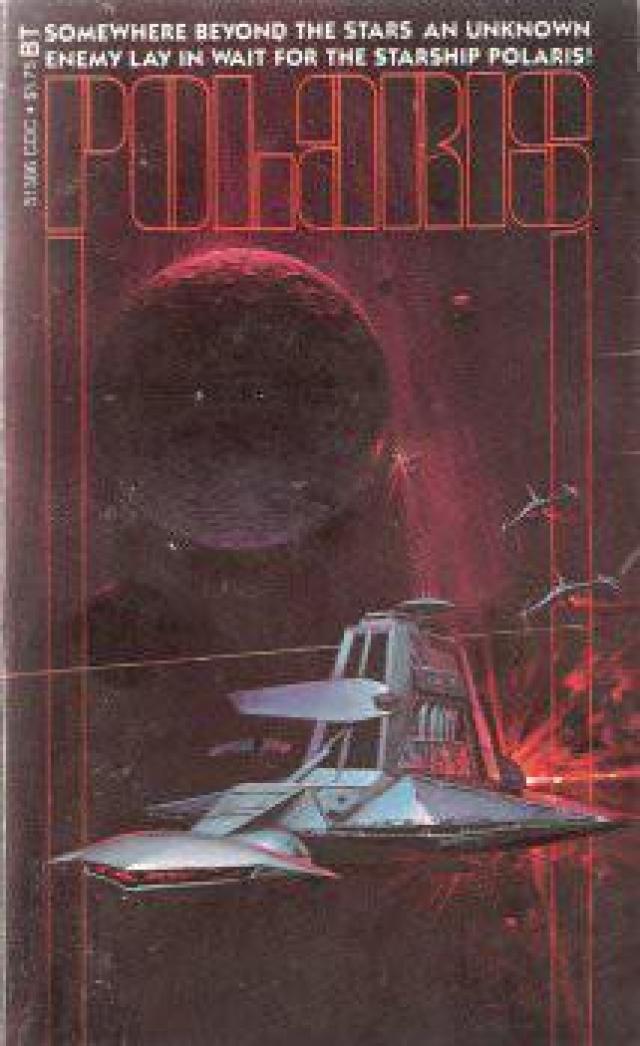
POLARIS
SHELDON PERKINS
A BELMONT TOWER BOOK
Published by
Tower Publications, Inc.
Two Park Avenue
New York, N.Y. 10016
Copyright (c) 1979 by Tower Publications, Inc.
All rights reserved
Printed in the United States of America
I
The dining room of the transport was alive with activity. Dignitaries being transported home brushed elbows with Fleet personnel shipping out to their new posts. A blond officer of medium height stepped through the automatic doors. He surveyed the crowd with a quick glance, and was about to leave when he heard himself being paged from across the room.
"Captain Traynor," the voice called. "Captain, please join me."
Alexander Traynor looked around in an effort to discover which body belonged to the voice. Being called Captain had thrown him. He had not quite associated himself with his new rank.
Traynor quickly located the source of the voice. It turned out to be the commander of the transport, Colonel Paul Mason. The young captain had met Mason earlier, when he'd boarded the ship. Now Mason was motioning him to join the ship's officers for dinner. Traynor slid into the proffered seat and spoke his order into the computer terminal at the center of the table.
"Glad you could join us Captain," Mason said.
"'Preciate the offer, Colonel," Traynor replied. "It's quite crowded. I hadn't realized there would be this many passengers."
"The name's Paul, sir," said Mason. "I get enough of the formalities when I'm on duty. And the crowd is mostly from Eta Barnard, sir."
"Make it Alex," Traynor grinned. "So what's the big deal about Eta Barnard?"
"Haven't you heard? They've petitioned for independence and applied for a seat on the Interplanetary Council," the Colonel replied.
"Really?" Traynor asked in amazement. "Was it accepted?"
"The Council was dismissed before a vote could be taken."
"If they vote independence, that'll make twenty-one seats on the council," Traynor said.
"That's right," Mason agreed. "Six from the Barnard system," he added. Traynor nodded, knowing the star system well.
Science took man to the stars in the twenty-first century. Space travel became a reality. But, when man was set to go, the question was raised: Where should he go? Should the first exploratory craft go to man's nearest neighbor, or should it be bypassed for a more conventional star. Both sides argued their points, but in the end, the scientists in favor of bypassing Alpha Centauri won out. Their reasons were twofold.
Reason number one involved the scientific evidence supporting the existence of a planet revolving around Barnard's Star, a star approximately 5.9 light years from Earth. Where one planet was found, there was a high probability others could be found. Possibly life could be found there.
Reason number two lay in the fact that Alpha Centauri was, in reality, a trinary. If planets did circle Alpha Centauri, no life could exist under the adverse solar conditions.
The choice of Barnard's Star had proved to be an excellent one. By 2325, over one hundred and thirty years earlier, fourteen planets had been discovered. Eleven proved to have Earth-type atmospheres, excellent for colonization, and ten had been colonized soon after their discovery. In addition, a small planet with a methane gas atmosphere became a mining colony when it was discovered the planet was largely made up of neutronium, an essential element for the super-light neutronium drive.
The eleventh Earth-type planet was not colonized because it was found to have what scientists had hoped to find when selecting Barnard's Star for exploration: Life. The inhabitants, small stocky creatures similar in many respects to humans, were entering their atomic age when the first United Space Republic (then United Earth Republic) spaceships made contact.
After almost fifty years of UER contact, Pronetha - as her inhabitants called their world - along with four Earth-colonized worlds, petitioned for seats on the -Interplanetary Council. Pronetha, Vendra, Collier, Drina, and Mimnon were admitted to the Interplanetary Council, and the United Earth Republic was changed to the United Space Republic. Now, almost two hundred years since the other Barnard planets had received their -council seats, a young planet wished to take its place in the galaxy.
"I understand that the reason for the dismissal was the reluctance of Earth to cast its vote," Mason continued. "Opposition from members of the Earth embassy who represent the Earth First party. They're a minority in Earth's embassy to the IC, but large enough to have some control over Earth's vote. Without Earth voting, Europa, Ganymede, Io, Isis, Lunar, Osiris, Titan, and Titania refused to vote. The council lost its quorum and was dismissed."
"Well, the Earth First party rears its ugly head again," Traynor said.
"Even though they lost the planetary election last year, they keep growing in power," Mason told him. "The Barnard planets are working hard for Eta's admittance. It's felt that if a council vote were taken now, nine members would vote for admittance. Against admittance, the actual tally is unknown, but at least five. Earth is the key. How she votes is how the other four will vote. With at least thirteen votes needed to pass, the Barnard planets need at least four of the six uncommitteds.'
"Tell me, Paul," Traynor asked. "How are you able to gain such firsthand knowledge of council action?"
"Well, Alex," Mason grinned. "On my layover at Hercules, I stayed with my brother, as I always do." He paused, theatrically. "He's a member of the Earth embassy."
Hercules, Traynor knew, was the huge, man-made asteroid that served as Fleet Command headquarters and headquarters for the USR Interplanetary Council. He laughed, thinking of how hard security was watched, and this young Fleet officer knew as much, if not more, about what was going on in the IC than many of the delegates.
"Paul," Traynor asked. "Do you have any political conflicts between crew members?"
"No, not to speak of," replied Mason. "Though there are fifty Earthers in my crew of one-seventy, only two are practicing members of that infernal Earth First party. They tried to recruit members of the crew when they first joined us, but I encouraged them to keep their political views to themselves while on board."
"Encouraged?"
"I suggested that for the good of the ship, it would not be acceptable for them to cause problems among the crew, which expressing their political affiliation, and attempting to persuade others to their way of thinking, was likely to cause."
"I take it they followed your suggestion."
"To a T," Mason answered.
"I appreciate your filling me in on the news," Traynor said. "I just got in from Sirius yesterday and was shipped out today. I found out I had been promoted to Captain by reading my new orders."
The others at the table had been diplomatically quiet, allowing the two Fleet officers to converse without interruption. Now a young lieutenant spoke up.
"Captain, what's the Sirius system like, sir?"
"Henson," Mason said, "is on his first space mission. Just graduated from the academy a month ago. He asks a lot of questions."
"That's good," Traynor observed. "Shows he's making an effort. It's the ones who don't ask questions you have to worry about." Traynor turned his chair to face the young man.
"I've been in the Sirius system for three tours of duty. Commanded Gerinomo. Fastest scout ship in the fleet. Also, I was weapons officer on Francis Watkins during the battle of Sirius.
"But to answer your question. From your studies, you must know that Sirius is a binary. The major star in the binary is a blue giant. Its companion is a white dwarf. The combination gives off a blue-white light, which takes a while to get used to. It's not bad, but when you're accustomed to the golden white of Sol, Sirius can be unsettling."
"And those blinking Earthers think they can get away with this," a man at the next table said loudly. The speaker was a minor official in the Eta Barnard political envoy. Mason threw a troubled glance in the man's direction. Traynor continued speaking, ignoring the loud remarks.
"There are ten known planets in the Sirius system. Their first planet is as far out as Jupiter in our system. Any closer and the heat from the two stars would turn the surface into liquid. As is, the sun side temperature is a constant eighty-five degrees centigrade."
"Earthers suffer from acute egomania. They think themselves indispensable to the galaxy," the Etan said, intentionally loud this time. "The higher the position they hold, the more important they think they are!"
Mason began to rise. Traynor saw his movement and shook his head. The colonel settled back into his seat uncomfortably.
"Osiris. Now there's a beautiful planet," Traynor continued. "I was there on R and R once."
"Where, sir?" a young commander asked. "I spent a week in a coastal city on the continent of Dravia."
"I had hoped to get over to Dravia, but I was occupied in a small city on Bralar."
"Occupied, sir?" Henson asked. "How?"
"Henson!" Mason said, grinning. The others laughed and the young man blushed a brilliant red.
"Excuse me, sir," Henson stammered. "I didn't mean to pry into your affairs." The others at the table, barely recovered from Henson's initial mistake, were thrown into fits by his newest slip. Henson, realizing what he had said, blushed even brighter.
"Apology noted and accepted, Lieutenant," Traynor laughed. He began eating, only to be interrupted almost immediately by the Etan at the next table.
"You there. In the fancy uniform," the man said loudly. The room grew silent. "I see by your shoulder patch that you're an Earther."
"Is he talking to me?" Traynor asked Mason, looking up from his meal. He was the only officer in dress whites. The others wore the uniform of the day, a dark blue work uniform.
"I think so," Mason replied. Traynor turned to the man.
"Were you speaking to me?" he asked politely.
"I was, Earther," the man replied savagely. "We were discussing your home planet's political stand against new members being admitted to the Interplanetary Council. We felt it might be interesting to learn an Earther's opinion on the point in question."
"My opinion," Traynor said thoughtfully. Several minutes passed. The room was silent. It seemed that everyone in the room was waiting for Traynor's answer.
"Come now," the Etan said at last. "Tell us. Everyone is waiting."
"Oh yes, my opinion," Traynor replied slowly. "You must forgive me. My mind wandered. For some reason I was thinking of the planet Osiris." A stifled laugh sounded from behind him. Traynor sympathized with Henson. He himself was having difficulty suppressing a smile. "My opinion? I have none."
"Surely you don't expect us to believe that," the man said angrily. A companion attempted to quiet the belligerent fellow by placing a hand on his shoulder. The angry man shook the hand away. "You have an opinion. Tell us! Or aren't you capable of expressing it?" he finished sarcastically.
"I'm sorry to disappoint you, but I have no opinion on the subject," Traynor replied quietly. "However, if you would like me to voice an opinion on something, I will." Traynor turned back to his plate. "This is a delicious meal," he said loudly.
Paul Mason had remained quiet when Traynor mentioned Osiris. However, this time he was unable to keep a straight face. He broke up. Nor was he the only one. Most of the diners were openly laughing at the discomfort of the diplomat.
The angry Etan rose quickly and stepped over to Traynor's seat. Gripping the other's shoulder, the Etan spun the man around to face him.
"You can't make a fool of me like that!" the Etan cried angrily.
"I don't have to," Traynor replied. "You're doing a fine job of it yourself." The listeners applauded Traynor's last remark.
"However," Traynor said, rising. He was no longer smiling. Even though he was only medium height, Traynor stood several inches taller than the Etan. "I will no longer tolerate this harassment. If you wish to discuss something, I will listen. I will not be party to a shouting match, though."
Traynor sat down and continued his meal. Th diplomat, conspicuous to the crowd as he remained standing, looked around for a friendly face, but saw none. Angrily, the man stormed out of the dining room.
"You handled that nicely, Alex," Mason said.
"I do hope the fellow wasn't hurt," Traynor said laughing. "Now, Isis: very similar to Osiris from what could see from space."
Traynor settled comfortably into one of the chair in his cabin aboard the transport. He opened the first of several folders that were piled on the table beside him. The folder he held was titled: OPERATIONAL STATUS - USRFC POLARIS.
That very morning, he had received the folders along with his new orders. Traynor had been called into Fleet Admiral Harrington's office at 0800 hours SE (Standard Earth Time).
"Good morning, Colonel," she had said, smiling She immediately handed him the sealed packet which he knew contained new orders. He broke the seal and lifted the flap to confirm, according to regulation procedure that the orders were for him. On the inside of the flap would be the name and rank of the person the order were for. He glanced at the flap and a look of surprise crossed his face.
"Ma'am, I believe there's something wrong," Traynor had said. "These orders are for Captain Alexander Traynor."
"There's nothing wrong," she replied. She slid her desk drawer open and removed a small packet. She dumped the contents onto her desktop. Out slid a full braid and two captain's bars. "Congratulations, Captain Traynor," she finished, still smiling.
Traynor accepted the envelope the Admiral handed him. He returned the braid and bars to it, then closed the flap. Harrington motioned for him to take a seat and continue reading through his orders.
Inside the packet was one sheet of paper which stated his orders plainly: Proceed to Mimnon base and assume command of the Fleet Cruiser Polaris.
"Is this all, ma'am?" Traynor wanted to know.
"Isn't that enough?" she replied. "You won't need any more. Polaris is in for repairs. Quite a few, from what I understand. She was disabled in a skirmish near Alpha Barnard. Free-floated for two days with no power except life support. Finally a destroyer discovered her and radioed for help. Guantanamo Bay towed her in.
"I see," Traynor said. "Is there anything special about Polaris I should know?"
"We all have our contacts," she smiled. "I'm no exception. From what I hear, there was a morale problem on the ship. The details are a little sketchy, so I won't feed you the rumors. However, I do know that the catalyst lay among the senior officers: captain, exec, chief surgeon, science officer, chief engineer, pilot, and navigation. The captain was bumped upstairs. Surgeon given a job on an orbital station. The rest are still there. They all survived the incident at Alpha Barnard. A lot of good people didn't." She finished solemnly.
''I see."
"You'll be interested to know that Polaris is being fitted with the High Energy Heat Ray," Harrington continued, in a much more conversational voice. "One of the last cruisers to be fitted."
They had spoken for a few minutes more, and then he had left. A cabin had been reserved on a military transport, which he had caught, though just barely.
Now he was reading over the operational reports of the Polaris. Page one, under the heading status. One word, which said it all: NONOPERATIONAL. The rest of the report was mere paper.
Traynor turned the page and came to the first section report. Engineering. A brief, non-technical, explanation of the damage to the neutronium drive. A disruptor beam had struck the engineering section, causing a chain-reaction explosion in the neutronium pile. A scientific description of what had occurred followed. Then the list of repairs to be made. Traynor skipped for the moment. He had plenty of time on the fourteen day trip to Mimnon.
The next report dealt with the shipboard computer. It had been totally destroyed. A new system was being installed.
The door buzzer sounded to break his concentration.
"Come," Traynor said. He closed the report as the cabin door slid open. An elderly man in a red business suit of silken material entered.
"You are Captain Alexander Traynor." It was statement and not a question. Traynor nodded, rising. The man was ten centimeters shorter than Traynor, but in weight, edged Traynor's seventy-five kilos by an easy twenty-five kilos.
"I am Akamel Dralar, diplomatic envoy from the colony Larandra, known on star charts as Eta Barnard to the Interplanetary Council of the United Space Republic." The man bowed slightly. "I am here to apologize for one of the members of my party. Dratvin Pasteur is young and not experienced in the matters of interplanetary diplomacy."
"There is no need to apologize, sir," Traynor told the man. "No offense taken, and the only inconvenience was my being in the middle of my meal."
"I have spoken with Pasteur and feel he will be no more problem," Drakar said. The entrance buzzer sounded again.
"Come."
The door opened and a dark-haired young man stepped into the cabin. He wore a white Fleet uniform with clusters and the insignia of the medical corps on his collar.
"Excuse me, sir," the officer said, with the trace of a French accent. "I didn't know you were busy." He started to leave.
"That's quite all right, young man," Dralar said, smiling. "I was just leaving." He turned to Traynor. "Good evening." Traynor nodded to the man. Dralar exited with the doctor's eyes on him. The medic turned back to Traynor.
"I hope I didn't interrupt anything important, sir," the man said.
"No, Major, nothing much," Traynor replied. He sat back down. "What can I do for you, and excuse me for sitting, but this has been a hectic day."
"Major Marcus DeGaulle, Space Service Medical Corps, Doctor," the man said. "My new assignment is Polaris, sir. I found out through the ship's grapevine that you're the new commander of Polaris, and felt I should come and introduce myself."


