

Seven Days of Mercy for the Apostatic Priest, page 1


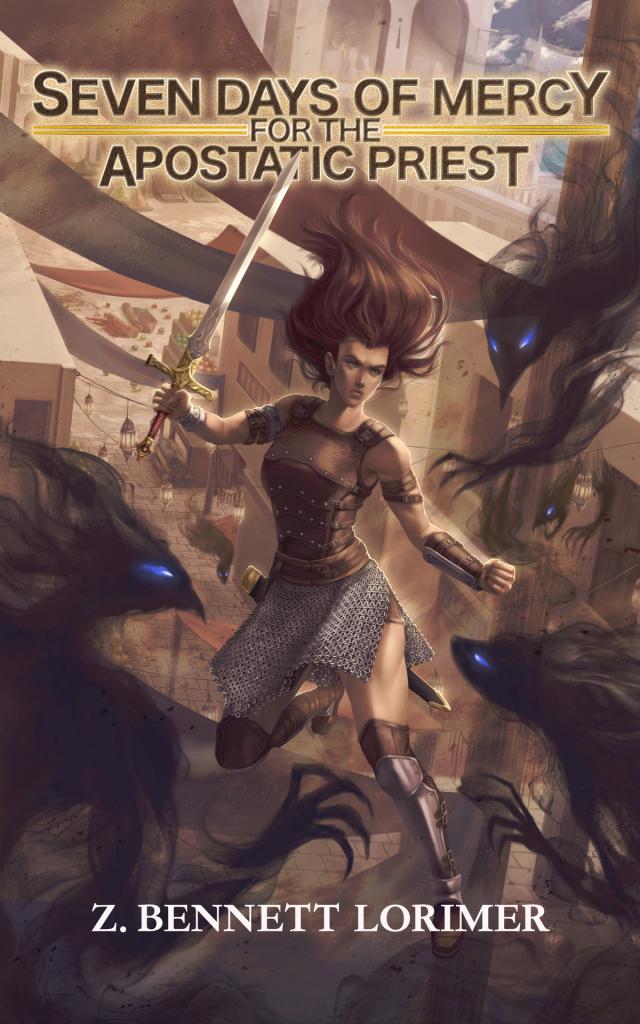
Seven Days of Mercy for the Apostatic Priest
THE DIVINE HERETIC
BOOK ONE
Z. BENNETT LORIMER
This is a work of fiction. All of the characters, events, and organizations portrayed in this novel are either products of the author’s imagination or are used fictitiously.
Seven Days of Mercy for the Apostatic Priest
Copyright (c) 2025 assigned to High Trestle Press LLC
All rights reserved.
Cover design by Aicel Escalada
A High Trestle Press Book
Address
Ames, IA 50010
The scanning, uploading, and distribution of this book via the Internet or via any other means without the permission of the publisher is illegal and punishable by law. Please purchase only authorized electronic editions, and do not participate in or encourage the electronic piracy of copyrighted materials. Your support of the author’s rights is appreciated.
ISBN 978-1-968122-02-7 (Ebook) | 978-1-968122-03-4 (Trade Paperback)
First Printing, January 2026
Printed in the U.S.A.
For Liz
Contents
Prologue
1. The Eternal Valley
2. The Holy City
3. A Procession of the Meek
4. The Unseen World
5. Lines in the Sand
6. Lehakva
7. Garden of Plenty
8. Shades
9. Delivery
10. Cikkot
11. The Altar of the Demiurge
12. Revelation
13. Ziggurat
14. Cataclysm
15. Judgment
16. Mystique
17. Passing of the Blade
18. The Zeal of a Convert
Epilogue
Acknowledgments
About the Author
Also by Z. Bennett Lorimer
Want to see what happens next?
Prologue
You are more.
More than your skin and bones. More than your name. More than the words you speak and the thoughts in your head. You are more than the actions you take. More than your choices. More than memories. More than pleasure and pain. From the ecstatic shudder of your conception until your last stubborn bone rots back into the earth, you are more.
You don’t see it, and well you shouldn’t. Sight is a privilege, and we lost ours long ago. But you wonder, don’t you? And sometimes you grasp.
It wasn’t always this way.
Your forebears stared into the firmament and saw the truth of their divinity, a darkling hint of the vast eternity contained within every thriving soul. No such certainty exists anymore. Not in the night sky or anywhere else. Believe me. I’ve looked. The stars are only lanterns now, and the gulf between them, an abyss in truth. When we exorcised our G-d, we were nothing if not thorough.
We are artifacts, you and I. Fossils of a murdered deity rendered down to mud and stone. Irreducible reflections of a divine spark, beautiful and terrible. Fallen and pure. It is a lonely condition—containment. To be both blessed and forsaken, haunted and ignored. Our fallen G-d still reaches for us across that infinite gulf, and we are cursed to reach infinitely back. Nature abhors a vacuum, and we are nature and this abhorrence both. This is why the Selki still speak the old hymns, and the Huskan Clerics their feral mantras, reduced by time and memory to an insensate blur. It’s why the Lucente poison themselves with lichen, lying wasted in oneiric fog. It’s why the Elan Friars spend their lives painting votive murals only to see them burned. After all this time, The Karochan kantors still sing in trope, and the Celukids hang new ribs from their Abattoir with every passing moon. Prayers by a thousand names, cast in as many tongues into the same deaf void.
My job is to keep it that way.
Chapter 1
The Eternal Valley
We planned for the worst but succumbed to a failure of imagination.
The ten-day journey out of Nurindra stretched over a month. Weeks of narrow mountain passes and barren steppe ground us down by inches. Not nine days in, a stranded wraithling cowl caught our scent on an unfavorable wind. Unable to stay ahead of their hunt, we retreated back to the mountains and selected a bottleneck to stage our defense. I killed two and frightened off the rest but broke my arm in the process. Gerritt’s art spared me a sling and a period of convalescence we could little afford, as he found reason to remind me at least once per day. By the time we reached the fertile Ohtahp Valley, I would have traded his self-satisfied crowing for the sling.
Pockets of civilization welcomed us with open gates and empty promises. Gerritt convinced me to decamp inside walled Rovan against my better judgment. Before I could change my mind, he vanished into the Red City’s warren of brothels, gambling houses and hash tents. It took him less than half a day to get caught swindling a shell game, provoking the local Varag. I cut down six Varagin warpigs to save him from a summary gelding and barely carved our way clear of the undercity before the lockheeds got word to drop the bronze portcullis.
Gerritt jangled his purse, now leaden with Rovan’s copper coinage. He seemed too pleased with himself by half. “Awfully sensitive here.”
“I need to keep you on a shorter leash,” I said.
“Prettier girls have tried,” Gerritt quipped. “Nicer ones, certainly.”
I elbowed him hard in the gut.
“I’m starting to regret mending that arm,” he grumbled.
At least that was the last I had to hear about his healing.
A safe distance from Rovan, we found the snaking line of the Tigrante River and followed it until we reached the first nexus of the Shevat Zubaydin. Silty river valleys and chaparral forests transected leagues of thirsty desert, where the great cities of Ohtahp endured a slow period of languorous decline. The migratory tribes of the deep desert swelled reciprocally as the cities emptied, and so it was mostly these nomads we encountered along the Shevat. Surrounded by so much civic decay, the pristine condition of these pathways unsettled me. By some lost art, the Shevuot withstood the ravages of time far better than the cities or the people. The Mysin Theocrats of antiquity tattooed the land with a skein of stone roads, demarcating paths of pilgrimage that outlived their divinity, connecting razed cities to temple ruins. Only the Shevat Zubaydin still saw any use, for its timeless path ended at Mahakalpe’s stone gate. Priapic waystones marked the Shevat at every league. We read their skritglyphs by the light of zimcrab shells collected at their bases. No one knew who maintained them.
Time sped up along the Shevat. We soon closed on an aromatic cloud of pilgrims from Samarja or Arrek or some equally desolate Ohtahpi Creche. Gerritt and I were only two. We moved faster than the caravan and would soon overtake them. My instinct was to slow our pace and allow the pilgrims to gain, but we were already running late, and the syzygy wouldn’t wait to accommodate our caution. A pair of young women wrapped head-to-toe in stoney shalwaz robes eventually broke from their caravan to hail us. Heedless of my reluctance, Gerritt accepted the invitation to join their camp, and once again I lacked the reserves to argue. We’d been on the road for over a month. We were both tired, and I was ornery.
The Shevat Zubaydin drew us up along a sheer sandstone cliff abutting the dead waters of the Karioch Sea. From the promontory where the tribe made camp, I could see the faded outline of Mahakalpe’s flat walls twisting on the western horizon like some tantalizing mirage. How many generations of pilgrims had taken in this same vista on the final night of their journey? How few looked upon it with irreverent eyes? The nights had gone quiet since we left the banks of the Tigrante, but the noisome chatter of insects now reemerged to fill the evening with song. Surf lapped against the cliff walls below. The crash of boulders calving into the hungry sea punctuated the din as time and motion worked their jaws, devouring this land by inches and feet.
I watched the pilgrim camp erupt like boils. Beiyit tents sprang up by virtue of a clever drawstring contraption that allowed the tribesmen to pitch and collapse the low canvas shelters in the blink of an eye. Gerritt broke away to regale a small group of huntsmen armed with simple wooden spears around one the camp’s seven fires. I overheard bits and pieces of our escape from Rovan, the familiar beats of the story seasoned with Gerritt’s personal brand of embellishment.
Four young men with broad shoulders and strong backs were the last to enter the camp. They carried a palanquin supporting a tall wooden ark painted red and gold. The men set their burden down near the center of the camp with its seven skritglyph grammatons facing west toward distant Mahakalpe. The ark must have held the tribe’s only clone of the Tractate, the Karochan faith’s most sacred text. They wouldn’t have left their creche without it.
I filled my canteen from one of several hanging bladders carried by the tribe’s small cohort of bactrians and walked out beyond the outer ring of beiyit tents, keeping company with the white churn of surf. One of the pilgrims found me before long to present a generous offering of flatbread and a green knob of bactrian cheese.
“I didn’t see you eat,” he said, which I took to mean he’d been watching.
I wasn’t really in a position to turn down the meal. We were planning to resupply in Rovan, but our hasty departure didn’t allow for it, so we’d been rationing ever since. “I didn’t want to impose,” I said as I accepted the food.
The man’s wrinkled grin revealed three missing t
“You shouldn’t be so trusting, Teacher.”
“Oh?” His mouth wrinkled as he tasted my warning. “Planning to rob us within sight of the Holy City?”
I stared at him for an uncomfortably long time before answering. “You lucked out this time, but the roads are crowded with creatures of ill intent.”
The cleric chuckled and shook his head. “Not this road.”
“Then it would be a lonely exception, and I’ve walked my fair share.”
“I don’t doubt that,” he said. “What’s your name, traveler?”
“Ruxindra,” I answered honestly.
He nodded, tucking a loose black ringlet of hair back inside his headwrap. “The Hesserat cities have opened their gates to many outlanders, but I do not think you came from Rovan nor Uruz…” He let the implied question dangle.
“Your intuition serves you well.”
He pressed his foot against the leather greaves lining my pants and eyed the unmended gash in my vambrace, a memento of the wraithling’s attack. I wasn’t carrying Caledin Vane. I’d left the sword in a bundle beside my pack back at the camp, but I hadn’t taken any pains to make its cache discreet. “Dressed for violence,” he mused. “Fearful of the open road. We didn’t expect news of the Eidolon’s emergence to remain bottled inside our G-dling Cradle, but one does wonder just how far the song has carried.”
“We came from Nurindra,” I said, again honestly.
He shook his head. “I do not know it.” I shrugged. “Do they read the Word in Nurindra?” I knew he meant the Tractate, just as Ohtahp became the “G-dling Cradle” in his desert vernacular.
“Some do,” I said. “Others?” I shrugged again and began eating my bread as another long silence settled around us. The Cleric remained at my side, though he let me work my way through my meal without further interruption.
“Arrekot?” I finally asked when I could no longer bear his patient regard.
He nodded. “You know something of our land, then? Half the Hesserat in Rovan couldn’t parse an Arrekot from a Uruzot.” He laughed then, but I didn’t get the joke. “Our creche is a hundred leagues across the desert, beyond the last fertile valleys of the River Narir. We passed many empty creches along the Shevat Zubaydin. I suspect my tribe will be among the last to reach Mahakalpe.”
“Let’s hope the Mahak hasn’t run out of space,” I said.
His lips turned down, and I feared my response had been too glib. The Arrekot had shown us nothing but kindness, and my war was not with them, but their G-d. Some might see it as one and the same, but I did not. In the distance, another rock lost its grip on the cliff and tumbled fatally into the sea.
The cleric turned his head toward the sound. “Even the land bows before the Eidolon,” he said.
“I think it’s the sea that demands obeisance.” I couldn’t help myself.
The cleric raised his finger to me in good-natured reprimand. “Ah, but is not the sea his instrument, and the waves his dauntless will? The waters erode the land and grind it into sand to deposit on some heathen beach, a reminder that change is the only eternity, even for stubborn stone. The cliff’s edge creeps ever closer. Someday even the great Shevat Zubaydin will crumble.”
“That will make it harder for the tribes to reach Mahakalpe,” I said, eager to drag the conversation out of the cleric’s numinous cant.
Then he said something that surprised me. “When that day comes, the Holy City will be a ruin to match all the other extinct vortices of our faith.”
I paused from chewing the last sliver of bactrian cheese. “You expect Mahakalpe will fall?”
He took a moment to consider his answer. “Mahakalpe will outlive its usefulness for a time, but yes, it will eventually fall.”
“Why do you say that?”
His eyes pinched together in a befuddled expression that rang discordant with his sagely performance. “I thought you would have heard?”
“Heard what?” I pressed.
“This Eidolon will be the last,” the cleric said. “So he has told us with the thousand mouths of the desert, and the sages have judged it true.”
The cleric already had my ear, but now he had my attention. “How can that be?”
“How can it be? Or how can it be known?” His eyebrows drifted upward. Karochan clerics all shared a habit of answering questions with questions. Perhaps that’s why the faithful call them teachers instead of priests. “Change,” he repeated.
I should have let the discussion fade at that point. He offered me the opening, but I didn’t take it. “The Eidolon has yet to reach the altar of Mahakalpe. He is not yet invested and may still fail.” As many before him have, I didn’t add.
I expected another rhetorical question, but the cleric instead glanced down at his hemp sandals, at his blackened toes encrusted with sand. “We’ve kept faith with a dead G-d for this long…” He shrugged.
The cleric left me to my silent consideration after that. In time, I drifted back toward the camp, roused by the sound of drumming. I returned to find a group of youngling Arrekot dancing and whooping in a tight circle, banging out a mantric rhythm on tambourines and goblet drums of every size and make. The dancers had discarded their androgyn shalwaz in favor of immodest hide breach cloths and narrow cream slips. Men and women alike exposed their chests, possessed by the spirit of the night and the freedom of the open road. The Arrekot elders watched the performance approvingly, a few tapping their feet to the rhythm of the drums. I saw my cleric sitting cross-legged among three yellow-scarfed women who might have been his wives. He bobbed his head to the drumming, beaming up at the dancers.
I found Gerritt standing amid a band of Arrekot near the Ark of the Tractate. He drank eagerly from a jar of cloudy arak that they passed between them. Gerritt was always quick to make friends. That’s never been my strength. I suppose it’s one of the reasons I kept him around, despite all the trouble he made for me.
“Rux!” He summoned me over and offered the jar, but I declined. I’d had my share of Ohtahpi arak, and every dram tasted like fermented piss. He claimed my sip for himself. “You’ll want to watch this,” he said, waving the arak in the direction of the dancers.
I squared up beside him and watched the circle converge and retreat, the tempo of their drumming increasing with each repetition of the cycle. After one final convergence, the younglings expanded their circle to the edge of the fires abutting the dance, and another young Arrekot appeared in the center of the ring as if conjured from drumming and dirt. She wore a dress purer than it had any right to be after enduring the dusty Shevat Zubaydin, white as mother’s milk but for a single red dot impressed over her navel. Firelight transmuted her wicker crown and the dun bronze pendant that hung from her shoulders into platinum and gold. The dancers circled her, and she spun with them, arms extended in cruciform, not quite dancing but revolving like a clockwork gear at the center of some holy machine. Oiled hair crashed in waves of perfect dark against her shoulders and gown. Her smile never faltered, pinned without blemish at the corners of her face.
Comeliness takes many forms in many cultures, but true beauty is an immutable spark, as constant as it is ineffable. This girl possessed it—the Arrekot embodiment of the good, the beautiful, and the true.
“Such a shame,” Gerritt lamented. Shaking his head, he took another sip of arak.





