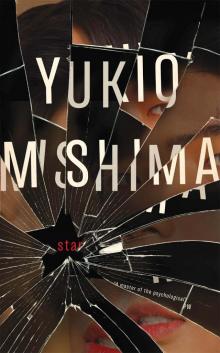
Beautiful Star, page 1


Yukio Mishima
* * *
BEAUTIFUL STAR
Translated by Stephen Dodd
Contents
Chapter 1
Chapter 2
Chapter 3
Chapter 4
Chapter 5
Chapter 6
Chapter 7
Chapter 8
Chapter 9
Chapter 10
About the Author
Yukio Mishima was born in 1925 in Tokyo, and is considered one of Japan’s most significant post-war writers. His books broke social boundaries and taboos at a time when Japan found itself in a state of rapid change. His interests, besides writing, included body-building, acting, and practising as a Samurai. In 1970 he attempted to start a nationalist military coup which failed. Upon realising this, Mishima performed seppuku, a ritual suicide, in public. He was nominated for the Nobel Prize in literature three times.
1
Under a cloudless mid-November sky in the dead of night, a 1951 Volkswagen emerged sputtering into life from the garage of a large, well-to-do residence in the city of Hannō, Saitama Prefecture. The stone-cold engine required a few minutes to turn over before the car was ready to depart. All the while its passengers glanced around uneasily.
This old-fashioned household had only recently built the ramshackle garage for their newly acquired second-hand car. Blue-painted garage doors fronted some bamboo lattice fencing that had seen better days. The garage was a sign that the family had broken free from a long rut and was stirring into action.
But no one could guarantee the course of the action they had embarked upon. As scions of Hannō’s premier lumber family business, they had inherited a sizeable fortune, but none of the interest in the light-hearted, run-of-the-mill pastimes that had enthused their predecessors. Akiko, the beautiful daughter, was a quiet type with no close friends. Just a couple of doors from their home was one of those old-fashioned post offices built with thick earthen walls, but she would walk right past it and take her stack of mail all the way to the main depot by the train station. Some looked askance at this, and tongues wagged. Her letters included airmail bound for every corner of the world.
The car sped along the wide, flat Hannō roads in the deep of night. The son, Kazuo, was Akiko’s elder brother, and he sat in the driving seat alongside Akiko. Their parents, Mr and Mrs Ōsugi, were in the back.
‘I’m so glad we left early,’ said the father, Jūichirō. ‘Things often take longer than you expect, so it always pays to be a bit early.’
‘Exactly. If we’re late, our friends will take offence,’ replied Iyoko, the mother. All four looked steadily ahead through the car’s windscreen at the night sky as it slowly unfolded between low, unlit rows of houses. The whole family had inherited the same beautiful, crystal-clear eyes.
There was not another soul on the road. The car passed the city’s Chamber of Commerce and turned right, made a left at the police station, its presence marked by the faint glow of the night watch, and soon reached the front of the new City Hall which also served as the city bus terminal. The pure-white City Hall building, rectangular and modern, loomed out from the darkness of the night that gathered thickly around Mt Rakan, immediately behind. The family was going to climb that mountain.
Mt Rakan stands 195 metres above sea level. In the Kōji Period (1555–1558) during the reign of Emperor Go-Nara, the Venerable Onoya, first abbot of Nōninji Temple, founded a temple on a mountainside which he named Mt Atago. Later, in the fifth year of the Genroku Period (1688–1704), Keishōin, mother of Tsuneyoshi, the fifth Shogun of the Tokugawa Dynasty, donated sixteen rakan (important saints’) statues to the temple, and the site’s name was changed to Mt Rakan.
Kazuo parked beneath the huge windowpanes of the deserted City Hall. On the other side of the dark glass, traces of light from the streetlamps reached out to the absurdly high ceiling and the hundreds of chairs. Semi-circular rows of empty seats faced an empty onstage rostrum. Emptiness reflected emptiness in a way that seemed to maintain a tense equilibrium far more effectively than during the daytime when the hall was packed with people.
After taking a peep, Kazuo went to open the boot of the parked car. He dragged out a rucksack packed with things to eat and a blanket to ward off the cold, and slung it over his back. The others would be carrying cameras, binoculars and flasks to the top.
Akiko sprang nimbly from the passenger side, well wrapped up against the cold in grey slacks and a gaudy ski sweater, with the ends of a woollen muffler dangling from her neck. The ethereal beauty of her face shone in the darkness, while her shawl set off her slender frame nicely. Energized by the night cold, Akiko used a silver torch to draw bold circles of light around herself in order to test its strength. It looked like a deadly weapon in her hand.
Next out was Jūichirō, with an extra sweater on to keep warm, and Iyoko, dressed Japanese style, with a muffler peeping from the neck of her thick full-length overcoat. After graduating from university in the liberal arts, Jūichirō had dabbled for a while as a schoolteacher, but he never gravitated towards any other particularly intellectual occupation. And yet his splendidly long, bespectacled face endowed him with an elite academic weightiness. His distinguished, rather bony nose immediately conveyed an air of loneliness and desolation to those around him. Iyoko, in contrast, had a warm, homely face, the same dull-witted, gullible features she had passed on to her son.
The party set off up the mountain in silence, the lights from their four torches criss-crossing the ground before them. By the time the white lettering of a sign emerged from the gloom to inform them they were on the path to the top of Mt Rakan, sharp-tipped cedars were already pressing in around them. From this point, street lighting was non-existent.
It had been virtually windless at ground level, but the higher they climbed the more powerful grew the rustling of trees in the night. Through gaps among the cedars, deep wells suddenly opened up that led to the night sky, revealing ever-brighter clusters of stars. Kazuo was in the lead, and his sharp, probing torchlight happened upon a group of gravestones at a roadside cemetery. Since the path was wide and the incline gentle, they took a wide detour around the stones, and emerged into an open space halfway up the mountain. Their lights fell on empty benches and a scattering of white scraps of wastepaper.
Not a single bird was in song. After they crossed the open space the path narrowed, becoming steeper and tougher to negotiate. Logs were set horizontally into the ground to serve as footholds, but rocks and tree roots had invaded the path from all directions, and the path’s unevenness was exaggerated even further by their torchlight, as rock shadows flickered wildly along the way. The wind stirring through the trees above their heads grew steadily louder.
But none of them appeared at all distracted from their noble objective. Even the womenfolk remained fearless.
If the moon had been out over the mountains the landscape would certainly have seemed brighter. In fact, the moon had made an appearance the previous day at dusk, but quickly disappeared. Moreover, it was such a thin sliver of moon that it would not have helped much even if it had remained in the sky. The four urged each other up the arduous path. Had they made the climb during the daytime, it would have been child’s play.
They eventually came to a small grassy spot where their torch lights struck a set of four or five dilapidated stone steps. The stones cascaded down through the dark cedars like a small waterfall.
‘At last, we’ve made it! The observation deck is just up there,’ said Jūichirō, short of breath.
‘It took twenty-seven minutes from base to here,’ said Kazuo, holding the luminous dial of his watch close to his face.
The observation deck was a level patch of rock-strewn ground about 300 metres square. To the north stood a stone monument that marked an imperial visit, surrounded by a forest behind it. The ground lay entirely open to the south. Apart from two or three straggly pine branches and the tops of some dense low-lying woods, a completely uninterrupted view of the southern sky spread from directly above them all the way to the horizon. Down to the east was a scattering of lights from Hannō, but they were outdone by the cluster of green, red and yellow illuminations emanating from Johnson Military Base, visible on the horizon due east.
‘What time is it?’
‘Seven minutes to four.’
‘I’m so glad we got here before the hour. I really wanted to arrive at least thirty minutes before things are due to kick off.’
They had worked up a sweat during the ascent, but this dissipated immediately, and they became aware that the cold of a November dawn on a mountain top was not to be taken lightly. Kazuo removed the scruffy blanket from the rucksack and spread it on the ground, while the women, their backs set against the wind as it howled through the northern forest towards them, strove to make their surroundings a little more comfortable. Iyoko poured hot tea from a flask into plastic cups and offered them around, and she unwrapped the sandwiches. At last, they all had a few moments to contemplate their individual patches of the starry sky.
‘How clear it is. And no moon, either. We’re so lucky.’ Iyoko’s eyes brimmed with emotion as she spoke.
It was one of those magnificent starry skies never visible in the big city. The stars were embedded in the firmament like spots on a leopard’s fur. The atmosphere was crystal clear, and the arrangement of stars – some distant, some closer – revealed the true depths of the night sky. Light flowed into haze-like clusters, in such a way that those looking on thought they saw nets
‘What a pity, though.’ Jūichirō’s tone was sonorous yet direct. ‘This morning, neither your mother nor I managed to see our home planets. Just a glimpse of those tiny points of light would have brought so many forgotten memories flooding back. When I was still living on Mars all that time ago, I can tell you I looked at Earth in exactly the same way.’
‘It’s not possible to see Mars in November.’ Kazuo’s response was rather curt. ‘Because it rises and sets about the same time as the sun. But Jupiter, where Mum comes from, is visible in the early evening.’
‘I was too busy to look yesterday,’ sighed his mother. ‘I can’t tell you how happy it would have made me here this morning for us to see our native planets all together.’
‘Mine will come into view soon,’ said Akiko, turning back affectionately to her brother.
‘Mine too. Poor humans, you’ve got to feel sorry for them.’
‘Now, now!’ His mother admonished him with a smile. ‘Remember, that kind of language won’t do. It might be OK around here because no one can overhear us, but if you make a practice of saying things like that in front of strangers, you could get into terrible trouble.’
Behind them to the north, the wind crashed like ocean waves, flailing through the upper branches of cedar and pine trees, then rising up at a distance before dropping down to pummel them like a sudden avalanche. Their hands were frozen through, but they had equipment to carry – cameras and binoculars – so none of them wore gloves. A constant flurry of leaves pelted their backs. The strange sound they could just about catch turned out to be the rattling of a zinc door in a deserted teahouse nearby.
The constellations turned quietly, invisible to the eye. Orion’s Belt hung in the sky to the south-west, its three stars lining up with a fourth, below, Rigel, to form the shape of an old-fashioned kite. The whole family was watching out for movements of light, but they kept getting distracted by extraneous things. There were meteors. There was an aeronautical beacon nestled among the mountains far to the south which they had never noticed until then. And head-lamps from cars travelling along the main highway flickered in the dimly lit outskirts of Hannō.
‘They promised they’d appear in the sky to the south between four-thirty and five.’ Even as he spoke, Jūichirō’s bespectacled eyes remained firmly trained in that direction.
‘Just another ten minutes to go. I wonder what tidings our brothers and sisters will bring. What sacred mystery will they convey?
‘The Soviet Union has finally managed to test a fifty-megaton nuclear bomb. They’re on the point of committing a heinous crime that will break the harmony of the Universe. And if America goes on to follow blindly in their footsteps … The end of human beings on Earth is already in sight. Our family’s mission is nothing less than to ensure it doesn’t happen. And yet we remain powerless, while the world seems utterly oblivious!’
‘Don’t despair, Dad.’ Kazuo offered soothing words while his binoculars continued to scour the heavens. ‘Compared to the timescale that frames the Universe, the period of our suffering pales into insignificance. I don’t believe earthlings can all be that stupid. At some point they’ll wake up to the error of their ways, and a time will come when they submit to our way of thinking about complete harmony and eternal peace. In any case, we should write that letter to Khrushchev as soon as possible.’
‘Akiko’s been working on a draft. You’re almost finished, aren’t you, dear?’ said Iyoko.
Her beautiful daughter replied with a monosyllabic grunt as she searched the starry sky.
Finally, it reached four-thirty. Total silence reigned as the family attended to the sky with a mixture of tension and expectation. Jūichirō had received notice early the previous morning that several flying saucers would be making an appearance at this time.
It was summer the year before when the family suddenly awoke to the fact that they were all extraterrestrials who had descended to earth from their respective celestial bodies. This supernatural insight began with Jūichirō, but within a few days it had possessed both parents and children. Even Akiko, who had just thought it funny at first, was no longer laughing.
The easiest explanation was to assume that the souls of extraterrestrials had suddenly taken up residence in all the family members, and they now had total control over each person’s body and spirit. At the same time, while the family still retained clear images of past events and things like the births of the children, such earthly memories had been transformed instantaneously into false histories. It was highly regrettable that their personal memories of other worlds (that is, their true histories) had been irretrievably lost.
Jūichirō was no man of action, but he was thoughtful and had a clear understanding of the world. It was his belief that, in order to protect his family, it was absolutely vital to prevent society at large from getting wind of their secret alien identities. But how to do that?
Jūichirō had enough common sense to understand that human purity and honesty could only be protected from harm if they were kept carefully under wraps. This thought never entered his wife’s head, and his children were still young, but he did make every effort to alert them all to this reality. Let them feel proud about being extraterrestrials all they liked, but even the tiniest display of arrogance might leave them highly vulnerable and in real danger of being exposed to the world. It was essential that they conceal any feelings of superiority. After all, the world was obsessed with sniffing out why some people stood out even a little from others.
There was no way Jūichirō could have anticipated that he, of all people, would suddenly develop such a clear sense of his higher calling at the age of fifty-two. As a young man, he had been tormented with an inferiority complex. Held in contempt by his father, a complete philistine, he had sought salvation in the gentle and forgiving world of the arts. As long as his father was alive, Jūichirō at least made a minimal effort to help out in the company business. But once his father was dead, he felt no further obligation and turned to a life of idleness. He would accompany his wife to Tokyo from time to time to see a play or an exhibition, and he had put his son and daughter into Tokyo schools. He created an untroubled, isolated and cerebral family in this provincial city just an hour’s train journey from the big city.
Then one day in his early fifties, and with no thanks to personal effort or accomplishment on his part, he was touched by the grace of a superior understanding which awakened him to his life’s mission for the first time. The lack of purpose that had characterized the first half of his life now struck him less as a mistake, and more as a half-finished, though flawlessly preserved condition that allowed the universal truth to seek him out when the time was right to make him its vessel.
During the earlier, inactive phase of his life, he was the sort of person who could not stop wondering why, for example, the top branches of garden trees were slenderer than their trunks, and why these branches shorn of leaves became so delicately embedded into the blue sky. The structure of giant elms in wintertime reminded him of fine river tributaries on a map. It was as if the wellspring of the trees was hidden away somewhere in the heavens, and numerous treetop branches, cascading down from the watershed in the blue above, forged together into black trunks and suddenly melded into the shape of a tree. Perhaps it was precisely because trees were delicate streams pouring down from the heavens in crystallized form that their abundant branches and leaves also stretched upwards, struggling to find their way back to the celestial realm.
But these fantasies were no proof that he possessed a poetic nature. Constantly troubled by the way his worldly illusions got smashed into tiny pieces, he could never quite trust the structure and effectiveness of individual objects in the world. For instance, he had thought long and hard about the shape of scissors. When you spread them wide, the extended tips centred on the fulcrum spread out in the shape of an open fan, creating two areas diametrically opposed to each other. Scissors are simply something you hold in your hand, but they readily bisect the world, forming spaces that incorporate mountains, lakes, cities and oceans. But a simple snapping shut of the sharp metal tool obliterates the wide earth, and you are left with nothing but a cut sheet of white paper and a strange, beak-like implement.