

China in Ten Words, page 1


Also by Yu Hua
The April 3rd Incident
The Seventh Day
Boy in the Twilight
Brothers
Cries in the Drizzle
Chronicle of a Blood Merchant
To Live
The Past and the Punishments
VINTAGE BOOKS EDITION, AUGUST 2012
Translation copyright © 2011 by Yu Hua
Penguin Random House values and supports copyright. Copyright fuels creativity, encourages diverse voices, promotes free speech, and creates a vibrant culture. Thank you for buying an authorized edition of this book and for complying with copyright laws by not reproducing, scanning, or distributing any part of it in any form without permission. You are supporting writers and allowing Penguin Random House to continue to publish books for every reader. Please note that no part of this book may be used or reproduced in any manner for the purpose of training artificial intelligence technologies or systems.
Published by Vintage Books, a division of Penguin Random House LLC, 1745 Broadway, New York, NY 10019. This work, originally written in Chinese, was first published in France as La Chine en Dix Mots by Actes Sud, Arles, France, in 2010. French translation copyright © 2010 by Actes Sud. A Chinese edition of this work was published in Taiwan as Shige cihui li de Zhongguo by Rye Field Publications, Taipei, in 2011. Copyright © 2011 by Yu Hua. This translation originally published in hardcover in the United States by Pantheon Books, a division of Penguin Random House LLC, New York, in 2011. Originally published in trade paperback by Anchor Books, a division of Penguin Random House LLC, New York, in 2012.
Vintage and colophon are registered trademarks of Penguin Random House LLC.
A portion of this work was originally published in different form in The New York Times.
The Library of Congress has cataloged the Pantheon Books edition as follows:
Yu, Hua, [date]
[Shige cihui zhong de zhongguo. English]
China in ten words / Yu Hua; translated from the Chinese by Allan H. Barr.
p. cm.
I. Barr, Allan Hepburn. II. Title.
PL2928.h78s5513 2011 985.1′85207—dc22 2011010320
Vintage Books Trade Paperback ISBN 9780307739797
Ebook ISBN 9780307906939
Author photograph courtesy of Fabrica
Book design by Iris Weinstein, adapted for ebook
penguinrandomhouse.com
vintagebooks.com
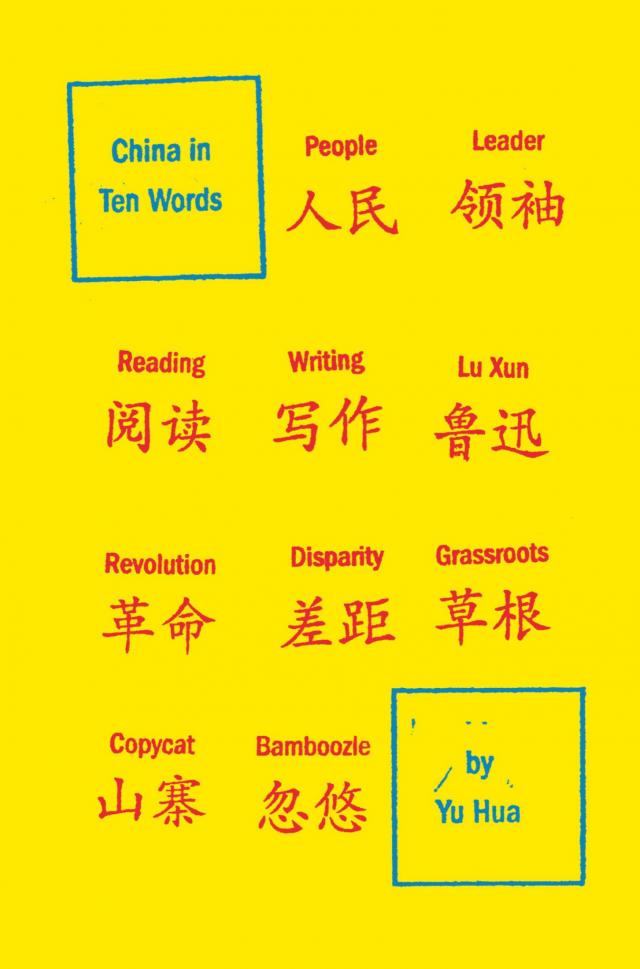
Cover design by Peter Mendelsund, Brian Barth, and Linda Huang
rh_3.1_150211618_c0_r2
contents
Cover
Other Books by This Author
Title Page
Copyright
Introduction
People
Leader
Reading
Writing
Lu Xun
Revolution
Disparity
Grassroots
Copycat
Bamboozle
About the Author
About the Translator
_150211618_
introduction
In 1978 I got my first job—as a small-town dentist in south China. This mostly involved pulling teeth, but as the youngest staff member I was given another task as well. Every summer, with a straw hat on my head and a medical case on my back, I would shuttle back and forth between the town’s factories and kindergartens, administering vaccinations to workers and children.
China during the Mao era was a poor country, but it had a strong public health network that provided free immunizations to its citizens. That was where I came in. In those days there were no disposable needles and syringes; we had to reuse ours again and again. Sterilization too was primitive: The needles and syringes would be washed, wrapped separately in gauze, and placed in aluminum lunch boxes laid in a large wok on top of a briquette stove. Water was added to the wok, and the needles and syringes were then steamed for two hours, as you would steam buns.
On my first day of giving injections I went to a factory. The workers rolled up their sleeves and waited in line, baring their arms to me one after another—and offering up a tiny piece of red flesh, too. Because the needles had been used multiple times, almost every one of them had a barbed tip. You could stick a needle into someone’s arm easily enough, but when you extracted it, you would pull out a tiny piece of flesh along with it. For the workers the pain was bearable, although they would grit their teeth or perhaps let out a groan or two. I paid them no mind, for the workers had had to put up with barbed needles year after year and should be used to it by now, I thought. But the next day, when I went to a kindergarten to give shots to children from the ages of three through six, it was a different story. Every last one of them burst out weeping and wailing. Because their skin was so tender, the needles would snag bigger shreds of flesh than they had from the workers, and the children’s wounds bled more profusely. I still remember how the children were all sobbing uncontrollably; the ones who had yet to be inoculated were crying even louder than those who had already had their shots. The pain that the children saw others suffering, it seemed to me, affected them even more intensely than the pain they themselves experienced, because it made their fear all the more acute.
This scene left me shocked and shaken. When I got back to the hospital, I did not clean the instruments right away. Instead, I got hold of a grindstone and ground all the needles until they were completely straight and the points were sharp. But these old needles were so prone to metal fatigue that after two or three more uses they would acquire barbs again, so grinding the needles became a regular part of my routine, and the more I sharpened, the shorter they got. That summer it was always dark by the time I left the hospital, with fingers blistered by my labors at the grindstone.
Later, whenever I recalled this episode, I was guilt-stricken that I’d had to see the children’s reaction to realize how much the factory workers must have suffered. If, before I had given shots to others, I had pricked my own arm with a barbed needle and pulled out a blood-stained shred of my own flesh, then I would have known how painful it was long before I heard the children’s wails.
This remorse left a profound mark, and it has stayed with me through all my years as an author. It is when the suffering of others becomes part of my own experience that I truly know what it is to live and what it is to write. Nothing in the world, perhaps, is so likely to forge a connection between people as pain, because the connection that comes from that source comes from deep in the heart. So when in this book I write of China’s pain, I am registering my pain too, because China’s pain is mine.
The arrow hits the target, leaving the string,” Dante wrote, and by inverting cause and effect he impresses on us how quickly an action can happen. In China’s breathtaking changes during the past thirty years we likewise find a pattern of development where the relationship between cause and effect is turned on its head. Practically every day we find ourselves surrounded by consequences, but seldom do we trace these outcomes back to their roots. The result is that conflicts and problems—which have sprouted everywhere like weeds during these past decades—are concealed amid the complacency generated by our rapid economic advances. My task here is to reverse normal procedure: to start from the effects that seem so glorious and search for their causes, whatever discomfort that may entail.
“We survive in adversity and perish in ease and comfort.”* Such were the words of the Confucian philosopher Mencius, citing six worthies in antiquity who suffered untold hardship before achieving greatness. Man is bound to make mistakes, he believed, and it is in the unceasing correction of his errors that human progress lies. Viewed in this light, he suggested, adversity has a way of enhancing our endurance, while ease and comfort tend to hasten our demise—whether as individuals or as a nation. When I write in these pages of personal pain and of China’s pain, it is with that same conviction that we survive in adversity. So in this quest to follow things back to their source, we cannot help but stumble upon one misfortune after another.
If I were to try to attend to each and every aspect of modern China, there would be no end to this endeavor, and the book would go on longer than The Thousand and One Nights. So I limit myself to just ten words. But this tiny lexicon gives me ten pairs of eyes with which to scan the contemporary Chinese scene from different vantage points.
My aim is to stay brief and concise, beginning this narrative journey from the daily life we know so well. Daily life may seem trivial and routine, but in fact it contains a multitude of incidents, at once rich, expansive, and touching. Politics, history, society, and culture, one’s memories and emotions, desires and secrets—all reverberate there. Daily life is a veritable forest and, as the Chinese saying goes, “Where woods grow deep, you’ll find every kind of bird.”
For me, as for a bus driver who drives back and forth along the same route, my starting point is also my last stop. My busload of stories sets off from daily life, pulls over when it reaches junctions with politics, history, society, and culture—or with memories and emotions, desires and secrets—and sometimes it pauses at outlying stops that may not even have a name. Some stories disembark along the way, while oth
My goal, then, is to compress the endless chatter of China today into ten simple words; to bring together observation, analysis, and personal anecdote in a narrative that roams freely across time and space; and finally to clear a path through the social complexities and staggering contrasts of contemporary China.
* * *
*Mencius, trans. D. C. Lau (Harmondsworth, U.K.: Penguin Books, 1970), p. 181.
people
As I write these characters I have to look a second time to make sure I have them right. That’s the thing about this word: it feels remote, but it’s so familiar, too.
I can’t think of another expression in the modern Chinese language that is such an anomaly—ubiquitous yet somehow invisible. In China today it’s only officials who have “the people”* on their lips every time they open their mouths, for the people themselves seldom use the term—perhaps they hardly recall its existence. We have to give those voluble officials some credit, for we rely on them to demonstrate that the phrase still has some currency.
In the past this was such a weighty phrase. Our country was called the People’s Republic of China. Chairman Mao told us to “serve the people.” The most important paper was the People’s Daily. “Since 1949 the people are the masters,” we learned to say.
In my childhood years “the people” was just as marvelous an expression as “Chairman Mao,” and when I first began to read, these were the first words I mastered; I could write them even before I could write my own name or the names of my parents. It was my view then that “the people are Chairman Mao, and Chairman Mao is the people.”
That was during the Cultural Revolution, and I marched about proudly sharing this insight with everyone I met. They responded with dubious looks, apparently finding something problematic about my formulation, although nobody directly contradicted me. In those days people walked on eggshells, fearful that if they said anything wrong, they might be branded a counterrevolutionary, endangering their whole family. My parents, hearing of my discovery, looked equally doubtful. They eyed me warily and told me in a roundabout way that they couldn’t see anything wrong with what I’d said but I still had better not say it again.
But since this was my greatest childhood insight, I couldn’t bear to hush it up and continued sharing it with the world at large. One day I found supporting evidence in a popular saying of the time, “Chairman Mao lives in our hearts.” I took this to its logical conclusion: “Chairman Mao lives in everyone’s heart, so what lives in Chairman Mao’s heart? It has to be the entire people.” Therefore: “The people are Chairman Mao, and Chairman Mao is the people.”
Those doubtful looks among the residents of my little town gradually dissipated. Some people began nodding in approval, and others began to say the same thing—my little playmates first, and then grown-ups, too.
But I felt threatened when lots of people started saying, “The people are Chairman Mao, and Chairman Mao is the people.” In a revolutionary era one cannot claim a patent for anything, and I found my status as inventor was being steadily eroded. “I was the first one to say that,” I would declare. But no adults set any store by my claim of authorship, and in the end even my young companions refused to accept that I deserved credit. Faced with my strenuous arguments or pathetic pleas, they would shake their heads: “No, everybody says that.”
I was upset, regretting bitterly that I had made my discovery public. I should have stored it forever in my own mind, safe from anybody else, keeping it for myself to savor my whole life through.
These days the West is astonished by the speed of China’s makeover. With the flick of a wrist Chinese history has utterly changed its complexion, much the way an actor in Sichuan opera swaps one mask for another. In the short space of thirty years, a China ruled by politics has transformed itself into a China where money is king.
Turning points in history tend to be marked by some emblematic event, and the Tiananmen Incident of 1989 was one such moment. Stirred by the death that April of the reform-minded Hu Yaobang, college students in Beijing poured out of their campuses to gather in Tiananmen Square, demanding democratic freedoms and denouncing official corruption. Because of the hard line the government took in refusing to engage in a dialogue, in mid-May the students began a hunger strike in the square and the locals marched in the streets to support them. Beijing residents were actually not so interested in “democratic freedoms”—it was the attacks on profiteering by officials that drew them into the movement in such huge numbers. At that time Deng Xiaoping’s open-door policy had entered its eleventh year, and although the reforms had triggered price increases, the economy was growing steadily and the standard of living was rising. Peasants had benefited from the changes. Factories had yet to close, and workers were yet to become victims. Contradictions were not as acute then as they are now, when society simmers with rage. All we heard then were grumbles and complaints about the way the children of high officials had made themselves rich on our national resources, and those sentiments found a focus in the protests. Compared with today’s large-scale, multifarious corruption, the diversion of funds by a minority back then didn’t really amount to anything. Since 1990, corruption has grown with the same astounding speed as the economy as a whole.
The mass movement that had begun to sweep across the country quickly subsided amid the gunfire on the morning of June 4. In October of that year, when I visited Peking University, I found myself in a different world, where engagement with affairs of state was nowhere to be found. After nightfall, courting couples appeared by the lakeside and the clatter of mahjong tiles and the drone of English words being memorized were the only sounds that wafted from dorm windows. In the short space of one summer everything had changed so much that it seemed as though nothing at all had happened that spring. Such a huge contrast demonstrated one point: that the political passions that had erupted in Tiananmen—political passions that had accumulated since the Cultural Revolution—had finally expended themselves completely in one fell swoop, to be replaced by a passion for getting rich. When everyone united in the urge to make money, the economic surge of the 1990s was the natural outcome.
After that, new vocabulary started sprouting up everywhere—netizens, stock traders, fund holders, celebrity fans, laid-off workers, migrant laborers, and so on—slicing into smaller pieces the already faded concept that was “the people.” During the Cultural Revolution, the definition of “the people” could not have been simpler, namely “workers, peasants, soldiers, scholars, merchants”—“merchants” meaning not businessmen but, rather, those employed in commercial ventures, like shop clerks. Tiananmen, you could say, marked the watershed between two different conceptions of “the people”; or, to put it another way, it conducted an asset reshuffle, stripping away the original content and replacing it with something new.
In the forty-odd years from the start of the Cultural Revolution to the present, the expression “the people” has been denuded of meaning by Chinese realities. To use a current buzzword, “the people” has become nothing more than a shell company, utilized by different eras to position different products in the marketplace.
Beijing in the spring of 1989 was anarchist heaven. The police suddenly disappeared from the streets, and students and locals took on police duties in their place. It was a Beijing we are unlikely to see again. A common purpose and shared aspirations put a police-free city in perfect order. As you walked down the street you felt a warm, friendly atmosphere all around you. You could take the subway or a bus for free, and everyone was smiling at one another, barriers down. We no longer witnessed arguments in the street. Hard-nosed street vendors were now handing out free refreshments to the protestors. Retirees would withdraw cash from their meager bank savings and make donations to the hunger strikers in the square. Even pickpockets issued a declaration in the name of the Thieves’ Association: as a show of support for the students, they were calling a moratorium on all forms of theft. Beijing then was a city where, you could say, “all men are brothers.”


