Counting Casualties, page 1


Begin Reading
Table of Contents
About the Author
Copyright Page
Thank you for buying this
Tom Doherty Associates ebook.
To receive special offers, bonus content,
and info on new releases and other great reads,
sign up for our newsletters.
Or visit us online at
us.macmillan.com/newslettersignup
For email updates on the author, click here.
The author and publisher have provided this e-book to you without Digital Rights Management software (DRM) applied so that you can enjoy reading it on your personal devices. This e-book is for your personal use only. You may not print or post this e-book, or make this e-book publicly available in any way. You may not copy, reproduce, or upload this e-book, other than to read it on one of your personal devices.
Copyright infringement is against the law. If you believe the copy of this e-book you are reading infringes on the author’s copyright, please notify the publisher at: us.macmillanusa.com/piracy.
The Coalition highship’s face changed its name from grace under gunfire to counting casualties when our fleet heard that Bekket-of-the-Spires had fallen to the deadships.
Let me tell you about Bekket. I never trod the pale shores or walked beneath the veiled shadows of its silver-tangled trees. I never climbed the almost-forever stairs of the spindle cities, never counted the fever-constellations they made of their stars, never combed the quaint stores for statues lathed out of starship hulls. I never thought of Bekket as a place I might visit among all the thousand thousand worlds.
But I knew of Bekket’s poetry. Not all of its people were poets, but enough of them were. Not all of its poetry was beautiful, but enough of it was. The Coalition demagogues especially liked the line about—it had something to do with eyes and ideals and things we don’t see. It’s gone now.
When the deadships destroyed Bekket with razor-fire and erasure-choirs, all of Bekket’s poetry was scratched out forever from every place it had ever lived.
I have a volume of Bekketer poetry bound in old, old paper. It’s hash now, glitched-out garbage that no one will ever be able to read again. I would have disposed of it, but I couldn’t bear to. So I honor the dead.
It was an open question why the deadships weren’t using this ability to destroy our technology base; why they erased our symphonies and soap operas but not our stardrives. Our scientists debated the question, but short of being able to ask the deaders themselves, there was no way of knowing. The going theory was that they were demoralizing us before swooping in for the kill.
The deaders, for their part, weren’t taking inquiries. Communication with them was as improbable as hoping that your pistol would wake up and learn the alphabet. We had sent words-of-greeting and entreaties in verse, videos, everything we could think of, only to be met with obdurate silence. They seemed bent on burning their way through our worlds. Perhaps we were only obstacles on the way to somewhere else, but we had sent out scouts and all we found was more silence.
In any case, the bad news wasn’t just the poetry. I always felt a moment’s guilty gratitude that they hadn’t done away with our computers or communications before remembering that we were still dealing with the death of a world. The people of that world, the animals slow and swift and sweet. The bad news was that Bekket-of-the-Spires was located on the Rose Curve of the Sieve, and no one had realized that the deadships had penetrated so far into the Sector.
My name is Niaja vrau Erezeng—vrau because I am neither man nor woman. As far as I know, the only other Erezeng left in the Coalition, or anywhere, is my cousin Damariev var Erezeng, who commands the one-way run. I did not want to be the fleet highship’s commander any more than I wanted my life to be a crazed patchwork of bullets, angles, the carcasses of ships and the people inside them. But my homeworld died in the razor-fires—the deadships took our calligraphy from us, which hurt me even though I didn’t care about it—and it only seemed right that I serve against them. It was simpler for Damariev. He was indifferent to the joy of shooting things, although he was good at it. But he was also good at loyalty, and he went where I did.
The Coalition’s council sent us our instructions not long after the news of Bekket’s fall came. Fleet 18 was to intercept the deadfleet in the Sieve and prevent them from advancing toward the Coalition’s heartworlds, for values of “prevent” that meant “you will probably die in the attempt.” It was terrible work and there was no one else close enough to do it. We were spread thin, and furthermore the void-storms made it difficult for them to promise us any assistance.
I could tell you about the heartworlds, but there would be no point. We would only know about each one’s particular art, the jewel that defined it, when the deadships’ erasure-choirs sang them out of memory. I remember in the case of Jai-binai it was political caricature. I hadn’t thought I cared for caricature—so coarse, so savage—until Jai-binai was dust and bonedrift. Better not to think about the vast possibilities for loss.
Fleet 18 had fifty-four ships in it plus the highship. I knew the names of the people who served on those ships, had them written into the secret crevices of my heart, and I knew their friends and follies and fears. The highship’s face remembered them for me, too, but I made a point of remembering for myself. Like most ship’s faces, it had a certain black sense of humor after over a century of service. It had nicknames for everyone, which I refused to divulge in the interests of preserving morale, and it liked to refer to me as “the latest unfortunate” when it bothered talking to anyone else.
It also went very quiet after every battle, once the guns sputtered to a stop, when it reckoned the dead. In case the numbers had changed, in case it had made a mistake, in case someone on the list had survived after all. It was never wrong; ship’s faces never were. But it checked anyway.
We had been en route for twenty-nine days when we got the first indication that the battle ahead would be even worse than we had anticipated. I had a scout-web extended around the volume of space the fleet occupied, but it had holes; they always did. We were lucky to get as much warning as we did.
A scout-web is this, and this is why we use them as little as we dare. Take a flock of birds. Raise them from embryo and eggshell. They follow you wherever you go. They croon to the sound of your voice. They orient to you the way they should orient to the polestar, to the sun overhead, to the wheeling of the seasons even in a world of sterile days and stark nights. Tell them to fly, but punch holes in their wings so they can never get too far away. Encase them in shells of metal, give them fuel to fly. Tell them over and over to sing only when their eyes are burned out. And then send them to keep watch over you.
They will do it, you know. Every time. Scouts never complain.
The warning came piecemeal, in words of skew and scatter and fracturing sky. Captain Aron var Aris was the first to report it. He had one of the fleet’s best scan operators, a woman whose homeworld, Starro, had once been known for its living arrangements of flowers and tame blinded birds. I sometimes look at videos of the arrangements. I would tell you the woman’s name, I once knew it as closely as I knew everyone’s, but the great art of her world had not been the arrangements of flowers, but its people’s names. Now the woman calls herself Flinch, and no one questions the choice.
In any case, Flinch told us what to look for sideways and forward, up and down, and none of it was good from any direction. The deadfleet numbered at least two hundred, and we knew from pallid experience that their ships were tougher and almost as fast, sisters to fire and thunder. They were swerving toward the Straits of Pierced Glass, which were known for their uncertain stellate weather, whorls and eddies of space where their drives and ours functioned treacherously or not at all.
I held a conference with my senior captains, all fourteen of them, and their ships’ faces. Damariev, my cousin, smiling the way he always smiled. Some people thought he was insensitive, but I knew better. There were needles behind his eyes, and red red ice. He knew how bad the situation was. Makione vrau Enon, who was young for their rank, and had a mind that thought in clean straight trajectories that others didn’t see until Makione pointed them out, and who had wanted to be an engineer. Jeuri vrau Kanzon, Nio var Merre, Lasura vel Kelas. I could tell you about all of them.
Even after it was over, I could tell you about all of them. That counts for something.
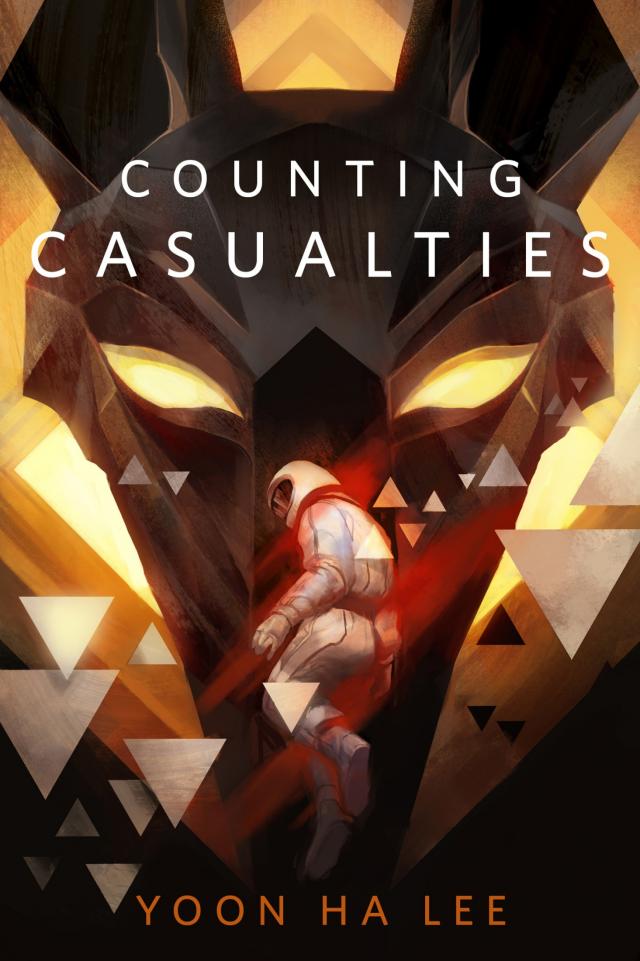
The faces projected themselves uniformly as black jackal masks with hellspark eyes, each considerately labeled with its name. Faces had a certain respect for tradition. As counting casualties liked to say, humans were so short-lived and changeable that it was nice to have some things to rely on, like basic protocol and the perennial popularity of coffee.
“Looks bad, is actually worse,” was the first thing that unhinged equation said. It was the face of Aron var Aris’s ship, and it had a reputation for understatement. “We might as well pack up and go home.”
This was also the face’s idea of a joke. The ship had been constructed in a system that hadn’t been inhabited for the past 294 years, after an ecological disaster.
“Thank you,” I said patiently. I had long practice being patient. “The deadships are taking a damned peculiar route through the Straits, as if they’re not aware how bad the fluctuations get. Their loss, our gain. If we’re willing to pass through Storm System Vulturehawk Nine, we can pin them as they’re mewed up in the worst of the narrows.”
“Could be a trap, sir,” Damariev said. His image flickered slightly, obscuring the angles of his face, the raptor’s eyes. He only bothered calling me “sir” during conferences, when hardly anyone else did, and I was honestly not sure why he did it even then.
“It’s consistent with their behavior throughout,” Lasura said. “They’ve always been willing to take a few losses if it’ll get them where they’re going faster, and frankly their ships are tough to begin with.”
“They could be headed toward any of two dozen heartworlds.” It was counting casualties. “Must be nice to be spoiled for choice. But the problem’s still the same. We could afford”—its voice was subtly ironic; we could all tell after the time we had spent together—“to lose Bekket and Nyo-o and Teufel-of-the-Devastation. We can’t afford to lose the heartworlds.”
The heartworlds were the technological and economic core. We couldn’t count on the deaders being content to demoralize us by erasing random pieces of culture. If we lost tech from the heartworlds, it could destroy the fleets’ ability to fight.
There was always the possibility that the deadfleet would remain consistent in its methods, but nobody wanted to lean too hard on the possibility.
“Well,” Damariev said, “we’re only outnumbered four to one and their ships are only half again as good as ours. What’s the panic?”
It’s never been clear to me whether my cousin feels no fear at all or is just better at hiding it. I’ve never asked.
I know what fear is. I see it looking back at me out of my eyes in the mornings, and I know how to keep it caged where it won’t get in my way. But every day it grows stronger, even if I’ve torn out its teeth and carved off its limbs. One of these days it will look at me with its gnawed-open eyes and tell me what to do, and on that day I will do whatever it says. I hope it will be a long time before that day.
“We know the terrain better,” I said. “If we can pin them in the narrows—that’ll be the hard part.”
“You’ve always been good at charts,” Damariev said, “so I presume you wouldn’t bring it up if it were hopeless.”
“I can’t believe you made it into university,” Jeuri vrau Kanzon said to him. They had never liked Damariev’s flippancy, and frankly I couldn’t blame them.
“Well, technically I never finished,” Damariev said, unoffended; he never was. He didn’t have to say what had interrupted his desultory efforts to study comparative literature.
“Here’s the chart,” counting casualties said. It triggered the display. There was an unsettling whispering sound, like worlds seething silent. The ships’ faces wouldn’t tell me what the sounds meant to them. It was probably just as well.
“Two goads,” I said after a moment. “They’re not going to deviate hard from their current vector, so it’s a matter of coming in from above and below, forcing them into the channel we want. The resulting spindle formation won’t do them any favors once we come at them.”
Lasura rubbed her temples. “That requires us to split our forces.”
“Right, but once we’ve pinned them, we can take advantage of strait geometry to focus fire at our leisure.”
“They can’t be stupid enough to fall for that,” Nio said.
“They’re stupid enough not to go around,” Damariev retorted. “Stupidity of some sort is involved in this somewhere. We’d be stupid ourselves not to take advantage of it.”
“Could be a trap,” Makione said. They weren’t looking at any of us. Instead, they reached out and drew vectors through the turbulent colors and lines that represented Vulturehawk 9. “Must be in a real hurry if the deaders aren’t willing to divert two days out.”
“Old news,” Lasura said. “They’ve been in a hurry for quite a while.”
“We need a storm spike,” Makione said, “but there isn’t time to rig one.”
“Coalition wouldn’t thank us for that anyway,” I said dryly. The storm system’s reaction would probably make travel through the entire sector a hell’s-gamble for the next several decades.
Void-storms challenge our stardrives, but require special equipment to detect otherwise. Older propulsion systems are unaffected, but they’re also slower by orders of magnitude. There are stories of how desperate governments sent sleeper slowships through void-storms in an effort to surprise their enemies on the other side, only for their regimes to disintegrate before their fleets arrived to fight.
“Tell me,” I said to Makione, “how well have your scan upgrades held up?”
“Nothing’s broken yet,” they said, “which is a good sign. But we’ve yet to see if they’ll be a significant improvement when reading storm-fluxes.”
I thought about it for a moment. “Here’s what we’ll do.”
Your ability to fight in a storm system depends sharply on the direction of your approach. You’re playing a board game, but every time you move, your piece changes into something else. Humans can rarely perform the necessary calculations without the aid of a ship’s face.
Once I asked the highship’s face why it needed humans at all. After all, it had access to a variety of robots to perform maintenance chores, and it could trivially split its attention. It said only that it liked having someone to remember.
This is the game.
The problem with manipulating the deaders is that their battle logic is full of bizarre twists. You can’t reliably scare them. They don’t surrender, but sometimes ships will flee at random while the rest of the deadfleet continues to fight. And the terrible thing is that the diminished fleets are still capable of destroying worlds. At other times, reinforcements arrive just as we think we’ve overcome the latest fleet. Most of us are convinced that their tacticians are crazy, but on the other hand you can’t argue with results.
After the meeting, after the captains and their faces had blinked out, I stared at the chart and its notations. They were all starting to look alike, numbers and topologies ground into dust. I leaned back in my chair and sighed.
“We’ll survive this,” I said into the humming silence. I didn’t sound convincing even to myself.
“Say that again after the battle’s done,” counting casualties replied.
“I, at least, intend to,” I said. That was one promise I’d be able to keep, despite what came after.
* * *
The first and last thing I will always remember about the battle is the pain.
The symbiosis between captain and face, or for that matter, between the crew of a ship and the ship’s face, was not limited to strategizing. The faces monitored us more intimately than any doctor, especially when we were strapped in for maneuvers. They knew that we were human, with human limitations, and that excessive pain distracted most of us.
Most of the battle comes back to me in a haze of red and black. Red was pain. Black was more pain. And that was after counting casualties filtered out the worst of it.
I had made the plan. Now it was my job to survive while the faces handled the maneuvers. Humans don’t have reaction times fast enough to do it themselves. Maybe the deadfleet uses a similar arrangement.
It’s unclear what the deaders really want. That being said, they understand fear. We know this because they use it against us. In the Battle of Atrophus, they pierced Fleet 3 again and again, targeting Captain Ior var Valle’s detachment. Var Valle was known for brave rhetoric, words of fire-splash and splendor, but worms chewed his heart. Every time the deaders so much as grazed one of his ships, he faltered. And finally he broke and ordered a retreat toward the main body of the fleet, which allowed the deaders to gain the initiative.
Atrophus’s art was that of the mortuary circus. For a long while after, people made cutting remarks about how the battle had been its own circus. But if that had been the case, we wouldn’t be able to remember it.
So. We couldn’t scare the deaders into the strait. But we could let them think they had scared us, and let them exploit the apparent weakness.
* * *
What else I understand of the battle, in no particular order. I am trying to let go of linearity, as counting casualties advises me.
1. Gödel’s incompleteness theorems teach us that certain facts transcend any attempt to prove them within their axiomatic system. Curiously, the deaders have not yet stolen our mathematics, unless you count the inverted architecture of Kerus-Tal.