

The Book of Goose, page 1


Copyright
4th Estate
An imprint of HarperCollinsPublishers
1 London Bridge Street
London SE1 9GF
www.4thEstate.co.uk
HarperCollinsPublishers
1st Floor, Watermarque Building, Ringsend Road
Dublin 4, Ireland
This eBook first published in Great Britain by 4th Estate in 2022
Copyright © Yiyun Li 2022
Cover design by Jo Thomson
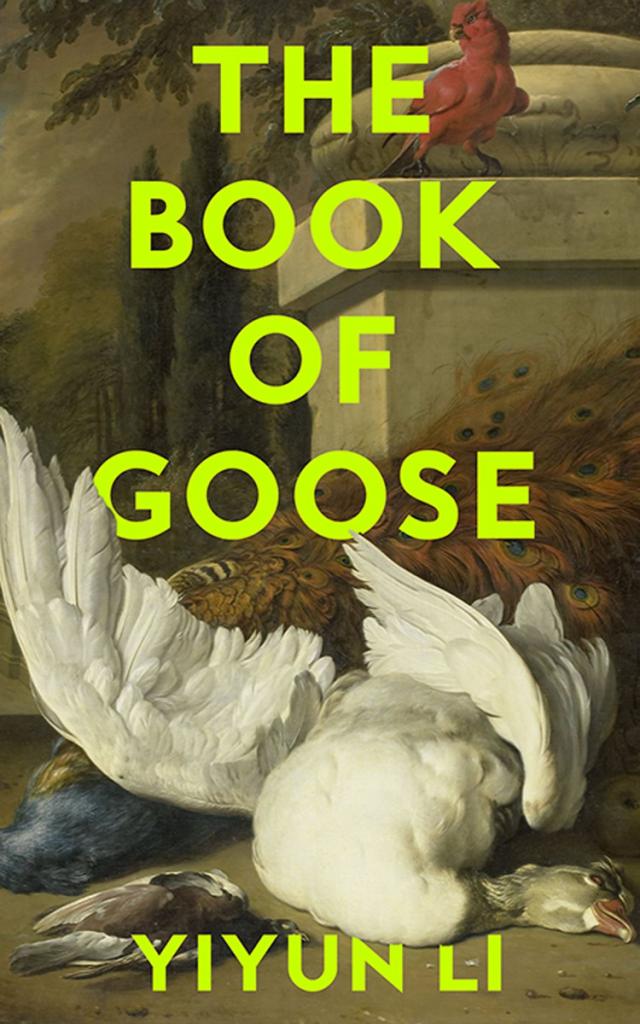
Cover image © Akg-images
Yiyun Li asserts the moral right to be identified as the author of this work
A catalogue record for this book is available from the British Library
Title page hand-lettering and chapter opener ornament by Na Kim
Designed by Abby Kagan
Information on previously published material appears here.
All rights reserved under International and Pan-American Copyright Conventions. By payment of the required fees, you have been granted the non-exclusive, non-transferable right to access and read the text of this e-book on-screen. No part of this text may be reproduced, transmitted, down-loaded, decompiled, reverse engineered, or stored in or introduced into any information storage and retrieval system, in any form or by any means, whether electronic or mechanical, now known or hereinafter invented, without the express written permission of HarperCollins
Source ISBN: 9780008531812
Ebook Edition © September 2022 ISBN: 9780008531836
Version: 2022-08-08
Dedication
For Dapeng and James
and for Vincent, a monumental child
Contents
Cover
Title Page
Copyright
Dedication
You cannot cut …
My names is Agnès …
How do you …
I did not …
Every story has …
I had some …
What’s the secret …
Why do you …
When we finished …
After the start …
When we—M. Devaux …
The way we …
M. Devaux arranged …
In Paris I …
There came a …
One afternoon, a …
Did they say …
Sometimes you hear …
In September I …
In Paris people …
After the meeting …
The night before …
M. Bazin, the photographer …
Am I making …
Some people might …
I was away …
I remember, a …
We went to …
I did not …
Jean was buried …
When M. Bazin, the …
Have you read …
The book was …
A letter arrived …
Something strange happened …
Mrs. Townsend was …
Suppose I don’t …
Mon cher Jacques …
The next day …
Au revoir, Paris …
Dusk fell earlier …
What did you …
Before I went …
The next day …
We saw the …
There were fifteen …
Next week the …
Ma chère Agnès …
The house was …
Thus began my …
Ma chère Agnès …
Three weeks after …
I see that …
That evening, Mrs. Townsend …
The weather turned …
It was around …
One day, when …
I heard you …
Mrs. Townsend gave …
Meaker lived alone …
A few days …
The next day …
That night I …
The next afternoon …
Meaker could still …
Of all the …
I wrote to …
My departure from …
My parents received …
Are you coming …
A few years …
Fabienne and I …
A year ago …
Acknowledgments
About the Author
Also by Yiyun Li
About the Publisher
YOU CANNOT CUT AN APPLE with an apple. You cannot cut an orange with an orange. You can, if you have a knife, cut an apple or an orange. Or slice open the underbelly of a fish. Or, if your hands are steady enough and the blade is sharp enough, sever an umbilical cord.
You can slash a book. There are different ways to measure depth, but not many readers measure a book’s depth with a knife, making a cut from the first page all the way down to the last. Why not, I wonder.
You can hand the knife to another person, betting with yourself how deep a wound he or she is willing to inflict. You can be the inflicter of the wound.
One half orange plus another half orange do not make a full orange again. And that is where my story begins. An orange that did not think itself good enough for a knife, and an orange that never dreamed of turning itself into a knife. Cut and be cut, neither interested me back then.
MY NAMES IS AGNÈS, but that is not important. You can go into an orchard with a list of names and write them on the oranges, Françoise and Pierre and Diane and Louis, but what difference does it make? What matters to an orange is its orange-ness. The same with me. My name could have been Clémentine, or Odette, or Henrietta, but so? An orange is just an orange, as a doll is a doll. Don’t think that once you name a doll, it is different from other dolls. You can bathe it and clothe it and feed it empty air and put it to bed with the lullabies you imagine a mother should be singing to a baby. All the same, the doll, like all dolls, cannot even be called dead, as it was never alive.
The name you should pay attention to in this story is Fabienne. Fabienne is not an orange or a knife or a singer of lullabies, but she can make herself into any one of those things. Well, she once could. She is dead now. The news of her death arrived in a letter from my mother, the last of my family still living in Saint Rémy, though my mother was not writing particularly to report the death, but the birth of her own first great-grandchild. Had I remained near her, she would have questioned why I have not given birth to a baby to be added to her collection of grandchildren. This is one good thing about living in America. I am too far away to be her concern. But long before my marriage I stopped being her concern—my fame took care of that.
America and fame: they are equally useful if you want freedom from your mother.
In the postscript of the letter, my mother wrote that Fabienne died the previous month—“de la même manière que sa sœur Joline”—in the same manner as her sister. Joline had died in 1946 in childbirth, when she was seventeen. Fabienne died in 1966, at twenty-seven. You would think twenty years would make childbirth less a killer of women, you would think the same calamity should never strike a family twice, but if you think that way you are likely to be called an idiot by someone, as Fabienne used to call me.
My first reaction, after I read the postscript: I wanted to get pregnant right away. I would carry a baby to term and I would give birth to a child without dying myself—I knew this with the certainty that I knew my name. This would be proof that I could do something Fabienne could not—be a bland person, who is neither favored nor disfavored by life. A person without a fate.
(This desire, I imagine, can be truly understood only by people with a fate, so it is a desire akin to wishful thinking.)
But you need two people to get pregnant; and then two people do not necessarily guarantee success. Getting pregnant, in my case, would involve looking for a man with whom I could cheat on Earl (then what—explaining to him a bastard would still be better than a barren marriage?), or divorcing him for a man who can sow and reap better. Neither appeals to me. Earl loves me, and I love being married to him. The fact that he cannot give me a child may be disheartening to him, but I have told him that I did not marry him to become a mother. In any case we are both realists.
Earl left the Army Corps of Engineers after we moved back from France and now works for his father, a well-respected contractor. I have a vegetable garden, which I started in our backyard, and I raise chickens, two dozen at any time. I was hoping to add to my charges some goats, but the two kids I acquired had a habit of chewing the wooden fence and running away. Lancaster, Pennsylvania, is not Saint Rémy, and I cannot turn myself back into a goatherd. “A French bride” is how I was first known to the local people, and some, long after I stopped being a new wife (we have been married for six years now), still refer to me by that name. Earl likes it. A French bride adds luster to his life, but a French bride chasing goats down a street would be an embarrassment.
I gave up the goats and decided to raise geese instead. Last spring, I acquired my first two, a pair of Toulouse geese, and this year I purchased a pair of Chinese geese. Earl read the catalogue and joked that we should go on adding American geese and African geese and Pomeranian geese and Shetland geese each year. Let’s have a troupe of international brigands, he said. But he forgot that the two couples will soon be parents. In a year I will be expecting goslings.
The geese, more than the chickens, are my children. Earl likes the geese, too, and he was the one to suggest that we give them French names. His French is not as good as he thinks, but that has not stopped him from speaking the language to me in our most intimate moments. I always speak English to the people in my American life. I speak English to my chickens and geese.
The garden produces more vegetables than we can consume. I share them with my in-laws—Earl’s parents and his two brothers and their families. They are all nice to me, even though they find me foreign, and perhaps laughable. They call me Mother Goose behind my back. This I learned from Lois, my sister-in-law, who is unhappily married and who hopes to turn me against the Barrs family. I don’t mind the nickname, though. It may be insensitive of them to call a childless woman Mother Goose, but I am far from being a sensitive or sentimental woman.
When Earl asked about my mother’s letter, I told him about the birth of my grandniece, but not the death of Fabienne. If he detected anything unusual, he would assume that another baby’s birth reminded me of the void in my life. He is a loving husband, but love does not often lead to perception. When I met him, he thought I was a young woman with no secrets and few stories from my childhood and girlhood. Perhaps it is not his fault that I cannot get pregnant. The secrets inside me have not left much space for a fetus to grow.
I was in such a trance that I forgot to separate the geese from the chickens at their mealtime. The geese had a busy time terrorizing and robbing the chickens. I chastised them without raising my voice. Fabienne would have laughed at my incompetency. She would have told me that I should simply give the geese a good kick. But Fabienne is dead. Whatever she does now, she has to do as a ghost.
I would not mind seeing Fabienne’s ghost.
All ghosts claim their phantom skills: to shape-shift, to haunt, to see things we don’t see, to determine how the lives of the living people turn out. If dead people had no choice but to become ghosts, Fabienne’s ghost would only scoff at the usual tricks that other ghosts take pride in. Her ghost would do something entirely different.
(Like what, Agnès?
Like making me write again.)
No, it is not Fabienne’s ghost that has licked the nib of my pen clean, or opened the notebook to this fresh page, but sometimes one person’s death is another person’s parole paper. I may not have gained full freedom, but I am free enough.
HOW DO YOU GROW HAPPINESS?” Fabienne asked. We were thirteen then, but we felt older. Our bodies, I now know, were underdeveloped, the way children born in wartime and growing up in poverty are, with more years crammed into their brains. Well-proportioned we were not. Well-proportioned children are a rare happenstance. War guarantees disproportion, but during peacetime other things go wrong. I have not met a child who is not lopsided in some way. And when children grow up, they become lopsided adults.
“Can you grow happiness?” I asked.
“You can grow anything. Just like potatoes,” Fabienne said.
I thought she would have given a better answer. Growing happiness on the top of a maypole, or in a wren’s nest, or between two rocks in a creek. Happiness should not be dirt-colored and hidden underground. Even apples on a branch would be better suited to be called happiness than apples in the earth. Though if happiness were like apples, I thought, it would be quite ordinary and uninteresting.
“You don’t believe me?” Fabienne said. “I have an idea. We grow your happiness as beet and mine as potato. If one crop fails, we still have the other. We won’t be starved.”
“What if both fail?” I asked.
“We’ll become butchers.”
Such were the conversations we often had then, nonsense to the world, but the world, we already knew, was full of nonsense. We might as well amuse ourselves with our own nonsense. If the thumb on the left hand got crushed under a hammer, would the thumb on the right feel anything? Why did god never think of giving people ear-lids, so we could close our ears as we shut our eyes at bedtime, or anytime when we were not in the mood for the chattering of the world? If the two of us prayed with equal seriousness but with the opposite requests—dear god, please let tomorrow be a sunny day; dear god, please let tomorrow be an overcast day—how did he decide which prayer he should honor?
Fabienne loved making nonsense about god. She claimed she believed in god, though what she meant, I thought, was that she believed in a god that was always available for her to mock. I did not know if I believed in god—my father was an atheist and my mother was the opposite of an atheist. If I had been closer to one or the other, it would be easier for me to choose. But I was close only to Fabienne. Perturbatrice of god, she called herself, and said I was one, too, because I was always on her side. In that sense we were not atheists. You had to believe that god existed so you could make mischief and upend his plans.
“If we can grow happiness, can we also grow misery?” I asked her.
“Do you grow thistles or ragworts?” Fabienne said.
“Do you mean misery grows by itself, like thistles and ragworts?”
“Or by god,” Fabienne said. “Who knows?”
“But happiness, can it grow by itself?”
“What do you think?”
“I think happiness should be like thistles and ragworts. Misery should be like exotic orchids.”
“Only an idiot would believe that, Agnès,” Fabienne said. “But we already know you’re an idiot.”
I DID NOT TELL FABIENNE then that I thought our happiness should be like the pigeons M. Devaux kept. They went away, they came back, and what happened in between was no one’s business. Our happiness should not be rooted and immobile.
M. Devaux: I should say a few words about him. He, like Fabienne, begins this story, but he was already in his sixties when we were thirteen. I suspect that he is dead now. He should be. Fabienne is dead, and he should not have more rights to life than she.
M. Devaux was the village postmaster, an ugly and sickly-looking man. Fabienne and I had paid as much attention to him as we had paid every adult, which was very little. We liked his pigeons, though. For a while we talked about keeping a pair of pigeons ourselves. One would go with Fabienne to the pasture during the day, one would accompany me to school, and they would fly over the fields and alleys, delivering our messages to each other. But the scheme, like that to grow happiness, entertained us for some days and was then replaced by a new one. We never seriously carried out any of our plans. It was enough to feel that we could, if we wanted, make things happen.
One day Mme Devaux died. She had been a robust woman, younger than her husband, coarser and louder. It was said that she had never been ill for a day in her life, until she came down with the fever. Three days and she was gone.
I do not remember if they had children. Perhaps M. Devaux could not give her a child. Earl cannot be the only man who has to endure that fate. Or their children had grown up and left the village before our time. The questions that did not occur to me to ask at thirteen feel important now. I wonder if Fabienne knew the answers. I wish I could ask her. This is the inconvenience of her being dead. Half of this story is hers, but she is not here to tell me what I have missed.
Mme Devaux was buried on a Thursday, that I remember. A funeral was not an excuse for Fabienne not to take her two cows and five goats to the meadow, or for me not to go to school. But in the evening, we went to the cemetery, looking for the freshest grave. There was more than one new grave that fall.
On the way there, Fabienne gathered some marguerites and gillyflowers and handed the bouquet to me. We were not the kind of girls who put flowers in our hair or made wreaths out of boredom, but if someone caught us wandering in the cemetery, we would say we were leaving flowers for Mme Devaux.
I do not think Fabienne explained the necessity of the flowers to me. I simply understood it. Back then we often knew what we were doing without having to talk things over between ourselves. But was it such a surprise? We were almost one person. I do not imagine that the half of an orange facing south would have to tell the other half how warm the sunlight is.
When we found the patch of fresh dirt, Fabienne took some of the flowers from me. There was a bouquet left near the wooden cross, and she scattered our flowers at the foot of the grave, one at a time. “Some flowers to hem into your robe,” she whispered. “And these are for your slippers.” I imitated Fabienne, though I did not say anything to the dead woman. We did not know Mme Devaux well. Most adults struck us as peripheral, some more annoying than others. But we liked the ceremony, the grave of a recently dead woman strewn with the more recently dead flowers.


