What's with Baum?, page 1


A POST HILL PRESS BOOK
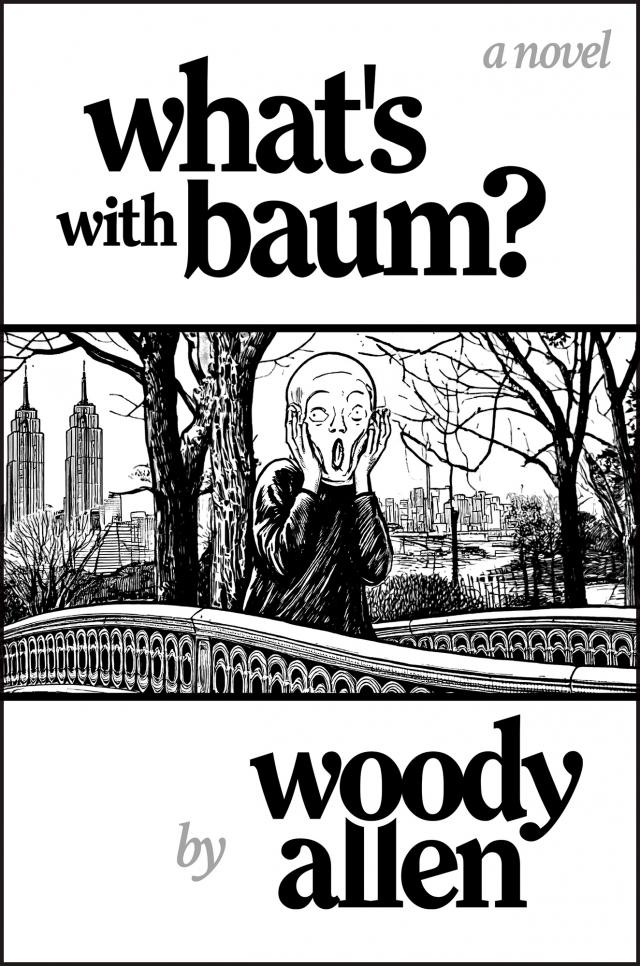
What’s with Baum?
© 2025 by Woody Allen
All Rights Reserved
ISBN: 979-8-89565-238-1
ISBN (eBook): 979-8-89565-239-8
Cover design by Cody Corcoran
Interior design and composition by Greg Johnson, Textbook Perfect
This book is a work of fiction. People, places, events, and situations are the product of the author’s imagination. Any resemblance to actual persons, living or dead, or historical events, is purely coincidental.
This book, as well as any other Post Hill Press publications, may be purchased in bulk quantities at a special discounted rate. Contact orders@posthillpress.com for more information.
No part of this book may be reproduced, stored in a retrieval system, or transmitted by any means without the written permission of the author and publisher.
Post Hill Press
New York • Nashville
posthillpress.com
Published in the United States of America
To my amazing wife Soon-Yi.
Where did you learn that?
lately Asher Baum had begun talking to himself. Not just the occasional mumbling of a man trying to clarify his thoughts or calm himself before some daunting task. Nor was he engaged in any delusional score settling with imaginary figures past or present. This would have made him bonkers or crackers which he was not. At least not yet full blown. That the conversations were a sign of early dementia was also ruled out as he was a fit fifty-one, with a sharp memory and no family history of any sort of cognitive gremlins. The only warnings from his doctors were to go easy on salt, use sunscreen and do just what he’s been doing on the treadmill. If he suffered from anything, it was hypochondriacal panic attacks where he saw the abyss in every mole, cough and hangnail. And sadly, in every song, flower and rainbow. When Baum looked in the mirror, he recognized an intelligent mutt, a mixture of his father’s sad eyes and his mother’s Semitic nose and his own anxious contribution.
His hair, which was full but incoherent, and his Foster Grant black-rimmed glasses gave him a scholarly air. If he were a movie actor he would have played shrinks, teachers, scientists or writers, the last of which is exactly what he was. In that same mirror he couldn’t help noting a few silver strands debuting here and there and saw this as a sign not of the promise of wisdom but with his luck, an aluminum walker.
As the summer wound down, Baum took to strolling around the seventy-some acres of green lawn and wild woods that surrounded the large pond fronting his and Connie’s country house, or more accurately Connie’s country house, chatting himself up on deep themes. Circling the far end of the pond where the woods began, Baum would often find himself in an intense discussion on some pressing issue. Even in the house, if no one was around, he might strike up a conversation if he felt the need to communicate, to pour his heart out. After all, who else should I talk to? he reasoned. Who else is so friendly, so congenial and perceptive, so engaged and decent? Yes, decent and most important, understanding. Who else hears me out with an open mind and a little sympathy and cares? Does anyone give a damn that I’m constantly pushing a rock up a hill? And if I ever get it up there, then what the hell have I got? A rock on a hill. Great. So why am I struggling?
Lately Baum had gotten into more and more disagreements with himself. Some rather heated. Still, he thought, who but Asher Baum can grasp the magnitude of my suffering, the scope of my concerns? Who can I bitch to that wouldn’t tune out after two minutes of my profoundest queries and not say, “Stop kvetching Asher, it’s tiresome. We have our own problems.” And yet all I’m trying to do is make lucid this minuscule slice of hysteria I routinely inhabit. Or no, maybe it’s bigger than that. Maybe what I really want is to make sense of all people’s lives. Of everything, the whole shebang.
Baum wanted in his writing to bring order to the chaos and tragic truth that seemed to cloud mankind’s every sunrise. Long ago he had declared war on Auden’s sound of distant thunder at the picnic. He believed he could best wage this battle with the human condition as a novelist by writing moving literature. These works must be great, he thought, because the night is large and the enemy is full of dirty tricks.
He decided early on he could not fight the fight as a mere journalist, reporting on the mundane ups and downs of reality. Fiction, he felt, was more real than reality, more capable of approaching the soul and getting to the truth of what the hell is going on. For Christ’s sake, who’s in charge here? He wanted his books to have an impact, to change people’s perspective, and for that he needed to get the whole thing right. He did not want to march victim-like into eternity not having left behind at least a few volumes that helped ease the way for others. He was determined his tombstone should not read: Here Lies Asher Baum—So What?
He could no longer talk to his wife. Not about the things that mattered most to him. There’s too much hostility with Connie, too much anger, too much disappointment. No more patience with my complaining, he thought. Fourteen years that began with dinner dates and flowers had through the drip, drip, drip of broken dreams and things said that could not be taken back formed a critical mass, ready to detonate. She’s five years younger than me, he figured. Still very beautiful, still desirable, still with that biting instinct for the jugular, which he once found so attractive. Of course, Dracula had a biting instinct for the jugular, but now it was Baum’s. I guess in some ways I still love that complex thoroughbred, he thought, but I certainly can’t talk to her. Not without quickly getting on her nerves. Nor can I talk to my brother Josh because he’s sleeping with her. Or has once. Or I think he has. I’m not positive. I feel our conversations have grown stilted and while I love him, I do not trust him; and because I cannot reveal my suspicions as they would hurt him, we can’t talk. I mean we can speak but not from the heart. Or at least not from my heart. Did I mention I think he slept with Connie? Yes, of course I just did. Great. All I need is to start repeating myself. That would be the icing on the cake. I also can’t talk to my first wife, Nina. Too guilty. I was such a meshugganah, and she was so nice. My first signs of irrational behavior were with Nina.
Baum had married at twenty-one, anxious to move out of his parents’ house and begin his life as a young newspaperman. He fell for a pretty Barnard student, Nina Glass, who happened to be an identical twin. Meanwhile, after two months of marriage he fell in love with the twin sister, Ann. Let’s just say a Shakespearean comedy did not follow but what did caused Nina great suffering and Baum bewilderment, guilt and self-loathing. He talked it over with an analyst who sought the answer in Baum’s dreams but what worked so well for Joseph and the Pharaoh didn’t seem to click on that couch in the little room on East Sixty-Eighth. He didn’t have any idea what had become of the Glass twins, but he knew if he ever saw either of them he would be too ashamed to speak. He had long ago given up talking with shrinks because in order for analysis to work the patient must be willing to change and the only change Baum was willing to make was the analyst.
He also could not talk to his second wife, Tyler. For one thing, she lived in New Zealand, but more important than distance, she had dumped Baum and gone off with some rock drummer who got very rich, very young, retired at thirty, bought a farm in Walter Peak Station and raised sheep. This came as a tremendous shock to Baum, and before that happened, he had only been to Payne Whitney as a visitor. He didn’t even want to talk to Tyler or ever think about her except he did sometimes, particularly on rainy afternoons.
That was it. There was no one who really understood Asher Baum except Asher Baum. No shrink, no ex, no friend, as they all seemed to have fallen away over the years. No one who made any sense except the man himself.
Now he wandered across the lawn, reached into his pocket and took out the small antique box Connie bought him, which in earlier centuries had held snuff to make some fop sneeze. What fools these mortals be, he thought. Sneezing for pleasure. Now the box held Nexium to cure his reflux, a Xanax, one Ativan. All that was missing, he joked, was a cyanide capsule.
He popped the Nexium, having just completed his stroll around the far end of the pond where he had been in a heated discussion about the poor reception his last play received. A few times he had tried his hand at drama in makeshift theaters off Broadway and found it even harder than novels. Ponderous and didactic, the press had said. The same criticism he got on his novel. Moralizing they wrote. His conclusion was that criticism, no matter how beautifully written and full of elegant-sounding insights, always boiled down to mere opinion.
He was on a roll with his writing but sadly it was a roll downhill. His last book was pretty much panned and so was the one prior—about a man and a woman who fall in love in a concentration camp, manage to carry on a passionate affair, risk death and torture by secretly meeting over and over for three years, finally to be liberated whereupon she dumps him saying, “It was fun while it lasted but you’re not really my type.” The book garnered faint praise. Very few bothered to read it and amongst those, most failed to see the satire and lambasted it for making light of the Holocaust. That was the year he tried meditation but couldn’t focus his mind on anything but his bad reviews.
Still smarting from the last conversation with himself about the demise of theater, Baum made his way back to the house, a pretty colonial style home authentically reproduced except for the large glass picture windows that would have delighted the Pilgrims if their
Baum had always hated the country, everything about it: the ticks and spiders; the racoons, cute but with rabies; the poison ivy; the sound of crickets and cicadas. He hated the isolation and the ghostly silence and dead black of the night. Yes, a Constable landscape for real took one’s breath away—for about six minutes. It was a great visit, but when the oohing and ahhing was over, it was back to civilization. Bookstores, record shops, cinemas. He enjoyed them even as they were almost all gone. But who wants to live where you need a flashlight to take a walk after dinner? True, the stars, unencumbered by Broadway’s lights were a thing to behold, sparkling in their infinite multitude, but to Baum they were terrifying. These blazing spheres of hot gas, so immense, so distant. My god, the thought of those numbers, everything measured in light years. And the whole megillah with huge hunks of rock flying aimlessly amuck in pointless violence. What is going on up there? Beseech the stars as you will, they will never grant you a single wish no matter how modest the request. Baum thought the crime and violence of the city streets was bupkis compared to what was happening in the night sky. He recalled once in a store everyone standing by impotently as thieves brazenly helped themselves while the security guard stared frozen into the barrel of one of New York’s ubiquitous Glocks. Still, in the city there’s hope and one has options. There’s people, there’s police cars, Good Samaritans, and doormen. If you’re isolated in a country house and a car pulls up at 3:00 a.m.—brother, that’s all she wrote.
Of course, all these unsettling thoughts did not trouble his wife, Connie. She was protected from anxiety by a loving childhood, good looks, and high intelligence backed up by faith in “something greater” which Baum always said was her trust fund. Watching her cool down after her morning run—a beautiful creature, tall and haughty with white skin, jet-black hair, dark eyes. Think the wicked queen in Snow White, a nasty babe but hot.
“Thane is coming for the weekend, and he’s bringing his girlfriend. I hope you’re going to join in the conversation and not tune out. I love that he’s serious about this girl.”
“Did I ever meet her?”
“You didn’t but I did. You would have if you’d have come to his book party.”
“I was running a temperature.”
“Bullshit. You’re jealous of him but you could have sucked it up for one lousy hour.”
“Connie, can we not—”
“It’s okay—subject dropped. Anyhow, she’s a lovely girl and of all the girls he’s brought home, this is the one I’d love for him.”
“Okay.”
“And on Friday there’s going to be a film crew up here. They’re doing a feature on Thane and his book. It’s caused such a sensation. Did I tell you it’s already past the thirty-five thousand mark? You realize what that is for a first novel?”
“I was planning to get some writing done this weekend. Do we really need a TV crew here?”
“Stop grumbling. They may want to interview us, so think of some nice things to say. Force yourself. And stop telling people I have a blind spot when it comes to Thane and making your unfunny Jocasta jokes.”
Connie. Constance. Connie and Thane. He loved the name Constance. It was so old-fashioned. Out of date in the freshest way. The raven-tressed eye candy of two unobservant Beverly Hills Jews. Spoiled rotten of course. Daddy the big agent, Ben Lister, and Mom, the ex-movie actress, Holly Neal. Holly was a drop-dead gorgeous starlet who never made it. Eventually she got tired of being hit on by every casting director in town, threw in the towel and got her real-estate broker’s license; she said goodbye to the movie business and sold French chateaux, Mexican adobes, and Italian villas all side by side right off Sunset Boulevard. Pushing rental homes once lived in by the likes of Clark Gable, Katharine Hepburn, maybe Esther Williams to twenty-one-year-old movie stars earning salaries with many zeroes brought in fat commissions. Peddling mansions was how she met Ben, selling him a home in Malibu with a swimming pool and tennis court.
Connie, an only child, grew up amidst the famous, kids with their theme birthday parties who watched first-run films in their parents’ screening rooms, and she hated it. She chose to move east and go to school at Harvard. She married a very successful eye surgeon in Boston, a marriage that lasted four years. Next up was the architect Philip Dunn, a neurotic genius she met in London and spent years married to in the Cotswolds. Connie loved woods and fields, thatched roofs, gardens, and brilliant men. They had a child and when the scenic designer Damian Bass, a pal of the Dunns, suggested the name Thane, they loved it. They moved to New York where she had an affair with Damian Bass that broke up her marriage, and Dunn took his quirks and tics and moved back to London while she kept the country house they had purchased some miles from Great Barrington. She remained friends with her ex despite their breakup though they almost never saw each other anymore.
Connie had a pied-à-terre in Manhattan but spent most of her time in the country. She loved the thought of being a woman married to a creative force, living in a house covered by vines and roses with perhaps a salon in her study peopled every so often by fine minds and gifted souls. She thought she might have found this inspired artist with Baum when she first met him but that is not how things went. Still, if he was a disappointment to her, the Berkshires were not. She spent the days gardening, making jewelry and socializing with friends who had first or second homes around the Lenox-Stockbridge area. She raised Thane, a sensitive child with his father’s colt-brown hair and patrician profile and his mother’s nervous intensity and passive-aggressive charm. Connie adored Thane and in his eyes she was perfection. He would do anything to please her, to win her love which he already had but nevertheless reveled in winning it over and over.
And as she dated an assortment of interesting men, it was her son’s precocious insights and youthful sophistication that commanded the biggest portion of her heart. She spoiled him as she had been spoiled, even more so as he was companionable, and she was skeptical about another marriage after two failed ones. She took Thane into the city, to films and plays, to museums and concerts. On their excursions they dined at high-end restaurants and had good chats and sometimes spoke French with each other. He loved nature in all its kaleidoscopic forms and photographed birds and had an ant farm. He read copiously, and his mother loved reading to him and for his tenth birthday bought him a hard copy edition of the Encyclopedia Britannica because it was so much more charming than the digital.
Connie, unlike Baum, had no qualms or jitters with time and space. She felt more than equal to the comets and shooting stars that scared the hell out of him and feared not the mysterious black hole that gobbled up a million suns a day, a statistic that could paralyze Baum should he pause to visualize it. One time someone gave her a magazine profile on Tadeusz Borowski that a journalist named Baum had written for a high-end intellectual quarterly. She found it brilliant, and it made her want to read Borowski’s book, This Way for the Gas, Ladies and Gentlemen. For the only time in her life, she wrote a fan letter to Baum thanking him for making her aware of the author which Baum answered politely. In reply he had recommended several other Holocaust books including one he had written. She wrote and thanked him. It would be years before their paths crossed again but when they did, stuff happened.
Now Baum watched her disappear into the house and followed along. She went upstairs to shower, and he went into the kitchen to make a cheese sandwich. He cut a piece of good Swiss from the wooden platter that had held the hors d’oeuvres she had served last night when they had Damian Bass over. Bass had long ago bought a place a few miles from her house, and he and his wife, Nora, had encouraged Connie and Dunn to consider the area around Tanglewood. Baum worried that she had never gotten over her crush on Damian Bass. She had cheated with him when she was married to Dunn so why not again? Damian had a new wife and appeared to be calmer but retained his luster. Bass was a great scenic designer, an artist by common consent and there was her weakness for creative souls. Baum wondered if they might not be occasionally canoodling behind a tree. They were, after all, neighbors. It would be very convenient. And intimacy between Connie and Baum had started to fall off two years ago, and like any falling thing, it accelerated on the way down.