

Mr Penrose, page 45


4. On the “first American novel,” see, for example, Cathy N. Davidson, Revolution and the Word: The Rise of the Novel in America (New York: Oxford University Press, 1986; 2004), chap. 5. To Davidson, who places Williams’s novel in the nineteenth century (based on the posthumous, heavily revised 1815 edition), Mr. Penrose is an example of early American picaresque. See Revolution and the Word, 169–170, 171–172. For a more recent transatlantic approach, see Melissa Homestead, “The Beginnings of the American Novel,” The Oxford Handbook of Early American Literature, ed. Kevin J. Hayes (New York: Oxford University Press, 2008), chap. 23.
5. Recent issues of PMLA have explored many of these approaches. See, for example, discussions of hemispheric studies (January 2009), oceanic studies (May 2010), and sustainability (May 2012). On the pitfalls of the nationalist “origins” model, see Ralph Bauer, “Early American Literature and American Literary History at the ‘Hemispheric Turn,’” Early American Literature 45 (2010): 217–233.
6. James Thomas Flexner, The History of American Painting. Vol. 1: First Flowers of Our Wilderness (New York: Dover, 1969), 180.
7. E. P. Richardson, “William Williams-- A Dissenting Opinion,” American Art Journal 4 (1972): 17; John Eagles, “The Beggar’s Legacy,” Blackwood’s Edinburgh Magazine 77 (March 1855): 267–268. For more on Williams, West, and the “problem of chronology,” see Dickason, William Williams, 7–52.
8. Dickason, William Williams, 78–99.
9. The inflammatory name of the War of Jenkins’ Ear alludes to an earlier incident in which a Spanish officer severed the ear of an English captain in the West Indies whom he suspected of piracy. The War of the Austrian Succession was known as King George’s War in the colonies. See Eric Nellis, An Empire of Regions: A Brief History of Colonial British America (Toronto: University of Toronto Press, 2010), 201–203 and J. H. Elliott, Empires of the Atlantic World: Britain and Spain in America, 1492–1830 (New Haven, CT: Yale University Press, 2006), 233.
10. Daniel K. Richter, Facing East from Indian Country: A Native History of Early America (Cambridge: Harvard University Press, 2003); Mary Louise Pratt, Imperial Eyes: Travel Writing and Transculturation (London: Routledge, 1992; 2008), 35–36. On Spain’s efforts to tighten its control, see Baron L. Pineda, Shipwrecked Identities: Navigating Race on Nicaragua’s Mosquito Coast (New Brunswick, NJ: Rutgers University Press, 2006), 48.
11. Pineda, Shipwrecked Identities, 22, 27–29, 46; Elliott, Empires of the Atlantic World, 98. Columbus, whose New World adventures ignited the Amerindian slave trade, visited the Mosquito Coast on his fourth voyage (1502). Forty years later, the Dominican friar Bartolomé de las Casas estimated that the Spanish had transported 500,000 Indians to Panama and Peru. Although Spain officially outlawed the Indian slave trade in 1542 (largely in response to Las Casas’s A Short Account of the Destruction of the Indies), the capture and sale of Amerindian slaves continued through most of the nineteenth century.
12. Pineda, Shipwrecked Identities, 36, 53–54. See also Linda A. Newson, Indian Survival in Colonial Nicaragua (Norman, OK: University of Oklahoma Press, 1987).
13. Nellis, Empire of Regions, xx. See also Andrew Jackson O’Shaughnessy, An Empire Divided: The American Revolution and the British Caribbean (Philadelphia: University of Pennsylvania Press, 2000), chap. 1–2.
14. For a relevant discussion of piracy, ethnicity, and “motley crews,” see Peter Linebaugh and Marcus Rediker, The Many-Headed Hydra: Sailors, Slaves, Commoners, and the Hidden History of the Revolutionary Atlantic (Boston: Beacon Press, 2000), chap. 5–7.
15. According to what Pineda terms the “shipwreck theory,”
The shipwreck of a slave ship in the area of the Mosquito Keys in the 1640s is presumed to have begun a long-term migratory trend in which escaped slaves of African descent trickled into the Mosquito Coast. This trend ultimately resulted in the rise of the Miskito as a new ‘raza mixta’ (mixed race) or ‘hybrid’ Indian group (34).
16. Olaudah Equiano, The Interesting Narrative of the Life of Olaudah Equiano, Written by Himself, 2nd ed., ed. Robert J. Allison (Boston: Bedford / St. Martin’s, 2007), vol. 2, chap. 11.
17. John Holm, “An 18th-Century Novel from the Miskito Coast: What Was Creolized?” Paper presented to the Meeting of the Society for Pidgin and Creole Linguistics (Accra, Ghana, Aug. 3–5, 2011), 20.
18. The art historian E. P. Richardson speculated, “Perhaps Williams had first wished to be remembered as a writer and on second thought deemed more memorable his career as a painter.” See Richardson, American Paintings and Related Pictures in the Henry Francis du Pont Winterthur Museum (Charlottesville, VA: University Press of Virginia, 1986), plate 39. To the art historian Susan Rather, the x-ray photographs “[show] him holding what appears to be a book in his left hand while draping his right arm over the back of a chair” (840). See Rather, “Benjamin West’s Professional Endgame and the Historical Conundrum of William Williams,” William and Mary Quarterly 59 (2002): 840, 842n45.
19. The phrase “scholar adventurer” comes from Richard D. Altick, The Scholar Adventurers (New York: MacMillan, 1950). For a useful (but dated) survey of Williams’s surviving paintings, see Dickason, William Williams, 138–180 and 207–217.
20. Holm, “An 18th Century Novel from the Miskito Coast,” 20. Holm finds in Mr. Penrose “what a creolist can hardly hope for”--”dialogue in the local vernacular that was still undergoing restructuring.” Based on close textual analysis, Holm has identified “evidence … [to] confirm that the contact [depicted in Mr. Penrose] was in fact with the Rama and Miskito of Nicaragua’s Caribbean Coast.” This evidence “includes words from Rama, Miskito, Spanish and African languages and phrases suggesting convergences with Creole structures” (1). For further information, see John Holm, The Creole English of Nicaragua’s Miskito Coast: Its Sociolinguistic History and a Comparative Study of Its Lexicon and Syntax (Ph.D. dissertation, University College, University of London, 1978).
21. As Laura Brown has argued, “The female figure, through its simultaneous connections with commodification and trade on the one hand, and violence and difference on the other, plays a central role in the constitution of this mercantile capitalist ideology” (3). See Brown, Ends of Empire: Women and Ideology in Early Eighteenth-Century English Literature (Ithaca, NY: Cornell University Press, 1993).
22. Pratt, Imperial Eyes, 84–85.
23. Readers of Pratt’s Imperial Eyes may find elements of what she terms the “anti-conquest” in Mr. Penrose. As Pratt relates, however, in anti-conquest narratives, “‘cultural harmony through romance’ always breaks down,” and the “outcomes” follow a predictable pattern: “the lovers are separated, the European is reabsorbed by Europe, and the non-European dies an early death” (95).
24. As Barbara Harrell Carson argues, Mr. Penrose demonstrates “the capacity of the natural world of the Americas to stimulate moral and spiritual growth in the attentive observer” and effect “the familiar American transformation: a developing sense of ‘psychic at-homeness’ in an alien environment.” See Barbara Harrell Carson, “‘I have heard [ … ] things Grow’: Uses of Nature in William Williams’s Colonial Novel,” ISLE: Interdisciplinary Studies in Literature and Environment 17 (2010): 495, 486.
25. Carson, “‘I have heard [ … ] things Grow,’” 20n8, 5. According to J. H. Elliott, Williams’s portraiture imitates European models. See Empires of the Atlantic World, plate 33. On Williams’s “picture … on the subject of Penrose,” see Dickason, William Williams, 48. Note also the opening of Chapter 16 of Mr. Penrose, in which Penrose imagines the scene as an “Ingenious Artist” might depict it.
26. Pratt, Imperial Eyes, 35–37.
27. Pratt, Imperial Eyes, 38; Carson, “‘I have heard [ … ] things Grow,’” 7.
28. Pratt, Imperial Eyes, 30; Karl H. Offen, “Creating Mosquitia: Mapping Amerindian Spatial Practices in Eastern Central America, 1629–1779,” Journal of Historical Geography 33 (2007), 264, 280–281.
29. Pratt, Imperial Eyes, 30. I borrow the term “creole ecology” from J. R. McNeill, Mosquito Empires: Ecology and War in the Greater Caribbean, 1620–1914 (Cambridge: Cambridge University Press, 2010). On the “chain of ecological events” resulting from these new “pressures on the environment,” see Carson, “‘I have heard [ … ] things Grow,’” 17–18.
30. Offen, “Creating Mosquitia,” 266. For relevant discussions of “Indian sagacity” and “topographies of slave knowledge,” see Susan Scott Parrish, American Curiosity: Cultures of Natural History in the Colonial British Atlantic World (Chapel Hill, NC: University of North Carolina Press, 2006), chap. 6–7.
31. Lawrence Buell, The Environmental Imagination: Thoreau, Nature Writing, and the Formation of American Culture (Cambridge, MA: Harvard University Press, 1995), 7–8.
32. See Timothy Sweet, “Projecting Early American Environmental Writing,” American Literary History 22 (Summer 2010): 425–428 for a relevant discussion of biogeography; on the domestic and georgic traditions, see Annette Kolodny, The Land Before Her: Fantasy and Experience of the American Frontiers, 1630–1860 (Chapel Hill: University of North Carolina Press, 1984) and Sweet, American Georgics: Economy and Environment in Early American Literature (Philadelphia: University of Pennsylvania Press, 2002), respectively.
33. For Dickason’s theory of the novel’s composition dates, see William Williams, 74–75.
34. See Wallace Brown, “The Mosquito Shore and the Bay of Honduras during the Era of the American Revolution,” Belizean Studies 18 (1990), 43–71. On the long-range consequences of “dislodging the US experience from a central position of normativity” in hemispheric scholarship (226), see Bauer, “Early American Literature,” 220–226.
Contributors
WILLIAM WILLIAMS (1727–1791) was a professional painter and landscape artist who tutored a young Benjamin West. Williams primarily resided in Philadelphia and New York and is thought to have substantially completed Mr. Penrose shortly before the Revolutionary War.
DAVID HOWARD DICKASON (1907–1974) was Professor of English at Indiana University and a specialist in American literature. He recovered William Williams’s original manuscript, which is now housed at Indiana University’s Lilly Library.
SARAH WADSWORTH is Associate Professor of English at Marquette University. A specialist in eighteenth- and nineteenth-century American literature, book history, and children’s literature, she is author of In the Company of Books: Literature and Its “Classes” in Nineteenth-Century America and (with Wayne A. Wiegand) of Right Here I See My Own Books: The Woman’s Building Library at the World’s Columbian Exposition.
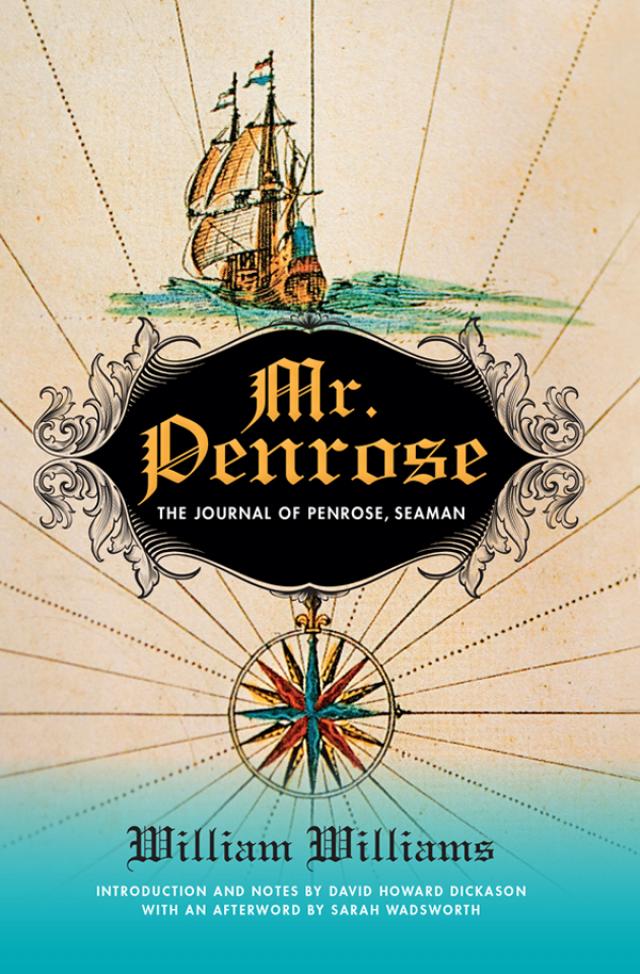
William Williams, Mr Penrose





