

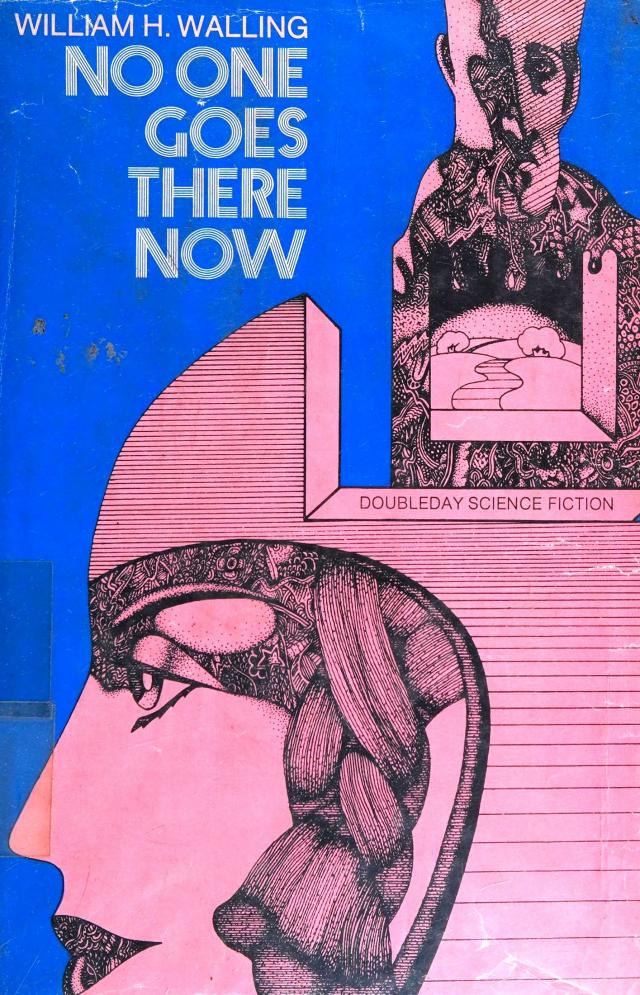
No One Goes There Now, page 1


15-09-2023
The planet Dan is the prize of the scant few dozen habitable worlds discovered by the inhabitants of Earth in hundreds of years of exploration. The planet is green and lovely, and the Danii are quiet and thoughtful, not revealing themselves at first, but preferring to watch and wait as colonization begins in earnest.
And it is a truly strange culture that begins to develop before them. For human society, still recovering from the interplanetary warfare of 500 years before, has approved the Code Duello as the behavioral norm of Earth’s elite. Under this archaic rule nobles slice it out with swords at imagined slights, ladies ooh and ah, and revival is possible, although almost never requested, in the event of demise—all to bind the aggressive instinct.
All of this the Danii observe in mute horror, disapproving of violence in any form. And when the day comes that they begin to make their displeasure known, the means that they choose provides a chilling and ironic climax that raises several provocative questions about man’s real place in the eternal scheme of things.
NO ONE
GOES THERE
NOW
William Walling
DOUBLEDAY & COMPANY, INC.
GARDEN CITY, NEW YORK 1971
All of the characters in this book are fictitious, and any resemblance to actual persons, living or dead, is purely coincidental.
LIBRARY OF CONGRESS CATALOG CARD NUMBER 71-150923
COPYRIGHT © 1971 BY WILLIAM WALLING
ALL RIGHTS RESERVED
PRINTED IN THE UNITED STATES OF AMERICA
FIRST EDITION
Contents:-
PROLOGUE
I
II
III
IV
V
VI
VII
VII
IX
X
XI
XII
XIII
XIV
XV
EPILOGUE
NO ONE GOES THERE NOW
PROLOGUE
He had waited through bright morning, glossy midday, and through the long, solemn afternoon with what he himself considered dutiful patience. But at last, boredom and a gnawing sense of uneasiness having conspired to undermine hitherto unshakable faith in the elder’s precognitive powers, Polct the younger felt his resolve not to be bothersome weaken into indecision. He waged silent battle with himself until, inevitably, curiosity won.
Squelching any lingering doubt, he dipped surreptitiously into the surface ripple of his companion’s thoughtstream, sorting the swirl of color, comparing the elder’s fleeting mental images with his own sense impressions.
Swollen and round on the far horizon, a sun the color of warm blood etched frothy whorls of saffron and bronze in a bank of receding thunderheads. Clear rust-colored light, plying deftly through a thrust of enormous trees bordering the glade, cast lengthening shadows over lush meadowland pocked here and there with hummocks of dark loam unearthed by timid, burrowing creatures. Pendant foliage, wax-green and dewy, returned a sea of glistening highlights, and one flashing cameo evoked a brief thrill of pleasure: a single grass-blade bowed by a raindrop diamond.
Polct learned little from his anxious prying. The elder’s true consciousness, he knew, still ranged the arching sky above them which remained immaculate, rain-washed—and quite empty.
With supposed finesse, he disengaged his mind and, frustrated, reflected upon the wisdom of disturbing the elder. Determined, but uncomfortable, he directed a tentative thought.
The afternoon wanes.
Polct waited. Only chill mental silence rewarded him.
It will he night here soon, he observed timidly.
Long aware of the intrusion, though reluctant to abandon the approaching confluence of events he had been laboring to integrate, Tanis the elder raised one pipestem appendage toward the flaring sunset. Attune thy senses, young Polct! he chided. Even a babe might form predictions about such fiercely living egos as these! You sense nothing?
My ineptness mortifies, admitted the chastened Polct.
The elder regarded his companion for a long, silent moment. But, impending change is all but upon us!
Change for good or …ill? quavered Polct.
Hardly an apt topic for contemplation, mused the elder. We shall act as but poorly endowed pawns in this coming en counter. Assessing abstractions like good and evil will remain the province of Higher Ones.
My ignorance is insurmountable, evaluated Polct glumly.
As may be. The elders manner became more amiable. Be not overwrought, however. Your anxiety is well predicated, though undigested, sorely misconstrued. Perturbation comes from without, not from within. Savor the tensions; follow them to their source. One cannot help sensing wildness, a drive . …
I do sense it, O Tanis. What shall be done?
Done? Emergent species are inherently unpredictable. We shall cope with them, since cope we must; cherish them, guide them should they stoop to invite our humble guidance. With the aid of Higher Ones we shall accomplish much. blow abide with me, counseled Tanis. Let us pursue the matter together.
Erect in the gathering dusk, Polct mulled the elders wisdom as, side by side, they searched the fading sky.
In deeper twilight their vigil was rewarded. A gleaming pearl swept high across the southern heavens to vanish, silent as dust, behind the magnificent trees. If either watcher sensed the alien passage, he refrained from comment.
Time passed. The forest began to speak with hushed chitterings, the whirr of nocturnal flying insects. Crisp air grew translucent; little by little faint pinpricks of emerging stars gave suggestion of the looming galaxy beyond the atmosphere.
At last the intruder reappeared at the zenith—a snick of violet light which swelled rapidly into a roaring, apocalyptic jet of fire. White sound inundated the meadow.
The exhaust cone touched, splashed on moist turf, sputtered and winked out. Reverberations chased one another in diminishing volleys across the glade to the perimeter of trees as, slowly, the forest trembled into hushed and unnatural stillness.
The afterglow dwindled along the horizon. Unfamiliar constellations wheeled over a hulking, ogive shape silhouetted among trees swaying in the night wind as if to withdraw from the uninvited presence.
Polct’s parting thought bristled excitement. They are cornel
Aye, they are come, echoed the elder calmly.
Polct and Tanis abruptly disappeared. The meadow lay sighing and empty as deep night engulfed the world of Dan.
I
Ecce Homo lnvictus
First inscribed upon the medallion of
the Congress of Man a.d. 3794 (old style).
Holt Morrow paused at the foot of the ship’s ramp and concentrated on movement—any sort of movement. Amplified birdsong rang in the headphones of his pressure suit; a few wisps of downy, femlike growth stirred here and there under a breath of vagrant air. But that was all. The broad meadow seemed innocent of anything inimical.
He began to move forward away from the pinnace, reflexes at hair-trigger, energy rifle at high port, churning metaled boots through the early dew and squinting into the sunny sparkle of morning. Despite the clumsy pressure suit, he bore himself erectly, like an athlete. But deep crow’s-feet gathered at the corners of his heavy-browed, narrowed eyes; his leathery cheeks formed a patina of broken venules.
Satisfied at last, the man leaned his weapon butt-downward against the bulbous knee of his suit and, rough-chiseled features split in a homely grin, waved a benediction to the forest. He keyed the helmet transmitter with his grizzled chin.
“Out, come out wherever you are,” he sang. “Looks like prime real estate.”
The ship’s main hatch rumbled open. Two dozen armored shock troops spilled down the ramp and quickly interdicted the pinnace, facing outward twenty meters beyond Morrow who watched them deploy with an idle, cynical expression. He undipped the dogs of his headpiece, cracked the seal with obvious unconcern, breathing shallowly, savoring the tang of clean, un- regenerated air, and began to shuck off the dull black pressure suit with a wriggling ease that suggested much practice.
He sat on the turf, unzipped his boots, stripped off heavy sweatsocks and rolled sidewise out of the suit, moving his bare feet ecstatically through the still-damp grass, watching the procession of approaching explorers without discernible emotion.
Commander Roberts, suited as had been Morrow himself in aristocratic black armor—an unspoken announcement of his legitimate descent through not less than nine centuries of pure, unmutated Human stock—was trailed by First Officer Ennis Ladeen, a cybernetics officer herding a pair of audiovisual robots, and two jittery medics in gray-green p-suits who did everything but cling to one another for comfort. The expedition’s chief scribbler, whom Morrow could see talking into a recorder as he walked, brought up the rear.
As he had known they would, the medics quickly confronted Holt as he lolled unprotected on the turf, lips working, arms flailing. But Morrow could hear only a confused buzz emanating from the p-suit’s fishbowl laying beside him on the grass.
Commander Roberts’ rather large mouth drooped in a frown of mild annoyance. His gauntlet dropped to an external speaker control at his belt. “You were somewhat hasty, were you not?”
“Aw, there ain’t nothing scary on this pretty lump of mud,” observed Morrow with complete assurance.
“Hereafter, please do as the surgeon suggests!” A hint of frost crept into the commander’s diction. “Bei
Morrow grumbled something about being revived dozens of times. A sharp look from Roberts silenced him. “I’ll be careful, doc,” he appeased. *
The Giver of Life glowered, returned to his companion with an outraged headshake, and followed him back toward the relative safety of the pinnace.
“Well, it certainly looks a’promise,” speculated Ladeen, eyeing the gargantuan trees.
“The preliminary digest was exemplary,” conceded Roberts. “The survey party published an excellent spaceside report on the entire system. Four looks worthwhile, too; it needs atmosphere, ecology, and so on, of course. The others will want six or seven Earth cycles—years—of intensive effort before reaching stage-one feasibility.
“But this one appears to be an authentic gem. How shall we begin? Suggestions?”
“Let’s have POLLY read the immediate area,” urged the cyberneticist, “then send GEG north along this big valley. I’d also like to do an archimedes search spiral from the air when this site’s secure.”
“Very well.” Roberts pursed his lips. “Ennis, perhaps we will move the picket line out another thirty meters or so to give ourselves elbow room.”
Ladeen nodded and turned away to give the orders.
“And Ennis,” Roberts called after him, suit to suit, “please post yourself on security watch in the pinnace until after first report.”
“Aye, ser Roberts.” Ladeen hurried off.
“It’s a damned nice looking lump, all right,” commented Morrow, almost to himself.
Roberts was cool. “Beautiful, though why you should want to spoil it for us with that ridiculous performance is bewildering. I should hate to lose you over something silly, Holt. We’ve voyaged together too long.”
Morrow scuffed his big toe through the grass like a petulant boy. “There’s, uh, nothing dangerous in this garden.”
“Umm-m-m, curious manner in which you chose to prove it!”
. “Aw, don’t be crotchety—”
“Holt,” emphasized the commander, “we have seen something of the galaxy together—pretty places, like this, and others not so pretty. None are alike, yet all share one aspect: the presumption of danger is universal!”
“Yeah, but I wanted a breath of fresh air—”
“Most,” pursued Roberts relentlessly, “turn out to be innocuous, true; empty vessels needing but the touch of a friendly hand. We scrape them, wean them, water them and make them fruitful, then swarm in, breeding and fighting and shortly—very shortly—asking for yet more living space.”
“Recollect the real-estate deal we turned on Arcania?” reminded Holt. “I seem to recall you being there.”
“How many, many real-estate deals we have consummated,” mused the commander, thinking wistfully of the wildernesses and dreary vacuum where most of his long life had been spent. He turned abruptly. “No, my impulsive friend; you shall not change the subject!”
Holt wilted under the almost hypnotic gaze. “This lump’s special,” he said plaintively.
“Special? Perhaps it is especially dangerous!”
Morrow denied it with a toss of his head. “Naw, this one’s a grassy-green garden; a beautiful lump floating way out here away from the noise and the crush. Spooky, too! I’ve got the craziest notion I’ve been here before and just now come back again. I’m almost sorry they found it!”
“Déjà vu.”
“Come again?”
“It’s a psychological trick the subconscious never tires of playing,” explained Roberts. “Your ‘pretty lump’ is that magic land of false memory. I feel it myself.”
“That so? Well, whatever it’s called, I’ve got a dose!” Commander Roberts appraised the stir of activity. He clapped Holt roughly on the shoulder with his black gauntlet. “Come, you must do penance.”
“For instance?” chuckled Morrow.
Roberts moved to a large gray console floating clear of the turf. “Since you’re barred from the pinnace for a decent quarantine period anyhow, we may as well put you to work.” With his slender hand, he covered a photosensitive amber plaque marked “Log,” actuating a parastatic switch having no moving parts whatsoever. The plaque glowed green; die word “Record” lighted obediently. “Ser Morrow,” he declared formally, “you will direct the preliminary survey. Observe and record all natural phenomena within a radius of twenty kilometers.
“You will maintain audiovisual contact with the pinnace at all times…
His orders continued as the red star dried the dew on the guardian trees.
* * *
Ten revolutions of the planet Dan—ten “periods” in the non-Earth-oriented parlance of the Terrestrial Imperium, where “day” and “year,” or cycle, were restrictive archaisms, sloppy terms used only by backward rustics—produced little change in the great meadow. A cluster of metal domes housing the command center now gleamed like anodized mushrooms against the darker forest, while four of the squat shuttles pointed accusingly at a single patrol aircar orbiting monotonously a thousand meters overhead.
All of the activity was elsewhere. Roving specialty teams systematically took the planet’s pulse; cartographic survey units mapped the five major land masses from the air. The interstellar cruiser, shifting to a polar orbit, proceeded to cut one orange, slice of terrain after another, recording photographic, infrared, and electromagnetic surface detail. Botanists and biologists roamed the forests and deserts. Topographers invaded the high plateau west of the landing site.
All assorted data, assimilated by the command center, was sorted and inputted to vast memory banks for storage and eventual incorporation into the expedition’s stage-one report.
The explorers played as hard as they worked—rock-climbing in the high country, shooting rapids in the white water of a dozen streams, taking panoramic stereographs of Dan’s shimmering landscapes, to the disgust of the inevitable handful of painters. And there were many bouts at swords in the natural, grassy amphitheater before the command center, with the expedition’s untied women offering themselves as prizes.
But it was fencing, not dueling; done in the spirit of competition, but lacking the rigid formality of grievance which Convention would have forced within the ever expanding sphere of Human civilization.
Explorers, feeling themselves beyond the jurisdiction or influence of the swarming masses in whose name they searched the skies, gave little thought to civilization, nor had they much patience for its exacting, inescapable Convention. Not that there was anything wrong with swordplay or with upholding one’s dignity. On the other hand, dueling for dueling’s sake was very uncommon within the tight, close-knit brotherhood formed by explorers all around the frontier. They lived too close to elemental outworld dangers to require artificial stimulation, or to waste time on the synthetic posturings and intrigues of Code Duello.
To most of them, Convention smacked of fraud—a reflexive fraud which had been palmed off on those same, naive Human masses as their own idea. Explorers were convinced they knew the truth: Convention in general, and Code Duello in particular, had been fostered and encouraged by the Planners as a substitute for organized warfare, as a very convenient method of helping control cancerous overpopulation, and as a simple method of instilling some sense of chivalry and nobility in the low-born Human animal, of lending some smatch of aristocratic noblesse to otherwise drab pedestrian lives.
At hour fifteen, his neck aching from hours of staring into communications tanks, Commander Roberts began to think about turning the board over to a subordinate for a shower and a stroll in the woods. Before he could get away, Holt Morrow hailed him.
“Hey, Commander, got a minute? This jonny says it’s urgent!”


