

Wolf Legion, page 1


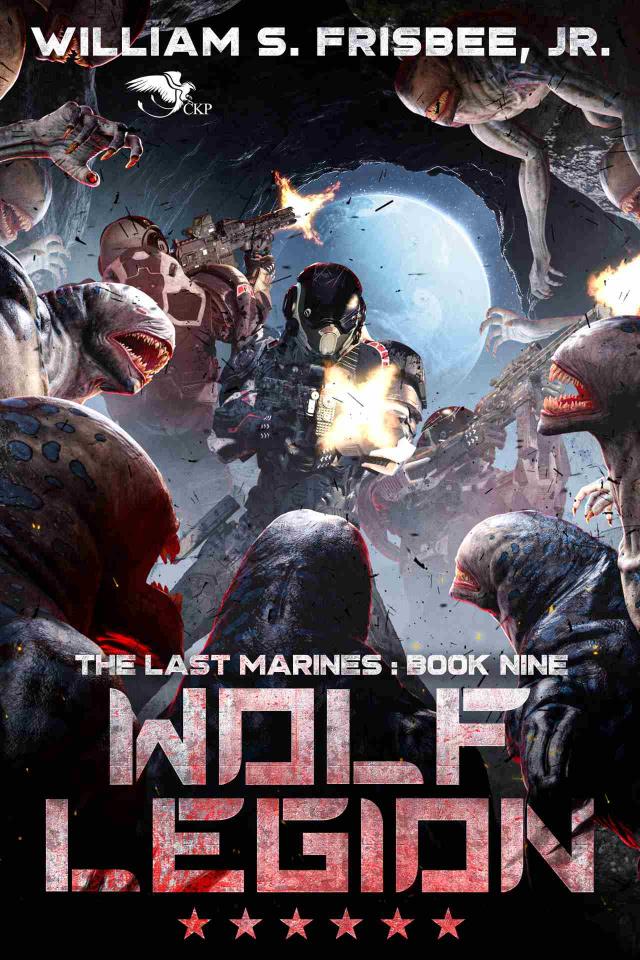
Wolf Legion
Book Nine of the Last Marines
By
William S. Frisbee, Jr.
PUBLISHED BY: Theogony Books
Copyright © 2024 William S. Frisbee, Jr.
All Rights Reserved
* * * * *
Get the free Four Horsemen prelude story “Shattered Crucible”
and discover other Theogony Books titles at:
http://chriskennedypublishing.com/
* * * * *
License Notes
This ebook is licensed for your personal enjoyment only and may not be re-sold or given away to other people. If you would like to share this book with another person, please purchase an additional copy for each recipient. If you’re reading this book and did not purchase it, or it was not purchased for your use only, then please purchase your own copy. Thank you for respecting the hard work of this author.
This book is a work of fiction, and any resemblance to persons, living or dead, or places, events, or locales is purely coincidental. The characters are productions of the author’s imagination and used fictitiously.
* * * * *
Cover Design by J Caleb Design.
* * * * *
Contents
Chapter One: Musashi
Chapter Two: Fleet Operations
Chapter Three: The Surge
Chapter Four: Infiltration
Chapter Five: Data Rape
Chapter Six: The Flagship
Chapter Seven: Prisoner or Guest
Chapter Eight: Ninth Company
Chapter Nine: Losing Earth
Chapter Ten: Rescue
Chapter Eleven: The Stand
Chapter Twelve: Ogres
Chapter Thirteen: The Return Flight
Chapter Fourteen: Date with Hakala
Chapter Fifteen: The Club
Chapter Sixteen: Terrorists
Chapter Seventeen: Foiled
Chapter Eighteen: Rebellion
Chapter Nineteen: Post Attack
Chapter Twenty: Gaufrid
Chapter Twenty-One: Prisoners or Guests
Chapter Twenty-Two: History
Chapter Twenty-Three: Fleet Admiral
Chapter Twenty-Four: Advancing
Chapter Twenty-Five: Haberdash
Chapter Twenty-Six: Return to the Romach
Chapter Twenty-Seven: Return to Valakut
Chapter Twenty-Eight: Nova
Chapter Twenty-Nine: Aod Departure
Chapter Thirty: Tomb Worlds
Chapter Thirty-One: Torag Guests
Chapter Thirty-Two: Bashaka-ta
Chapter Thirty-Three: Fourth Planet
Chapter Thirty-Four: Snow and Ash
Chapter Thirty-Five: Redirected
Chapter Thirty-Six: Into the Artifact
Chapter Thirty-Seven: Hungering
Chapter Thirty-Eight: Invasion
Chapter Thirty-Nine: Ancient Tomb
Chapter Forty: Fighting
Chapter Forty-One: Rescue
Chapter Forty-Two: Death of the Romach
Chapter Forty-Three: Survivors
Chapter Forty-Four: Escape to Space
Chapter Forty-Five: Enemy SCBIs
Chapter Forty-Six: Retreat
Chapter Forty-Seven: Reinforcements
Chapter Forty-Eight: Invasion
Chapter Forty-Nine: Inconvenience
Chapter Fifty: Guerrilla
Chapter Fifty-One: Speech
Chapter Fifty-Two: Mister Punchy
Chapter Fifty-Three: Stathis
Chapter Fifty-Four: Fighters
Chapter Fifty-Five: Messages
Chapter Fifty-Six: Squadrons
Chapter Fifty-Seven: Talking to the Enemy
Chapter Fifty-Eight: Birds
Chapter Fifty-Nine: Diversion
Chapter Sixty: Breakthrough
Chapter Sixty-One: The Emperor
Chapter Sixty-Two: Ambushed
Chapter Sixty-Three: Proposal
Chapter Sixty-Four: Away
Chapter Sixty-Five: Escape
About William S. Frisbee, Jr.
Excerpt from Book One of the Revelations Cycle:
Excerpt from Book One of The Prince of Britannia Saga:
Excerpt from Book One of The Sergey Chronicles:
Excerpt from Book One of the Abner Fortis, ISMC:
* * * * *
Chapter One: Musashi
Sergeant Nova Dallas, ODT
Dallas followed Major Yang off the shuttle into the cavernous shuttle bay. The Musashi was a massive ship, over four kilometers in length, and the mobile headquarters of the war command fighting the Torag. There were no larger ships in human space. Some claimed the Vapaus Republic space pirates had bigger ships, but could you really call an asteroid with weapons bolted onto it a ship? The Musashi was the only super dreadnought in existence and two lesser dreadnoughts and a host of battleships, destroyers and battle cruisers usually protected it, though she hadn’t seen them on approach. Not a surprise. They would be spread out, the distance making them invisible to the naked eye.
If the Musashi was in orbit, then the Torag didn’t dare try anything. The Goshkak Torag battleship squadron stationed in the system wouldn’t dare approach Valakut. Intel said the Goshkak squadron never left the system. It just lurked in the outer system where they likely had a base. But that was a Fleet problem. Four battleships couldn’t threaten the mighty Musashi or her escort.
She followed her commander as they made their way to some ODT briefing rooms. There was a short regiment of ODTs aboard the Musashi, two battalions and a heavy support battalion of gunships and missile batteries. The Musashi could house a lot more, but she rarely kept her bays full.
In the briefing room, she took her seat as Major Krakow entered and moved to the head of the table. He placed a small box the size of a medicine bottle on the table.
“Sol has declared the Stalingrad Protocol,” Krakow said with no introduction. Dallas had seen him before. He looked tired. He had bags under his red eyes and it looked like he had slept in his uniform. He didn’t start with his usual prattle about the glories of the Governance and how the war against the Torag was going exceptionally well because of the valiant troops. His abrupt announcement was like a splash of cold water in the face.
What did that mean? Would there be no more reinforcements? Why would the Central Committee do that? Were the Vapaus pirates preparing for an assault? Had the Torag discovered the home world?
Krakow sat in his chair and looked at the regimental intelligence team. Dallas wasn’t near him, but she caught a whiff of vodka. Had Krakow been drinking?
“This,” Krakow said, pointing at the small device, “may save us.”
“What is going on?” Yang asked. “Have you been drinking?”
Krakow turned bloodshot eyes toward Yang.
“You don’t know what I do,” Krakow said and a chill went down Dallas’s spine. “I’m going to tell you. From this day forward, you will not sleep well. It is bad enough that we have survived to watch humanity die.”
“Make some sense, fool,” Yang demanded. “You should return to your quarters and sober up. I will report this indiscretion to your commanding officer.”
“Go ahead,” Krakow said. “He’s less sober than I am.”
Everyone stared at Krakow.
“It was a risk coming here,” he said. “We have returned from a Torag world; the name or location doesn’t matter. The Torag are dying too, might already be dead. Hopefully, the Stalingrad Protocol will save our race.”
“Enough of this shit,” Yang said. “Tell us what is happening.”
“Monsters from Shorr space have come to our galaxy. Ships in Shorr space are being attacked, the crews killed or changed. A courier from the Zhukov Fleet came to us last week. They showed us what happened there. We’re still pouring through the video footage and reports. It was horrifying. That courier also gave us a technology called ‘Inkeri’ which may help protect us. But…”
“But?” Yang prompted.
“It may be too late,” Krakow said. “These monsters—they are calling them vanhat—are growing in strength. They have captured several of our warships, and their forces are continuing to grow.”
“Doesn’t this Inkeri protect us?” Yang asked.
Krakow’s laugh was slightly manic.
“We don’t have many of them yet, but it does keep us from changing into one of them,” Krakow said. “A missile will kill us just the same. Shorr space is dangerous. Our escorts did not survive.”
“You are drunk,” Yang said, standing up. “You don’t know what you are talking about. It appears the discipline aboard the Musashi has deteriorated. You should be ashamed of yourself.”
Krakow laughed, and Dallas heard a touch of madness there.
A siren sounded.
“All hands, general quarters,” the intercom announced. “All hands, general quarters. Prepare for hard maneuvers.”
“They are coming,” Krakow said, his laughter turning to tears.
“Who is coming,” Yang asked.
A notification appeared in Dallas’ cybernetic display, showing her the path to the nearest crash couch where she could survive high-gravity maneuvers. She slipped on her helmet and the rest of Yang’s staff did the same.
“We should have had more time,” Krakow said as he pulled himself to his feet. “How did they follow us so quickly? Damn them.”
“Who?” Yang yelled.
“The vanhat. They have alread
“You’re insane,” Yang said, slipping on his own helmet.
“I wish,” Krakow said sinking back into his seat. “I have heard the whispers. The old gods are returning, and they are angry.”
Yang looked like he wanted to say more but headed out the door. His crash couch would be closer than the enlisted. Dallas knew she had to hurry. A chill ran down her spine, and she had a bad feeling, the kind of feeling that had preceded the death of her brothers and sisters.
Dallas, sergeants Iris Miller, Remi Hughes and the others sprinted toward their assignments.
Was someone really attacking the Musashi? How could the discipline aboard the Musashi break down that fast? Were the escorts really gone?
She reached the acceleration couch and wasted no time strapping down and linking into the Musashi’s network to see if she could figure out what was going on.
“All hands, prepare to repel boarders,” the intercom said.
Who would attempt a hostile boarding of the jewel of the War fleet? Who dared board the Musashi?
Dallas pushed down her fear as she waited for orders. All she had was a sidearm, but she would do her duty. Where was Aod? Would they bring troops up from the surface?
She heard whispers, but when she turned toward them there was nothing there. Even in her armor, she felt cold.
* * * * *
Chapter Two: Fleet Operations
F
Captain Diamond Winters, USMC
Winters didn’t wonder what could go wrong so much as what would go wrong, and there were a lot of things that could go wrong. Blitzen had a very detailed, very specific list. There were a lot of assumptions. A lot of things the SCBIs just didn’t know.
The IWS Eagle slid closer to the asteroid.
No longer the USS, it was now the IWS, the Imperial War Ship Eagle. Winters wasn’t sure what she thought about that. “Imperial” sounded very anti-American, but she understood the logic, mostly. She wished Mathison had chosen something a little less provocative. But he hadn’t consulted her; he had gone with his gut, and she trusted him, even if she didn’t always understand or agree with him.
He hadn’t made his declaration to the public until they had deployed the Legion throughout the Governance, posted to warships and combat units. They could trigger cortex bombs, and while some had been forced to resort to that, the majority of the military accepted the changes and declarations. There were not enough Legionnaires, and Winters doubted there ever would be, but they were effective. They had taken control of the SOG military as quickly and efficiently as Mathison had seized control of the Governance core computer systems.
Already the Legionnaire-led forces were pushing back the vanhat on Earth and now it was time for Sol Fleet to launch their attack on the vanhat in the outer system. Mars, Venus, and Saturn were being raided almost daily. It was starting to look like humanity had a chance, though.
“They are intelligent,” Britta said from her station. “They have unlimited time. Why would they keep at it?”
She didn’t have a SCBI, and Winters wondered if she was resentful. Admiral Carpenter was absolutely livid the ex-Governance ODTs and Spacers got SCBIs, but the Marines would not share the technology with the Republic.
“Because they have nothing better to do,” Winters said. “It takes resources to redirect asteroids, but it will take more resources for us to counter them. They will eventually drain and overwhelm our defenses.”
This was not the first time they’d had this discussion. Britta was just being stubborn. The vanhat were nudging countless rocks and asteroids, moving them onto a collision course with Earth, Jupiter, or Mars.
Most of the objects in the solar system had relatively stable orbits. Having spent millions of years settling down, most interstellar body collisions had already occurred. But it took very little to change them. Like playing pool, that first ball could throw all the rest into a pattern that could not be predicted, except in this case the corner pockets would be Earth, Jupiter, or Mars and the balls would not stop moving or colliding until they hit a gravity “pocket” that would remove them from the “table.”
“Let them destroy Earth,” Britta said. “It would be better if humanity lived in space anyway. Gravity wells require so much energy and resources to enter and exit. Space habitats are much better in so many ways.”
Britta might never understand. She had been born in space aboard the homestars. To her it was about math and threat level. Homestars provided safety, security, and stability. There was no unpredictable weather aboard the massive city ships. Everything they needed could be mined from interstellar garbage. There was no danger of a novae, radiation, or other threats when your home could just leave.
Except if the vanhat found the ship there was no escape. There were some dangers that a homestar simply could not avoid.
If any homestars survived.
“Vanhat detected,” Blitzen reported.
The Russelman index rose as the stealth drones approached the asteroid. While there were countless objects floating around the asteroid belt, the SOG had identified most of them. The Governance had considered a problem like this almost a century ago. They watched the asteroids from the inner planets along with several outposts further out that watched everything from the other side. Usually, anyone tampering with the asteroids would be detected and Sol Fleet would investigate with overwhelming force. The vanhat had an uncanny ability to find and silence these outposts.
Another major problem was that human technology differed from vanhat technology. The Governance watch stations had seen no signs of tampering before the asteroids shifted orbit and accelerated.
If it had been the Republic or Golden Horde trying to hijack and redirect the asteroids, they would have been detected. Boring holes would have generated heat plumes and ejected fragments away from the asteroids. Gravity waves or explosions would also have been noticed.
The vanhat were not doing any of that, but there was no question the asteroids had suddenly changed course and were accelerating toward targets. Some would take years to reach their destination, but few were done accelerating.
Who or what or how they were doing this was a mystery.
Sun Tzu once said, “If you know the enemy and yourself, you need not fear the result of a hundred battles.”
Nobody knew how the vanhat were doing it.
“Can we see anything?” Winters asked, zooming in on the asteroid in question.
It was nothing special. Maybe a mile wide, small enough to be common, large enough to be a serious threat if it hit Earth or the Moon with significant force.
“No,” Britta said. “Just the spike in the Russelman index so far.”
The Russelman index was one of the few sensors that revealed when vanhat pulled energy from another dimension. There were very few vanhat entities that didn’t reveal their presence in such a way and, to Winter’s knowledge, nothing else caused such readings.
Was it a physical entity or some kind of ghost? If it wasn’t physical, then what could the IWS Eagle do against it?
“Send the signal,” Winters said, deciding. The asteroid wasn’t moving yet, but when it did, it would accelerate and have a set course. It only took them an hour to reach velocity and Winters suspected that was when it would be abandoned by the vanhat, like a fire-and-forget missile.
“Nothing,” Blitzen said. The SCBIs scanned every inch of the asteroid, looking for some clue to the nature of the vanhat.
How long before it began its acceleration? Minutes? An hour? Would she get to see something?
“Prep a d-bomb volley,” Winters said. If it was a spiritual vanhat without a physical form, then the d-bombs should hurt like hell. Anything that registered on the Russelman index suffered when d-bombs hit nearby. Some egghead had called them dimensional bombs, a sort of nuclear-pumped explosive that sent an energy wave into nearby dimensions in a destructive attack that made even humans suffer, though not at the same level as the vanhat.
This was extremely good luck. Maybe there weren’t many of these things speeding up asteroids?
Based on the number of incoming asteroid attacks, there were three vanhat selecting and launching the attacks while countless others prowled around the outer edges of the systems. There had been sightings of non-vanhat, unless they were vanhat who had taken Chechen Sector ships, though whether or not they were aligned with the vanhat was another question. Hard to tell sometimes because even the vanhat were quick to run. Everyone was gathering information, and nobody wanted to fight.


