

One-Thousand Dollar Death (A Peacemaker Western #7), page 1


The Home of Great Western Fiction
The warriors of the Comanche nation ringed Garrison. Inside the town John T. McLain was sitting on $1,000 in stolen money and a vengeance-bent outlaw called Hondo John Montrose. Hondo John left the lawman with a bullet in him and ran with the money. But McLain wasn’t the kind of man to let a bullet stop him. Or hostile Comanche. He went after the killer ... and nothing was going to stand in his way.
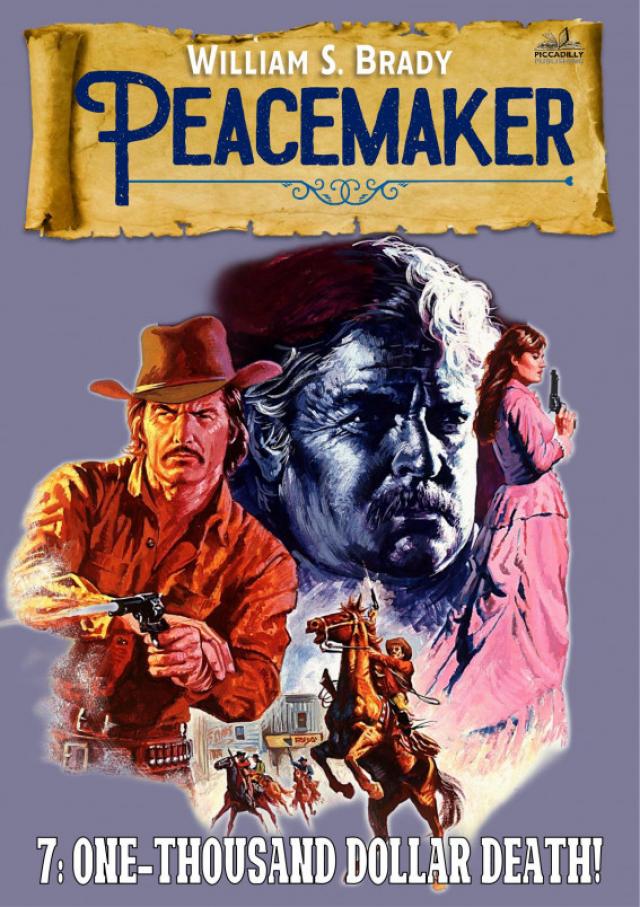
PEACEMAKER 7: ONE THOUSAND DOLLAR DEATH
©William S. Brady 1984
This electronic edition published December 2023
Names, characters and incidents in this book are fictional, and any resemblance to actual events, locales, organizations, or persons living or dead is purely coincidental.
You may not copy, store, distribute, transmit, reproduce or otherwise make available this publication (or any part of it) in any form, or by means (electronic, digital, optical, photocopying, recording or otherwise), without the prior written permission of the publisher. Any person who does any unauthorized act in relation to this publication may be liable to criminal prosecution and civil claims for damages.
This is a Piccadilly Publishing Book / Text © Piccadilly Publishing
Series editor: Mike Stotter
Visit www.piccadillypublishing.org to read more about our books
The bane! The bane!
for John Harvey.
Author’s Note
$1000 Death is a continuation of the story begun in Peacemaker 6: War-Party!, and although it is a self-contained narrative, readers may prefer to start with the earlier book.
Prologue
THE VALLEY WAS wide and lush with grass, sheltered to the north by the hills of the Eagle Range, watered by the Rio Verde running down from the San Antonio river. To the south and west there was open range before the badlands began, and to the east the grass went away to the distant Texas coastline. It was a good place: a fertile place where folk could make a home if they had the will and the endurance.
Once the valley had been the domain of the Nokoni Comanche, and the horse-warriors still claimed it in part. But the coming of the settlers had driven the Nokoni steadily deeper into the hills, and the establishment of an Army post had done a little to quell the depredations of the hostile Indians. Originally the post had been a fortified Spanish mission, but the Nokoni had brought that down, and after the Texicans had won their independence from Spain, the mission had fallen into ruins. The rubble, however, provided building materials for the Army of the United States of America, and even now there were faint traces remaining of the older buildings.
The garrison boasted a standing complement of around forty men of the Sixth Cavalry, commanded by Captain Frank Donnely. The town that had grown up around the post had taken its name: Garrison. It was burned into the solitary marker post set alongside the trail that came in from San Antonio. No one had ever thought to put a marker on the southbound road that went down to Fort Davis and Laredo before swinging past Lake Falcon to hit the coast at Brownsville. A rider coming in from the north would have seen the marker, and beyond it the fifteen-foot outline of a watchtower. Running out from the watchtower was a network of ditches and timbered walls, augmented by the adobe of the old mission buildings: the perimeter defenses of the Army post.
Behind the earthworks there was a parade ground with a small, wooden command post, a timbered barracks, a sutler’s and an armory. A corral to the rear held the troopers’ mounts.
Beyond the post there was the town. It was fair to call it a town now, rather than a settlement, because it had a street and permanent buildings, and it was growing all the time. The oldest building was the largest: the Garrison Saloon. It was owned and run by Alice and Shawn Docherty, who were also the longest-established settlers. Indeed, it had been Alice’s dream of a regular town that had mostly got the thing started. Now the saloon boasted rooms out back and a regular kitchen, and Alice felt she belonged someplace.
Next to the saloon was a store that carried the legend: Abraham Kintyre – Purveyor of the Finest. It sold just about anything a settler might need, and what it didn’t, Kintyre could ship in. Pushing along the street from the focal point of saloon and store were the other buildings that had grown up as Garrison grew: Angus MacKay’s barber shop — also dentist’s and funeral parlor; a smithy manned by a massive, white-haired Scandinavian whose name was so alien everyone called him simply Swede; a livery stable and saddlery owned by a man called One-Eye Peters on account of the patch he wore; and a fresh-built whorehouse run by a Mexican called only Gomez.
There still weren’t too many houses. Most of the permanent inhabitants lived out back of where they worked, and the rest either roomed in the saloon or lived in the wagons that had brought them there. One of the few who did occupy a real place was Janey Page. She had lost a husband getting to Garrison, and now made a living as a seamstress and unofficial school teacher. Like Alice Docherty, she saw a future in Garrison.
So did a man called Tevis Stark. He owned – and often as not also ran and worked – the stage line that now linked Garrison to San Antonio and Laredo and Brownsville. He had seen the need for a line in the aftermath of the War Between the States, and had parlayed his capital in an all-or-nothing venture that hooked the settlement in the Rio Verde valley to the network of larger towns.
Garrison had indeed grown. And as it had expanded, it had felt the need for a lawman. That was why Main Street sported a new building, a solid, four-square building of adobe and timber with a flat roof and bars on the windows. There was a sign fixed by chains to the porch roof outside the jailhouse. It read: Jail. Marshal – John T. McLain.
McLain had been one of the early comers. A drifter, riding away from the memories of the War with nothing to his name save a Sharps buffalo rifle, a brace of Colt’s Dragoon pistols and a maroon shirt like the Missouri guerrillas wore. He had fought for the Southland alongside Bloody Bill Anderson and Butcher Harvey and the man called Josey Wales. And when the War had ended he had had nothing: his farm was gone, burned down; his wife with it. Josey Wales had told him: Go to Texas, and he had gone. He had come down through the Eagle Range into the hell-hot heart of an Indian war and found a place to live. Friends, too: Alice and Shawn, the others. He was young and strong and honest. He was also fast with a gun and good with his fists. And he had nothing to lose by staying. And a lot to gain. So he had stayed and become the marshal.
And now he wore a star pinned to his shirt.
And the problems that went with it.
Like how to defend Garrison against the encircling Comanche with Frank Donnely and most of his command ridden off, leaving only ten troopers behind...
And what to do about the money Cord Amsterdam was carrying when he tried to ambush McLain and got shot down…
And the kid who had beaten up on Alice when he jumped jail…
And Belle Hannett
Wearing that star wasn’t easy. But John T. McLain wasn’t the kind of man to back away from problems.
And he was the lawman.
Chapter One
‘THAT’S GOOD ENOUGH.’
Angus MacKay dunked the red-hot poker he was holding in a water bucket and stepped back to admire his handiwork. The smell of scorched wood filled the room built on behind his barber shop, overwhelming the sweeter odor of fresh-cut timber coming from the plain coffin standing on trestles to one side of the small room.
‘I guess,’ John T. McLain agreed, studying the two words burned into the horizontal bar of the cross: Cord Amsterdam. No dates. No explanation as to why the dead man should be occupying a place in Garrison’s cemetery. Just the name, and the mystery of the $973 Amsterdam had been carrying when he’d tried to ambush McLain. ‘When you fixin’ to plant him?’
MacKay shrugged thin shoulders and said, ‘Now. Before he starts to smell. You can help me load him.’
McLain nodded and together they lifted the coffin and carried it out back to where the barber-cum-dentist-cum- undertaker had his wagon parked. They dumped it on the flatbed and MacKay went back inside to fetch the cross.
‘Best tell Alice,’ he suggested. ‘She’ll most likely want to read over him.’
‘Yeah.’ McLain nodded. ‘I’ll do that.’
MacKay grunted and flicked the reins to urge the two- horse team into a walk as the lawman strode down the side alley. He was wondering why anyone should feel the need to accord a troublemaking back-shooter like Amsterdam the niceties of a ceremony. Especially when it looked probable a whole lot of decent folk could die with no time to say any words if the Nokoni grouped outside the town came in.
The thought angered him and he glanced towards the Sixth Cavalry flag hanging limp in the noonday heat before Frank Donnely’s command post. Goddam Army! he thought. Goddam Frank! Do it by the book — and leave ten troopers to defend a town against upwards of sixty hostile Comanche. Shavetails, too, for the most part. Goddammit!
His handsome face was set in angry lines as he approached the saloon, his irritation fueled further by the clusters of men grouped around the wagons blocking the approaches to Garrison. They were all carrying long guns of one kind or another, mostly single-shot weapons like the Henry and the Springfield, with a few repeating Spencers and a scattering of shotguns. They were nervous: he could almost taste their fear on the still air. And, God knew, he was jumpy enough himself. They were organized into a civilian defense force, but he didn’t like that many armed men around town. Not with tension riding so damn high. It was a recipe for trouble; with or without the Indians.
He climbed the steps onto the porch and pushed through the batwings. The saloon was crowded - the men not on duty drinking their way through the talk about the uprising. It was inevitable: too many of them had been living in the wagons that now served as barricades, so they naturally congregated in the saloon. And drank to compensate for their fear.
A path opened as he stalked grim-faced up to the bar. The ones who knew him knew better than to block his way when he looked like that, and those who didn’t had heard how he had gunned down Amsterdam, and they eyed him with respect. Or fear. McLain didn’t care much which, so long as they stayed in line.
He reached the bar and nodded his thanks for the beer Shawn Docherty pushed towards him.
‘That’s a sour look, John.’ Docherty’s own grizzled features were serious enough. ‘What’s on yore mind?’
‘Them.’ McLain indicated the crowd with a nod of his head and ran a hand through his long brown hair. ‘Too much fear an’ too many guns.’
‘Yeah.’ Docherty nodded his agreement. ‘It’s like standin’ sentry on an armory with a bush fire blowing close.’
Shawn Docherty had been a top-sergeant before mustering out and marrying the recently-widowed Alice Patterson. Now he ran the Garrison Saloon with his wife. He was one of the few men McLain trusted.
‘Angus is buryin’ Amsterdam,’ McLain said. ‘We figgered Alice’d maybe want to read over him.’
‘Be Christian,’ Shawn murmured. ‘She’s in the kitchen.’ McLain emptied his mug and shouldered his way to the rear of the building. There was the appetizing smell of cooking as he opened the door: a homely contrast to the tension on the other side.
Alice Docherty looked up from the stove. Her grey hair was whitened by streaks of flour, but the smile that decorated her face took away a good many of the years so that McLain could see once again how she must have looked in her youth.
‘John T.,’ she said, ‘you come to eat?’
‘No.’ McLain shook his head. ‘Angus is ready to plant Amsterdam. You want to be there?’
‘He was a no-good.’ Alice wiped at her hands, shedding a pale cloud of flour. ‘But it don’t seem Christian to let him go into the grave without no words. I’ll come along.
‘So will I.’ Janey Page came in through the rear door. ‘If that’s all right.’
McLain shrugged, feeling embarrassed. And angry with himself for the feeling. There was no logical reason for it: Janey had no claim on him; there was no reason he should feel guilty she had seen Belle Hannett kissing him. But in some obscure way, he did. And Janey looked real good with those strands of wheat-golden hair falling loose around her face, and flour smudged on her cheek. He looked into her eyes, and the blue reminded him of cornflowers.
‘Sure,’ he said. ‘Why not?’
The two women took off their aprons and dusted their hands and faces. Alice set a tray of biscuits in the stove and took a last look at the stew simmering on top.
‘Them hostiles don’t quit soon,’ she murmured, ‘we’ll be runnin’ short.’
McLain nodded as he held the door: it was one more thing to worry about.
They went out the back of the saloon and walked towards the plot of land between Garrison and the river. There weren’t enough graves there yet to justify a fence, so the cemetery was a loose sprawl of markers, some plain wood, a few marble. Angus MacKay was waiting beside the grave. He took off his black stovepipe as they approached, sweat glistening between the strands of black hair plastered over his skull.
‘Alice. Janey.’ He nodded a greeting.
The women nodded back and clasped their hands as they studied the coffin.
McLain doffed his Stetson, feeling the sun hot on his head. He glanced at Alice.
‘All right,’ she said. ‘Let’s do this Christian. Then I gotta get back to feedin’ that multitude.’
McLain stared at Janey’s blonde hair as the words were said:
‘I am the resurrection and the life, sayeth the Lord …’
Beyond those gold locks he could see smoke drifting lazily into the clear blue sky from the foothills. And he knew that if he turned his head, he would see more lines of drifting grey off to the east and north. The Nokoni were waiting. Like vultures circling the blue.
Goddam you, Frank Donnely.
‘And to thine keeping, Lord, do we commit the soul of this sinner. Asking that you look with mercy upon his misdeeds and take him unto thine bosom in redemption of his sins.
‘Amen.’
‘Amen.’ came the echo of the response.
‘All right.’ Alice looked up, businesslike as ever. ‘Now Janey an’ me got mouths to feed. Yours included, John T. Where you want it?’
‘The jail, I guess.’ McLain didn’t feel like eating in the press of the saloon. Nor in the kitchen, where Janey might be watching him. ‘If that’s all right.’
‘Sure.’ Alice glanced from his face to Janey’s, her own creased by a doubtful frown. ‘I’ll give you time to get the grave filled.’
McLain nodded and stooped to take hold of the rope handles on one side of the coffin. Angus MacKay took the other side and they swung the plain box out over the hole. Cord Amsterdam dropped into his last resting place with a dully final thud. The two men began to shovel dirt.
McLain swabbed the last of the gravy with a biscuit and pushed the plate aside. He licked his fingers and wiped them absently on his pants as he stared at the form waiting blankly on his desk. Keeping the peace was one thing, filling out the paperwork that went with the job was another. Mostly he let it go. Filing a report for Judge Lefevre back in San Antonio for every minor misdemeanor was a pure waste of time. But once in a while something came up that needed the official touch. Like the half-completed report on the kid who had beaten up on MacKay for a lousy few dollars, then jumped jail when Alice was soft enough to let him get a hold on the keys. That rankled with McLain. All right, Alice’s bruises were healed now – and she admitted she had only herself to blame – but, still, the kid had escaped from McLain’s jail. And the big, brown-haired man intended to put him back there; if the Comanche hadn’t got him already.
And the business with Cord Amsterdam needed reporting.
Hell! The man had come in on Tevis Stark’s stagecoach with a bag full of close on $1,000. He’d done his level best to talk anyone who cared to listen into making a run for the south. And when that had failed – thanks to McLain – he had tried to ambuscade the marshal.
So McLain had a new form to fill out.
He picked up the pen Abe Kintyre had supplied along with the desk and chair and inkpot and began to write. When he was finished he appended his signature and left the sheet to dry as he stared around the spartan office. Over in the corner farthest away from the barred windows set either side of the solid door a potbellied stove sat on the plank floor. It was cold, the blackened coffeepot empty on the plate. His desk and chair occupied the other corner, and there was no more furniture. A row of bars divided the office from the two cells, each containing a narrow bunk, a slop bucket, and a barred window. Both were empty. Except for the locked leather bag with Amsterdam’s money inside. Only it wasn’t, McLain felt certain, Amsterdam’s money. A gun rack was mounted on one wall, holding McLain’s big Sharps buffalo gun and a single-barreled Meteor shotgun with the muzzle cut down to close on eighteen inches. A chain ran through the trigger guards, fastened to a heavy staple with a locked padlock: after the kid’s escape, McLain wasn’t taking any chances. The opposite wall carried a wood-framed bulletin board, fliers tacked to the green baize. The topmost flier was emblazoned with the large letters Wanted, beneath which there was a print-smudged sketch of a face that might have been nondescript were it not for the eyes. The face was long and angular, a drooping moustache overhanging a small, mean mouth. The eyes were small, too, but somehow the artist had caught an expression of rage so that they glared from the flier with furious intensity. Below the sketch were the words Hondo John Montrose and the figures $600; then a list of the outlaw’s crimes. They spanned a fair spectrum of criminal activity: rustling, stage robbery, robbery with violence, the suspected murder of at least two men. Under the list were three more words in large type: Dead or Alive.


