

Comanche! (A Peacemaker Western--Book One), page 1
part #1 of Peacemaker Series


The Home of Great Western Fiction
War taught him to kill …to stay alive!
John T. McLain had nothing left in Missouri. His wife was dead, his farm was burned out.
The Civil War taught him the bloody art of killing, and now he was alone. He owned a brace of Colt Dragoons pistols, a Sharps carbine, and a horse. He followed the rebel guerrilla trail south to Texas …
And there, the Nokoni Comanche took his horse and plunged him into violent struggle for survival that was even more savage than the White man’s war.
A brutal fight for life that sent McLain down the killing trail again.
But this time in pursuit of a dream.
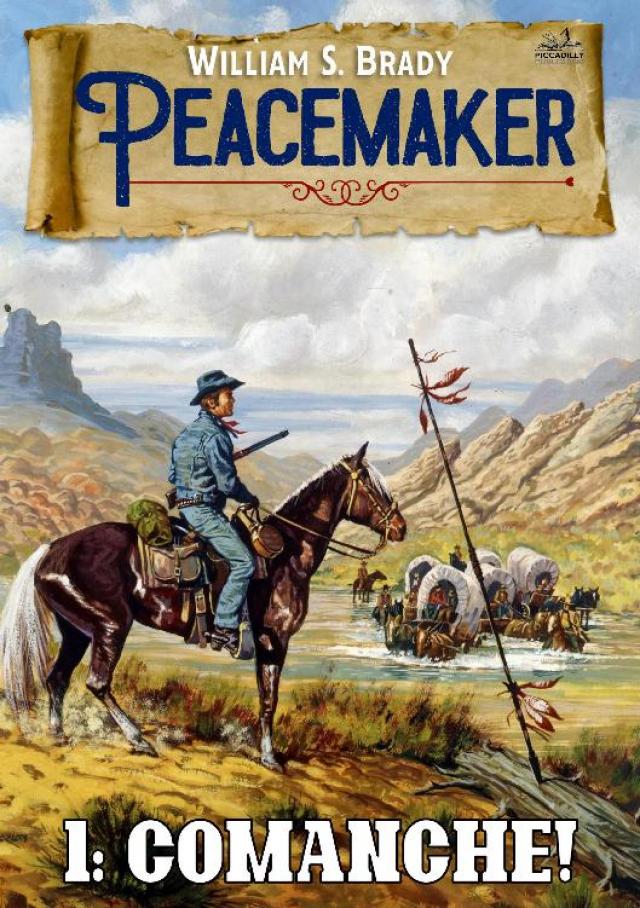
PEACEMAKER 1: COMANCHE!
By William S. Brady
First published by Fontana Books in 1981
Copyright © 1981, 2022 by William S. Brady
This electronic edition published April 2022
Names, characters and incidents in this book are fictional, and any resemblance to actual events, locales, organizations, or persons living or dead is purely coincidental.
You may not copy, store, distribute, transmit, reproduce or otherwise make available this publication (or any part of it) in any form, or by means (electronic, digital, optical, photocopying, recording or otherwise), without the prior written permission of the publisher. Any person who does any unauthorized act in relation to this publication may be liable to criminal prosecution and civil claims for damages.
This is a Piccadilly Publishing Book / Text © Piccadilly Publishing
Series Editor: Mike Stotter
Published by Arrangement with the Author’s Agent.
Visit www.piccadillypublishing.org to read more about our books.
Editor, supporter, and friend:
this one is for Carolyn Caughey.
It’s good to know you, lady.
Table of Contents
Prologue
Chapter One
Chapter Two
Chapter Three
Chapter Four
Chapter Five
Chapter Six
Chapter Seven
Chapter Eight
Chapter Nine
Chapter Ten
Chapter Eleven
Chapter Twelve
About William S. Brady
Prologue
THE PLACE WAS a wide river valley, lush with grass. To the north, it was sheltered by a range of low hills, where the San Antonio river ran down towards the distant Gulf of Mexico. To the south and west, beyond the confines of the valley, there was open country: grassland and arid semi-desert. A tributary of the San Antonio ran down the center; a wide, shallow stream that was called the Rio Verde.
Conquistadores under the command of an adventurer called Don Jose de Vizcaya y Torreon established a camp there while they searched for the legendary cities of gold. When the cities failed to materialize, the soldiers left; but missionaries stayed on: a small band of monks dedicated to the conversion of the savages. They built a church of wood that was burned down by the Nemenna – the Comanches – of the Penatekas clan. They rebuilt, using hard-won stone and adobe; and this time, they fortified the structure.
The mission remained the center, but now it had walls, and the church was as much a fort as a place of prayer. It grew. Not large, but stronger; and for some years there was peace.
The Spaniards went home and the Mexicans occupied the walls. It was a strong place, used by the troops of Santa Ana, and later by the soldiers of Maximilian.
And then the incomers from the north – the Texicans – won their war, and the mission fell into disrepair. Penatekas and Nokoni Comanche raided, and brought down the walls. In far less time than it had taken to build the mission, it was reduced to a memory outlined against the grass by crumbling stone and weed-covered adobe.
And then the incomers began to fight amongst themselves. For the bloody years of the Civil War, the mission was a base for Confederate troops, and when the war ended at Appomattox, Union soldiers replaced the Stars and Bars with the flag of the new-won United States.
It was good cattle country down there, and the Union needed beef. But before the nation could be fed, it was necessary to secure the land from the Indians. And so a detachment of cavalry was posted to the Rio Verde Mission, under orders to maintain the peace and clear the country for settlement. The new soldiers lived under canvas—their task was transitory enough that there seemed little point in establishing a permanent fort: they lived on the move, and the establishment of a real garrison would take too many men away from the duties of daily survival.
Civilians disagreed. After all, when the Comanche were pacified a town would grow, and living from a wagon was uncomfortable when an enterprising trader might set up a solid cabin and make money selling drinks to the troopers. So a cabin appeared above the ruins of the mission, and the lonely bivouac of the Army began to take on the faint outline of a town ...
The man was tired beyond his years. Once, a long time ago, he had worked a farm in Missouri. It wasn’t a big farm; was never likely to get much larger, because he was not an ambitious man: he wanted mostly to be left alone to enjoy his land and his wife.
Raiders out of Kansas had ended that dream, leaving him with nothing but a burned-out shell and a corpse to bury. And a slow-burning anger, the kind that festers into violence like the long fuse on a keg of powder.
He had set a marker over his wife’s grave and stocked his saddlebags with all the powder and shot he owned. There wasn’t much: enough for twelve blasts from the .54 caliber Sharps carbine. It was sufficient to take him through the war-ravaged border country of the Kansas/Missouri line to where the guerrilla called Bloody Bill Anderson was camped.
Anderson gave him a brace of Colt’s Dragoon pistols, and a man nicknamed Butcher Harvey taught him how to use them. He was a natural shot, and the heavy Dragoons worked in his hands as easily and as skillfully as he had used a plough. He fought with Anderson throughout the war, and at times he almost forgot the farm and his wife. When it ended, he went back to the farm.
There wasn’t much left. Weeds had taken hold of the fields, and moss was climbing over the memory of the house. His wife’s grave marker had fallen sideways, and something had tried to burrow down through the soil.
He set the marker upright again and stared at the house. There was an owl nesting in the still-standing chimney, staring at him with curious eyes as he paced through the wreckage.
A few yards off, a man called Josey Wales said, ‘There ain’t nothing left for us here no more. I’m goin’ to Texas.’
He nodded, and said, ‘Why the hell not?’
A week later he took the amnesty offered by the victorious Northerners and headed south. He had a horse – a big bay stallion – two Colt’s Dragoon pistols, a Sharps carbine, and a dead dream.
He went to Texas …
Chapter One
KICKING HORSE STARED across the burning flat to where the man lay inside the old buffalo wallow. There was little the Comanche could see through the haze, except the faint, dark outline of the man’s hair, and a hint of his shirt.
The Nokoni war chief remembered that the shirt had been a rich maroon color, with little patterns sewn about the shoulders at front and back. It would be a fine prize – if the arrows didn’t spoil it too much. Almost as good as the thick crop of dark brown hair and the guns the man was carrying.
It was a pity the horse had died, because it was a fine animal that might have added good blood to the war chief’s own animals. But that was a minor consideration against the larger plan set out by Walking Bear, and now the main thing was to prevent the white man from reaching the blue-legs and warning them of the numbers of the Nokoni gathered for a strike against the place.
Kicking Horse glanced up to where the sun was trailing an incandescent path across the sky, and smiled. By now the white man must be feeling the heat. By now the ants would be crawling over the horse. Soon it would begin to smell. And the white man had only the single canteen. When the sun shifted two fingers farther, he decided, would be the time to attack. Two men from the front, to draw off the fire of the long-shooting gun, then the others from the side and rear. Fin the man with arrows – if they didn’t kill him, at least they would confuse him – then go in with the lances.
Kicking Horse eased back against the overturned stone, enjoying the coolness the exposed underside of the boulder gave him as he adjusted his spread blanket to fend off the sun’s glare and fill his particular hollow with shadow. There were no boulders down there, he thought, not where the white man was. No stone to turn over so that a man could rest his back against the coolness of sand-dried rock and drain the heat from his skin. All the white man had was heat: dried salt that reflected the glare up at his eyes and took the sweat from his body like a ghost draining the soul. He would be sweating. The moisture running from that swathe of brown hair into his eyes. His mouth would be dry, the lips cracking, the body itching as the sweat percolated through the cloth to coalesce against the skin.
Kicking Horse reached down to scratch his crotch, and closed his eyes under the shade of his blanket, thinking about how Walking Bear would praise him for the capture of two pistols and a long-firing gun.
John T. McLain scratched his belly and wondered how he was going to stay alive.
The Sharps was rested on his saddle blanket with a fold of cloth dr
Allowing for all the shots, he had thirteen chances of surviving. And as best he had been able to tell, there were six Indians watching him—presumably waiting.
But they could fire faster: an empty Sharps needed reloading. And an empty Dragoon took longer. A Comanche with a bow could loose off six arrows while a Colt was still filling with powder.
And his water was running out.
He shook the canteen, hearing the slush of tepid liquid against a point midway up the sides. Enough – maybe – for the remainder of the day. But then? He dropped the water bottle back under the blanket and glanced round at his horse.
It was sad that Old Bo had died. They had come a long way together. Sadder still that the ants were now crawling into the wounds made by the arrows, seeking the rich harvest of blood, and before long would be trailing into the nostrils and eyes.
He looked up: buzzards were circling overhead; black specks against the burning sky. Waiting.
Anticipating.
Knowing that whatever transpired beneath their dark wings would feed them; bring them fresh meat. Indifferent meat: the buzzards didn’t care who they plucked.
‘Jesus!’ McLain wiped a hand over the scabby drying of his lips. ‘I come an awful long way to die.’
‘Now.’
Kicking Horse folded his blanket over the mustang’s back and lashed it in place. He fastened his rawhide-and-wood shield in position over his left arm and picked up his lance, using it as a vaulting pole to swing astride the pony.
The others grunted their assent and moved to the positions designated by the war chief.
By the time they were all in position, the sun had faded three fingers’ lengths over to the west, but even then there was no shadow in the wallow.
Sky Watcher and Buffalo Man began the attack.
They came up over the fold of land and feinted a charge at the depression, shrieking war cries and loosing random arrows at the man crouched there. When there was no answering fire, they moved in closer – still howling – and taking more time to aim.
McLain saw the two Indians come into sight and wondered where the others were. He held his fire, remembering a time when Union troopers had sent scouts out to pinpoint and draw the fire of a guerrilla camp.
Now there were only two … but four more were hidden somewhere.
Where?
Waiting? Waiting for him to waste his shots?
So as to ride in?
The Union had tried that.
He lifted a cartridge and set it between his teeth. Then swung the Sharps up to his shoulder and squeezed off a single shot. While the black powder smoke was still clearing from around the barrel and the echoes of the discharge were dying, he had the breech open and was spitting the fresh load into the chamber.
Buffalo Man went backwards off his pony while McLain was snapping the breech shut and fastening a fresh cap over the nipple of the Sharps. Sky Watcher stared in amazement as his companion was lifted from the saddle with both arms flinging wide as a crimson flower burst from his chest. Then grunted himself as his pony fell down under him with fragments of bone and blood spraying from the head. He lifted clear, landing heavily in the sand as the mustang kicked its death knell, and ran forwards while the others charged in.
McLain dropped the Sharps and rolled over. It was a movement born of habit and expediency. His hands fisted the Colts clear of the holsters while his thumbs dragged the hammers back and his forefingers closed on the triggers. Close on three pounds of heavy metal dragged his aim down, but he was accustomed to firing double-handed. Accustomed, too, to firing against an enemy piling as many shots against him as he could return: he ignored the Comanche arrows and waited until the horsemen were within range.
Then he let the hammers on both guns slip, the pins striking the fulminate charges of the percussion caps to detonate a spark through the narrow firing holes so that the black powder of the cartridges was detonated, exploding outwards through the sole exit: against the weight of the lead slugs, blasting the smooth balls down the tubes of the Dragoons’ muzzles, the expanding gases created by upwards of ten grains of black powder expelling the one-third-of-an-ounce slugs outwards at a terrific velocity.
Both guns bucked upwards against McLain’s grip. Small Wolf and Little Eagle fell off their ponies with blood splattering from their chests and backs. They landed in the sand and made sticky puddles that were swiftly covered by flies as they writhed around and bled their lives over the waiting ground.
McLain cocked the twin Dragoons as the other riders came in.
Kicking Horse was on his left, Pony Dancer to his right. Both Indians had dropped their bows and were now charging with lances couched low beside the mustangs’ necks. They were moving at full gallop, coming over the rim of the wallow at such speed that only a solid wall might stop them.
McLain fired again with both guns.
His natural inclination was to the right, so Pony Dancer got shot more accurately than Kicking Horse. The .44 caliber slug hit the Comanche dead center of his quill breastplate. It exploded the quills outwards and covered the design painted there with blood, crimson covering the black and white and scarlet. Pony Dancer dropped his lance and slumped sideways over his horse, tumbling clear as the panicked animal thundered up the far side of the wallow.
Kicking Horse had more luck. McLain’s bullet sliced flesh from his right arm, cutting out a furrow of bloody skin that caused him only to shift the aim of the lance, so that instead of imbedding in the white man’s stomach, it ripped through his sleeve as the Nokoni lifted clear of the hollow.
McLain grunted, cursing as the Dragoon spun clear of his left hand. There was a moment of pain, followed by the hot spread of blood down his arm. He began to reach for the fallen gun, but his left hand got covered with blood, and the pistol was too far away.
Even as he reached for it, Kicking Horse came back over the rim. There was blood running from his arm, dripping back to bathe the withers of his pony in crimson streamers. But the lance was couched firm under his elbow, the stone tip angled down at McLain’s body; poised to take him in the side.
McLain thrust back, hurling himself clear of the charge in a desperate attempt to save his life. At the same time, he fired. His shot went wild over Kicking Horse’s head, and the Comanche spun his pony round in its own length and came racing back over the salt.
McLain saw the head of the lance the same way he had seen the Civil War approaching: undeniable and deadly. Only now it was coming a whole lot faster. Very fast. With a screaming face behind it that was painted in red and black and yellow.
He lifted his right arm, still on his back, and triggered a shot that exploded one side of the painted face in fragments of red. Kicking Horse jerked to one side, his lance imbedding in the wall of the hollow a foot to the American’s right. The power of the bullet lifted him off the mustang’s back, the weight of the grounded lance adding extra thrust so that he flew clear through the air as the pony charged on and upwards over the rim while the Comanche plunged to the ground.
McLain fired again at the blood-ravaged face. His shot hit Kicking Horse in the teeth, sharding splinters of enamel out as it ploughed through the neck to burst the windpipe and shatter the spine. Kicking Horse jerked upright, then back; like a puppet, tugged on the strings of an invisible master. His moccasins ground against the salt of the wallow, churning up twin furrows through the white. And then the furrows got filled with red, and the white faded under the gasping imprint of his body.
McLain holstered the Dragoon and went over to fetch the dropped pistol. It was covered with dust, the nipples too dirty to risk firing, and the forward chambers larded with a spread of salt.


