

Blood on the Tracks (An Apache Western #8), page 1


The Home of Great
Western Fiction!
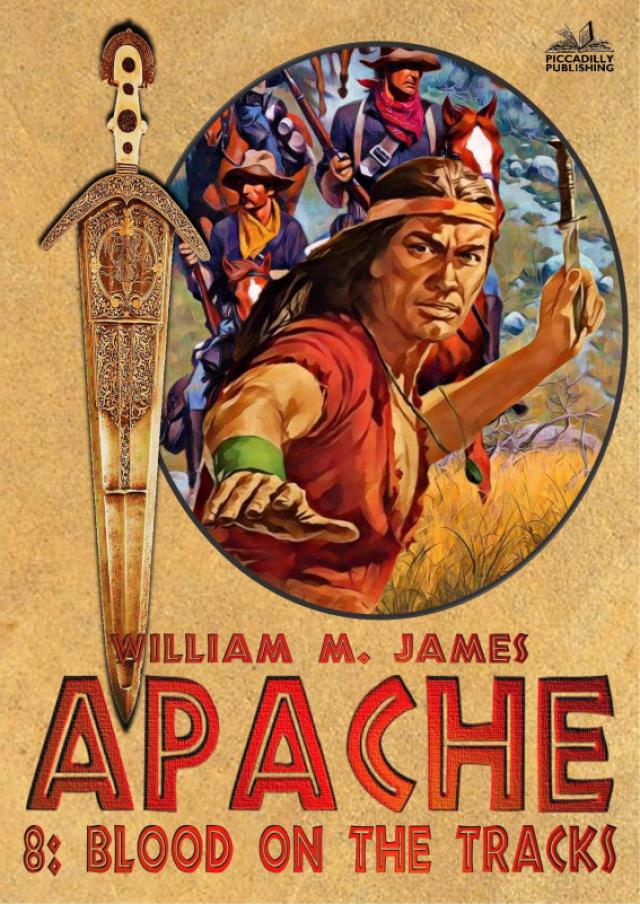
Cuchillo Oro is riding along the Gila River Trail when he comes to a railroad camp—the butchered bodies of the Chinese workers and their white enslavers cover the construction site. It is New Mexico Territory and this is the ghastly work of renegade Apaches, who don’t want the railroad on their land.
Just moments after Cuchillo arrives, a cavalry patrol rides up and accuses him of leading the Indian attack. Out for revenge, the soldiers decide to tie him to a locomotive and drag the red skin they hate right off his body.
He survives, filled with rage for the white man who has taunted and abused his people for years. But now Cuchillo must also deal with John Colt, leader of the renegade Apaches … a warrior every inch as tough as Oro.
Can the Golden Knife hold out against both Apache and white savagery?
APACHE 8: BLOOD ON THE TRACKS
By William M. James
Copyright ©1977, 2023 William M. James
First Digital Edition: January 2024
Names, characters and incidents in this book are fictional, and any resemblance to actual events, locales, organizations, or persons living or dead is purely coincidental. You may not copy, store, distribute, transmit, reproduce or otherwise make available this publication (or any part of it) in any form, or by means (electronic, digital, optical, photocopying, recording or otherwise), without the prior written permission of the publisher. Any person who does any unauthorized act in relation to this publication may be liable to criminal prosecution and civil claims for damages.
This is a Piccadilly Publishing Book
Published by arrangement with the author’s estate.
Editor: Lesley Bridges
Text © Piccadilly Publishing
Visit www.piccadillypublishing.org to read more about our books.
For
Derek and Mike
Who gave invaluable help with the most taxing problems
Chapter One
JOHN COLT ABSENTLY sharpened his already finely honed hunting knife on the sole of his moccasin as he sat astride his pinto pony and peered down at the railroad construction camp. Behind him, in the mouth of the narrow ravine above the camp, were twenty more Chiricahua Apaches—mounted and dressed in the same manner as their chief.
All the Indians were naked to the waist, so that the blazing noon sun shafted down directly on to their paint-daubed upper bodies. Hatless, they wore broad headbands of cloth around their brows to keep the long black hair from veiling their dark eyes, and their impassive faces were also streaked with the colorful signs of their violent intent. Their leggings were of buckskin and their feet were encased in moccasins. Two braves carried lances, and every member of the war party wore a single red feather tucked into the back of his headband.
The mounts of the braves were former mustangs schooled in the Apache way, ridden bareback with rope bridles and reins.
In all these respects, John Colt and his braves were the epitome of an Apache war party. But except for the lances, their weapons were of White Eyes manufacture: Spencer seven-shot repeating rifles, Remington Army Model .44 revolvers and factory-made, long-bladed knives. And their belts, fitted with a holster, sheath, and ammunition pouches, were Union-Army issue.
With no saddles or blankets across the ponies, John Colt and the seventeen braves who were armed with Spencers gripped the rifles in their brown-skinned hands.
There was nothing about the attire or arms of John Colt to mark him as the leader of the band, but Nature had fashioned him so that he stood out as a man among men. For he was over six and a half feet tall and built broadly at the shoulders and chest. Atop this massive, muscular frame, his head was of an oddly squat shape, seeming somehow too wide for its depth. The features between the falls of greasy hair at either side were well formed and attractive to the squaws of his tribe: even though—or perhaps because—the narrow eyes, slightly hooked nose, and thin mouthline displayed by their set a latent cruelty.
It was the summer of his fortieth year, which made him almost twice the age of the majority of the braves who waited for his order to attack.
The war party had been assembled in the ravine for almost an hour, but it was only minutes ago that John Colt had instructed the braves to mount. During those few minutes, all except the tall leader began to show signs of growing impatience. No disgruntled words were spoken, and there were no restless movements, but in varying degrees the sweat-sheened, colorfully decorated faces of the younger Apaches expressed concern at the delay and a frustrated eagerness to swoop down upon the unsuspecting railroad workers at the camp.
Occasionally, John Colt shifted his impassive gaze from the White Eyes below his vantage point to quickly survey the braves tightly grouped in the ravine. But he did not transmit any sign of tacit disapproval at their obvious chagrin. For he knew his qualities as a leader were held in high regard by the braves.
Qualities that extended far beyond mere physical size and its accompanying strength: for such were never enough to elevate a warrior to become an Apache chief. No, behind the dark and brooding eyes of John Colt, was a keen brain that had planned more than a score of successful attacks on White Eyes communities.
His braves were well aware of this, and of the latest coup—with its rich rewards—which had led John Colt to bring the war party to this place.
So, while they might be discontented with the need to delay, they would not question its necessity. And from the time when he had himself been aged between seventeen and twenty-five summers, John Colt knew that impatience could be used to good effect by a leader able to understand and direct it.
Thus, he neither rebuked the braves with a stern look nor attempted to assuage their feverish impetuosity by promising that the raid would start soon. For no blame was attached to him, and when the time to attack arrived, it would be the White Eyes who experienced the explosive results of the steadily building frustration. And anything that reinforced a war-bent brave’s hatred of his enemy was to be encouraged.
Below the mouth of the ravine was a gentle rock-strewn and crater-pitted slope sinking into the south some hundred and fifty yards from crest to base. Then the ground was almost flat, with just slight undulations for about a quarter of a mile to the lip of a canyon. This broad ledge between the craggy ridges of a line of hills and the deep drop into the canyon swung in a long curve from east to west for as far as the eye could see—which was not a great distance on such a blisteringly hot day, for slick-looking veils of heat shimmer advanced the horizons on all sides.
To the east, the ledge was as it might have been for a million years, showing no sign that man had ever set foot upon it. But appearing out of the broiling haze to the west and running arrow-straight to the group of buildings that formed the construction camp were the sun-glinting metals of a single-track railroad: the symmetry of steel across timber ties, a man-made ugliness upon the irregular forms of Nature.
Even uglier were the sprawl of timber buildings and the stacks of supplies—rails, ties, and crates of spikes—that formed the camp. All single-story, the buildings included a bunkhouse and cookhouse on the north side of the track and an office on the south side. The supplies, which were being added to as a six-flatcar train was unloaded, were stacked neatly beside the office.
This work was being done by a score of coolie-hatted, naked-to-the-waist Chinese laborers. Five Americans watched them from beneath the shade of the caboose. These White Eyes had been playing cards when John Colt first looked down on the camp—the engineer, fireman, brake-man, and two work superintendents. Since the final game had ended, they had all passed the time by yelling and cursing at the sweat-sheened Chinese—berating the workers to finish the chore so that everybody could eat.
John Colt knew there were three more people in the construction camp. The cook, attending to the food—which added an appetizing aroma to the black woodsmoke billowing from the cookhouse chimney—and the survey engineer and a woman, who were in the office.
As far as the tall, muscular Apache chief knew, only the two work superintendents were armed with guns, and these were just revolvers.
It would be a one-sided fight, and as a veteran warrior of so many attacks on the White Eyes, John Colt experienced a slight feeling of regret about this. But then, as the final crate of ties was removed from a car to the stack on the ground, a quiet smile altered the set of his cruelly handsome features. The men had moved out from beneath the caboose and were ambling toward the cookhouse. The Chinese laborers remained where they had stopped work, silent except for their deep breathing, until one of the superintendents blew a shrill blast on a whistle. Then the Orientals streamed under and over the now empty flatcars—and halted again in an orderly line behind the Americans at the cookhouse door.
‘Very soon now,’ John Colt told his braves, not turning to look at them as he broke the long silence in the ravine.
His dark eyes continued to survey the construction camp, as first the Americans and then the Chinese carried tin plates of food out of the cookhouse and into the bunkhouse. And the smile turned to a mild scowl of dissatisfaction. For although he could regret the weakness of his enemy, he also experienced distrust of a departure in that enemy’s routine.
He had been at this vantage point at the same time yesterday, watching as the Chinese workers built the camp with materials offloaded from a similar train—perhaps the identical one. Then, when the noon
Today, as the cook trailed the last Chinese laborer into the camp’s largest building, the door of the office remained firmly shut. On the other side of the door—and thus outside the trap John Colt intended to spring—were the survey engineer and the woman who had ridden out to the camp on this morning’s train.
But an Apache chief of John Colt’s caliber was able to adapt to a change of circumstance quickly, and his face was set in impassive lines again as he turned to look over his shoulder.
‘It will be as I said,’ he announced softly in the guttural native tongue of his tribe. ‘Except that Redwing will come first with me. Silver Fox will take my place here and await my signal.’
Redwing was one of the lance-carriers: a squat, round-faced brave of twenty-five with a badly set nose from an old break. Silver Fox was five years younger, with a clean-cut classically handsome face: tall, although a full head shorter than John Colt, and the proud bearer of two white scars on his chest from old bullet wounds.
The two moved silently away from the main group, and the sweat-run faces of the entire band were abruptly taut with anticipation of the carnage they would shortly unleash on the unsuspecting White Eyes.
The bunkhouse was divided into two sections by a stout timber partition. The sections were of equal size, even though only the survey engineer, two superintendents, and the cook lived in one half and twenty Chinese laborers occupied the other.
The Chinese laborers sat morosely on their tight-packed bunks to eat the meal, talking little as they attempted to replace the expended energy of their morning’s labor with beef stew that was adequate, but unpalatable. Beyond the partition, on the other side of a closed door, the Americans sat around a table in the center of their spacious accommodations. They talked a great deal, and laughed a lot—enjoying the food and the ribald jokes that crisscrossed the table. Jokes about why Waldo Roe couldn’t spare the time to eat while his attention was engaged by the whore who had ridden the train out from Tyler Bend this morning.
The heat in both sections of the bunkhouse was malodorously high, and there was not a hint of a breeze from any of the open windows. Thus, with no breath of moving air and a monotonous view of a barren, eye-dazzling landscape, nobody sat at the windows looking out.
And John Colt and Redwing were unobserved as they led their ponies toward the camp.
It was even hotter in the closer confines of the small office, murky behind the shades drawn across the closed windows. But the two occupants were unaware of any discomfort. They lay on their sides, facing each other, atop a blanket spread on the dirt floor in front of the cluttered desk. Both were naked, breathing deeply in an exhausted sleep caused by frenetic coupling and an excess of liquor.
Waldo Roe—forty years old, balding and paunchy—still clutched a half-empty bottle of whiskey in one hand, while the other was clasped tightly over a bruised breast of the whore. She was half his age, a thin, hard-faced redhead with each bone of her rib-cage contoured by her sparse, pallid flesh.
Their hurriedly discarded clothing was spread about them, and there was an overturned, empty bottle close to the whore’s head.
John Colt and Redwing entered the office by the door after leaving their ponies behind the building—and both braves wrinkled their noses at the stench of body odor and expended sexual lust that clung to the overheated air.
The naked couple did not stir at the brief shaft of sunlight that fell across them from the open door. And remained unaware of danger as the two Apaches approached them. For just a moment, the intruders eyed the woman’s sparse nakedness, indulging in sexual fantasies. Then John Colt explained his plan with brief hand signals. Redwing nodded his understanding and moved to stand behind Roe’s sleeping form—raising the lance to the full length of his arms, point directed downwards.
John Colt rested his rifle on the floor, then squatted and reached over the woman and the man. His hands bunched around the far edge of the blanket.
‘Die,’ he said softly in English—and stood up.
The blanket curled up around Roe’s back, lifted the engineer’s bulk and thrust it against the whore. Both came awake with cries of alarm, but were too bleary-eyed and slow-witted with liquor to recognize the danger.
His face wreathed in a brutal smile now, John Colt bobbed down onto his haunches again, jerking the blanket in another direction. The whore was knocked onto her back, and Roe went face down on top of her. The couple stared into each other’s sweat-sheened faces at close quarters for a part of a second. Then wrenched their heads around to catch a glimpse of the smiling Apache chief. Shock at the rude awakening became stark terror, and both the White Eyes gaped their mouths wide to vent the screams forming deep inside them.
Redwing, gripping the lance tightly in both hands, plunged the weapon downwards. Its sharpened metal point penetrated Roe’s naked back to the left of the victim’s spine. With his physical strength augmented by hatred for his pale-skinned enemy, the squat-built brave was able to drive the lance completely through the writhing body of the engineer.
The sound that was intended as a scream emerged as a gasp, then became a death rattle. A lung had been pierced, and Roe’s final outward breath spewed a bright crimson torrent over the face of the whore.
She would have screamed, perhaps. But terror at the sight of the Apache’s painted face and horror at the feel of warm blood on her skin paralyzed her both physically and mentally. She experienced a mild pain between her breasts, flattened under the dead weight of Roe. But nothing more than this, until John Colt towered to his full height and leaned forward to add his strength to Redwing’s downward force on the lance. The pain became excruciating then, as the tip of the lance drove deeper into her flesh, sliding through tissue and nerves and veins. But still her voice was trapped inside her. And she was dead—soundlessly—when the point bit through the blanket into the ground and she and the man were skewered obscenely together by the wooden shaft of the killing lance.
‘A man could not wish to die in a better position, John Colt?’ Redwing gasped as both Apaches released their hold on the lance and looked down at the blanket-wrapped corpses. Except for a faint circle of stain where the weapon had penetrated the blanket, and the blood on the whore’s face, it had been a cleanly executed double killing. ‘Drunk with firewater and on top of a woman?’
‘Better to die rich,’ the Apache chief answered, eyeing the crude surroundings of the office with contempt. Then he smiled. ‘But drunk and with a woman, also.’
He picked up the rifle, turned and went to the door. Redwing made a half-hearted attempt to withdraw the lance and shrugged in resignation when the weapon remained firmly embedded in the two bodies.
‘Come,’ his chief ordered, and the brave moved quickly to join John Colt at the cracked open door, sparing just one rueful glance for the bottle that had slipped from Roe’s lifeless hand.
John Colt had already seen that the bunkhouse was precisely as it had been when they circled it and the stalled train to reach the office—stoically shading the men inside from the eyeball-frying heat of a sun just started on its slow path down the cloudless western dome of the blue sky. But the Apache’s ears detected a change and he smiled once more, in response to the lower volume of sound from within the long, low building.
There was no longer any scraping of spoons against tin plates. What talk there was had diminished to a subdued mumbling. No men were laughing now. Several were snoring. The soporific buzz of hungry flies on the wing was the loudest noise in the construction camp. And the moccasined footfalls of John Colt and Redwing were no louder than the soft thud of the lance into Waldo Roe’s back had been.
Midway between the office doorway and the 4-4-0 locomotive, John Colt glanced up at the mouth of the ravine. He saw Silver Fox sitting astride his pony on the high ground, and raised a splayed hand in a signal. Silver Fox acknowledged the order by heeling his pony out onto the slope. The other war-painted braves trailed him—single file at first, then fanning out on either side to advance down the pitted and boulder-strewn decline, in a curved line. The lance-carrier held his weapon high above his shoulder in a throwing posture. Rifles were gripped two-handed and aimed toward the bunkhouse, the ponies being controlled by skillful movements of knees and heels.





