The Turn of the Tide, page 1
part #7 of Soldier of the Republic Series


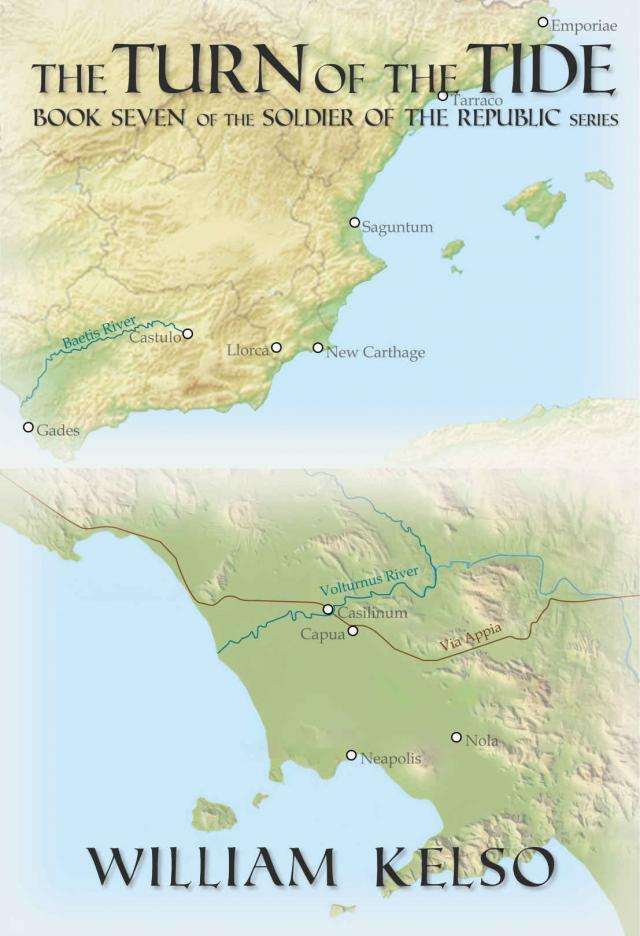
The Turn of the Tide
Book seven of the Soldier of the Republic series By: William Kelso
Visit the author's YouTube site
William Kelso is also the author of: The Shield of Rome
The Fortune of Carthage
Devotio: The House of Mus
The Veteran of Rome series (9) Soldier of the Republic series (7) Published in 2021 by KelsoBooks Ltd. Copyright © William Kelso. First Edition The author has asserted their moral right under the Copyright, Designs and Patents Act, 1988, to be identified as the author of this work.
All Rights reserved. No part of this publication may be reproduced, copied, stored in a retrieval system, or transmitted, in any form or by any means, without the prior written consent of the copyright holder, nor be otherwise circulated in any form of binding or cover other than that in which it is published and without a similar condition being imposed on the subsequent purchaser.
A CIP catalogue record for this title is available from the British Library.
ABOUT ME
Hello, my name is William Kelso. I was born in the Netherlands to British parents. My interest in history and in military history started at a young age, when I was lucky enough to hear my grandfather describing his experiences of serving in the RAF in North Africa and Italy during World War 2. Recently my family has discovered that one of my Scottish/Northern Irish ancestors fought under Wellington at the Battle of Waterloo in 1815.
I love writing and bringing to life the ancient world of Rome, Carthage and the Germanic and Celtic tribes. It is my thing. My aim is to write 100 books in my lifetime. After graduation, I worked for 22 years in financial publishing and event management in the city of London as a salesman for some big conference organizers. Working in the heart of the original Roman city of Londinium I spent many years walking its streets and visiting the places. The names of which still commemorate the 2,000-year-old ancient Roman capital of Britannia; London Wall, Watling Street, London Bridge and Walbrook. The city of London if you know where to look has many fascinating historical corners.
So, since the 2nd March 2017 I have freed myself from corporate life and become a full-time writer. It is one of the best decisions I have ever made. Stories as a form of entertainment are as old as cave man and telling them is what I want to do.
My books are all about ancient Rome, especially the early to mid-republic as this was the age of true Roman greatness. My books include, The Shield of Rome, The Fortune of Carthage, Devotio: The House of Mus, the seven books of the Soldier of the Republic series and the nine books of the Veteran of Rome series - Caledonia (1), Hibernia (2), Britannia (3), Hyperborea (4), Germania (5), The Dacian War (6), Armenia Capta (7), Rome and the Conquest of Mesopotamia (8) and Veterans of Rome (9). So, go on. Give them a go.
I live in London with my wife and support the “Help for Heroes” charity and a tiger in India.
To: Uncle David
Dear Reader,
I hope that you will enjoy this book. “The Turn of the Tide” is the seventh instalment of the “Soldier of the Republic” series. “Book eight” will be published by September 2021. In total there are going to be twelve books in the whole Soldier of the Republic series.
As an independently published author, I do not command huge marketing resources so, if you are so inclined, please do leave me a review or a rating. Also have a look at my short historical themed YouTube videos at
Feel free to contact me with any feedback on my books. Email: william@kelsoevents.co.uk
The story so far…
If you have not started reading the series “Soldier of the Republic” with book 1, then here is a short summary of what happened previously in the first six books. I would also suggest that you check the glossary and character list at the back; if you have forgotten “who is who” or you want to know a bit more about a particular topic or name.
The series “Soldier of the Republic” is set during the turbulent times of the Second Punic War between Rome and Carthage and involves three main characters.
Flavius is an ordinary but poor Roman citizen concerned with providing for his family but also much aware that he has a duty of service to the Roman Republic. Having fought against the invading Gallic tribes at the battle of Telamon he is a veteran and a family man who has known the sharp end of war. Readers from the beginning of the series will have followed him from his war service against the Gaul’s through to his decision to take his family north to join the hardy Roman colonists who are setting out to create a new home for themselves on the dangerous frontier in Cisalpine Gaul. From there we have watched him move from the fierce fighting in the snow-covered forests of northern Italy to the stinking slums of the city of Rome, to besieged Nola and Cumae and on to the magnificence of ancient Syracuse and Greece. Stoically facing the many daily hardships and dangers of Roman life Flavius is a rock that will not be moved if he doesn’t want to. Father, soldier and spy. Now a new chapter in his life is about to begin…
Julian, Flavius’s wayward son, runs away from home when he is just seventeen to join the legions after a bitter dispute with his mother and his departure divides the family. So far we have followed Julian through the war in Spain and Sardinia as he learns his military trade and starts to rise through the ranks to become the closest thing the Roman Republic has to a professional soldier. Now a respected centurion in Scipio’s army Julian has not seen his family for seven years.
Gisgo is a proud prince of Numidia, an aristocratic horse warrior from northern Africa who is also bankrupt and suffering from the sins of his father who gambled away his inheritance. Seeking a way out of his current plight he signs up to join Hannibal’s mercenary army as the Carthaginian prepares for war with Rome. We have followed Gisgo as he accompanied Hannibal into Italy and eventually to the battle of Cannae where Rome gambles all on a decisive victory. But Gisgo has never got over the mysterious loss, at sea, of his wife and young son. So, when an unexpected opportunity suddenly arises to find out what has happened to them, he must decide. A fateful choice that will have long lasting ramifications. On his return to Carthage Gisgo is imprisoned by his enemies and awaits his fate. Rescued by prince Masinissa Gisgo finds a new purpose and new respect, joining Masinissa in Spain as the war against Rome drags on. Soon with help from Masinissa’s superb Numidian cavalry and Gisgo’s military skill Carthage however will stand supreme. The Turn of the Tide picks up the story…
Chapter One – The Time For Diplomacy is Over
Early Spring 211 BCE – The City of Saguntum, Spain
Fondly Julian ran his fingers across Sicounin’s cheek. The time to say goodbye to his wife had finally come. It was dawn and at the ruined city gate of Saguntum, the caravan of merchants were preparing to leave - the excited trader’s voices and the bellow of an impatient ox drifting, across the acres of destroyed city blocks. Snuggled in her blanket sling secured around Sicounin’s neck, Daleninar, Julian’s eight-month-old baby daughter, was fast asleep oblivious to everything. Clutching his mother’s hand six-year-old Corbulo, Julian’s son however was gazing up at his father with an anxious expression. Crouching down beside him, Julian reached out and laid a hand on the small boy’s shoulders.
“You must look after your mother and sister now,” Julian said, quietly addressing the boy in an earnest voice. “That’s your job. When I am not here you are the man in the family. Will you remember that?”
“I will father,” Corbulo replied nodding dutifully.
“Good man,” Julian said with a pleased smile. Then, straightening up he turned to Sicounin and his expression changed. Sicounin looked nervous – her face ashen and with two small children and a travelling bag - which was slung across her back - she appeared weighed down.
“I will write when I can,” Julian said. “But no news is good news. We have done this before.”
“That does not make it any easier,” Sicounin replied, refusing to meet his gaze, her tense eyes fixed on the merchants. “There is talk of a new campaign. The army is going to march out to confront the Carthaginians. I have heard the soldiers talking about it. You are going to war and soon.”
Eyeing his wife, Julian nodded and then sighed. “Listen,” he said gently, “we talked about this. If something were to happen to me you know what to do. Retrieve the money and the letter that I buried in the ground and leave Spain. Take the children and go and find my father, Flavius in Placentia. Give him my letter. You, Corbulo and Daleninar will be safe on my father’s farm. From what I have heard it is a fine home and my father is a good man. He will not turn you away. He will take you in. You can start again there.”
Standing facing him with her children Sicounin nodded but said nothing as she nervously bit her lip. It was getting late. At the ruined gate, the convoy of wagons had started to move out and a couple of skittish horses were stamping their hooves on the dusty ground.
“Just come back to me alive,” Sicounin said at last, as she tightly embraced Julian, giving him a final kiss on his cheek. Then swiftly, before he could say anything, she turned and hurried away to take her place on the back of one of the wagons. As she hastened away, leading little Corbulo by the hand, the boy turned to look back at his father. The merchants were heading north. They would take his family back across the Ebro to the safety of the city of Tarraco where the main Roman army base was located. Softy groaning Julian raised his hand in a silent farewell as he watched his wife and children depart. It would be months before he saw them again, for Sicounin was right he thought. Spring had
For a while Julian stood watching the departing convoy of merchants and wagons. Then at last he reached up to place his magnificent, plumed centurion’s helmet on his head. They were going to be alright he thought. His family would be alright. He had to believe that. At twenty-five he was a handsome dapper man, with closely cropped hair. A battle-hardened Roman officer and veteran in Scipio’s Spanish expeditionary army. Over his fine coat of close-fitting chain mail body-armour that protected his torso he was wearing a short brown woollen cloak, fixed at the top by a simple brooch. On his feet he had a pair of hobnailed army boots and his leg and arm muscles were well toned and deeply tanned, whilst across his left shoulder he was sporting an old, faded tattoo – LEG III.
Wrenching his eyes away from the last of the departing wagons, Julian sombrely turned to survey the acres of derelict abandoned buildings, the heaps of rubble, the walls that had been pulled down. The destruction of Saguntum had been done in a systematic manner, as if some vengeful spirit had swept through its streets destroying everything it had touched. Once Saguntum, had been a powerful, thriving metropolis but that had been before Hannibal had attacked and destroyed it, after a lengthy siege. Now Saguntum resembled a ghost city populated by an army of Roman soldiers, their camp followers, orphans and stray dogs - a shell of its former lively self with the surviving inhabitants having largely moved away. There was something depressing about this place Julian thought. After the long winter he’d spent here, he couldn’t wait to leave. It was over this very town that Rome and Carthage had gone to war eight years ago. But now it was back under Roman control having fallen to the advancing Roman forces without much resistance. The city had been recaptured late last year and the Scipio brothers, supreme commanders of all Roman forces in Spain, had turned the abandoned and destroyed settlement into their advanced HQ and winter quarters.
***
As Julian approached the house that acted as his maniple’s HQ, he caught the scent of freshly baked bread wafting across the piles of rubble around him. His home for the last few months had been gutted by fire, which had left black scorch marks across the stone walls. But during the winter, his men had managed to repair the roof and make it habitable again. Pushing back the army blanket that acted as a door, Julian entered and strode across the cold and dimly lit space towards his corner of the room, where he’d stashed his personal belongings and where he slept on a straw-filled mattress on the floor. In the backroom the company’s tesserarius, watch commander and third in command, was kneeling beside a makeshift and rudimentary oven, in which he was preparing breakfast. Noticing Lucius and Bion, who were sitting cross-legged on the floor, engaged in a game of dice, Julian suddenly frowned.
“Morning Sir,” Lucius called out in a cheeky cheerful voice as he raised the cup containing the five dice and shook it. “Did the wife and kids get away alright?”
“Yes,” Julian murmured as he took off his helmet and carefully placed it on his makeshift bed. Stashed away against the wall was his marching pack, containing his worldly belongings, a blanket, some spare clothes, a fresh pair of socks, a sponge, his grain rations, writing materials, a Celtic silver torc and a splendid Gallic king’s sword that his father Flavius had given him.
“So, what are you two doing here?” Julian said sharply as he turned to face the big man and the dwarf with a displeased look. “Gambling, are we? I thought I had told you both to go over to teach those Celti-Iberian mercenaries how to recognise our trumpets and army signals. That was your job this morning.”
“Oh that,” Lucius said breezily, as once again he rattled the dice in their cup. “Don’t worry Sir. It is being taken care of. The optio decided to go in my place. It was very generous of him to do so.”
Placing his hands on his hips, Julian glared at Lucius. He had known Lucius since he had first come to Spain eight years ago – when they had both been teenage recruits in Scipio’s expeditionary army. Lucius was his best friend, the company’s standard bearer, an experienced soldier with the courage and strength of an ox - but today he was pushing it, Julian thought. Looking up at him, the butcher’s son from Rome gave him a cheeky – good natured smile.
“And what about you,” Julian snapped as he shifted his attention to Bion. “How is the optio going to make himself understood to our Celti-Iberian friends without a fucking translator?”
“Don’t worry Sir,” Bion said sheepishly. “I got a colleague to stand in for me. I may be the best translator in the army, but I am not the only one. Your orders are being carried out as I speak. No harm done.”
“That’s not the point,” Julian said sounding annoyed. “I asked you to do the job and now I find out that someone else is doing it.”
“The optio is a good man Sir,” Lucius said looking up. “Unlucky but solid if you know what I mean. He will be alright. He knows how to handle those mercenaries.”
“Of course, he is a good man,” Julian snapped in an exasperated voice. Then abruptly he shook his head, turned away and gave up. There was no point in arguing with Lucius and Bion, his two closest friends. They were too smart to let themselves be caught out and after years of service together, they knew him too well. In all likelihood they had enticed his optio, the company’s second in command, into a game of dice and it appeared that his deputy had lost the bet. The price of losing would probably have been to swap chores with Lucius. It was not the first time this had happened, but he would let it go. Deep down he knew he could rely on all his officers. He could not dish out punishment every time the rules were slightly infringed. There were other ways of handling his subordinates. Authority came from respect. As commander of his maniple, he had a duty to maintain discipline, but no one had ever taught him how to command men. He’d just had to learn on the job and make it up as he went along. The divide between being a tyrant, who ruled through fear and punishment, and a respected officer beloved by his men and who led by example was a thin one which he did not want to cross.
“Fine,” Julian said looking down at his mattress as he made up his mind. “After breakfast I need a man to go down to the quarter master’s office to arrange for the maniple’s grain resupply. Lucius, as you have nothing to do – that will be your task. Then once you are done with that, I want you to take the whole company on a run around the walls. It’s been too long since we have done that sort of exercise. The winter has made the men lazy, fat and bored. We can’t have that. Not now that spring has come and the campaigning season is here. So, tell the boys that the first man back from the run will be rewarded with a silver-denarii, but if anyone stops to walk, the whole company will be doing the run again from the start. I expect us all to be fit and in shape. Understood.”
“Seriously Sir,” Lucius replied in a glum voice. “Can’t you get someone else to go?”
“Well - I would have asked the optio,” Julian said patiently raising his eyebrows, “but he is now going to be busy all day, so I’m afraid it’s going to have to be you. There is no one else who is free right now. So - see to it. Bion,” Julian said sharply, turning to the dwarf. “As I see that you have nothing to do but take up my standard bearer’s valuable time, I am going to bring forward our lesson. In fact, we shall have a double lesson this time. When you have eaten, we can begin. I want to learn as much of my wife’s Iberian language as I can before we move out.”
On the ground Lucius groaned as he threw the dice onto the floor.
“See – I was right,” Lucius growled as he glanced at Bion not caring that Julian was standing within earshot. “The moment his wife leaves he changes for the worse. I wish she had stayed.”
Across from him, Bion sighed in a resigned manner as he collected the dice and dropped them into the cup before rattling them about.
“One more throw before the day begins, big man,” the dwarf said, raising the cup and ignoring Lucius’s comment. “I win – I get to screw your Lusitanian slave girlfriend. I lose, I will teach you the secrets of how to make a woman happy.”
“Yes, you would like that wouldn’t you,” Lucius scoffed looking not the least bit offended. “But you know my beautiful girl is off-limits and any way, it would take her too long to find that little prick of yours. See this belt here little man,” he added, pointing to his broad military belt with a sudden seriousness. “Just the one notch now. I got rid of the old belt. It was juvenile to record all the women I had slept with. That was something those sailor pricks in the fleet would do. No. I have changed. It’s just one woman for Lucius now. One woman.”