In Defence of the Walls of Rome, page 1
part #1 of Soldier of the Republic Series


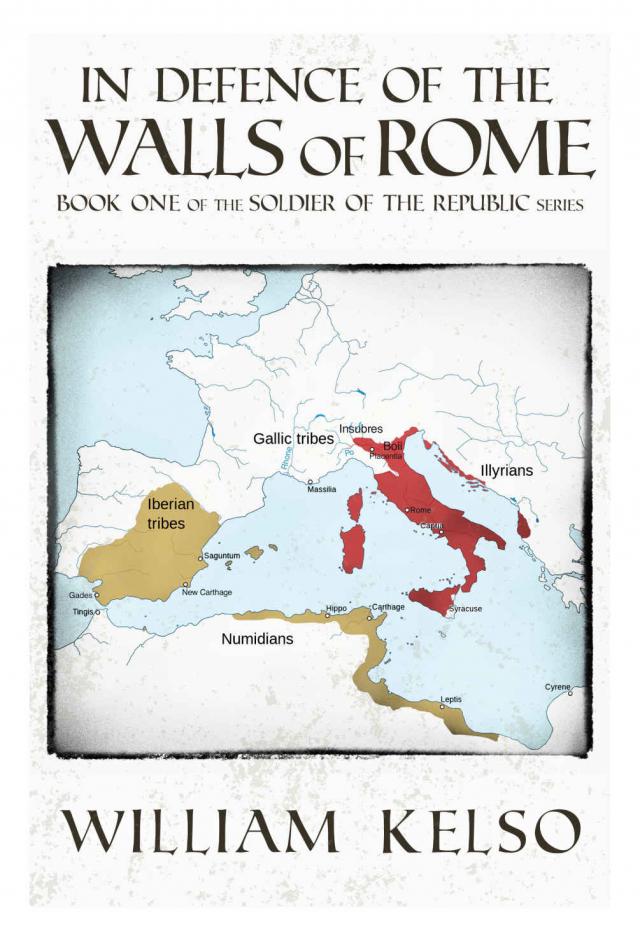
In Defence of the Walls of Rome
Book one of the Soldier of the Republic series
By: William Kelso
Visit the author's website http://www.williamkelso.co.uk/
William Kelso is also the author of:
The Shield of Rome
The Fortune of Carthage
Devotio: The House of Mus
The Veteran of Rome series (9)
Published in 2018 by KelsoBooks Ltd. Copyright © William Kelso. First Edition
The author has asserted their moral right under the Copyright, Designs and Patents Act, 1988, to be identified as the author of this work.
All Rights reserved. No part of this publication may be reproduced, copied, stored in a retrieval system, or transmitted, in any form or by any means, without the prior written consent of the copyright holder, nor be otherwise circulated in any form of binding or cover other than that in which it is published and without a similar condition being imposed on the subsequent purchaser.
A CIP catalogue record for this title is available from the British Library.
ABOUT ME
Hello, my name is William Kelso. I was born in the Netherlands to British parents. My interest in history and in military history started at a very young age when I was lucky enough to hear my grandfather describing his experiences of serving in the RAF in North Africa and Italy during World War 2. Recently my family has discovered that one of my Scottish/Northern Irish ancestors fought under Wellington at the Battle of Waterloo in 1815.
I love writing and bringing to life the ancient world of Rome, Carthage and the Germanic and Celtic tribes. It’s my thing. My aim is to write 100 books in my lifetime. After graduation, I worked for 22 years in financial publishing and event management in the city of London as a salesman for some big conference organizers, trying to weave my stories in the evenings after dinner and in weekends. Working in the heart of the original Roman city of Londinium I spent many years walking its streets and visiting the places, the names of which still commemorate the 2,000-year-old ancient Roman capital of Britannia, London Wall, Watling Street, London Bridge and Walbrook. The city of London if you know where to look has many fascinating historical corners. So, since the 2nd March 2017 I have taken the plunge and become a full-time writer. Stories as a form of entertainment are as old as cave man and telling them is what I want to do.
My books are all about ancient Rome, especially the early to mid-republic as this was the age of true Roman greatness. My books include, The Shield of Rome, The Fortune of Carthage, Devotio: The House of Mus and the nine books of the Veteran of Rome series - Caledonia (1), Hibernia (2), Britannia (3), Hyperborea (4), Germania (5), The Dacian War (6), Armenia Capta (7), Rome and the Conquest of Mesopotamia (8) and Veterans of Rome (9). So, go on. Give them a go.
In my spare time, I help my brother, who is also a Winston Churchill impersonator, run his battlefield tours company which takes people around the battlefields of Arnhem, Dunkirk, Agincourt, Normandy, the Rhine crossing and Monte Cassino. I live in London with my wife and support the “Help for Heroes” charity and a tiger in India.
Please visit my website http://www.williamkelso.co.uk/ and have a look at my historical video blog!
Feel free to write to me with any feedback on my books. Email: william@kelsoevents.co.uk
In Defence of the Walls of Rome
Chapter One – Duty
Spring 225 BCE – Central Italy
It was raining heavily as the solitary, hooded figure hurried purposefully down the mountain track. In the bleak skies, the grey clouds had banished the sun and it was a cold, sombre morning. The patter of the driving rain striking his drenched and glistening poncho was incessant. Out of sight, Flavius could hear the distant but urgent ringing of a village bell. His expression was grave as his sharp, alert eyes peered through the rain, searching the broad valley ahead. Around him, the mountainous landscape stretched away to the horizon. Dense forests clung to the rocky slopes and patches of snow were still visible on the high, jagged-peaks that clawed the sky.
Pausing to check his bearings and catch his breath, Flavius pushed back his hood, allowing the rain to plaster his short blondish hair. He was a rugged handsome man, with hands that looked well used to manual labour. Long years of hard physical work had etched itself into his face, but for a thirty-seven-year-old he was in good shape. His sandals were caked in mud and he was clad in a plain woollen tradesman’s tunic, over which he was wearing a paenula - a poncho. A simple and worn-looking bronze-breast-plate hung across his chest, but it seemed barely wide enough to give him any proper protection. On his left shin, a bronze greave protected his lower leg. Squinting at the river valley through the driving rain he paused. There was no one about but he needed to stay alert for the roads were not safe.
In his right hand he was clutching a seven-foot-long, hasta-thrusting-spear that rose a foot and a half above his head. A sheathed, gladius-short-sword, a sling and a pugio-army-knife were hanging from his belt. Over his shoulder, attached to a stout wooden pole, he was carrying the rest of his belongings – an old and dented bronze-Montefortino-style army-helmet and his marching pack, containing a set of spare clothes, a blanket, bowl, wooden cup and a small ration of barley, hard cheese and dried beans which Agrippina had prepared for him. Strapped to his back, protected by a dust cover, was a large oval-scutum-shield.
For a couple of minutes Flavius rested, his expression sombre and grave. Then ignoring the foul weather, he started out again, pushing on down the desolate track as fast as he could. He could not afford to waste any time. Rome was still more than fifty miles away; at least two days walk. The summons, when it had reached his village of Falacrinum, had been both urgent and chilling. War was coming. Italy was being threatened by a massive and deadly danger. The despatch from Rome, signed by the newly elected consuls, the supreme war leaders of the Roman state had described a very serious situation. A “tumultus gallicus” had been announced throughout Italy, a state of emergency and all regular and existing army exemptions had been suspended. The consuls were mobilising all the resources of the state. The reason was clear. The Gallic tribes to the north beyond the mountains were preparing to invade Roman and Etruscan territory. The long peace with the Gaul’s had broken down. Flavius bit his lip as he hurried onwards. The thought of hordes of barbarians pouring southwards through the mountain passes was enough to keep any family man awake at night. Rumours had already reached his village that a hundred thousand Gallic warriors were massing to the north and would soon be on the march. The barbarians would no doubt be intent on plundering, raping and murdering their way across the rich and fertile lands of Italy. The huge invasion threatened every Roman and allied town, farmstead and village. The Gaul’s would make no distinction between Etruscans, Roman citizens, Samnites, Umbrians or the other peoples of Italy. All would be fair game. Nowhere in the countryside except in the fortified towns would be safe.
A little colour shot into Flavius’s cheeks as he hastened onwards down the track and into the valley below. The summons had ordered him as a reservist to report for duty in Rome, bringing his own weapons and equipment, on the specified date. The time had come again for him, as a Roman citizen, to do his duty for his country. It would be the seventh occasion in nineteen years that he’d answered the call. Leaving Agrippina, his wife and their four children behind, in Falacrinum, had been hard, but he had to go. A state of emergency had been announced and he had a duty to protect his country. Rome needed him.
Emerging at last from the forested mountain slope Flavius stoically plodded on across the open fields with his head bowed against the wind, his poncho glistening and streaming with water. Half a mile away, a raging, chaotic stream, swollen with fresh snowmelt, cut the valley in half and, as he reached it, he turned downstream to follow the muddy track along its banks. The path was deeply rutted by wagon wheels and slippery and made his feet heavy. Cursing the treacherous mud, Flavius struggled onwards using the butt of his long hasta-spear to maintain his balance. As far back as he could remember, there had been talk of building a proper paved and drained road between Rome and Ariminum, but nothing had ever been done.
Hearing the bellow of an ox, Flavius raised his head. Coming towards him along the path was a solitary wagon, pulled along by a team of oxen. Sitting at the front holding the reins, a man, his cloak tightly wrapped around his body and his head covered by a wide-brimmed farmer’s hat, had lowered his face against the driving rain. As the wagon came rolling past, an apprehensive looking woman and two frightened young children silently turned to stare at Flavius, from where they were sitting huddled at the back of the wagon. Flavius lowered his gaze and struggled on without saying a word.
As the travellers moved away, Flavius paused and gingerly half-opened his right hand and peered at the white scar across his palm. The scar was shaped into the single letter M. Someone had given him that scar when he was still a baby. Maybe his mother or father had had second thoughts – hoping one day to recognise him again. Maybe to ask for forgiveness. It didn’t matter. He had never known his real family; father or mother. They were a mystery to him. Nor did he wish to know them. His parents meant nothing to him. As a baby he had been exposed. He had been unwanted. He didn’t know why. No one knew why. All he knew was that the people who should have cared for him; looked after him and raised him as their son; had left him to die alone in the forest. They had really meant for him to die, for he’d been abandoned naked, in a spot where it’s unlikely he’d have been found. But fortune had been on his side that day and he had been discovered by a shepherd boy and his dog. Grimly Flavius closed his hand and, gripping his spear, he resumed his journey. The family that had eventually adopted him as their son had called him “the boy who would not die.” They had told him that he was blessed by the protection of the goddess Fortuna. They were right. He was a survivor. A lucky bastard. And as soon as he had been old enough, he had vowed that he would never abandon his own children. He would be the good father to them - which he himself had never had.
It was a couple of hours later, when a noise made Flavius turn his head and look back the way he’d come. It had stopped raining, but across the grey sodden landscape, the sun still refused to show itself. Along the track, a horse-drawn cart with a single occupant was jolting and swaying towards him. As the cart drew closer, a man raised his hand in a friendly greeting, his eyes peering at Flavius’s weapons and equipment.
“You look like you are heading to Rome for the muster,” the man called out in a cheerful voice. “Do you need a lift? I can take you as far as the bridge across the Tiber. Does that suit you?”
Cautiously Flavius glanced up at the stranger. The driver looked old - around fifty and with a disarming grin. Shifting his gaze to the cart, Flavius saw that it was filled with small wicker cages containing a brood of noisy, cackling chicks.
“Sure. Why not,” Flavius replied, with a grateful look.
“Throw you gear in the back and come and sit at the front,” the stranger said, gesturing to the free space beside him.
Silently Flavius heaved his pack, shield and spear into the back of the wagon and clambered up onto the platform, where the man was sitting, clutching the reins. Having the weight off his shoulder and back was a welcome relief. Then they were off, rolling and jolting through the mud and puddles. To their right the river had widened and had lost some of its natural fury as it flowed towards the gentler more civilised plains of Latium.
“I suppose you have heard about the tumultus,” the man said, his eyes fixed on the track ahead. “Fucking Gaul’s. Can’t trust them to die properly, if you ask me. They say that thousands of mercenaries are pouring across the Alps to join the Insubres and Boii, lured by the promise of taking our silver and women. You should be careful. The roads are not safe, not even for a man armed like yourself.”
“We will stop them,” Flavius replied in a resolute voice. “The consuls will drive them back. We have defeated them before and we shall do so again.”
“Yeah,” the man growled with a resigned look. “Let’s hope so. I am an Etruscan myself. We stand with Rome. It will be our land and our homes that will be ravaged first. People are worried and scared. I have sent my family south to my relatives in Capua; for safety you know. But they won’t let me go and join them. I may be too old to go on active service - like yourself, but I am still with the seniors, in the army reserve. When the invasion comes, they will no doubt put me in the city guard or something like that.”
For a while the two of them rode on in silence.
“What do you do when not serving Rome?” the man asked at last, giving Flavius a quick, inquisitive glance.
“I am a carpenter,” Flavius replied.
“A carpenter,” the man repeated, raising his eyebrows.
“Family?”
“Four children and a wife.”
“Oh boy, that must be tough,” the man said with a sympathetic sigh. “Four children and a wife to feed and then they call you away to war.”
Flavius said nothing as he gazed at the landscape ahead. He and Agrippina and their four children were indeed only just about managing to survive. He had been a carpenter all his life, having simply followed his adopted family into the trade. It was not a high-status profession and it was not going to make him wealthy, but he loved working with wood and he was good at it.
“My sons help me in my workshop,” Flavius said, glancing at the man. “I am training them as my apprentices.”
The driver nodded.
“I thought you might be a farmer,” the man said. “Those weapons of yours and that equipment that you are carrying look pretty impressive. Must have cost a fortune to procure. You have done well for yourself.”
“I am just a carpenter,” Flavius replied, looking away. “It’s a good, honest profession.”
The man’s questions were beginning to annoy him, but the driver was right. His gear and weapons had indeed cost a small fortune, far beyond what he could afford on his meagre carpenter’s income. But he was not about to reveal that everything he had with him, apart from his sling, did not actually belong to him, but had been borrowed from his landlord. The long-standing arrangement which he’d come to years before, with his landlord in Falacrinum, from whom he rented his small home and workshop, was that he could borrow it all when called up to serve Rome. If he was to fight, it made sense to do so with the best weapons and armour. However, if he ever failed to bring the equipment and weapons back, there would be a price to pay. As a debtor, he and his family would come under the authority of his landlord until the debt had been repaid, which might be never. In practice they would become the man’s slaves. That was how it worked. Not that it would really matter, Flavius thought sourly, for if he failed to bring back the weapons, it was most likely because he was dead.
“Well I manage my own transport business,” the driver said. “I am always up and down between Ariminum, Narnia and the cities of Latium, Umbria and Etruria; that’s me. Never in the same place for very long. Wife hates it, but I like the freedom and a man must make a living, right,” he added, with a sudden booming laugh.
Flavius smiled politely but said nothing.
For a while the two of them remained silent. Flavius was gazing pensively at the river when the man suddenly called out to his horse and the wagon turned and began rolling away from the water.
“What are you doing?” Flavius exclaimed, as he glanced at the driver. “This isn’t the way to the bridge. We should keep to the river.”
“Shortcut,” the driver replied calmly. “Trust me. I know all the paths in this district. This way is quicker.”
Flavius frowned but didn’t reply. They were heading back up into the hills and in the distance, across the open meadows, he could make out a large forest clinging to the steep mountain slopes. As the track started to rise, the horse pulling them along, began to slow. Sweat was streaming down the beast’s flanks, but the driver showed no sign of wanting to call a halt. Soon the winding path had reached the start of the forest, and up ahead the track disappeared around a bend into the increasingly wooded and rugged terrain. Looking unhappy, Flavius turned silently to gaze at the woods. They had gone another mile or so into the forest when one of the wagon wheels suddenly struck a large stone, violently jolting both men from their seats. With a snapping, splintering sound, the wagon swayed alarmingly and then came to a halt. Cursing, the driver leapt from the wagon and came around to inspect the damage.
“Oh man, the wheel’s buckled, just my luck,” the man swore in a despairing voice.
Clambering quickly down onto the ground, Flavius knelt and peered at the wheel. The stone had nearly wrenched the wheel from the axle. The wagon was going nowhere. Slowly he straightened up and glanced at the cart. There was no spare wheel.
“Fucking hell,” the man hissed, despair turning to anger. “Those chicks need to be delivered by tomorrow. How am I going to do that now?”
Flavius was about to say something, when in the forest he heard a distant bark. And as he heard the animal, he felt a sudden sense of unease. Something was wrong. Something did not feel quite right about this whole set-up. For a moment he hesitated as he turned to glance at the forest, but amongst the trees nothing moved. Then without looking at the driver, he came around the back of the wagon and reached for his spear and equipment. Calmly he slung his shield over his back, hoisted the wooden pole with his helmet and pack over his shoulder and, gripping his spear, he turned and began to walk away from the wagon, back the way they’d come.