

Imaginations, page 1


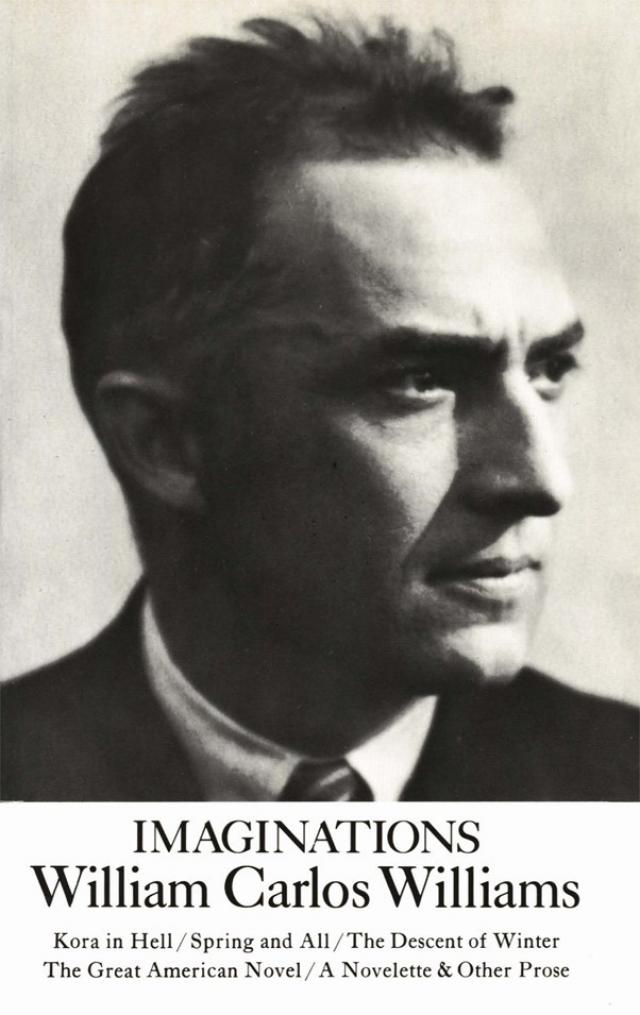
WILLIAM CARLOS WILLIAMS
Imaginations
Kora in Hell
Spring and All
The Great American Novel
The Descent of Winter
A Novelette and Other Prose
edited with introductions by
Webster Schott
A NEW DIRECTIONS BOOK
Contents
INTRODUCTION by Webster Schott
I. KORA IN HELL
Introduction [W.S.]
Prologue (1918)
Prologue to City Lights Edition (1957)
Kora in Hell: Improvisations (1920)
II. SPRING AND ALL
Introduction [W.S.]
Spring and All (1923)
III. THE GREAT AMERICAN NOVEL
Introduction [W.S.]
The Great American Novel (1923)
IV. THE DESCENT OF WINTER
Introduction [W.S.]
The Descent of Winter (1928)
V. A NOVELETTE AND OTHER PROSE
Introduction [W.S.]
A Novelette (1932)
Other Prose (1921-1931)
The Accident (1921)
Marianne Moore (1925)
A Matisse (1921)
An Essay on Virginia (1925)
A Memory of Tropical Fruit (1927)
The Venus (1928)
A Note on the Recent Work of James Joyce (1927)
The Somnambulists (1929)
The Work of Gertrude Stein (1930)
George Antheil and the Cantilène Critics (1928)
Kenneth Burke (1929)
Water, Salts, Fat, etc. (1932)
Statement (1928)
Acknowledgments
Without the encouragement, help, patience of several others, this book would never have been completed. Most important were James Laughlin, Dr. Williams’s friend and publisher and enthusiastic critic, and Florence Williams, Williams’s remarkable wife and friend to all who value his work. Before his death Winfield Townley Scott helped me to see Williams clearer. Conrad Knickerbocker asked the right questions. Emily Mitchell Wallace’s efforts in A Bibliography of William Carlos Williams made everything easier. Dee Danner Barwick typed and retyped much of the manuscript and commented intelligently. Editing the early Williams would have been drudgery without the help of Barbara Harr. Nan Schott tolerated anxiety and listened. David E. Scherman first understood what I have tried to say here about William Carlos Williams.
The introduction originally appeared, with minor changes, in The American Scholar.
W.S.
Kansas City, Mo.
Introduction
Beautiful Blood, Beautiful Brain
And approaching the end of the novel in his mind as he sat there with his wife sleeping alone in the next room he could feel that something unusual had happened. Something had grown up in his life dearer than—It, as the end. The words from long practice had come to be leaves, trees, the comers of his house—such was the end. He had progressed leaving the others behind him.
—The Great American Novel
WILLIAM CARLOS WILLIAMS forces the kinds of questions we address to natural disasters, reports of miracles and works of genius. How? Why? From what inexplicable source?
He was an American original. In his 79 years Williams led at least two lives, and at manic intensity. For some forty years he practiced medicine—obstetrics and pediatrics—in the small industrial town of Rutherford, New Jersey. He saw by his own account a million and a half patients and delivered 2,000 babies. This was from 1910 until 1951, before the era of doctoring by answering service and beginning the medical day with a call to the stockbroker. Williams worked like a slave at medicine. It brought him neither fortune nor special rank. Instead, it gave him and us that other life beyond value, a life of art.
While stealing time between patients, catching images and ideas between house calls, scribbling at midnight, William Carlos Williams laid the foundation of the most consequential one-man body of modern literature in American history—a total of 49 books in every literary form we know and in forms we still have trouble classifying. He wrote some 600 poems, four full-length plays, an opera libretto, 52 short stories, four novels, a book of essays and criticism, his autobiography, a biography of his mother, an American history, a book of letters. He translated a medieval Spanish novel. He wrote the five-volume epic-spectacular poem Paterson over a period of three decades. Williams’s most important work had been done by the time he retired from medicine in 1951. When he died 12 years later, after a series of crippling strokes, William Carlos Williams had no peer as the total American writer.
Not our time but another time will fix Williams’s place in American literature. For the present he stands first among his contemporaries. If the public did not draw him to its bosom as it did the performing Robert Frost or canonize him as it did T. S. Eliot, the new young poets of his era paid him the perfect homage. They became like him. Not Ezra Pound or E. E. Cummings, but finally William Carlos Williams freed American poetry from the irons of rhyme and meter. His disciples of liberation ranged from formal poets like Winfield Townley Scott and Karl Shapiro to insurgents like Charles Olson and Robert Duncan. He was the instrument of change. Without him one cannot account for contemporary American poetry.
If Williams left tingling elegances to Wallace Stevens and academic grace to W. H. Auden, he chose larger. He seized experience and turned it into poetry hot with the blood of life. His was a found art that raised everything it touched—trees and birds, people and dogs, water and fruit, love and flowers—to a level of startled awareness. It was an art so embedded in his own personality and manner of living even Williams could never translate it into a coherent system of aesthetics readily available to others.
William Burroughs once told the critic Conrad Knickerbocker there is no such thing as will power, only need. Driving William Carlos Williams was a need for both medicine and literature that exceeded the definitions of commitment. He turned his moods into work: “Periodicity of psychological and imaginative energy,” he said in a notebook in 1930. “Work all the time—manic depression but learn to use yourself: when up drive in—when down assume the clerk—there’s plenty of room for both.” He pursued both medicine and art simultaneously. “Time meant nothing to me,” he said in his autobiography. “I might be in the middle of some flu epidemic, the phone ringing day and night, madly, not a moment free. That made no difference … Five minutes, ten minutes can always be found. I had my typewriter in my office desk. All I needed to do was pull up the leaf … and I was ready to go … I worked at top speed. If a patient came in at the door while I was in the middle of a sentence, bang would go the machine—I was a physician. When the last patient left, up would come the machine … Finally, after 11 at night, when the last patient had been put to bed, I would always find the time to bang out 10 or 12 pages. In fact, I couldn’t rest until I had freed my mind from the obsessions which had been tormenting me all day … Having scribbled I could rest.”
Medicine fired and fed the poet. Art informed the doctor: “To treat a man as material for a work of art makes him somehow come alive for me.” It also held him together: “Most of my life has been lived in hell—a hell of repression lit by flashes of inspiration, when a poem such as this or that would appear.” There was not only space, but absolute necessity, for both writer and physician in Williams.
Mostly we know William Carlos Williams as the titan who created Paterson, as the revolutionary miniaturist of “The Red Wheelbarrow,” or as the magnificent autumnal lover of “Asphodel That Greeny Flower.” This is the artist commanding his powers. To know the doctor searching for his art and testing it, the artist tasting life and suffering it, or to know the literary heretic rationalizing his schism and anticipating the future, we need more. We need the socially introspective journal writer of “The Descent of Winter.” We need the iconoclastic and privately published (usually in France) doctor-poet of such strange and troubled books as Kora in Hell, The Great American Novel, A Novelette, and Spring and All. Qualified fictions that probe the idea of fiction, not wholly poetry but set with the jewels of poetry, they are William Carlos Williams’s books of primary belief. They are also crisis books. Crisis books because they show Williams immediately after his first poems, barely known and desperately struggling to erect a platform of ideas from which he could make sense to himself and whoever would read him. They show him breaking through a thicket of words and emotions to a belief in his own worth that was never shaken. A belief that poured the concrete of Paterson and gave Williams his heirs.
These are difficult books, these four, and not to be wished onto desert minds. They churn with giant ideas and powerful feelings, often pursued with the fragile butterfly net of intuition. There are no narrative lines except those in Williams’s head. No conventions except those Williams invented as he went along. No genuflections to formality or propriety. Williams had no time and less taste for that. He was writing these books in search of a faith, not an audience. From 300 to 1,000 copies of each were printed. Fewer were sold. The radical present and the revolutionary future were Williams’s goal, not an invitation into the lace-curtained living room of America. “I’ll write whatever I damn please,” he said in his preface to Kora, “whenever I damn please and as I damn please and it’ll be good if the authentic spirit of change is on it.”
This doesn’t mean Williams was living in splendid isolation among the Dantesque vistas of industrial New Jersey. The aesthetic upheavals of the post-World-War-I period (when all of these books were written) lifted Williams too. His appetite for art was gargantuan. He consumed music, drama, painting, literature as if they were food. He visited France and Switzerland briefly. Through friends he had lines out to dadaism, surrealism, furturism, objectivism, imagism, cubism, cacophonous music. These convulsions of aesthetics caught Williams at a crucial time—his late 30’s and early 40’s—and he was struggling between discontent and assertion, self-examination and self-discovery. He was put down by poets who counted—Eliot, Stevens, Hilda Doolittle, even his old college pal Ezra Pound. As a physician he found meanness and stupidity thwarting his medicine and life itself. The nights looked like corpses, he says in Kora. It was hard to tell loss from gain and all beauty stood upon “the edge of the deflowering.”
So Williams wrote, as always, to keep his sanity by extending the world he saw into the one that bloomed in his imagination. In The Great American Novel he ruminated over such vexing questions as what makes a novel? where are its sources? how does it become American? what should language do? One of the first anti-novels written in America, the work becomes a commentary on its own construction. The luminous Kora in Hell grew out of compulsion. Like Kora, the Greek goddess of spring who was captured and taken to hell, Williams “thought of myself as Springtime and I felt I was on my way to Hell (but I didn’t get very far).” After a year of writing every day he had created an underground classic, one of the earliest models for contemporary prose poetry. Williams wrote Spring and All as a travesty on the typographically chaotic literature of the time (1923). He also wanted to push on with the freedom he had found in Kora. Thus he framed some of his finest poems—”The Red Wheelbarrow,” “By the Road to the Contagious Hospital,” “The Sea That Encloses Her Young Body”—in eccentric prose sermons on their principles. Years later Williams said that Spring and All “made sense to me, at least to my disturbed mind—because it was disturbed at that time—but I doubt it made sense to anyone else.” A Novelette was another piece of imaginative prose written “for personal satisfaction” and to learn more about the problems of prose. He had “abandoned all hope of getting American readers of a special sort.” Remembering Kora, Williams sat down, faced the page, and poured himself out in automatic paragraphs. He broke rules, defied logic, and charged his psychic battery. By dint of rhetoric if not force of argument, he also managed to wed his theories of art to his ideas about matrimony. With The Descent of Winter, a journal he never saw fit to push beyond its first appearance in 1928 in Ezra Pound’s The Exile, Williams seemed to throw poetry, fiction, social insight and critical commentary onto paper as if attempting to exorcise depression via the act of creating. Art was Williams’s therapy. Several fine poems glorify this nearly forgotten work. But the most instructive thing about The Descent of Winter is Williams’s great sense of urgency. Time was running out for art as it was running out for him as he wrote. Poetry must make contact with hard facts and authentic feelings or else become rhetorical trash atop the junk heap of industrialization.
These works tell us as much about the how and why of William Carlos Williams as anything he wrote. All speak in the voices of autobiography, and they reveal an immensely complicated man: energetic, compassionate, socially conscious, depressive, urbane, provincial, tough, fastidious, capricious, independent, dedicated, completely responsive. To the charge that he contradicted himself, Walt Whitman replied that he embraced multitudes. So did Williams. He was the complete human being, and all of the qualities of his personality were fused in his writing. He possessed to the full those traits we associate with the myth of the American: ingenuity, lusty enthusiasm, and an absolute faith in the new. Yet despite all the riches of his personality and the fluids of exegesis embalming his writing in scholarship, Williams’s writing came from a simple source—his belief in the imagination.
Long after these works, near the end of his career, Williams turned inward in “Asphodel That Greeny Flower” to seek out those truths that had held firm. He said:
It is difficult
to get the news from poems
yet men die miserably every day
for lack
of what is found there.
He was speaking of the power of the imagination to hold human beings to life and propel them onward. Kora, The Great American Novel, Spring and All, A Novelette, The Descent of Winter are documents of that discovery. Williams made it for himself; it became the foundation of all his poetry, fiction, drama. And he extended it as a means of evaluating all other art.
Williams knew one reality. He created another reality to make the first manageable. Against the practice of medicine, following “the poor defeated body into gulfs and grottoes,” he posed his flights of imagination into the intensity of living things, the splendors of association and dislocation. If these books are “about” anything—as opposed to being the things they are themselves—they are about the powers of the imagination to sustain and expand human consciousness. “To refine, to clarify, to intensify that eternal moment in which we alone live there is but a single force—the imagination,” Williams says in Spring and All. “The only realism in art is of the imagination.” It makes blackness beautiful. “The birth of the imagination is like waking from a nightmare. Never was the night so beneficent.” In a mysterious psychoanalytic transaction with the self, imagination “gives the feeling of completion by revealing the oneness of experience, it rouses rather than stupefies the intelligence by demonstrating the importance of personality, by showing the individual, depressed before it, that his life is valuable—when completed by the imagination. And then only.”
Words, language, the means of speaking the imagination, were also the barrier to penetrating the imagination. “Words are the flesh of yesterday,” Williams says in The Great American Novel. “Progress is to get—But how can words get. Let them get drunk. Bah. Words are words.” Worse yet, our words were English words trying to do American work. Struggling against the dead cultural whale of Europe, the American imagination had to recreate “everything afresh in the likeness of that which it was.” Using spoken, heard American English the imagination “affirms reality most powerfully … it creates a new object, a play, a dance which is not a mirror up to nature.”
What did such theories mean in action? That Williams would see life brand-new but all of a piece. The hums of a dynamo and the screams of a woman in anguish are fused in the energy of the present. The discovery and exploration of America parallel Williams’s search for the new speech to create the New World’s art. Erotic juice flows through all things. A little car purrs to itself at the thought of night and longs to be a woman. Imagining turns words into things. It lifts them from beneath the nose and hurls them fresh as rain against Williams’s consciousness. The poems of Spring and All turn from print into the things, the events themselves. Sun streams. Roses bloom. “Say it, no ideas but in things,” Williams demanded. And his writing snaps pictures like a marvelous image machine.
Williams found a system that worked for him. The imagination became source of calm, art, union with the universe. Riding along in his car with a yellow pad and pencil on the seat, stopping for locomotives, swerving to avoid ash carts, Williams plunged his mind into the deluge of objects and actions around him. He snatched poetry from the instant. He may have been the first writer in the world to fashion art from the dreaminess of driving a car. Swift, fragmentary, compressed, his technique was the product of his circumstance. He had to write his way because his medicine gave him no choice. Ringing telephones and waiting patients allowed no deliberation over sonnets or villanelles. Williams had to make art straight from common speech and uncommon imagination or no art at all. Succeeding at art and succeeding at life through art, Williams believed he had nailed truth down. What worked for him had to work for everyone. He was drunk with enthusiasm—sometimes even irrational—in celebrating what the imagination could do. He behaved like a prophet. Reading these early works now, we know he was.
In the last half of the twentieth century we’ve learned we can be free only through the senses, and we’ve been struck by a sensual revolution. Industrialization triggered it. Technology completed it. William Carlos Williams anticipated it. Williams was our forebear, and if our time had any saintly men he was among them.


