

The Wild Adventures of Cthulhu, Volume 3, page 1


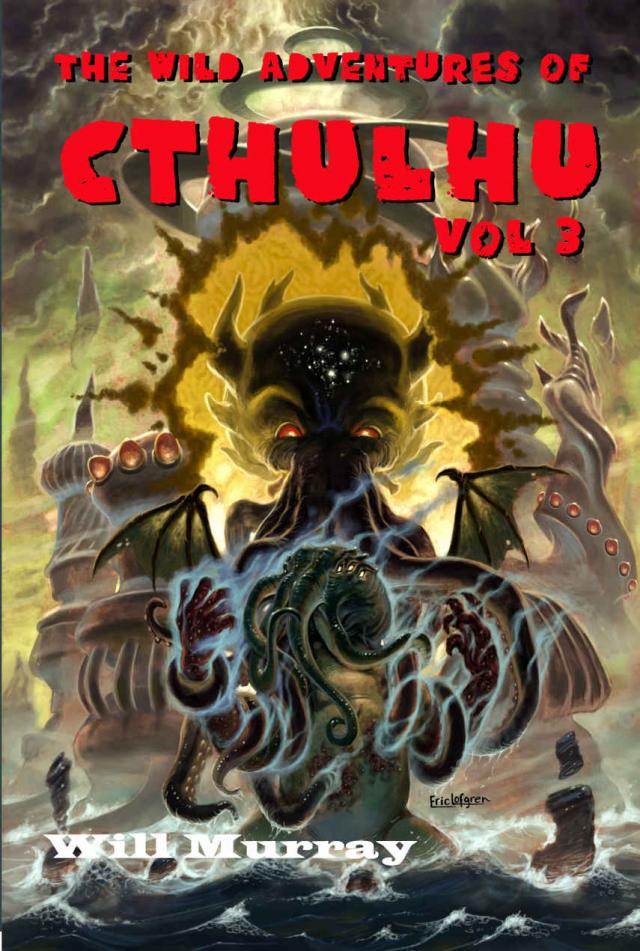
THE WILD ADVENTURES OF
CTHULHU
Volume Three
Will Murray
Odyssey Publications — 2024
Kingsport, Massachusetts
BOOKS BY WILL MURRAY
Nick Fury, Agent of S.H.I.E.L.D.: Empyre
Doc Savage: Skull Island
Tarzan: Return to Pal-ul-don
Tarzan: Conqueror of Mars
King Kong vs. Tarzan
The Spider: The Doom Legion
The Spider: Fury in Steel
The Spider: Scourge of the Scorpion
The Wild Adventures of Sherlock Holmes, Vol. One
Master of Mystery: The Rise of The Shadow
Wordslingers: An Epitaph for the Western
Forever After: An Inspired Story
The Wild Adventures of Cthulhu, Vol. One
Dark Avenger: The Strange Saga of The Shadow
The Wild Adventures of Cthulhu, Vol. Two
Tarzan: Back to Mars
The Wild Adventures of Sherlock Holmes, Vol. Two
The Wild Adventures of Sherlock Holmes, Vol. Three
Spicy Zeppelin Stories
The Wild Adventures of Sherlock Holmes, Vol. Four
The Spider: The Hangman from Hell
FORTHCOMING:
Knight of Darkness: The Legend of The Shadow
The Wild Adventures of Sherlock Holmes, Vol. Five
Secret Agent X vs. Dr. Death
Tarzan: Plateau of Dread
The Wild Adventures of Cthulhu Vol. Three © 2024
by Will Murray.
All Rights Reserved.
Covers and Frontispiece by Eric Lofgren © 2024.
All Rights Reserved.
Characters and concepts derived from A. Merritt’s Dwellers in the Mirage are used with the express permission of Adventure Pulp LLC, and are © copyright 2024.
THANKS TO:
Elizabeth Carter Bissette, Gary Buckingham, Jeff Deischer,
Stefan Dziemianowicz, Doug Ellis, Barbara Friedkin, Don O’Malley, Ray Riethmeier, Darrell Schweitzer and Christopher Sequeira.
Map, Dedication art, Demon drawing, and Cthulhu dingbats
by Jason Eckhardt.
First edition, November, 2024
Designed by Robert J. Sodaro.
Like us on Facebook: “The Wild Adventures of Cthulhu”
www.adventuresinbronze.com
Map, Dedication art, Demon drawing, and Cthulhu dingbats
by Jason Eckhardt.
First edition, November, 2024
Designed by Robert J. Sodaro.
Like us on Facebook: “The Wild Adventures of Cthulhu”
www.adventuresinbronze.com
Kingsport, Massachusetts
Dedication
For the fabulous Abraham Merritt.
CONTENTS
Introduction 8
The Furnace of Yeb 12
What Ghouls These Portals Be 33
Kingsport Tea 45
The Pokkuri Pattern 64
The House at One Tower Way 77
Miss Hitchbone Reclaims Her Own 87
The Shadow Over Uxmal 89
Draculhu 101
The Caller in the Cupboard 116
Cthulhu’s Garden 128
The Summoner of Khalk’ru 151
Into the Blackest Beyond 182
About the Author 186
About the Artist 187
INTRODUCTION
As with the previous volumes of The Wild Adventures of Cthulhu, this collection is a mixture of stories previously printed in various horror anthologies, interwoven with tales written expressly for this book.
In this case, owing to the fact that I have nearly exhausted my Lovecraftian stories for reprinting with the prior volumes, the majority of narratives collected herein are original. While not every story in this new collection properly belongs to the Cthulhu Mythos, most that are, I’ve set in Massachusetts, which H. P. Lovecraft considered to be––in his time, at least––a “seat of weirdness.” As always, certain cosmic entities Lovecraft made immortal turn up when the reader least expects it.
The opening novelette, The Furnace of Yeb, revisits the Antarctic artifact of the Great Old Ones I originally wrote about in “To Clear the Earth,” which was reprinted in Volume 1 of this series. Here, we once more meet the Cryptic Events Evaluation Section agents, Sofia Volpe and Raymond Redpath. They might have survived their prior encounters with the cosmic enemy, but here, perhaps predictably, any victory they achieve is at best a holding action and comes at a high price.
“What Ghouls These Portals Be” is another Cryptic Events Evaluation Section story, this time involving one of their professional remote viewers. Here again, my training as a remote viewer takes this out of the realm of pure fantasy. The techniques I describe are authentic.
Kingsport Tea, I trust, is also original. My years as a professional Tarot card reader working in a traditional New England tea room inspired this story, which originally appeared in the PS Publishing anthology, Shadows Out of Time.
“The Pokkuri Pattern” was written expressly to justify my planned cover, which depicted Cthulhu emerging from his risen tomb, R’lyeh. One cannot release a collection entitled The Wild Adventures of Cthulhu without the original Great Old One making an appearance, now can one?
Some of these stories I had drafted in prior years, but never satisfied me. So I put them aside until I could revisit them.
“The House at One Tower Way” is an example of this. The original version seemed to lack coherence, and the motivations for the characters were obscure. H.P. Lovecraft liked obscurity in his stories because he thought it ramped up the sense of horror and focused the confrontation with the unknown. But you can be too obscure for the modern reader.
So I tackled this story again and found ways to solve the problems presented by the original draft. A few decades of writing experience no doubt helped me in this endeavor.
“Miss Hitchbone Reclaims Her Own” is a Lovecraftian yarn in the vein of Lovecraft’s “In the Vault.” Written for an anthology of horror tales limited to five hundred words, it may be the shortest professional story I ever penned. I expanded it slightly for this collection.
“The Shadow over Uxmal” was one of the earliest stories I ever wrote. And represents one of the rare times I attempted to consciously emulate H. P. Lovecraft’s style––although in the context of the times, which was the early 1970s. My interest in Meso-American mythology strongly informs this narrative.
“Draculhu” is another CEES story involving a different remote viewer. This was written for the 2022 anthology Dracula Unfanged, and gave me the opportunity to explore Lovecraft’s Dreamland, and the entities that reside there.
“The Caller in the Cupboard” was inspired by a photograph sent to me by a friend––a professional medium––who once opened her kitchen cupboard and discovered in the woodgrain on the back of one door a perfect screaming demon face. I decided to build a tale around that, setting it in a remote corner of Lovecraft’s Arkham country.
I wrote “Cthulhu’s Garden,” when I decided that my proposed lineup required a second narrative in which Cthulhu played a significant role. So many stories centering on him prove disappointing because they merely revisit Lovecraft’s original story, “The Call Of Cthulhu,” with variations. I thought about what could be done that was wholly original.
Since I haven’t read most Mythos stories written in recent decades, I can only hope that I succeeded!
While I was writing Cthulhu’s Garden and pondering how best to conclude this nihilistic story, an opportunity to sequel A. Merritt’s 1932 Lovecraftian novel, Dwellers in the Mirage, came my way via Doug Ellis, who had acquired the rights to the author’s published works.
I was a big fan of Merritt back in the 1970s, when I first encountered his works. Dwellers in the Mirage reflected marked Lovecraft influences, but for many decades the Cthulhu Mythos borrowings were a matter of speculation and not confirmed fact. Eventually, when Lovecraft’s letters began to be collected in book form, it was revealed that in 1934 he and Merritt had met over lunch in New York City, during which Merritt told Lovecraft that he had been reading the latter’s contributions to Weird Tales for years. Obviously, Merritt had been inspired by “The Call of Cthulhu,” at least.
This was an exciting, even tremendous opportunity. While still in mid-story, I decided that Cthulhu’s Garden would serve as the prequel to my sequel to Dwellers in the Mirage, which I called The Summoner of Khalk’ru. For those who are unfamiliar with Merritt’s work, Khalk’ru is an analogue of Lovecraft’s Cthulhu. But are they one and the same?
More than that, I will not say…. lest I spoil the story sequence.
This exciting development motived me to rethink my story selection, discard my planned cover, and commission the talented Eric Lofgren to paint something appropriate for the epic struggle between Cthulhu and Khalk’ru––a clash readers of both literary giants could only imagine, until now….
The concluding story, “Into the Blackest Beyond,” is an idea I’ve had kicking around in my skull for a decades, but never got around to writing. What happens if in the future astronauts exploring the unknown encounter the ultimate horror that lies beyond the rim of the known universe?
Half of this collection is comprised of Cryptic Events Evaluation Section stories. Previously, I’ve focused on the various field operatives, remote viewers, and other undercover
Some have wondered if I selected the character’s name to evoke that of Lamont Cranston, otherwise known as The Shadow. I will not completely deny that, but I will note that a close suburb of H. P. Lovecraft’s beloved Providence was also named Cranston….
––Will Murray
THE FURNACE OF YEB
In the beginning, the anomaly was thought to be an asteroid that had impacted Antarctica during Earth’s antediluvian past.
It was first discovered by an orbiting Russian cartographic satellite, a Roscosmos GEO-IK-2. The telemetry radioed back to Earth was intercepted by a surface station in Australia known as Pine Grove. The Russians did not know this, of course.
As a consequence, Russian Intelligence and the American National Reconnaissance Office simultaneously became aware of the object.
At the Plesetsk Cosmodrome in Russia, the analysts jumped to a facile but understandable conclusion.
“It is asteroid. Doubtless melting of Antarctic ice has exposed it to view.”
Since it was summer in Antarctica, this conclusion made a certain amount of sense. The South Pole was indeed melting, despite the bitter temperatures predominating in the southernmost continent in the Antarctic summer month of November.
After the images were studied and relayed to the Kremlin, it was decided at the highest levels of the Russian government that an expedition would be mounted to examine the asteroid—if for no other reason than to beat the West to the prize.
This decision was made three days after the Americans had already launched their own expedition.
An analyst at the National Reconnaissance Office pored over the intercepted images, and came to the same premature conclusion.
“Meteoroid or asteroid. Probably older than the dinosaurs.”
Another analyst concurred. “Hard to judge its size, but I would guess it’s eighty feet across. Can you imagine the impact that had? Especially if it hit before the last polar tilt. Antarctica was a sprawling tropical forest back then.”
The analyst’s report went up to the chain of command, where it landed on the desk of Deputy Director Arthur Arrowsmith.
He examined the images in silence. After a while, a growing concern started gnawing at the pit of his stomach.
Arrowsmith had once been an analyst himself. These images looked familiar. They showed an irregular-surfaced dome the color of faded rust. The surface was crackled and pitted as if it had been subjected to unusual atmospheric forces. At the apex of the dome there was a shallow depression. That was all.
It did not look manmade, yet it did not appear entirely natural. If it was an asteroid, it was unique. But Arrowsmith did not think it was an asteroid. He had seen images like this before.
Hand-carrying the supersecret folder down three flights of stairs at the NRO’s headquarters in Chantilly, Virginia, deputy director Arrowsmith entered a secure wing and walked directly to a black door that bore no name or department designation.
Internally, it was known as the “Weird Desk.” It was where all the anomalous data and inexplicable reports ultimately landed.
Officially, this was the Cryptic Events Evaluation Section of the NRO—the blackest of black agencies. It was so secret that 98% of NRO personnel did not know it existed.
Entering, Arrowsmith confronted a cold-faced individual who sat behind an executive desk with a nameplate that read: Director Cranston. Cranston looked up.
“You have something for me?”
Arrowsmith dropped the folder on to the desk, saying, “About thirty years ago our satellites picked up something in this area of Antarctica. We sent an agent to investigate. He never came back. On its next pass, a KH-11 spy sat failed to detect the anomaly. There was only a section of broken ice. We closed the case. Now the thing appears to be back.”
“Where is this spot?”
“The location is a ridge of ice called Ymir’s Welt.”
“I’ll look into it,” said Cranston.
“The lost operative was named Pickman. He was before your time.”
After the deputy director exited, Cranston turned his attention to his desktop computer and did a search of the name Pickman. Reading the file quickly, he picked up the telephone, dialing an extension.
A crisp female voice answered, “Special Powers Directorate.”
“See me in my office, Specialist Volpe. A hot one just landed on my desk.”
“How hot?”
“So hot it’s supercold.”
“Be right up.”
“Bring Redpath with you. This is bigger than one operative.”
The woman who entered the office was barely thirty, with a gymnast’s feline body and long auburn hair. She was accompanied by a sullen man with the dark eyes and sun-bronzed face of an American Indian.
Director Cranston began, “Sit down. First, let me give you the bad news. This assignment will take you to the heart of Antarctica.”
“What’s the good news?” grunted Specialist Raymond Redpath.
“There is no good news. You should expect that by now. But for what it’s worth, it’s summer down there. That means constant daylight and survivable conditions. Now here’s the skinny. Thirty years ago one of our people went to the South Pole to investigate something that pushed up through the ice. Agent Pickman never came back. The thing in the ice disappeared. Our satellites confirmed this. The decision was made back then to close the file. Now we’re reopening it. The thing is back.”
“What thing?” asked Specialist Sofia Volpe.
“This damn thing.”
They examined the photographs, but got nothing from them.
“Meteorite?” asked Redpath.
“I wish. Russian satellite picked this up, but we intercepted their telemetry. We need you operating in Antarctica before the Russians get there. Don’t bother packing. You wouldn’t own suitable clothing. Not if you want to live. Appropriate gear will be provided. Now get to the airfield. Figure out what this thing is and what needs to be done about it.”
“Do you think this is an external threat?” asked Sofia.
Standing up, Cranston said, “For all I know, we could be in planetary trouble. Last time, this globe seemed to poke itself up out of the ice. Then it retreated. Maybe Pickman helped engineer that. Now the ice has melted all around it. So another retreat seems unlikely. Now get going. I’ll squirt you any research that might be useful.”
* * *
A day later, a Hercules C-130 turboprop transport came lumbering out of the bright Antarctica sky and dropped down on long skis onto a runway consisting of iced-over concrete that serviced the Amundsen-Scott South Pole Station sitting high on the Antarctic plateau at the Geographical South Pole.
Redpath and the Sofia stepped out. Despite being bundled up to their noses in white three-layer survival suits, they immediately retreated.
“My eyebrows just frosted over!” Sofia complained in a shivering voice.
“Mine, too,” grunted Redpath. “Let’s get to it. The quicker it’s done, the sooner we are home.”
They stepped out and were met by a shapeless someone whose breath steamed so much it was as if his mouth was on fire, making it difficult to see his face. His features were covered by a cold mask and goggles, so it didn’t matter.
“We have a nice warm helicopter waiting for you,” he greeted. “You just have to survive the transfer.”
They were rushed to the waiting Chinook via an International Orange Sno-Cat; its electric heater radiated reassuring warmth.
The world in which they found themselves was incredibly white and supernaturally cold. The snowy landscape was dominated by a modular row of barracks-style bluish-gray buildings built on tall stilts. Both operatives felt an overpowering urge to duck inside and crawl into a warm sleeping bag.


