

The Wild Adventures of Sherlock Holmes Vol. 2, page 1


BOOKS BY WILL MURRAY
Nick Fury, Agent of S.H.I.E.L.D.: Empyre
Doc Savage: Skull Island
Tarzan: Return to Pal-ul-don
Tarzan: Conqueror of Mars
King Kong vs. Tarzan
The Spider: The Doom Legion
The Spider: Fury in Steel
The Spider: Scourge of the Scorpion
The Wild Adventures of Sherlock Holmes: Vol. One
Master of Mystery: The Rise of The Shadow
Wordslingers: An Epitaph for the Western
Forever After: An Inspired Story
The Wild Adventures of Cthulhu: Vol. One
Dark Avenger: The Strange Saga of The Shadow
The Wild Adventures of Cthulhu: Vol. Two
FORTHCOMING:
Tarzan: Back to Mars
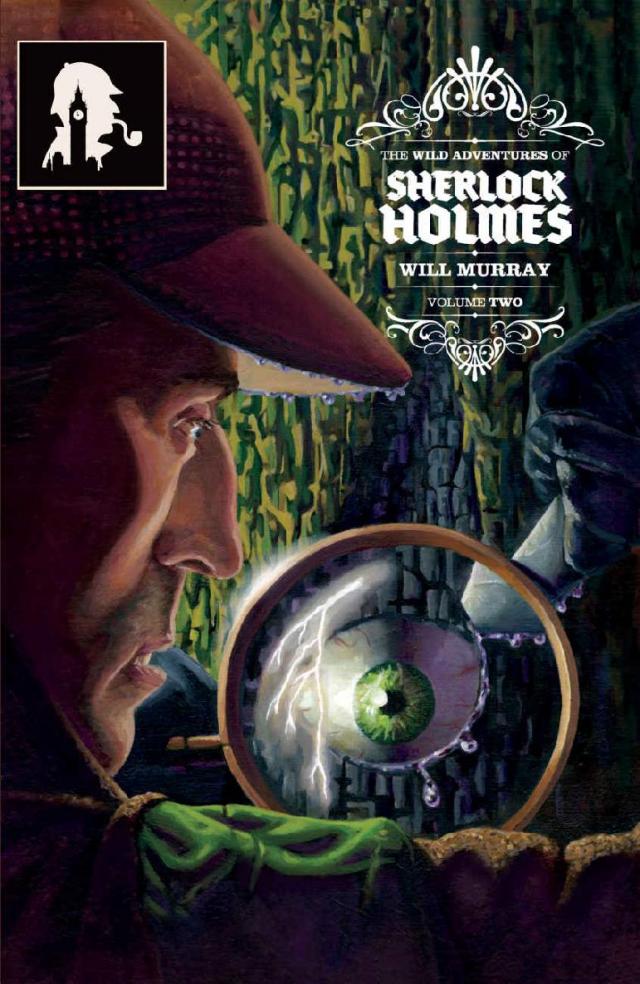
Cover by Gary Carbon
Odyssey Publications, 2023
The Wild Adventures of Sherlock Holmes, Volume Two
© 2023 by Will Murray. All rights reserved.
Front cover image and frontispiece copyright by Gary Carbon © 2023. All rights reserved.
Back cover image copyright by Joe DeVito © 2023. All rights reserved.
THANKS TO
Gary A. Buckingham, John Linwood Grant, Robert Greenberger, David Marcum, Matthew Moring, Brian Belanger and Derrick Belanger.
Series Editor: Ray Riethmeier, BSI
PUBLISHING HISTORY
All stories previously published in MX Publishing or Belanger Books Sherlock Holmes anthologies, with the exception of “The Problem of the Surrey Samson,” which first appeared in
Thrilling Adventure Yarns, 2021.
DESIGNED BY
Robert J. Sodaro
MAP OF ENGLAND BY
Jason C. Eckhardt
First edition––April 2023
Like us on Facebook: “The Wild Adventures of Sherlock Holmes”
www.adventuresinbronze.com
Dedication
For Algernon Blackwood,
Who showed us the other side of the Sherlockian coin….
The Wild Adventures of Sherlock Holmes
Volume 2
CONTENTS
Introduction xi
The Singular Problem of the Extinguished Wicks 11
The Mystery of the Spectral Shelter 26
The Problem of the Surrey Samson 42
The Uncanny Adventure of the Hammersmith Wonder 52
The Repulsive Matter of the Bloodless Banker 65
The Adventure of the Abominable Adder 84
The Adventure of the Sorrowing Mudlark 102
The Adventure of the Emerald Urchin 117
The Adventure of the Expelled Master 135
The Conundrum of the Questionable Coins 154
Introduction
For this, my second collection of Sherlock Holmes stories, I have many more published tales from which to choose than from that I did with the prior volume. Accordingly, this selection is more focused than the first one.
While The Wild Adventures of Sherlock Holmes is simply another branch of the umbrella series of my Wild Adventures books, their “wildness” is relative, and not necessarily indicative of major deviations from the traditional approach to Holmesian pastiches. Most of my efforts have been canonical-style stories set in the Victorian era and written as closely as possible to the way Sir Arthur Conan Doyle approached his original Holmes adventures.
Yet I’ve occasionally been asked to contribute to anthologies where the obdurate rules that constrained Conan Doyle have been temporarily suspended, and this volume reflects this approach more than did Volume One.
You have been duly warned.
Nevertheless, most of the ten adventures reprinted in the following pages adhere to the basic rules of the canon. Inasmuch as I tend to write highly imaginative stories in my other endeavors, I like to challenge Sherlock Holmes with mysteries that take him to the edge of knowledge and give him a glimpse beyond, without quite stepping over into the Supernatural.
The opening story in this volume, “The Singular Problem of the Extinguished Wicks,” deals with the imponderable issue of spontaneous human combustion, for which no solid scientific explanation has yet been established. Accordingly, Sherlock Holmes finds himself challenged in a manner that is not normally within his professional experience. This is a theme repeated throughout this volume, depicting the undeniable fact that Sherlock Holmes, although a genius in his field of endeavor, is not infallible.
Several of the stories in this collection were written for MX Publications anthologies where the challenge was to write a satisfactory story based on Dr. John Watson’s citing of otherwise-unrecorded adventures mentioned in Doyle’s tales. Among them are “The Singular Problem of the Extinguished Wicks,” “The Uncanny Adventure of the Hammersmith Wonder,” and “The Repulsive Matter of the Bloodless Banker.” Others were devised in response to editorial requests for baffling problems that appeared to be Supernatural, but could be proven otherwise. These, too, strain at the boundaries of Victorian thought without shattering them.
For three adventures, I have engineered cases that brought together Sherlock Holmes with his rational knowledge and Algernon Blackwood’s psychic physician, Dr. John Silence, into cases that test Holmes’s and Watson’s shared rational worldview and put them at odds with Dr. Silence.
How these unique cases unfold and are resolved I leave it up to the reader to discover and evaluate for himself. I will only say that sometimes Sherlock Holmes’s materialistic point of view is vindicated, but not always. The joy in writing these encounters lies in being true to the visions of their respective creators, while also portraying their unique creations with fidelity.
While I share Conan Doyle’s view that there is more to Spiritualism than mere superstition, I think his creation, Sherlock Holmes, takes the correct point of view with phenomena that seem to operate outside of consensus reality, that they must be rigorously examined before a purely rational worldview can be surrendered for any alternative theories.
Consequently, in this collection of truly extraordinary tales, Holmes and Watson periodically bump up against the inherent problems of looking at the world through strictly scientific lenses. Not often, but sometimes , but not often, the magnifying glass of accumulated scientific knowledge is not the most appropriate tool.
The collection closes with “The Conundrum of the Questionable Coins,” in which Sherlock Holmes wrestles with possible surviving artifacts of lost Atlantis. As with my opening tale, not every question is satisfactorily answered.
Beyond that, you have been warned to expect the unexpected. I leave it to the reader to take away from these tales what they choose. In my own personal and professional life, I am much more akin to John Silence than I am to Sherlock Holmes. But my admiration for both fictitious men is equally unbounded, and I do not favor one over the other. I trust that this will be evident to those reading this unusual collection.
—Will Murray
The Singular Adventure of the Extinguished Wicks
Among the myriad items at the bottom of my little tin dispatch box, to which I have referred so frequently, lies an oilskin packet containing the accounts of cases of Mr. Sherlock Holmes which, for various reasons, my esteemed friend has preferred to keep out of the public eye.
The reasons are many. Most have to do with strict confidences and the respect for privacy of notable persons, or like delicate matters. A few refer to individuals who, while they may have transgressed early in life, had redeemed themselves in later years.
There is one that I never believed Holmes would give me leave to write up for the edification of the general public. I do not mean to say that this was a case that was not brought to a successful conclusion. For it was.
Solving crimes is not the only kind of matter to which my friend’s keen brain bent its energies, as I will relate.
I fear that the chief reason Sherlock Holmes has acquiesced to this revelation has more to do with his increasing age and the prospect of the nearing conclusion of an illustrious life.
Although I am glad to report on the matter now at hand, I am forced to conclude that Holmes is allowing me to offer it up, as it were, because he has concluded that a final resolution of the overarching problem is not within his power. At least, not insofar as his allotted span of life can be projected.
The matter opened, as nearly as I can recall, in the year 1881. It was the month of May. Of that, I am certain. I had not been living with Holmes for very long, and his recondite ways were still unfamiliar to me.
Returning home one evening, I was nearly knocked off my feet as I attempted to enter the door at 221b Baker Street. Sherlock Holmes abruptly flung the panel open and charged out.
“My dear Holmes!” I exclaimed. “Wherever are you bound in such an infernal hurry?”
“A woman has been found burnt to death in a most uncanny way,” he replied urgently. “I would like to see her rooms before the corpse is carted off.”
“What–– Do you suspect murder?”
“Murder,” replied Holmes cryptically, “is a commonplace compared to what had transpired. I am keen to see what remains. You may accompany me if you wish, Watson. Halloa! I spy a cab. Well, come along, if you are coming along.”
Following him at great speed, I climbed into the hansom cab while Holmes gave an address in a neighborhood I did not hold in very high esteem.
“How did you
“A fellow of my acquaintance in the fire brigade informed me. I have been awaiting such a case for several years. As you know, Watson, I make it my business to converse with tradesmen of various types. A fire officer is, in his unique way, a tradesman. Much can be learned by conferring with people who do interesting work.”
As the cab reeled around corner after corner, I asked, “Why would the prospect of so horrible a demise interest you?”
Holmes continued as if he had not heard the question, yet managed to answer it nevertheless.
“During the course of my conversation with the fellow, I was astonished to learn that such cases happen two and three times a year, but the fire officials go out of their way to cover them up with commonplace explanations.”
“Death by fire is a distressing consequence of dwelling in these modern times in a metropolis the size of London,” I offered.
“I am not referring to the consequences of failing to extinguish a candle, or of falling asleep whilst smoking a pipe or cigar,” Holmes continued. “This type of mystery is much more impenetrable. Rarely do the facts get into the newspapers. And when they do, they are papered over with generalities and ambiguities.”
“I confess that I cannot imagine what you are discoursing on, Holmes,” I frankly admitted.
“You should see it with your own eyes,” said my friend. “As will I. As a medical man, as well as a veteran of the British campaign in Afghanistan, you are no doubt inured to the horrible things that can befall a human being in the last ditch. But I must warn you: If I understand the situation correctly, we are about to witness the uncanny.”
I cried out, “My dear fellow, you have piqued my interest! And rest assured, you need not fear for my nerve or, for that matter, for my stomach.”
A curl of a smile warped Holmes’s austere profile.
“Consider this a test, Watson. For if you intend to accompany me on future excursions, you will need iron nerve and a stomach of steel.”
His words evoked in me a nerve-chill I can still feel all these decades later. If I believed in supernatural presentiments, I would have regarded it then as a subconscious inkling of what I was about to experience.
* * *
Presently, the cab dropped us before a rather slatternly rooming house in congested Southwark, which only a few decades before, mature readers will recall, had been the site of the Great Fire of Tooley Street. The bitter odor of burnt timbers could yet be recognized on rainy days.
Brigadiers of the Metropolitan Fire Brigade stood about an idle scarlet parish steam engine, signifying that the blaze had been quenched. As we stepped to the ground, the grey-uniformed official in charge acknowledged Holmes with a rather grim wave.
“Halloa!” Holmes responded, striding up to the man in his brisk, nervous way.
“It’s a sad case, Mr. Holmes. A very sad case.” He shook his helmeted head with a grave ponderousness.
“Has the body yet been removed, Mr. Clavering?”
“What remains awaits your pleasure. I would apply a handkerchief to my nostrils, were I you. Now come along.”
Calling over my shoulder, Holmes said, “Watson!” I needed no more encouragement. I drew out a handkerchief as well, and applied its thick folds to my nose and mouth.
The room was on the second floor. No sooner had we ascended to the landing than I became aware of a faintly bluish haze in the air. A sweetish smell accompanied it. I did not care for the odor, despite its sweetness.
“Brace yourselves,” said Clavering. Then he threw open the door. We entered.
We found ourselves in a parlor. It was neat and tidy. Possibly it could be called fastidious. It was clearly the apartment of a woman of conservative taste, if its appointments were any guide.
A maple rocking chair stood by one window. It bore scorch marks, and the unburnt wood showed an unusually thick coating of soot. As I looked around, I noticed the wallpaper was greyish with some oily deposit. A yellowish liquid clung to the solitary window. I recognized the color as similar to that of human fat, with which I have been acquainted since my first dissection of a cadaver in medical school.
In my searching, I missed entirely the shoe that lay upon the hardwood floor. Or should I say the human foot, which was shod. It was only the one foot.
Giving forth a strange murmur of excitement, Sherlock Holmes went to it, knelt, and examined the member carefully, all without touching the grisly relic.
“This is all that remains of the poor woman?” he asked.
“There are fingers as well,” Clavering added. He indicated three human digits from which the phalanges protruded. They made a loose pile on the floor, like gruesome kindling. One bore a ring of gold, set with a garnet. The scorched metal was deformed by the intense heat.
I examined them all. “Remarkable!” I exploded. “The finger bones appear to be calcined.”
Holmes nodded shortly. “Exactly as was the case in previous occurrences of this sort.”
“Of what sort?” I demanded curiously.
“The phenomenon of inexplicable human combustion. What you see on the floor here, Dr. Watson, is all that remains of the woman in question, Kathleen Wick.”
“Unfortunate name,” grumbled the fire officer through his handkerchief.
“What is this pile of ash in the chair?” I asked.
“The greater portion of Miss Wick,” advised Holmes. “She was incinerated as she sat rocking.”
Turning abruptly, Holmes swept about the room. He applied a finger to the wallpaper and the fingertip came away greasy and grey.
“She lived alone?”
Clavering nodded. “So I understand from the landlord. Would you like to speak with him?”
“Presently,” said Holmes distractedly. I was astounded by the diffidence with which the fire official treated my friend. He was early in his long career in those days, but apparently had made a great impression upon certain persons in greater London.
A bottle of gin, three-quarters full, rested upon a taboret. A short glass stood beside it, its contents dirty and discolored.
“I am not surprised,” murmured Holmes. “Spiritous liquor is typically found in such cases.”
At that point, my mouth and nose protected by my handkerchief, and struggling with a compulsion to gag, I drew up to the rocking chair and studied the ashes. They lay moist and greasy upon the maple back and arms. Additional ash residue had formed a film on certain horizontal surfaces about the room, not quite so thickly as coated the rocker.
There was a fireplace, but it was cold, as this was not the season for keeping a fire.
As I studied the heap of ashes, I could not keep the incredulity out of my voice when I exclaimed, “My dear Holmes, the heat required to reduce a human body to mere ash can only be created in a proper crematorium. Even so, after the bones are incinerated, they must be pummeled with heavy tools in order to reduce them to an ashy state.”
“I am well acquainted with mortuary practices,” murmured Holmes. He was going about the room, looking at this item and that thing, taking in every detail with his piercing grey eyes. I knew him well enough in those days to understand that he was mentally cataloging every iota of datum, every detail, whether in place or out of place. Little, I was sure, would escape his notice. But what to make of it all? That was the question.
“If this woman died in this rocking chair, why is the wood not also incinerated?” I demanded.
“Why was the bed in which the late Mrs. Vanderlip was found burnt alive also untouched?” Holmes turned to the fire officer and asked, “Are you acquainted with that case?”
“I presided over the investigation,” the man returned. “The poor woman was found in bed, reduced to a collection of disassociated arms and legs. There were some portions of her skull and jaw that survived, although they broke apart upon handling. Other than that, nothing but ashes, greasy fetid ashes.”


