

Tarzan: Back to Mars (The Wild Adventures of Tarzan Book 2), page 1


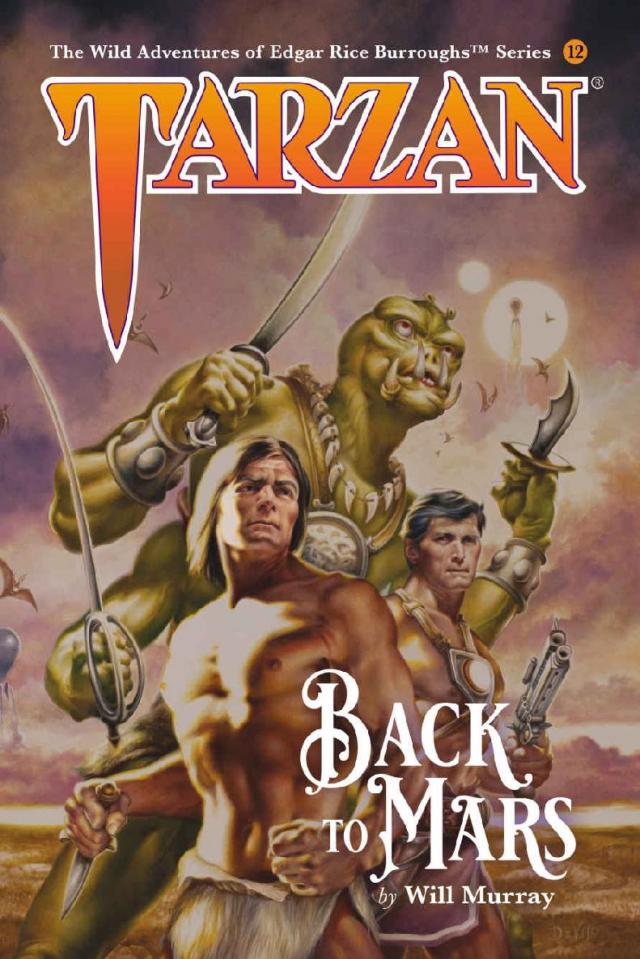
Tarzan: Back to Mars
The Wild Adventures of Edgar Rice Burroughs™ Series 12
by
Will Murray
cover illustrated by
Joe DeVito
Altus Press • 2023
Copyright Information
Tarzan: Back to Mars © 2023 Edgar Rice Burroughs, Inc. All rights reserved.
Cover illustration by Joe DeVito copyright © 2023 Edgar Rice Burroughs, Inc. All rights reserved. Map of Barsoom by Jason C. Eckhardt copyright © 2023 Edgar Rice Burroughs, Inc. All rights reserved.
Trademarks Edgar Rice Burroughs®, The Wild Adventures of Edgar Rice Burroughs™, Tarzan®, Lord of the Jungle®, Tarzan of the Apes™, Lord Greystoke™, Tarzan and Jane®, Jane Clayton™, Jane Porter®, Korak™, Korak the Killer™, Meriem™, Jad-bal-ja™, Nkima™, Kala™, Mangani™, John Carter®, John Carter of Mars®, A Princess of Mars®, Gods of Mars™, Warlord of Mars™, Dejah Thoris®, Tars Tarkas®, Carthoris™, Woola™, Warhoon™, Zodanga™, Barsoom®, Pellucidar®, David Innes™, Abner Perry™, and Jason Gridley™ owned by Edgar Rice Burroughs, Inc. Associated logos (including the Doodad symbol), characters, names, and the distinctive likenesses thereof are trademarks or registered trademarks of Edgar Rice Burroughs, Inc. Used by permission.
thanks to Gary A. Buckingham, Christopher Paul Carey, Jeff Deischer, Joe DeVito, Dave McDonnell, Don O’Malley, Stephen Payne, Ray Riethmeier, Jim Sullos, Jess Terrell, Cathy Mann Wilbanks, and Edgar Rice Burroughs, Inc.
cover illustration commissioned by Richard Burchfield
No part of this book may be reproduced or utilized in any form or by any means, electronic or mechanical, without permission in writing from the publisher.
designed by Matthew Moring
Like us on Facebook: “The Wild Adventures of Tarzan”
www.edgarriceburroughs.com
www.adventuresinbronze.com
Dedication
For Jim Sullos, who believed in us…
And who took the Wild Adventures in exciting new directions….
Chapter 1
Homeward Bound
All things come to an end, as they inevitably must.
Lives, loves, even dreams ultimately reach their culmination. Nightmares as well. This is the immutable law of all creation.
And so it was in the late summer of 1945 that the Second World War ceased to trouble the world. Soldiers who had been forged in the furnaces of battle were mustered out of service and duly returned to their families, forever altered in body, mind and spirit.
Not the least of these defenders of freedom was Royal Air Force Group Captain John Clayton, otherwise Lord Greystoke. For his service to the Crown, he was presented with his decommissioned and unmarked black P-40B Tomahawk warplane and allowed to fly home to Africa, unescorted.
Yea, Tarzan of the Apes was winging his way homeward.
The flight from Cairo was a tedious one until Clayton refueled at Addis Ababa in Ethiopia, after which the mountainous terrain ceased unrolling beneath the ebony wings of his shark-mouth-painted aircraft, and a zone of desert wastes came and went. Then the magnificent greenery of the African jungle stretched out as far as the eye could behold to the south.
Pushing back the glass canopy to let in rushing air, Tarzan drank in the mingled smells of the jungle—odors he had not inhaled in a long time. The welcoming scents of familiar trees and animals, both friendly and otherwise, greeted him.
The ape-man was flying too high to detect the spoor of Numa the lion or Tantor the elephant. Because these were the scents he missed most of all, he drove downward until he was skimming the treetops and the myriad jungle smells filled the open cockpit, charging his lungs with oxygen and reinvigorating his brain with strong memories.
Clayton wore his fur-colored Sidcot flying suit and boots, but once he was on the ground, he would shuck them off and become the demi-god of the forest savage Africa had made him, Tarzan, Lord of the Jungle.
A bull elephant seemed to trumpet loudly in salute. Tarzan knew that Tantor could not recognize him from the jungle trails far below. Still, it was a welcome sound. Throwing back his head, he gave vent to the riveting hunting cry of the bull ape, and no sooner had that cry resounded, than the jungle came alive with a wild chorus of answering calls, which all but drowned the roar of his rotary engine. Some were calls of welcome, but others told of fear—fear that the bronzed Tarmangani was returning to his domain after a long absence.
Tarzan smiled at the cacophony of sounds. This was his realm. This is where he belonged. His years of military service finally had come to an end. And a deep longing to return to his family and estate soon would be sated.
There was much to smile about. Lady Jane, his wife, would be waiting for him. And his faithful Waziri warriors. Perhaps his son Jack would have returned from his own service by now. That remained to be seen.
Reaching Kenya, Tarzan turned toward Lake Victoria and the Greystoke estate.
It would not be long now. The boots encasing his feet would be discarded, the uniform stored away, perhaps never to be worn again. For Tarzan had grown weary of civilization’s latest war.
For the medals in a small wooden box under his seat, John Clayton cared little. Deeds were what mattered. Of what use were medals to Tarzan of the Apes, whose magnificent chest was always bared to Usha, the wind?
As Clayton completed the turn toward the southwest, he spied a flash of sunlight against distant wings.
At first, Tarzan thought little of that fleeting flash. Since the war had broken out, aircraft were a common sight in the African skies. Ever alert, he kept his eyes on it as it flew lazy circles under the equatorial sun.
After a time that very aimlessness drew the ape-man’s interest, for the aircraft was not behaving as it should. It seemed to skim about, as if unpowered by a motor. Perhaps it was a glider, but the wings were not the flat wings of a glider, he perceived. They reminded Tarzan of the gull wings of a Royal Navy Corsair Mk, but these bent wings did not appear to be painted the regulation sky gray.
Determined to reach home while he had sufficient fuel, John Clayton chose not to investigate the strange sight. But that turned out not to matter.
Evidently, the pilot spotted Clayton’s aircraft for, in the middle of executing a slow turn, it abruptly shifted its course and commenced beating in his direction.
Here, Tarzan’s interest was piqued. The metallic craft appeared to be flapping its wings in a rhythmic and regular fashion!
At first, Tarzan questioned the reality of what he saw. Kudu the sun, burnishing those distant wings, could play tricks on the brain and the eye, even upon those of Tarzan of the Apes. And the way the other ship seemed to drop into a flat glide, and then canted and jinked about like a great bird transitioning between gathering air under its wings and stretching them out again to skim effortlessly, it was difficult to discern clearly at the distance involved.
Inevitably, the two aerial objects closed with one another, and behind the goggles of his leather flight helmet, the gray eyes of Tarzan widened in surprise.
For this was no aircraft!
Yes, it gleamed like metal. It appeared to be formed of metal. But this weird thing was in the shape of a great long-necked bird, the size of which brought to mind the Roc of the Arabian Nights tales. Two gleaming crystal disks served as eyes, and seemed to regard him with a brittle intelligence.
Seeing this clearly, Tarzan drove his all-black Tomahawk toward the approaching apparition.
The bird-like creature of metal shifted to meet him. Almost immediately, they fell on an intercept course.
Tarzan advanced his throttle. Collision seemed almost inevitable. Banking his moaning aircraft to starboard, he hoicked it around again, circling the other winged thing.
There was no question but that it was a bird encased in metal, entirely unlike any other avian of Africa. More astonishingly, a man in silvery armor sat perched upon the back of the bird, between its widespread wings and behind the goose-necked head, guiding it somehow, as if astride a horse.
Tarzan could see the man was seated on some type of wood and leather saddle and his feet were encased in metal devices resembling boxy stirrups nothing at all like those normally seen on equine saddles.
In the brief seconds in which Tarzan took in the fantastic sight, the ape-man saw that the man was encased in smooth armor of some whitish metal suggesting platinum. Moreover, he was equipped with a bow of peculiar design. Reaching back over his shoulder, the armored warrior took out a fletched arrow from a quiver at his back.
In a flash of movement that was more practiced than swift, the bowman let fly. With a distinct thunk, an arrow sank into the fuselage of the speeding Tomahawk, just behind the fierce shark’s mouth painted on her nose radiator scoop. It caused no harm, having missed the motor entirely.
Banking, Tarzan came around for another pass.
The winged mount was necessarily slower than the engine-driven warplane, so Tarzan was forced to throttle back as he swept in for another look.
As he did so, Tarzan threw the greenhouse canopy forward, locking it in place. It was well that he did so. For the next arrow smashed one of the glass panes at his shoulder without penetrating further. Slipstream forces snatched it away.
Engine howling, the Tomahawk swept around once more and Tarzan got behind his avian antagonis
t. Now the bowman would have to turn completely around in his saddle in order to let fly.
The Tomahawk’s guns were charged with full belts, but the ape-man chose not to reach for the trips that would send 30-caliber lead screaming at the amazing aerial rider from her four winged-mounted Browning guns.
Clinging to the other’s tail, Tarzan could see that the man’s arm was composed of the same whitish metal that sheathed the bird. His sharp gaze studied the winged thing, and it became obvious that it was not a living bird of stupendous size but a cunning machine fashioned to resemble a bird of impressive size.
Here and there, it was decorated with scarlet streaks, suggesting feathers. A single red-metal plume stuck up from the back of its head, suggesting both an antenna and the feather decoration of an Apache brave. But the creature was not alive. How the rider controlled it was unclear.
Staying on the reddish tail, Tarzan was able to study the man’s face. This was no native of Africa. His face was extraordinarily pale, almost as white as an albino man. It did not seem that the fellow could have long been in the Dark Continent, for his skin was neither burnt red nor bronzed by the sun.
A helmet encased the rider’s head. His features were regular without being distinctive. The ape-man could not discern his nationality. There was nothing about him suggesting a country of origin.
Twisting in the saddle, the armored man nocked his arrow to his bowstring, and Tarzan sent the Tomahawk into a dive as another bright-feathered shaft whistled over his glass-shielded head.
Coming up from beneath, he could see the wings flex and beat, then fall into a posture that permitted it to glide extended distances. Somehow the mechanical bird was capable of staying aloft through a series of simple repetitive actions.
Extending from its smooth belly were two sets of talons. They appeared to be fixed in place, like aircraft landing gear. The talons were splayed outward, as if to enable the bird to land and hold itself upright.
Tarzan was considering what to do about the situation. He did not care to shoot down the intruder. Nor was he of a mind to chase it to its rookery. More than anything else he yearned only for his home estate.
But curiosity is a powerful thing. And Africa was Tarzan’s home. Such a strange intruder suggested trouble coming from a new direction.
Pulling back on the stick, Tarzan sent the warbird’s snarling nose upward. It shot past the gliding machine of metal. Reasoning where there was one, there must be others—and that all birds that ever lived must return to their nests, whether they were living or otherwise—the bronzed giant decided to give chase.
Reaching an altitude of six thousand feet, Tarzan leveled off and began tracking the bird from on high.
In response, the rider attempted to urge his unliving steed upward to match Tarzan’s altitude. But the metallic mount appeared not to possess such a capability. It rose laboriously, fell, rose again, and settled back into what appeared to be its comfortable cruising altitude.
It was perhaps a strange phrase to employ when considering a metallic steed and armored rider armed only with a bow and arrow, but it seemed to fit the circumstances, improbable as they were.
Unable to match the altitude of the Tomahawk, the bird-rider decided to return to his business, whatever it was. He struck out toward the west, in the direction of Lake Victoria.
Where before, the bird-man seemed to be exploring, now he showed signs of having a definite destination.
Whether he might have reached it or not would never be told. For not long after, two more metal birds rose from the jungle canopy to join the first. They fell into an arrowhead formation, with the first bird making the point.
They, too, attempted to rise and challenge Tarzan’s shark-mouthed warplane. But they lacked the ability. Now the ape-man had three quarries to track.
For nearly an hour, Tarzan patiently followed. The metallic birds showed no signs of fatigue, nor did they slacken in their majestic pace. What motivated or propelled them was a mystery.
Once or twice, a rider would twist in his saddle and send a shaft skyward. But it fell far, far short of the droning Tomahawk.
One gray eye on his gas gauge, the ape-man realized that his fuel supply would give him limited time to pursue these fantastic fugitives. He could not afford to run empty over the jungle where suitable landing spots were rare and taking off again was almost impossible.
Reluctantly, Clayton broke off the chase.
Turning his howling propeller southward, he resumed his original course, looking back from time to time until the three metal birds were no longer in view.
This uncanny development was something that former Group Captain John Clayton would set aside for now.
Later, at the appropriate time, Tarzan of the Apes would investigate these strange new inhabitants in his jungle….
Chapter 2
Arrow Unknown
Little Nkima the monkey was the first to know of Tarzan’s return.
The monkey was bored. He had been bored for a long time now. He missed his master, but there was nothing he could do about it.
And so he went about his monkey business, climbing trees, throwing rocks at animals that were his betters, eating grubs, and hiding from any trouble he managed to manufacture due to his own predilection for mischief.
The drone of the approaching airplane caught his attention.
Spread out in the high branches of a banyan tree, Nkima sat up suddenly and his tiny brown head swiveled this way and that. Curiosity seized him.
The noise of an airplane motor here in this part of East Africa known as Kenya was unexpected. The monkey was not ignorant of airplanes in and of themselves. But such things were so rare that his attention was immediately arrested.
Scampering to the top of the tree, he poked his head above the uppermost leaves of the closely-packed crown, beady eyes searching the sky to the north.
At last he spied the plane. It was black. The monkey did not know that color was unusual in aircraft, but it was a shade that was nevertheless ominous. He began to chatter with nervous concern.
Hunkering so that only the top of his head and dark eyes poked above the canopy, Nkima tracked the approaching craft. From time to time, he shivered. He did not know why he shivered. Little Nkima did not know why he did many things. He just did them.
The black airplane was flying low. As he watched, it seemed to descend even lower. This was not something that met with the cowering monkey’s approval. For it possessed a gaping fanged mouth large enough to devour a tiny creature such as Nkima!
Ducking his head even farther, he craned his small skull backward and stared straight up, dark eyes wide.
The black-winged monster flashed over his head. Nkima became very, very still.
But in the next instant, he exploded into manic activity. For as the droning monster passed by, down reverberated a familiar sound.
It was the weird hunting cry of the great apes of Africa!
Nkima knew that call. When voiced by the Bolgani, it meant danger. But this was no Bolgani. This was a cry he recognized emanating from a throat he knew well.
Tarzan of the Apes had come home!
Chattering excitedly, Nkima scrambled down to the base of the banyan tree, ran some distance, and leaped into another tree, this time swinging from limb to limb, then tree to tree, covering a short distance until at last he reached the heart of the vast farmstead of his master with its bungalows and surrounding huts and outbuildings.
Attempting a landing on an airstrip of packed dirt, the black aircraft had dropped to tree-top level.
Running to and fro were the Waziri warriors who guarded and maintained the Greystoke estate. And out from the bungalow came fair-haired Lady Jane Clayton.
With glad cries of joy, they rushed toward the makeshift landing spot.
The black warplane struck ground, bounced slightly, then settled as it rolled away airspeed. At the last moment, it seemed about to run out of runway and pile into the jungle at the other end.


