

Kalila and Dimna, page 1


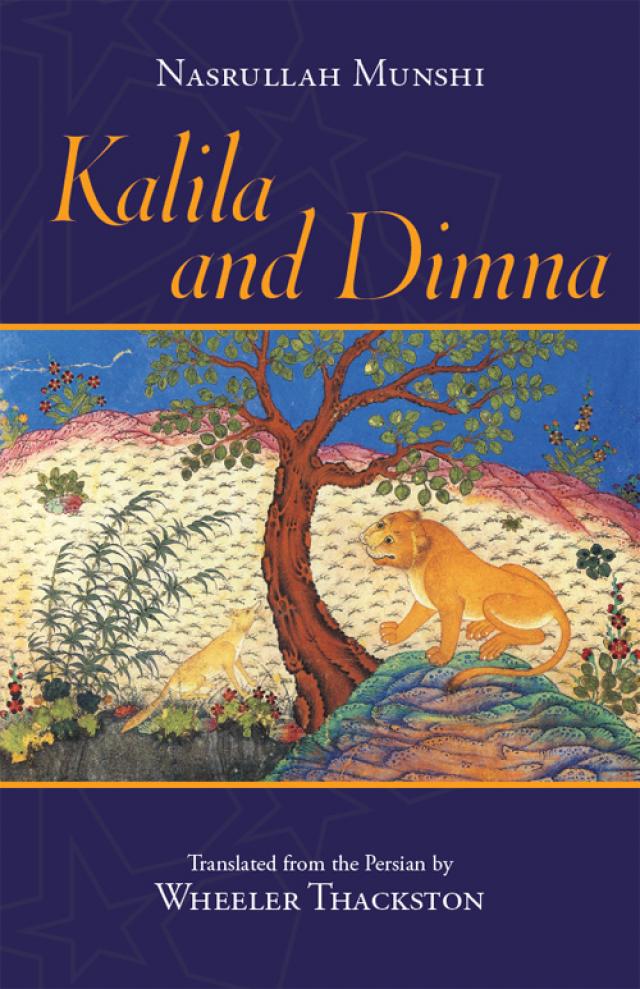
NASRULLAH MUNSHI
Kalila and Dimna
NASRULLAH MUNSHI
Kalila and Dimna
Translated from the Persian by
Wheeler Thackston
Hackett Publishing Company, Inc.
Indianapolis/Cambridge
Copyright © 2019 by Hackett Publishing Company, Inc.
All rights reserved
Printed in the United States of America
22 21 20 19 1 2 3 4 5 6 7
For further information, please address
Hackett Publishing Company, Inc.
P.O. Box 44937
Indianapolis, Indiana 46244-0937
www.hackettpublishing.com
Cover design by Rick Todhunter and E. L. Wilson
Interior design by E. L. Wilson
Composition by Aptara, Inc.
Library of Congress Cataloging-in-Publication Data
Names: Naòsr Allåah Munshåi, active 12th century, author. | Thackston, W. M. (Wheeler McIntosh), 1944– translator. | Ibn al-Muqaffa°, –approximately 760, compiler.
Title: Kalila and Dimna / Nasrullah Munshi ; translated from the Persian by Wheeler Thackston.
Other titles: Tarjumah-i Kalåilah va Dimnah. English | Fables of Bidpai. Persian.
Description: Indianapolis : Hackett Publishing Company, Inc., 2019. | English translation of the Persian version of the Arabic text of Kalåilah wa-Dimnah.
Identifiers: LCCN 2019010478| ISBN 9781624668081 (pbk.) | ISBN 9781624668098 (cloth)
Classification: LCC PK6495.N33 T3713 2019 | DDC 891/.5531—dc23
LC record available at https://lccn.loc.gov/2019010478
ePub3 ISBN: 978-1-62466-840-1
Titles of Related Interest Available from Hackett Publishing
Nizami, Haft Paykar: A Medieval Persian Romance. Translated with an Introduction and Notes by Julie Scott Meisami.
Marco Polo, The Description of the World. Translated, with an Introduction and Annotations, by Sharon Kinoshita.
The Arthaśāstra: Selections from the Classic Indian Work on Statecraft. Edited and Translated, with an Introduction, by Patrick Olivelle and Mark McClish.
Contents
The page numbers in curly braces {} correspond to the print edition of this title.
Introduction
Nasrullah’s Preface
Ibn al-Muqaffa‘’s Preface
Buzurjmihr Bokhtagan’s Preface
The Testament of Burzoë, Physician of Persia
Kalila and Dimna
Chapter One: The Lion and the Bull
The Monkey That Pulled Out the Wedge
The Fox That Tried to Eat a Drum
The Holy Man’s Adventures
The Crow That Killed a Snake
The Heron That Schemed against the Crab
The Rabbit That Outwitted the Lion
The Fates of the Three Fish
The Duck That Saw the Reflection of a Star in the Water
The Wolf, the Crow, and the Jackal That Conspired against the Camel
The Plover That Threatened the Spirit of the Sea
The Contentious Turtle and the Ducks
The Bird That Tried to Advise Monkeys
The Two Partners and the Betrayed Trust
The Frog, the Crab, and the Weasel
The Iron-Eating Mice
Chapter Two: The Trial of Dimna
The Lover and His Slave
The Quack Physician
The Scheming Gamekeeper
Chapter Three: The Benefits of True Friendship
The Dove, the Mouse, the Crow, the Turtle, and the Gazelle
The Woman Who Sold Sesame for Sesame
How the Greedy Wolf Died Eating a Bowstring
Chapter Four: The Consequences of Failing to Beware of Enemies
The Owls and the Crows
The Birds That Wanted to Make the Owl Their Prince
The Rabbit That Made Himself a Messenger of the Moon
The Partridge and the Hare Take Their Case to the Cat
Three Charlatans Fool an Ascetic
The Old Merchant and His Young Wife
The Holy Man, the Thief, and the Demon
The Unfaithful Wife and Her Foolish Husband
The Mouse That Was Offered the Sun, the Cloud, the Wind, and the Mountain in Marriage
The Snake That Served the Frog
Chapter Five: The Monkey and the Turtle
The Monkey and the Turtle
The Donkey without Ears or Heart
Chapter Six: The Ascetic and the Weasel
The Ascetic and the Weasel
The Hermit Who Spilled the Honey and Oil
Chapter Seven: The Cat and the Mouse
The Cat and the Mouse
Chapter Eight: The King and the Bird Finza
The King and the Bird Finza
The Old Woman and Her Daughter
Chapter Nine: The Lion and the Jackal
The Lion and the Jackal
Chapter Ten: The Lioness and the Archer
The Lioness and the Archer
Chapter Eleven: The Ascetic and His Guest
The Ascetic and His Guest
The Washerman and the Crane
The Man Who Lost His Beard
The Crow That Wanted to Walk Like a Partridge
Chapter Twelve: The Superiority of Clemency
The King and the Brahmans
The Pair of Doves That Stored Up Grain
Chapter Thirteen: The Goldsmith and the Traveler
The Goldsmith and the Traveler
Chapter Fourteen: The Prince and His Friends
The Prince and His Friends
Titles of Related Interest Available from Hackett Publishing
{ix} Introduction
The history of the fables known variously as Kalila and Dimna and the Bidpai Fables is long and involved. It began in India with a collection of animal fables that became known as the Pañćatantra ‘Five Sections’ set in a frame story, some version of which is thought to have been composed around the third century before our era.1 Over time the Sanskrit Pañćatantra has inspired at least twenty-five recensions and many translations into regional languages in India, but this preface is concerned instead with the westward migration of the tales.
According to the oft-repeated legend, a version of the tales was brought to Iran from India and translated into Middle Persian by a physician named Burzoë at the behest of Chosroës I Anoshirvan, who ruled Persia from AD 531 to 579. The Middle Persian translation and the Sanskrit text from which it was purportedly made have both disappeared without a trace.
Not long after the Middle Persian version was produced it was translated into Syriac. This version is known as the Old Syriac to distinguish it from a later one, and so far as is known, it gave rise to no other versions.2
In the middle of the eighth century, an Arabic-writing Persian scholar named Ibn al-Muqaffa‘ translated the Middle Persian into Arabic.3 One of the earliest examples of literary narrative prose in Arabic, the translation {x} became a model of elegant writing and achieved such lasting popularity that it is still read in schools all over the Arab world. Translations of it were made into (1) Syriac, (2) Greek, (3) Persian, (4) Hebrew, and (5) Spanish.
(1) A Syriac translation of Ibn al-Muqaffa‘’s Arabic was made by an unidentified Christian priest in the tenth or eleventh century (the New Syriac version).4
(2) A Greek translation was made around 1050 by Simeon, son of Seth, and that was rendered at some point, perhaps as early as the twelfth century, into Old Slavonic and later into Italian.5
(3) The first rendering of Kalila and Dimna into Persian was made by the poet Rudaki in the mid-tenth century, but only a few scattered lines of his work remain. Around 1120 Abu’l-Ma‘ali Nasrullah, a writer employed in the court chancery of the rulers of the Ghaznavid Empire, freely translated Ibn al-Muqaffa‘’s Arabic into New Persian and dedicated his work to the ruler Bahramshah (r. 1117–1157).6 It is apparent that Nasrullah found the economy of expression that characterizes Ibn al-Muqaffa‘’s Arabic—not to mention the elegance of diction—difficult to capture in Persian. His version is significantly expanded, and what was expressed in one pithy phrase in Arabic may run to a page of Persian, not counting the lines of epigrammatic poetry, often Arabic, that were inserted in conformity with the approved style of the time. Nasrullah’s version is also replete with quotations from the Koran and hadith, “all of which [sound] rather quaint in the mouths of animals in the jungles of India.”7
{xi} At the end of the fifteenth century, Nasrullah’s Persian having become hopelessly old-fashioned, Husayn Va‘iz Kashifi, a Timurid polymath, composed a new version in the fashionably elegant prose of the period and called it Anvār-i Suhaylī ‘The Lights of Canopus.’8 After lavishing praise on Nasrullah’s prose style, Kashifi adds:
However, because he introduces strange words, embellishes his prose with Arabic features, overdoes the use of various metaphors and similes, and is too wordy in obscure locutions and expressions, the mind of the listener fails to enjoy the purpose of the book and to comprehend the contents, and the reader is also unable to connect the beginning of a story to the end. All this inevitably leads to weariness on the part of the reader and listener, especially in this elegant time, when people have reached such a level of subtlety that they can comprehend meanings without their being decked out in verbiage, not to mention the fact that for some words one has to thumb through dictionaries and search to discover the meaning. For all these reasons, such a valuable book was almost abandoned and nearly became obsolete, and the people of the world were on the verge of being deprived of its benefits.9
In addition to being completely reworded in a much more fluid Persian, Kashifi’s version is considerably expanded from Nasrullah’s. While he retains the basic framework and stories of the earlier version, Kashifi added a number of stories, making his version considerably longer than Nasrullah’s. A hundred years after Kashifi, it was once again felt that it was time for a stylistic revision. This time the Mughal emperor Akbar’s friend and biographer Abu’l-Fazl composed a new version entitled ‘Iyār-i dānish ‘The Assay of Knowledge’ in the Persian style prevalent in India at that time.
{xii} (4) A Hebrew translation of the Arabic was made in the twelfth or thirteenth century by a Rabbi Joel.10 Toward the end of the thirteenth century, Giovanni da Capua made a Latin translation of the Hebrew.11 A German translation was made from the Latin, and the earliest printed edition is from around 1480.12 From the German were produced translations in Danish in 1618 and in Dutch in 1623.13 A Spanish translation of the Latin appeared in 1493.14 On it is based Agnolo Firenzuola’s Discorsi degli animali ragionanti tra loro, first published in Venice in 1548, and that was translated into French in 1556.15 An Italian translation of the Latin was made in 1552 by Anton Francesco Doni, and part of that was translated into English by Sir Thomas North in 1570.16
(5) In 1251 Ibn al-Muqaffa‘’s text was translated into Old Spanish by an unknown author.17 It and Giovanni da Capua’s Latin formed the basis of a later Latin version in 1313.18
As a testimony to the enormous worldwide popularity of Kalila and Dimna, there are today versions to be found in Arabic, Armenian, Azerbaijani, Chinese, Croatian, Danish, English, French, Georgian, {xiii} German, Greek, Hungarian, Indonesian, Italian, Karakalpak, Kashmiri, Kurdish, Laotian, Lebanese, Malay, Marathi, Nyanja, Old Church Slavic, Portuguese, Punjabi, Russian, Spanish, Tatar, Thai, Tongan, Turkish (both Ottoman and modern), Uighur, Urdu, and Uzbek.
The collection is often known in the West as the Bidpai Fables after the philosopher Bīd(a)bā, who serves King Dabshalīm, as Ibn al-Muqaffa‘ calls them.19 In Nasrullah’s version, those names are dispensed with. The philosopher becomes the Brahman, and Dabshalīm is simply the “Raja of India.” Kashifi transposes the setting to “olden days in the farthest reaches of the realm of Chīn,” which is the equivalent of “long ago and far away,” but he retains the emperor Dabshalīm and calls his vizier Bīdpāy, or Bidpai, an adaptation of the name given by Ibn al-Muqaffa‘.
The Pañćatantra belongs to an Indian genre called nītiśāstra, a treatise on nīti, or right, wise, and moral behavior that leads to security, prosperity, {xiv} resolute action, friendship, and learning to produce joy. The five sections of the Pañćatantra, into each of which are embedded numerous stories, are as follows:
(1) mitrabheda ‘breach of friendship’: The lion king Pingalaka (unnamed in Arabic and Persian) and the bull Sanjīvaka (Shanzaba) become friends, but the king’s scheming jackal retainer Damanaka (Dimna) breaks up the friendship.
(2) mitralābha ‘acquisition of friendship’: A crow sees a mouse free a pigeon from a snare and befriends the mouse against the mouse’s initial objections. A turtle and a gazelle join them. When the gazelle is trapped, they set him free, and then they work together to save the turtle when he is caught.
(3) kākolūkīya ‘crows and owls (natural enemies)’: A crow gains access to a group of owls and betrays them to the crows, who set the owls’ cave ablaze.
(4) labdhapraṇāśa ‘loss of gain’: A crocodile conspires to get a monkey’s heart to heal his wife, but the monkey escapes through guile.
(5) aparīkṣitakāraka ‘ill-considered action’: A Brahman’s wife leaves her child with a mongoose. Mistakenly believing that the bloodstained mongoose that greets her on her return has killed the child, she kills it, whereas the mongoose actually saved the child from a snake.
Ibn al-Muqaffa‘’s Arabic version also contains these five chapters, but after the first chapter, to accord with Islamic sensibilities, which demanded justice for Dimna’s outrageous scheming against the bull, he inserts a chapter on the trial of Dimna. After those six chapters, Ibn al-Muqaffa‘’s version also contains another eight chapters, (7) Īlādh (the minister), Shādram (the king), and Īrākht (the king’s wife); (8) the cat and the mouse; (9) the king and the bird Finza; (10) the lion and the fasting jackal; (11) the traveler and the goldsmith, and the monkey, the snake, and the tiger; (12) the king, the nobleman’s son, the merchant’s son, and the husbandman’s son; (13) the archer, the she-wolf, and the jackal; and (14) the ascetic and the guest. The cat and the mouse of chapter eight, the king and the bird of chapter nine, and the lion and the jackal of chapter ten are all found in the Mahābhārata. These three stories are found already in the Old Syriac translation, so whatever text the Syriac translator had must have included them.
In Nasrullah’s version there are, in addition to Ibn al-Muqaffa‘’s fourteen chapters, four prefaces: (1) Nasrullah’s preface outlining the history {xv} of the book, (2) a Persian adaptation of Ibn al-Muqaffa‘’s preface, (2) Buzurjmihr’s preface to Burzoë’s translation, and (4) the testament of the physician Burzoë.
Major themes that are stressed throughout versions of Kalila and Dimna in their Islamic guise are ḥazm, a quality that is a combination of resolve, firmness, judiciousness, and prudence, and muruvvat ‘gallantry.’ Muruvvat is etymologically connected to the Arabic word for ‘man’ (mar’) and would be the equivalent of ‘manliness’ were not modern notions of manliness at such odds with the medieval ideal. It would also be the equivalent of ‘virtue,’ which is derived from the Latin for ‘man,’ vir, if the modern understanding of virtue were not limited to moral excellence. The ideals of chivalry are not far from those of muruvvat, but chivalry conjures up images of knights in armor and is inappropriate. The best modern word for muruvvat is probably ‘gallantry’ because it still contains implications of moral excellence, bravery and courage, and good manners, all of which are implied in muruvvat. The Persian equivalent of muruvvat is hunar, and both words are often found on the pages of Kalila and Dimna.
Another quality that is often mentioned is ‘ignorance’ (jahl, nādānī). For the Arabic- and Persian-writing authors of Kalila and Dimna, ‘ignorance’ is not so much the lack of knowledge as it is the lack of self-control—that is, impetuosity and incautiousness. Anyone who rushes into action not fully prepared and without judicious reflection on the consequences of his actions is guilty of ‘ignorance.’
Much advice is given throughout concerning master-servant relationships. Few people these days have servants, and that relationship is a thing of the past, but if employer-employee relationships are substituted, much will be immediately recognizable.
In the various versions, one animal is sometimes substituted for another. For example, the Pañćatantra story that is chapter five in Nasrullah’s version is the story of a monkey and a crocodile. In Ibn al-Muqaffa‘’s version, the crocodile is a tortoise (ghaylam) and remains a tortoise or turtle in subsequent versions. While some substitutions may have been made because the animal in question, like the mongoose or the crocodile, was unfamiliar in Arabic- and Persian-speaking environments, usually it makes little or no difference since the animals, while being appropriate to their settings, behave less like animals and more like human beings. In Nasrullah’s chapter twelve, the King and the Brahmans, there are no animals {xvi} at all. The purpose of the chapter was originally to excoriate Brahmans, and it is thought to be thoroughly Buddhist in origin.20 Ibn al-Muqaffa‘ and, following him, Nasrullah have expanded this chapter into a long and tedious exchange between the king and his minister Bilar before the resolution of the tale. Kashifi, as usual more interested in good storytelling than in faithfully reproducing an old tale, reduced the exchange to the bare minimum.
Changes in other respects, too, have been made in the various translations. In the Old Syriac version, the various holy men of the Sanskrit are called mgušē ‘Magi,’ or Zoroastrian priests. In the Islamic versions, they have all become nāsik ‘ascetics,’ since in the Islamic world there was no priestly caste, and there was certainly nothing analogous to the hermits and Brahmans of the Sanskrit.


