

Reed Farrel Coleman - Moe Prager 01, page 1


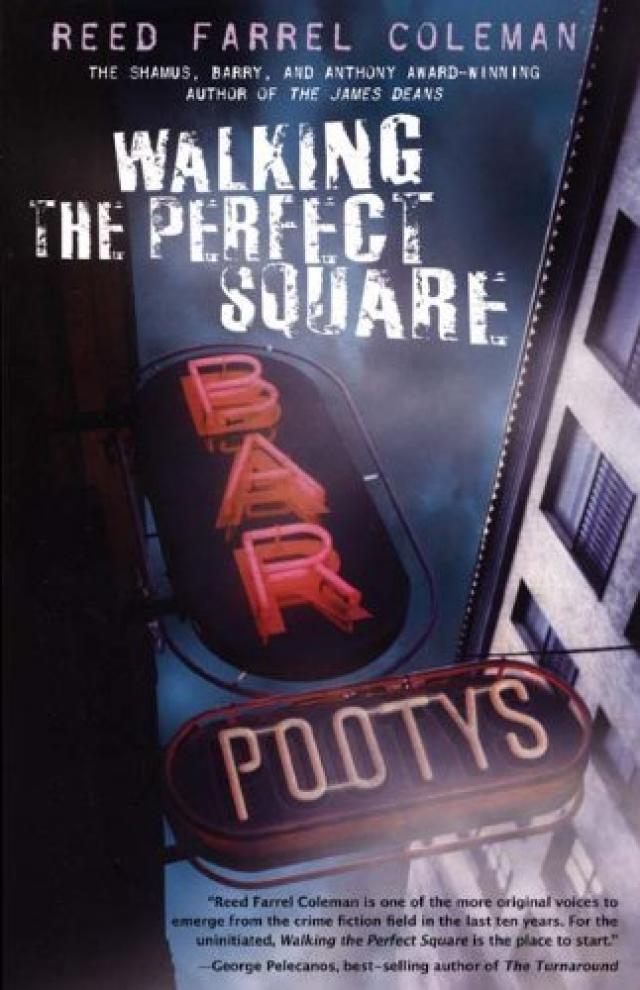
Walking the Perfect Square
by
REED FARRELL Coleman
Raymond Chandler once advised that when things get slow in a story, have a man with a gun come through the door. What's most remarkable about Coleman's first mystery to feature Brooklyn PI Moe Praeger (after three Dylan Klein noirs: Little Easter, etc.) is that he never resorts to such a crude device.
Rooted in the late 1970s, the story is so solid, the characters so compelling, the pace so expertly driven that he can dispense with the usual genre stitches.
If the one murder in the book occurs off-stage, there's no lack of suspense. The author makes us care about his characters and what happens to them, conveying a real sense of human absurdity and tragedy, of the price people will pay to get ahead or hide their true selves. Moe's job he's an ex-cop forced to retire because of a knee injury is to find the son of another cop, a young man who left a party one night and hasn't been seen since. So many people have been searching for Patrick Mahoney in the 20 years since his disappearance that Moe doesn't expect to be successful. As his investigation proceeds, he finds himself looking for two Patricks: one a choir boy lookalike and the other described by those who knew him as "weird" and "strange." But why? Is it possible Patrick's father really doesn't want to find his son? Patrick stands at the core of the novel, and the intricate tale of what happened to him makes for a first-rate mystery. Moe is a fine sleuth. Coleman is an excellent writer.
More Praise for Walking the Perfect Square "Walking the Perfect Square has perfect pitch in the key of NYC."
--Rocky Mountain News
"Coleman writes in a way that seems absolutely right. Interesting, honest and worth reading."
--The Mystery Review
"The author makes us care about his characters and what happens to them, conveying a real sense of human absurdity and tragedy ... a first-rate mystery.
Moe is a fine sleuth. Coleman is an excellent writer."
--Publishers Weekly (starred review) Reed Farrel Coleman was born and raised in Brooklyn, New York. He is the author of three Dylan Klein mystery novels: Little Easter, Life Goes Sleeping, and They Don't Play Stickball in Milwaukee. He resides with his family in Lake Grove, New York.
Š
A PLUME BOOK
PLUME
Published by the Penguin Group tnn,A tic a Penguin Putnam Inc., 375 Hudson Street, New York, New York 10014, U.S.A.
Penguin Books Ltd, 80 Strand, London WC2R ORL, England Penguin Books Australia Ltd, 250 Camberwell Road, Camberwell, Victoria 3124, Australia Penguin Books Canada Ltd, 10 Alcom Avenue, Toronto, Ontario, Canada M4V 3B2
Penguin Books (N.Z.) Ltd, Cnr Rosedale and Airborne Roads, Albany, Auckland 1310, New Zealand Penguin Books Ltd, Registered Offices: Harmondsworth, Middlesex, England Published by Plume, a member of Penguin Putnam Inc. This is an authorized reprint of a hardcover edition published by The Permanent Press. For information address The Permanent Press, 4170 Noyac Road, Sag Harbor, New York 11963.
First Plume Printing, February 2003
10 987654321
Copyright Š Reed Farrel Coleman, 2001
All rights reserved
"Nobody Hurts You" written by Graham Parker. Copyright Š 1979 Ellisclan Ltd (PRS). Administered by Bug Music. All rights reserved. Used by permission.
For my big brothers, Jules and David Printed in the United States of America Without limiting the rights under copyright reserved above, no part of this publication may be reproduced, stored in or introduced into a retrieval system, or transmitted, in any form, or by any means (electronic, mechanical, photocopying, recording, or otherwise), without the prior written permission of both the copyright owner and the above publisher of this book.
PUBLISHER'S NOTE
This is a work of fiction. Names, characters, places, and incidents either are the products of the author's imagination or are used fictitiously, and any resemblance to actual persons, living or dead, business establishments, events, or locales is entirely coincidental.
Acknowledgments
I am grateful for the love and support of my wife, Rosanne, and my kids, Kaitlin and Dylan. I could not have written this book without the technical advice of Mitchell L. Schare, Ph.D., or my NYPD buddies: Billy Johnson, John Murphy, Jim Hegarty and Tom McDonald. I would also like to thank Ellen W. Schare for her editorial input.
To be is to be perceived --Berkeley
I hold a picture up
everybody thinks it's me
I get a thrill out of tampering with the atmosphere
Hey baby, I'm out of favor You can't always be
the right flavor
Just seems that no matter
what you do
Someone, somewhere
Someone's got to punish you
Nobody hurts you
harder than yourself
--Graham Parker
Hofstra University
Theater Department
Acting 2.1 Professor Stroock
Dramatic Monologue
The Lie of Wetness by Patrick M. Maloney Setting: Boardwalk. Nighttime. The sky--moonless, starless. Waves of an unseen ocean are heard crashing ashore. The solitary figure of a young man--his image illuminated by a lone, flickering streetlamp--leans over the sea air ravaged railing. Contemplating a final walk into the womb of the ocean, he speaks...
You know what it's like? (pause) I'll tell you. You ever been to one of those fancy amusement parks like Busch Gardens or Hershey Park? (cups his ear) Oh, you have. Then you'll know what I'm talking about. At these parks they have these huge flume rides. Now, I don't mean the little cute ones with the fake logs. I mean they have these really big ones. They go like ten stories straight up in the air, swoop around a curve and then come flying--(gestures with his hand) I mean flyin' down into a big basin of water. You know the ones I'm talking about? The boat slams (smacks fist into other palm) into this water and boom! This freakin' wall of water soaks everything and everybody for like hundreds of feet around. Well, it's like that. Not the ride, exactly, but the waiting on line.
So you're standing there waiting your turn as this big line snakes around (gestures S shape) and you're watching big boat after big boat go up that freakin' ramp and come splashing down. And there's like these signs everywhere: (points to wording on imaginary sign) "Be aware: You WILL get wet." It's not like you need those signs either, because everybody you see getting off the damn ride's so wet they could wring out their sunglasses and make a puddle. But see here, this is the point I'm trying to make about how it is; even though you watch everybody getting soaked and there's these signs that tell you you're gonna get soaked, you tell yourself that you're not gonna get wet. Nope, not you!
(thumps chest) Somehow, all of a sudden, you're fucking waterproof as Jesus in plastic slipcovers.
But then it's your turn. And you stick your foot into the boat and there's like six inches of standing water there and you're up to your ankles in it. Then it dawns on you: the signs weren't lying. And unlike Jesus, the water's gonna walk on you. So you look at the bald guy next to you and his toothless girlfriend or the mom and her frightened kids two rows up or the fat retarded guy in the tight T-shirt sitting alone behind you and you wonder how many other people getting on that ride with you told themselves the lie of wetness.
Well, that's my point, you see. It's like that; just like that. We don't come with slipcovers, so we lie to ourselves instead. Christ knows I wish we didn't have to, but we do.
I have to go now.
Direction: Young man moves slowly out of flickering light; his footsteps can be heard walking down wooden steps. When footsteps stop, flickering light snaps off.
August 6th, 1998
Things that happened on August 6th: In 1945, Colonel Paul Tibbets at the controls of a special B-29 named after his mom, Enola Gay, dropped the uranium bomb, Little Boy, on the city of Hiroshima--the bomb they dropped on Nagasaki, Fat Man, was a plutonium bomb, but since both killed Japanese pretty damned well, it's not a detail most people bother with and since the second bomb was dropped on August 9th that doesn't really count, not here, not for our purposes.
My daughter Sarah was born on August 6th. God, I can still remember watching the crown of her head appear, red curls even then, and how for once, just briefly, I understood about reasons for being. I'd have to call her later.
Now I was on my way to Mary the Divine Hospice of New Haven to meet Tyrone Bryson. Until today I'd never heard of Tyrone Bryson and from what the sister told me, we wouldn't have much time to cultivate a relationship. Mr.
Bryson, it seemed, had taken to heart the mission of Mary the Divine and was doing his level best to make his bed available for the next poor soul to die in peace. Apparently, the "in peace" part of the equation is where I came in.
I assured the sister several times that I knew Tyrone Bryson only slightly less well than I had known Chairman Mao. At least I had seen Mao on TV. I said I couldn't ever quite recall seeing Mr. Bryson on the tube. That was, unless he had starred in a summer replacement or a short-lived sitcom.
Sister was not amused, explaining that Mr. Bryson had already said we had never met. I asked if we could just clear this all up over the phone, but the sister said that was a no go on two counts; it took a monumental effort for Bryson to speak above a whisper and, she was afraid, even if he could belt out a tune like Pavarotti in the shower, Bryson had insisted upon seeing me in the flesh.
&nbs
"What clipping?"
"It's quite brittle, so I imagine it's rather old. He only showed it to me after I explained you might be unwilling to come visit a total--"
"Yes, sister," I cut her off. "The clipping, what's it about?"
"A missing man, a Patrick-- "
"--Maloney."
"Yes, that's right!" Sister was impressed.
"Late this afternoon is the best I can do," I heard a voice that sounded like mine tell the nun. I think she offered me directions. I'm not sure what I said to that. I do recall hanging up.
The only thing is, I don't remember what inning it was.
Maybe it was the fifth, for some reason the fifth sounds right. Whatever inning it was, it had to be the bottom half, because Ray Burris was on the mound for the Cubs and Lenny Randle--who was more famous for beating the shit out of his onetime manager Frank Luchesi than he was for his ballplaying--was at the plate for the Mets. I remember Jerry Koosman was pitching for the Mets, but that's neither here nor there, because he didn't get to pitch the top half of the next inning that night.
It was the summer of 1977, July 13th, I think, and I'm sitting with my buddy Stevie in the upper mezzanine at Shea on the third base side. As Randle steps into the batter's box, I notice whole chunks of Flushing and Whitestone going dark over the outfield fence. All the Number 7 trains pulling in and out of the station across the street from the stadium stop dead. The buzz in the crowd is starting to build. Not because Randle got a hit or cold-cocked the third base coach, but because a lot of other fans are beginning to see what I'm seeing; the city going black one neighborhood at a time beyond the 410 sign in centerfield.
Meanwhile, the players and the umps are totally oblivious.
There's a three and two count on Randle and ... Snap!
The lights go out in the stadium. There's an immediate announcement: Everyone stay calm. We're working to correct the problem. Please stay in your seats. Blah, blah, blah . . . Next thing you know, Jane Jarvis, queen of the Shea Stadium keyboards, starts playing Christmas songs on the organ and people are singing and I'm singing and we're all happy. Then, boom, these red auxiliary lights come up.
I look down on the field and the players are still at their positions, but Lenny Randle's not in the batter's box. He's standing on first base. The fucking guy had run to first in the dark. He was still one ball away from earning a walk, yet there he was, trying to steal first base. Even Frank Luchesi, I thought, would have appreciated Lenny Randle's ingenu ity at that moment. I'll never forget the night Lenny Randle tried stealing first base in the dark.
My other memories of that year, as I imagine they are for many New Yorkers who lived through it, are bleak. Though they are as vivid to me as the sight of Randle on first, they are more akin to the reminiscences of an amputee reliving his last few steps before his right leg was crushed beneath the wheels of a city bus. I could have told you about the record snowfall that year and how on February 17th me and my partner found an old black couple frozen to death, huddled in their bed. My partner thought it was funny that they'd have to thaw the bodies out to untangle them. Somehow, I didn't see the humor in it.
That summer was also the summer of Son of Sam. Not before, not since, have I seen the city quite so panicked.
Even the looting that came in the wake of the blackout felt like a day at the shore compared to the grip of the .44Caliber Killer. As night fell the whole of the city would hold its breath, exhaling only at the warmth of the morning sun on our cheeks. But serial killing was a nascent industry then and its purveyors didn't seem to grow on trees the way they do now.
My last shift on the job, I was working crowd control when they brought Sam in. If you look hard at the old news footage, you can see me standing just over Detective Ed Zigo's right shoulder and Berkowitz's left. Honestly, I was just as surprised as everyone else that this chubby postal worker with the wiry hair and goofy smile was Son of Sam.
To me, he looked like a cross between an overgrown bar mitzvah boy and a Macy's Thanksgiving float. Christ, maybe Jack the Ripper looked like Humpty-Dumpty.
With all that went on that year it's understandable, even excusable, that few New Yorkers would recall the disappearance of Patrick M. Maloney. We were a tired city; the city that never sleeps needed rest. The local rags and electronic media ran with it for about a week, but by Christmas Eve, Patrick Maloney had been consigned to the namesounds-familiar-didn't-he-win-the-Heisman-Trophy?
bin in
most people's minds. If he had been a little boy like Etan Patz or a teenage girl, maybe the press would have milked it a little while longer.
Looking back, I'm not certain I had heard of Patrick Maloney's disappearance before being brought into the matter.
That's one of the slippery slopes of piecing history back together.
Sometimes I'm sure I must've read about it in the papers or heard of it on the tube. Surely, I must have seen one of the thousands of posters his parents put up around the five boroughs. In my life I have seen millions of flyers posted on every blank space New York City has to offer. Yet for all the wives of the Sultan of Brunei, I don't think I can describe a single one.
I just don't know. I was far too busy feeling sorry for myself after my second knee operation in three months to be certain of much of what happened that December. Back then, arthroscopes and MRIs weren't standard operating procedure. The docs cut me up pretty good. All of a sudden I had great empathy for the sliced lox my parents ate on Sunday mornings. When people ask why I had to leave the job, I tell them I had a severe case of knee-monia. It gets a laugh.
The answer I give as to how I hurt the knee is inversely proportionate to the amount of alcohol I've consumed. Sober, I tell them I was hit by a flaming arrow shot by some schizophrenic junkie from a housing project roof in Queens. Two drinks, I tell them I injured the knee catching a baby thrown from a burning building by its frantic mother. Shitfaced, I tell the truth; I slipped on a piece of carbon paper in the squad room. That's me, Moe Prager, nobody's hero.
So anyway, the department handed me my limping papers
during the financial crisis, every job cut brought the city a little further away from the brink of fiscal collapseand sent me packing. I had mixed feelings about it. I was good at the job, but never loved it, not the way the Irish guys did. It wasn't in my blood. Jews are funny that way. We have almost religious respect for the law, but tend to view the enforcers of it with great suspicion. I had taken the police exam on a drunken dare and when I received my letter for the academy, I decided it was time to stop knocking around the city university system just to maintain my draft deferment.
One year I was protesting the war, the next I was throwing protesters into paddy wagons. Though I don't suppose many would admit it, I think cops ranked a close third behind POWs and kids with high lottery numbers as the group most happy to see the war come to an end. Those "Pride Integrity Guts"
bumper stickers on our cars were horribly ineffective BandAids.
No one enjoyed being called a pig.
For a few years prior to my fall, my big brother Aaron and I had begun pooling our resources. It was always his dream to own a family business, a wine store somewhere in the city. It wasn't my dream necessarily, but I hadn't done badly hitching my cart to other people's dreams. Besides, Aaron was really sharp with money. We always joked that he could plant a nickel in the soil and grow five bucks. He was also driven by Dad's past failure.
Having managed supermarkets for many years, my dad finally invested in his own. The store went belly-up and my parents were forced to declare personal bankruptcy. The task of lying to creditors about my parents' whereabouts most often fell on Aaron's shoulders. Aaron never got over the embarrassment of covering up for Mom and Dad. At that moment, however, no one could have anticipated the manner in which that embarrassment would bind us to Patrick M. Maloney's fate.


