

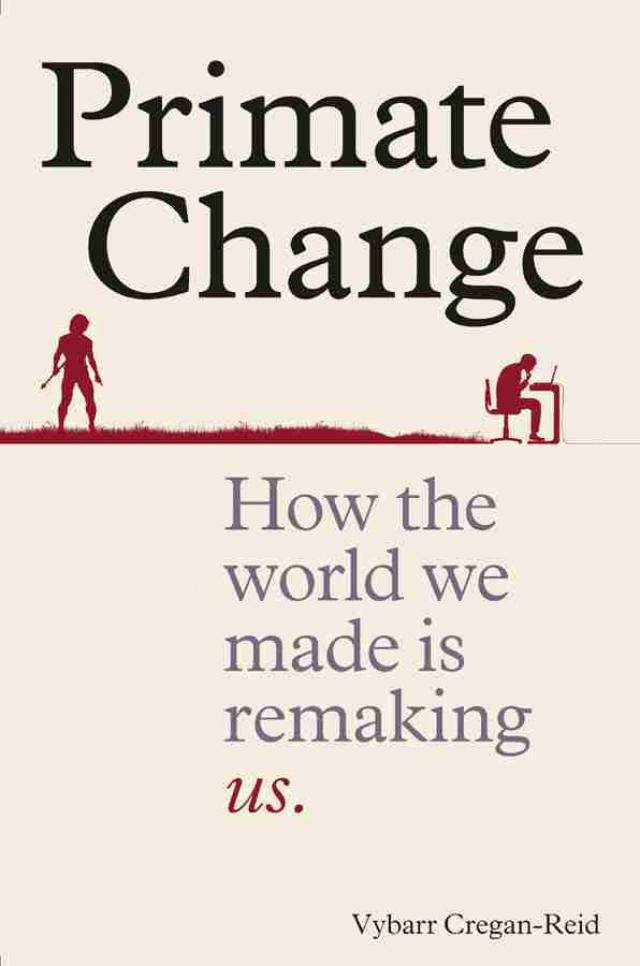
Primate Change, page 1


Yes; all the advantages of sitting still when he ought to move, and of leading a life of mere idle pleasure, and fancying himself extremely expert in finding excuses for it.
Jane Austen, Emma (1816)
CONTENTS
What Becomes You?
Part I
500,000,000–30,000BCE
Primates Change: Movement, Mechanics & Migrations
CHAPTER 1
Getting Up & Running
CHAPTER 2
Stand Up
Winding Back
Part II
30,000BCE–1700CE
Seeds, Settlements & Cities
CHAPTER 3
Planting Seeds, Processing Food & Life Under Cover
CHAPTER 4
Soil, Toil & Growth
CHAPTER 5
Exercise, Ergonomics & Life & Death In The City
Winding Back
Part III
1700–1910
Mines, Spines, Smoke & Steam
CHAPTER 6
Developing (Bad) Work Habits
CHAPTER 7
Early Air Pollution – or The Big Choke
Winding Back
Part IV
1910–present
The Sedentary or “Digital” Revolution
CHAPTER 8
The Waist Land
CHAPTER 9
Drowning in Air
Winding Back
Part V
The Future
Homo Sapiens Ineptus
CHAPTER 10
Hands & A Digital Revolution
Epilogue
Endnotes
Acknowledgements
Picture Credits
HOW TO USE THIS EBOOK
Select one of the chapters from the main contents list and you will be taken straight to that chapter.
Look out for linked text (which is blue) throughout the ebook that you can select to help you navigate between related sections.
You can double tap images to increase their size. To return to the original view, just tap the cross in the top left-hand corner of the screen.
WHAT BECOMES YOU?
Ill fares the land, to hastening ills a prey,
Where wealth accumulates, and men decay
Oliver Goldsmith, The Deserted Village (1770)
There is properly no history, only biography.
Emerson
If you think you’re you, think again.
Your DNA, the code that instructs the assembly of the right amino acids into the right proteins at the right times in the right order and in the right places tens of trillions of times over, giving you a body, is not like a computer script. The code is not perfect, reliable or definitive. Instead, DNA sequences are more like the dialogue in a play. There may be a script, but the outcome depends on the environment in which those instructions are performed. Versions of Romeo and Juliet can vary in quality and tone, from the most ornate productions by the Royal Shakespeare Company to an elementary school performance.
DNA code is a little like this. With a few exceptions, we each have our own unique scripts, but the way those scripts perform in different eras or parts of the world shows considerable variety.
Our bodies are not just expressions of a code. We think of ourselves as the outcome of our unique genes, but our bodies also need an environment to shape them. For a body to function well it needs an appropriate habitat, and when there is friction or tension between body and habitat this can result in discomfort, pathology, disease and morbidity. A genetic code that is ill-matched to its environment spells trouble for the host. Organs that are highly adapted – the gills of a fish, for example – are useless in the wrong environment. DNA in the wrong environment will also have either to compensate in some way, or fail. And, now that we are at the point in our evolution as a species when we have already changed so much of the world around us, from its physical state to the way we interact with it, these changes are expressing themselves with chatty verbosity throughout our bodies, inside and out.
Because of the way DNA works, we are all different and we are all the same: identifiably human, but with an unending variety of shape and form. Every one of us is a complex genetic experiment, a random throw of the dice that hopefully suits the environment we meet when we first see the light of the sun. But because the environment plays such a key role in how our DNA is expressed, I guarantee that you are not the person that your DNA would have made 1,000, 20,000 or 100,000 years ago. Your height would be different, your weight, your face and your eyesight. And the chance that you would have an ingrown toenail, athlete’s foot, asthma, seasonal or perennial rhinitis, tinnitus, acne, lower back pain, fatty liver disease, inflammatory bowel syndrome, short-sightedness, osteoporosis, a sleeping disorder, diabetes, depression, high or low blood pressure, rheumatoid arthritis, panic attacks, tuberculosis, Crohn’s disease, fungal infections, malaria, attention deficit hyperactivity disorder, eczema, cavities and malocclusions, social anxiety, repetitive strain injuries, chronic obstructive pulmonary disease, and many cancers would be close to zero percent. This is what our environment has done, and is still doing, to us.
Still, modern life does have its benefits; in a busy metropolitan centre you are significantly less likely to be eaten by a dinosaur, so there’s that.
OUR BODIES ARE OLDER THAN WE ARE
Humans are a little bit like plastic building blocks – indeed, any living thing is. Amino acids are the building blocks of life and these tiny organic compounds are pieced together to make proteins (of which there are millions of different kinds). Proteins go on to become cells, which in turn bind together to become tissue. Tissue makes up organs, and when they all function together, you have an organism. Whether it is a blade of grass or a beech tree, a starfish, a cephalopod, a Dilophosaurus or a human, the process is the same.
For this reason, the history of the human body is a long one, with some of our anatomical parts predating our species by hundreds of millions of years. But a step over two million years ago, the first identifiably human species began to walk the planet and since then several species of human have emerged, disappeared or converged. Homo sapiens, it seems, was the only species (among quite a few) sufficiently adapted to survive the harsh climatic changes of the Pleistocene and the Holocene. How they will fare in the Anthropocene is yet to be seen – you do have to worry about a species that names itself after the Latin word “wise”. Indeed, some believe that the correct terminology for modern humans – those arguably more intelligent and technically capable than their forbears – should be Homo sapiens sapiens, so wise they use the name twice.
These anatomically modern humans (that most resemble us) first appeared in the middle Palaeolithic; the oldest known fossil discovered in Morocco in 2017 dates from 300,000 years ago. Although Neanderthals exhibited the kinds of symbolic behaviour that demonstrated their creative impulses, Homo sapiens were additionally thought to be capable of planning and abstract thinking (though evidence is mounting that this might also have been the case for Neanderthals).
The story of the emergence of these species and subspecies is one of evolution by natural selection, in which random mutation renders the organism more (or less) likely to breed and succeed in any given environment. But the processes and revolutions we are interested in are not evolutionary, they are cultural, and these cultural revolutions have led in turn to anatomical revolutions. During anatomical revolutions the body undergoes a number or series of changes that lead to an alteration of a feature or operation in response to one’s surroundings or working patterns.
For the purposes of Primate Change, the key cultural revolutions or turning points in our development sometimes happened over thousands of years, and at others the changes might be measured in mere decades.
The first turning point is the very slow Agricultural or Neolithic Revolution that took place roughly 10,000 years ago in which humans shifted from being nomadic hunter-gatherers to become settlers and farmers. This Agricultural Revolution is not to be confused with others of the same name. It specifically refers to thousands of years of transition from hunter-gathering to the settled farming that is practised in cultures and countries throughout the world. But the demographic transition that took place was much greater than just the development of growing and production techniques. Hunter-gatherers morphed into a sedentary species that settled in villages and small towns, with all the associated environmental impacts attached to food production, such as irrigation and even deforestation. It is at this point, too, that we see the invention of something so basic that modern humans may wonder at it needing to be invented at all: storage.
Storage is only necessary when a society has reached a point at which it is acquiring and producing more than it needs – not something that previously troubled the Homo genus. First, Homo required the invention of something as simple as a jar. Then the jars needed to be housed on shelves – shelves go in cupboards, and so on. Fast-forward a few thousand years and this process has transformed into the fluorescent storage metropolises that skirt our towns and cities. These are places where we dump our things because we no longer have space for them, because the pleasure of acquisition is greater than that of possession.
The next turning point we might call the metropolitan or urban revolution, being the move from agrarian or village to city life. It was the second key point in our movement into the Anthropocene and the development of its body. From our perspective, this seems a long history, but this time of change is a good deal shorter than the Agricultural Revolution.
If the agricultural body is human version 2.0, then the metropolitan is version 2.1. Cities such as Damascus and Aleppo in Syria, Jericho on the West Bank, Athens and Argos in Greece or Plovdiv in Bulgaria have traces of settlements going back as far as 11,000 years, but they were not cities at that time. The ancient city of Ur in Mesopotamia is estimated to have had a population of about 65,000 people at its height – and this was about 4,000 years ago. Then, it would have been practically the only city that we would recognize as such. At the time, the world population is estimated to have been between 27 and 72 million, so the number of people living in cities compared to those living in rural communities would have been tiny. Fast-forward a few thousand years and the story changes substantially.
The tipping point comes in 1851.
In the middle of the 19th century, London was the capital of the world. The British Empire was about to reach its zenith, and the metropolis was the centre of culture and commerce for all of it, with the new northern cities being the engines driving manufacture and export. The current population of London is about 8.7 million. In 1851, it was just over 2 million. But that doesn’t mean that the population density was all that different. The difference in numbers is mostly accounted for by the geographical spread of London throughout the 19th and 20th centuries. More people have spread themselves more widely.
During the 19th century, London’s population grew quickly; from 2.2 million in 1841 it more than doubled in size by 1881 to 4.8 million. Population growth like this may seem normal to us, but what happened during those 40 years was part of a larger and more significant story that marked a change in our relationship with the landscape and the environment, disease, morbidity and everything.
In the 1841 census, the urban population was 48.3 percent of the country’s population. But by the time of the next census, the scales had tipped. In 1851 this figure suddenly jumped to 54 percent. The significance of this shift is difficult to underestimate. There had been no previous time when a country’s rural population was outnumbered by an urban or metropolitan one. And the trend continued; by 1891 urban populations had ballooned to represent more than 75 percent of the country’s population. Throughout the 19th century urban populations increased by more than 20 percent during every decade.
The other spike in human history was, of course, the Industrial Revolution (see here) – the time when we transitioned from using hand production methods to devising mechanical ones. The industrial body is a new kind of human; version 3.0.
Inventions proliferated in the white heat of the foundries, with new technologies such as steam power, textile and paper manufacture, cement and concrete production, gas lighting, mining, the railway and other modes of transport conjured from the flames. The Industrial Revolution was the reason labourers moved from the country to the city during the 19th century and its impact was felt everywhere.
Innovation rocketed as quickly as the world’s population soared. In 1750 estimates place the number of people at 700 million; today we have crested 7 billion and we are still accelerating, in much the same way as technology. It now takes just four and a half days for another million people to be added to the world’s population and it is estimated that the total will reach 8 billion within the next decade. Estimates vary, but approximately 10 percent of all the humans who have ever existed are alive today.
At its most basic level, population grows because the birth rate outstrips the death rate, and advances in healthcare (particularly neonatal) also push up life expectancy. Today we can really see the rise of unnatural selection. With the refinement of healthcare techniques and technologies, a greater variety and abundance of food, as well as better education about lifestyles, infant (and parent) mortality rates have plummeted even in underdeveloped countries. In the 12 months between June 2016 and June 2017 the population in the UK rose at the fastest rate since 1947 – the year of the post-war baby boom. The reason for the recent rise? Worryingly, there is no particular reason beyond that of births outstripping deaths at unprecedented rates.
The impact of the Industrial Revolution on human bodies was significant. A broad range and variety of working practices existed before that period. I don’t wish to romanticize them; many were hard, unpleasant, life-threatening occupations, but the range of body movements they required was extensive. Friedrich Engels, who studied the working classes of Manchester in the mid-19th century, suggested that the rural labourers of the preceding century had been lucky enough to have, “vegetated throughout a passably comfortable existence, leading a righteous and peaceful life in all piety and probity; and their material position was far better than that of their successors.”^
During the shift from manual to machine labour, particularly during the first half of the 19th century, the range of body movement used by manual workers (or “hands”, as they were called) diminished significantly. The work that the hands did, by hand, gradually became more limited and eventually became as refined as the carbs in a sugar sandwich.
There was much concern about the number of accidents and the terrible disabilities that were caused by modes of work in the 19th century. An avalanche of legislation was passed to protect the working classes (including young children) from widely-reported abuse by their employers. And the evidence cited was often the damaged bodies of the poor left unable to earn after work-related injury or disability, or as the result of chronic misuse – there were harrowing stories of workers having their skin stripped from their bodies by machinery, or being left blind or disfigured with amputated limbs.
What happened over the next hundred or so years was a further refinement of these new working practices, which was so complete as to be nearly unimaginable. Black smoke-chuffing chimneys sprang up in cities throughout the 19th century; they became a feature of the urban landscape everywhere, announcing these new ways of working.
We have something similar in the 21st-century urban landscape: the office block. These new buildings announce version 4.0 of the human body. They declare an even further refinement of working practices. These are undoubtedly healthier environments than the factories that preceded them, but their plate-glass windows, strip lighting and stain-proof carpets hide perhaps the most significant contributor to our Anthropocene bodies.
This second wave of the Industrial Revolution is not quite as unhealthy as the first, but it is persistently toxic. What I am doing as I write this is what more than half the population of the world is probably currently doing: sitting down. The majority of work now undertaken on the planet is performed in this pose, with the body bent at two right angles while sitting on a chair, hunched slightly forward, with rounded shoulders and the nuchal ligament at the back of the neck engaged to stop the skull crashing onto the keyboard.
Despite what we might think, chairs have not been common for all that long a period. While they are extremely old, chairs were historically rare. There are monuments in the ancient Babylonian city of Nineveh that feature ornate chairs. There are images of them on Greek vases and carved steles, as well as representations of them in early Chinese and Japanese culture. For millennia they have been used as a symbol of authority (the highest academic attainment in my profession is referred to as “a chair”) and perhaps because the chair had become such an important status symbol, for a long time it could not be widely adopted.
In homes, benches and stools were widely used for many hundreds of years, but it was not until the Early Modern period that chairs became a common feature of a family’s home – hard, wooden, upright chairs were mostly to be found.
For all its tough ways of living, working and being, the Industrial Revolution was also a period during which people craved comfort and leisure. During the early 18th century, there was a shift in the fashion of manners in the French court, from upright formality to a much more leisurely mode of social interaction in a seated, semi-reclining posture. This fashion went hand-in-hand (or bum on seat) with the introduction of the fully upholstered chair, one in which it was comfortable to sit for hours at a stretch.
Add to this the invention of cinema, TV and video games and you have a perfect storm of sedentary work followed by predominantly sedentary leisure, too. The imbalance is so extreme that the fingers of a sedentary worker roam up to several kilometres a day as they dance briskly across phone screens and computer keyboards; while some studies suggest that their feet cover 1km (0.6 of a mile) over an entire month.^


