The Exile Waiting, page 1


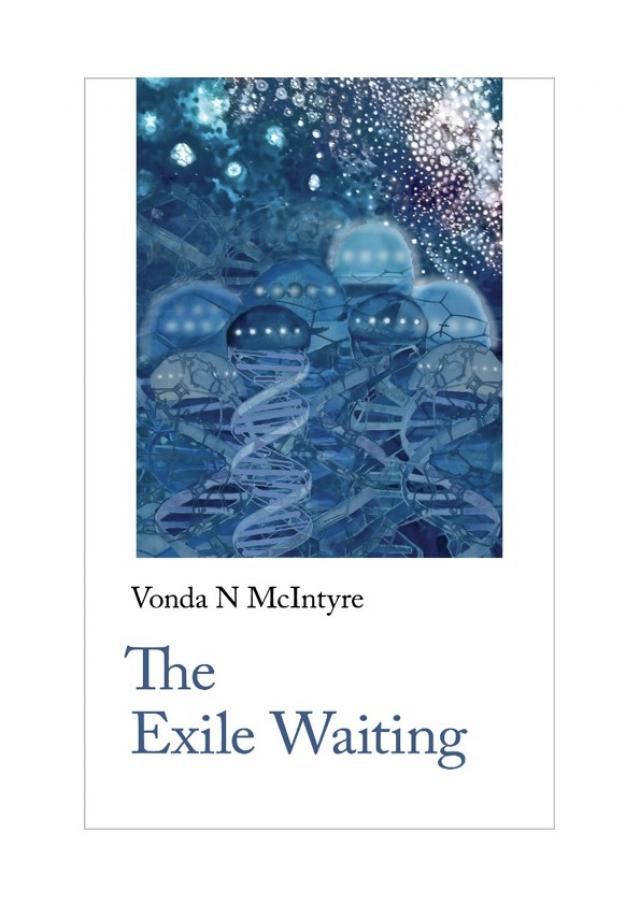
The Exile Waiting
Also published by Handheld Press
HANDHELD CLASSICS
1 What Might Have Been: The Story of a Social War, by Ernest Bramah
2 The Runagates Club, by John Buchan
3 Desire, by Una L Silberrad
4 Vocations, by Gerald O’Donovan
5 Kingdoms of Elfin, by Sylvia Townsend Warner
6 Save Me The Waltz, by Zelda Fitzgerald
7 What Not. A Prophetic Comedy, by Rose Macaulay
8 Blitz Writing. Night Shift & It Was Different At The Time, by Inez Holden
9 Adrift in the Middle Kingdom, by J Slauerhoff, translated by David McKay
10 The Caravaners, by Elizabeth von Arnim
HANDHELD MODERN
1 After the Death of Ellen Keldberg, by Eddie Thomas Petersen, translated by Toby Bainton
2 So Lucky, by Nicola Griffith
HANDHELD RESEARCH
1 The Akeing Heart: Letters between Sylvia Townsend Warner, Valentine Ackland and Elizabeth Wade White, by Peter Haring Judd
2 The Conscientious Objector’s Wife: Letters between Frank and Lucy Sunderland, 1916–1919, edited by Kate Macdonald
The Exile Waiting
by Vonda N McIntyre
with an Afterword by Una McCormack

This edition of The Exile Waiting was published in 2019 by Handheld Press
72 Warminster Road, Bath BA2 6RU, United Kingdom.
www.handheldpress.co.uk
Copyright of ‘Cages’ © the Estate of Vonda N McIntyre 1971, first published by Paperback Library in Quark/4 in 1972. Republished here by permission.
Copyright of The Exile Waiting © the Estate of Vonda N McIntyre 1975
Lines from ‘The Anger’ copyright © the Estate of Ursula K Le Guin 1975, from Wild Angels, published by Capra Press, Santa Barbara, California. Used by permission of the author.
Copyright of the Afterword © Una McCormack 2019
All rights reserved. No part of this publication may be reproduced, stored in or introduced into a retrieval system, or transmitted, in any form, or by any means (electronic, mechanical, photocopying, recording or otherwise) without the prior written permission of the publisher.
The moral rights of the authors have been asserted.
ISBN 978-1-912766-09-3 Print
ISBN 978-1-912766-10-9 epub
ISBN 978-1-912766-11-6 MOBI
Series design by Nadja Guggi.
Contents
Acknowledgements
The Exile Waiting
‘Cages’
Afterword
by Una McCormack
Further reading
List of works
Notes
This Hugo-Award-winning writer was one of the most important people to help increase the number of writers in the science fiction community. — Samuel R Delany, author of Dhalgren
Rewarding as well as entertaining, with a memorable protagonist coming of age amid the ashes of old Earth. Vonda N McIntyre writes skillfully, compassionately, tracing an exciting trail through darkness and danger. — Roger Zelazny
The addition of the previously-uncollected story ‘Cages’ is enough to justify buying the book by itself. — Tom Whitmore
Acknowledgements
This edition of The Exile Waiting was made possible by the good will and professionalism of many people, especially in the weeks before and after the author’s death.
Kate Macdonald is grateful to Vonda N McIntyre for her receptiveness to the proposal for a new print edition of The Exile Waiting, and for her care in ensuring that a master copy of the text was supplied to Handheld Press as soon as possible. She thanks Vonda’s agent Fran Collin, Nicola Griffith and Stephanie A Smith for their help during production.
This edition of The Exile Waiting was intended to be brought out in 2020 as a 45th anniversary edition. However, once Vonda had made it known in February 2019 that her recently diagnosed condition was terminal, Handheld Press worked to bring publication forward by almost a year, hoping to be able to let Vonda see the new edition. In the event, she only lived long enough to see the cover, which she approved. Kate is deeply grateful to Jane Cornwell for producing the cover art so serenely and quickly, to Nadja Guggi for expediting the book design so speedily, and to Una McCormack for reorganising her writing life to produce the Afterword several months ahead of time.
Una McCormack thanks Janet Brennan Croft and Edward James for assistance in sourcing texts.
Note on the text
Inverted commas have been changed from double to single, and ellipses have been given an additional preceding space, but no other styling changes have been made, in accordance with the author’s wishes.
For Ursula and Charles
with fond memories of their
Charitable Home for Writers
Unlock, set open, set free, the exile waiting
in long anger outside my home.
— Ursula K Le Guin
The Exile Waiting
Chapter 1
Jan Hikaru’s Journal:
Contacts in a spaceport bazaar are tenuous and quickly broken. Most of the people are transients—I’d leave too, if I could. I never had to think about money before, and the sudden realization that it’s necessary is disconcerting. But I won’t ask my father for support, nor have I petitioned my mother’s estate. I’ve been thinking more about myself and my numerous faults than about money. I’ve been lonely. Yet, somehow, I’m more content than I was as a respectable reader at university, learning everything and knowing nothing. I’ve just begun to realize how much time I’ve wasted.
Ichiri has not quite disowned me. He simply did not answer my letter. I won’t write him again—I’m not even sure why I feel I owe him any explanations. All I want is an attempt at understanding. He may be hoping I’ll give up and come home, so he can pretend he never knew about my brief bout with rebellion and—to him—insanity. Then neither of us would lose face. I don’t know yet, but I think I’m stronger than that.
If I never went home, he would be able to forget that his only offspring has blond hair, and he would be able to immerse himself completely in his fantasies. I can’t bend myself to them anymore—they have become stronger, more pervasive, and, worse, more intrusive on other people’s lives. Yet I can’t forget him. I still love the old man, on a level much deeper than that of my resentment.
I sat in a bar all evening, keeping myself mildly intoxicated. That helps very little. I become introspective. If I got more intoxicated, maybe I could begin to believe my father’s fantasies. I could proclaim myself legitimate son of the bastard son of the emperor of ancient Japan, then they could ship me home and I would live happily ever after in a world of stories and words that no longer have any meaning. I see by those lines that I am still a little drunk.
I met a retired navigator while I was drinking. She is almost deaf and almost blind—she’s outlived many of the ships she served on. Her hair has aged from ebony to white, her eyes from black to luminous gray. Too many flights have battered her, and stray radiation has turned her corneas to ground glass. They could be restored, but not the optic nerves. Yet she has a dignity about her that her tremors and deafened near-oblivion cannot strip away. She is ubiquitous, yet unique. A hundred castoff, worn-out relics wander in this bazaar alone, but she is the first with whom I’ve talked at length. She could go to one of the homes established for her kind, but she would have to leave space to do that, and she says it would kill her. She says she was born on old earth: she says it defiantly, with her clouded eyes glaring from her dark face, and she dares anyone to say she lies, or to be repelled by her. She was born there—it’s true in spirit. And perhaps even in fact, though I’ve always been taught that earth was dead and abandoned.
The old navigator and those like her rely on the aid of the younger members of their society, who know they in turn will be cared for. Tonight she and I talked so long that everyone else went off to sleep through daybreak, so she came with me to my cheap little room. Now, while I write, she is dozing on the cot, lying close to the wall, because, I think, she does not wish to displace me from my bed. She has given, now she will accept—but she does not take.
***
The scarlet darkness cooled gradually to maroon as Mischa followed the rising caves toward Center. She was tired, thirsty, hungry. She had been in the deep underground for several days, wandering and exploring, guided by intuition and the experience of other, similar escapes. But now it was time to return to the city.
She wished she could stay away longer and extend the limits of her range. The strangest sights were deepest in the earth, delicately sculpted by eons, or, rarely, rarely, built by people who had abandoned their immense constructs when they had no more need for weapons of war.
Mischa heard a noise and stopped. The sound came again, a faint scratching of metal against rock. A few shards of stone clattered down the wall and fell at her feet. She looked closely, at shoulder height, and laughed. A tiny machine quivered at the edge of a small new hole, seeming to sniff the air. As Mischa watched, the antenna mouse extruded a shiny metal lead and backed away into the darkness, leaving behind a new connection to the communications network. This far from Center there was no one to use the leads, but the mice worked on, directed in a random and useless pattern by some lost and forgotten program.
Mischa continued upward; the cave was no longer completely natural, but had been smoothed and straightened into a long, regular passa
A faraway glow appeared and increased as Mischa walked toward it: light-tubes, marking Center’s outskirts. Few other people ventured beyond the illumination, for they were afraid. Some of the fear Mischa understood. An hour before, she had caught a glimpse of a cave panther: amber eyes, smooth, black pelt, wide strokes of whiskers, when it started at her silent approach and sprang away. But the outcast people of the deep underground were more feared. People who half-believed in them used their presence to frighten disobedient children. Mischa knew the underground people existed, though she had never met them. She had seen their painted symbols on the tunnel walls, and learned to heed the caution, but she found no reason for fear. The outcasts were shyer than the panthers.
Mischa reached the light spilling from the small round room ahead: a wellcell, the only source of good water for this section of the city’s fringes.
Cut rock gleamed softly with condensation, and the air was sharp with the cool damp tang of limestone. In the middle of the circular chamber, the rim of the well projected a few handsbreadths from the floor. A tall figure in purple and black lay on its wide edge. His near-white hair spread across the worked stone. Mischa hesitated, then went toward the young man. She sat on the wall and reached out to shake him, but stopped with her hand almost on his shoulder when she saw the green flash of his eyes. Her brother stared straight up at the light above him.
‘Hey, Chris.’ She did not understand why he was not in Center. He never went home; he had not needed to for two years.
‘Go away.’ His voice held a thin note, a whine that had never been there before. His hand hung in the water, and his shirt, wet to the shoulder, clung to him as though his arm were only bones. He was much thinner than the last time Mischa had seen him.
‘What’s wrong?’
‘No dreams,’ he said, sounding close to tears.
‘Come on.’
‘Go away.’ He flung his arm over his face, covering his eyes, flinging sparkling drops of water across the bright sand and dark water. His hand was pale blue and parchment white, seeming translucent. Veins and bones protruded beneath the skin. Above the shush of water, Mischa could barely hear his slow and shallow breaths. For a moment, with a heavy fist of apprehension in her stomach, she wondered if he had stopped breathing altogether. He had not, yet her apprehension coalesced: she knew why she felt afraid.
She slid off the edge of the well and touched him. ‘Chris—’
He struck out as though he had forgotten who she was or that she was ever there. Because he had not planned it, because she had not expected it, he hit her, hard enough to knock her back. She lunged and reached for him, but he lost his balance and rolled. The water closed over him and sloshed against the well’s side, reflecting in irregular waves.
Mischa straddled the wall. Her face might be bruised, but Chris was not strong enough to hurt her. He floated motionless, face down. She reached out and down and caught the tail of his shirt. As she pulled him toward the rim, he revived, flailing and choking, trying to fight her. When he almost pulled her in, she let him go and waited.
His struggles slowly ceased. He hung in the water; ripples surrounded him. He looked up at her, and intelligence leaked back into his eyes.
‘Give me a hand.’ Still whining, self-pitying, yet trying to demand.
‘I tried,’ she said. She brought her bare feet up on the wall and crossed her arms on her knees.
Chris paddled slowly toward the edge, reached for the stone, caught it and held on. ‘Bastard,’ he said.
‘And you too.’
He pulled himself half onto the wall, stopped, and swung his leg up to hook his heel over the corner. Water splashed out of his boot and dripped from his shiny black pants and bloused sleeves. He held himself there, trembling, unable to pull himself any farther.
‘Misch …’ His voice was very weak.
She dragged him out of the water, over the wall, into the sand. He fell against her; she supported him. He tried to lie down, but she would not let him. ‘Home, Chris, huh?’
‘I want to go to sleep.’
She did not answer, but pulled his hand across her shoulders and put her arm around his waist, turned him and took him away, down a radius and toward Center. He stumbled, and leaned on her heavily, but he came.
Chris was twenty, half again as old as she. He looked taller than he was, as Mischa would when she finished growing. Chris’s hair was pale, almost colorless, fine-textured, tending to fall across his eyes. Mischa’s was darker, a shade between dark blond and brown, untidily cut, but it had the same texture and the same tendency. Her forehead was wide, her jaw strong and rather square. Chris’s face was more delicately built, and the fine bones were accentuated by his painful thinness.
What marked them truly close was their eyes. The startling green was an unlikely shade, but no one had ever asked either of them if they heightened the color.
‘Why’d you come down here?’
He took some time to answer. ‘Where?’
‘So near his niche.’ For Mischa and Chris, their uncle had no name.
‘I didn’t know I was …’ His voice trailed off, and Mischa kept him walking until he began to make weak and ineffective movements of escape. ‘Why don’t you let me sleep?’
She stopped, let him go, and looked up at him. ‘Could you? Even if I let you try, right now?’
He met her gaze, for just a moment. It was like looking deep into a person she could too easily be, if she ever let herself become as frightened as Chris was now. He looked down. ‘I can’t dream, Misch. I forget …’ His voice rose, and he grabbed her shoulders as though to shake her in anger, but he had to use her as a support. ‘I never dream anymore.’ Terror and despair were the only emotions he had left.
There was nothing Mischa could say, nothing she could do but put her arm around him again and lead him through the tunnels, back to Center, back to his niche. He came obediently, silent now. Glowing light-tubes began to outnumber dead ones. As they passed beneath the lights, their shadows lengthened and shortened like turning spokes.
Nearer Center were more people, but they took no notice of Chris and Mischa: a couple of kids, one sick, no account.
Mischa’s clothes were wet down the side where Chris leaned, clammy and warm against her in the heavy air. But she felt him begin to shiver; she moved her hand against his side and found that all the warmth came from her own body. Chris was cold, all the way through, his energy depleted by exhaustion because he could not sleep and by oblivion because he could not dream.
His boot slid across the stone; he stumbled and fell, pulling Mischa with him. She knelt beside him, holding him up on his knees, engulfed in his limp arms. ‘Get up, Chris, come on.’
‘Leave me alone.’
She could not carry him and he could not stand.
‘Get out’ the way!’
Mischa looked up, startled. A miner swayed above them. Mischa could smell the alcoholic taint of his breath, but she had not felt his approach. The sight of helplessness excited him. He struck out at her; he wore heavy rings on every finger of his soft white hands. Mischa threw herself backward into the sand. The miner turned from her to Chris and kicked out viciously. The heavy boot caught Chris in the lower ribs, lifted him, and threw him against the wall. He slid down next to a little pile of trash.
The miner chuckled low in his throat and went toward him, clenching and unclenching his fingers, head low, shoulders hunched. Mischa darted in front of him. She tossed her head and her hair flipped back; he was confronted with anger on the edge of irrationality. ‘Don’t,’ Mischa said. A touch flicked the crystal blade of her knife straight out. The point just grazed the miner’s stomach. As he jumped back, a spot of blood spread on his shirt. Mischa followed him, one step. He backed away. His gaze jerked down to the well-blooded knife. He backed another step, and when she did not follow, he turned and ran.
Mischa wiped the blade. It remained bright, clear ruby from other encounters in which it had tasted blood more deeply. The miner, Mischa reflected, should never have left his Family’s safe rich dome and the machines that did all their work.
Chris was curled around himself, unconscious or simply unaware. He did not move when she shook him, though his eyes were open. She supported his head and slapped him gently until he closed his eyes and opened them again. False euphoria, backed, then overwhelmed, by depression, crept up in Chris and leaked to Mischa. She resonated to the pitch of his exhaustion.