

A Mosque in the Jungle, page 1


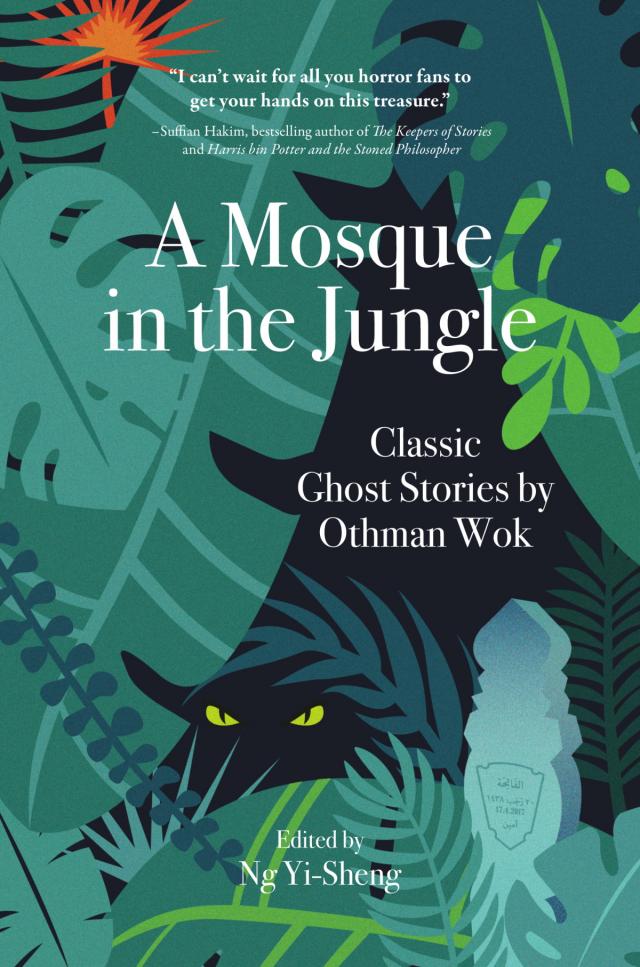
“One should not forget Encik Othman Wok as a journalist and author…someone well-known for his fascinating ghost stories to share, indeed not without deeper meaning to life.”
—ZAINUL ABIDIN RASHEED, former Senior Minister of State, Ministry of Foreign Affairs, and former editor of Berita Harian and The Sunday Times
“Haunting plots, memorable casts of characters and classic, even surprising, twists. These stories are reminiscent of the ones we might have told or been told about secluded corners in our schools, the old, abandoned buildings in our urbanising midst, and the forested areas that seem so dooming and untouchable at night. Reading them while home alone makes every scratch sound like the scuttering of thousands of invisible rats and that random tap or bump the knockings of a murdered woman from within bricked-up spaces in our walls.”
—NURALIAH NORASID, award-winning author of The Gatekeeper
“I can’t think of a better person to introduce Othman Wok’s macabre tales to a new generation than Ng Yi-Sheng, a passionate, erudite scholar of local literature and culture. His insights take Othman Wok’s tales to a whole new level. I can’t wait for all you horror fans—new and old—to get your hands on this treasure.”
—SUFFIAN HAKIM, bestselling author of The Keepers of Stories and Harris bin Potter and the Stoned Philosopher
“This collection of stories brought me on a nostalgic trip down memory lane, to a Singapore of yesteryear. It is evocative of an era in Singapore’s history which does not exist anymore.”
—GLEN GOEI, theatre director and filmmaker (Revenge of the Pontianak)
“Singapore in the fifties and sixties was different. Hantu kubur, jembalang tanah, langsuyar, hantu galah, hantu raya, hantu laut, orang bunian, pontianak, orang minyak, saka and hantu tetek were very much alive in the minds of Malays. In this context, Encik Othman Wok penned his stories.”
—YATIMAN YUSOF, former Senior Parliamentary Secretary, Ministry of Information, Communications and the Arts
“Make no mistake, these aren’t tales for children. There’s the battering and violent dismemberment of animals and women, and with them, swift retribution upon their perpetrators; ghosts of women and little girls in cemeteries; haunted houses with their victims screaming for justice; murderous husbands getting their comeuppance; and the karmic fates of greedy treasure hunters. Yet there are also the tender recollections of ghosts reaching out to loved ones to say goodbye, of unrequited love and of unfinished business. They temper the gut-clenching horror just as dawn quenches the night. These tragically realistic depictions of the monsters among us transcend time, space and culture, but the context and settings make these tales ours—stories and myths from our history. A must-read for those hungry for a slice of local horror, a fascinating glimpse into the past, and a nostalgic return to a Singapore and Malaya peppered with ghosts.”
—CHRISTINA SNG, Stoker Award-winning author of A Collection of Nightmares
“Classic spooky tales that will keep you turning the page.”
—TUNKU HALIM, bestselling author of Scream to the Shadows
“For someone who is deathly interested in what quickens the Malayan pulse, I am horrified to discover footsteps before mine. Othman Wok’s stories blast a heartstopping trail through our Malayan history, squelching through mangrove swamps, tearing up forgotten Javanese ports and taking a parang to the undergrowth that conceals what we truly dread.”
—KELVIN TONG, film director of The Maid
“Othman Wok is definitely one of the most compelling horror story writers in Singapore. I find his book thrilling and terrifying.”
—DJ KC CHAMPION, presenter and producer of Malam Seram: The Horror Talk Show
Copyright © 2021 by the Estate of Othman Wok
Cover design by Razi Alaydrus
Published in Singapore by Epigram Books
www.epigram.sg
All rights reserved. No part of this publication may be reproduced, stored in a retrieval system or transmitted in any form or by any means, electronic, mechanical, photocopying or otherwise without the prior written permission of the publisher.
Published with the support of
National Library Board, Singapore
Cataloguing-in-Publication Data
Name(s): Othman Wok, 1924–2017, author. | Ng Yi-Sheng, 1980– editor.
Title: A mosque in the jungle : classic ghost stories by Othman Wok / edited by Ng Yi-Sheng.
Description: Singapore : Epigram Books, 2021.
Identifier: OCN 1246257999
ISBN: 978-981-4901-70-3 (paperback)
978-981-4901-71-0 (ebook)
Subject(s): LCSH: Horror tales. | Ghost stories, Singaporean (Malay)— Translations into English. | Ghost stories, Malaysian— Translations into English
Classification: DDC 899.283—dc23
This is a work of fiction. Names, characters, places, and incidents either are the product of the author’s imagination or are used fictitiously. Any resemblance to actual persons, living or dead, events, or locales is entirely coincidental.
First edition, May 2021.
CONTENTS
Introduction by Ng Yi-Sheng
A Mosque in the Jungle
The Sound in the Wall
The Anklets
Dollah Returns
Si Hitam’s Curse
Among the Gravestones
The Old House
The Mad Artist
Who Shot Sergeant Ito?
Under the Banyan Tree
Visitor from the Coffin
The Golden Lantern
The Guardian
The Skulls of Kuala Banat
The Eyes of Mak Long Memah
The Mystery of the SS Juita
Witri’s Vengeance
Monster Catch
Sweet Suriati
Tengku Ripin’s Wife
Hidir’s Trial
No Escape
Mermaid’s Tears
Her Dead Husband Hasn’t Left Home
Introduction by Ng Yi-Sheng
Upon my desk, there lies a well-thumbed copy of Othman Wok’s Malayan Horror: Macabre Tales of Singapore and Malaysia in the 50’s. The uncanny cover art returns my gaze—a pair of massive, soulful eyes rising out of the darkness, obscured by the attap-roofed kampung huts of yore. Against the back, below the fresh-faced photo of the author at age twenty-four, the original price tag is still affixed: $11.90 from the Wordshop. And inside, on the title page, hovering above the windmill logo of the Heinemann Asia series, there’s an autograph in black ink: Othman Wok, 27.12.2011.
I only met Pak Othman briefly. I had been assigned to write a children’s newspaper article about Singapore’s first president, Yusof Ishak, and I’d decided to approach one of his surviving colleagues for some personal recollections, and—why not?—seize the opportunity to get a classic work of Singaporean literature signed by the author. I met him at his office in The Concourse on Beach Road and did the interview over cups of English tea. Afterwards, when I brought up his literary career, he seemed embarrassed—as if it was a shameful deed he’d committed as a younger man, now come back to haunt him.
I found myself frustrated at how little he cared for his writerly fame. Yet this was understandable: he’d had an incredibly illustrious life beyond the world of fiction, after all. He’d been a World War II survivor, a journalist, a student abroad in London, a young PAP politician fighting for independence, a diplomat, a director and board member of numerous organisations (including the Singapore Tourism Board and the Sentosa Development Corporation), a father of four, a grandfather of five, and a great-grandfather of two.
Nevertheless, throughout the 2010s, I found myself returning to his work again and again, explaining to all who would listen how rich and fascinatingly unique his stories were. By this time, a new wave of readers and writers had arisen, championing Singaporean fantasy, sci-fi and horror, including Sandi Tan’s The Black Isle, Nuraliah Norasid’s The Gatekeeper, Neon Yang’s Tensorate series, Rachel Heng’s Suicide Club and Suffian Hakim’s The Minorities. I began playing the role of amateur literary historian, reminding people that these more recent works weren’t just imitations of Western trends—they were a continuation of a local literary tradition that had been alive since the 1950s, when Pak Othman first began writing.
Pak Othman passed away in 2017 at the grand old age of ninety-two. The Karyawan, a magazine published by the Association of Muslim Professionals, commissioned me to write an obituary, focusing on his literary legacy.1 I also began communicating with his daughter and compiler, Lily Othman, urging her to bring his stories back into print. This was how I ended up being asked to edit this volume—a role that honestly should’ve gone to a specialist in Malay literature, who’d have been able to provide new, dynamic translations of the texts. I can’t do that, alas. What I can do, however, is help a new generation of readers understand why his stories are vital and important. They’re not just creepy, nail-biting, spine-chillers—they’re genuine classics.
Othman Wok was born in Telok Blangah, Singapore, on 8 October 1924. He grew up steeped in Malay tradition: his family told him stories of his Orang Laut great-great-grandfather, killed by a tiger in Singapore before the arrival of Stamford Raffles. When Othman caught malaria at the age of five, he was diagnosed as being “kena sampuk” and was treated using rituals by a visiting dukun.2
At the same time, his father, a teacher and principal at Radin Mas Primary School, insisted on giving him a modern education. This meant that he studied the English
Such youthful idylls, however, were cut short by the real-life traumas of the Japanese Occupation. During this period, he worked as a fisherman, then as an assistant in a Japanese anti-plague laboratory. (Decades later, he would discover that this lab had in fact been a centre for biological warfare.) In 1946, he joined the Malay newspaper Utusan Melayu, first working as a clerk, then as a roving reporter. He thrived at his new job, mainly working the crime beat but occasionally venturing into the depths of jungles to cover the RAF troops’ capture of Communists. This ultimately won him a scholarship to study journalism in London in 1949. Mind you, he wasn’t one hundred per cent married to his work—his colleague Said Zahari recalls how he was rather adept at slipping out during office hours to amuse himself in the city.3
His big break came in 1952. This was thanks to Yusof Ishak, the founder and Editor-in-Chief of Utusan Melayu, and the future president of Singapore. He commissioned Othman to write a weekly series of horror stories for the new Sunday edition of the newspaper, Utusan Zaman. “Malays just love stories like these,” Othman recalled in an interview with The New Paper. “Sure enough, the circulation almost tripled.”4 He would spend the next four years spinning these tales for both Utusan Zaman and the entertainment magazine Mastika, making him a household name in Singapore and the Malay peninsula—even before he joined the People’s Action Party in in 1954.
Why were these horror stories so popular in the fifties? Part of the answer lies in the fact that this was a time of a Malay cultural renaissance—the arts were flourishing in pretty much every field, with practitioners furiously creating work that engaged with post-war modernity and burgeoning nationalism. We see this in the rise of ronggeng, joget and keroncong in music; the artworks of Persekutuan Pelukis Melayu (the Society of Malay Artists); the literary works of ASAS ’50 (the Writers’ Movement 1950); the shift from traditional bangsawan theatre to radio dramas and the films of the Shaw Brothers’ Malay Film Productions and Cathay-Keris—including many beloved horror movies, such as BN Rao’s Pontianak and L. Krishan’s Sumpah Orang Minyak.5
But why horror specifically? My personal theory is that the genre represents a return of the repressed—a resurgence of old, purposefully forgotten memories. Like many traditions of world literature, the classical Malay canon abounds with uncanny and mystical episodes. Consider how Badang receives his powers of superhuman strength from a hantu air, or water spirit, in Sulalatus Salatin,6 or how the maiden Bidasari is cursed to waver between life and death each night in her tomb in Syair Bidasari. The coming of British colonialism, however, dispelled the old magic of the past. This is most poignantly expressed in Abdullah Abdul Kadir’s 1849 autobiography Hikayat Abdullah, often hailed as the first great work of modern Malay literature. Here, the glories of Singapore’s precolonial kingdom are reduced to mere ghosts that haunt the royal hill of Bukit Larangan—spirits easily exorcised when William Farquhar fires a cannon from the summit and orders the forest to be cleared.7
Malay intellectuals thus began to favour realism in their writing.8 Many of them viewed ghost stories as shameful artefacts of a less civilised age, best to be abandoned as the community progressed into the future.9 Abdullah emphatically reminded his readers that “all these beliefs are groundless and nothing more than sheer deceit.”10 By the time of the post-war era, this ideology had become even more ingrained. Keris Mas, a prominent member of ASAS ’50, stated that the agenda of the group was to critique “societal backwardness…those whose consciousness have been frozen by the influence of feudalism and myths, and superstition that has been enmeshed with religion.”11
Othman’s horror writing stems from a diametrically opposed impulse: the desire of the Malay public to celebrate their heritage, without censorship of its spookier, non-rational face. We see the triumph of tradition over modernity in stories such as the tantalisingly suspenseful “The Golden Lantern”, which begins when a family of brothers ruins the folk medicine practice of Pawang Kassim, telling their neighbours to use Western treatments instead. The sorcerer inflicts a deadly curse on them—notably, the first sign of its effects involve the malfunctioning of a scientific innovation, the electric light bulb. We see such a victory again in “The Skulls of Kuala Banat”, when Pawang Mat Yassin uses his spells to save the British administrator Martin Haliday from the spirits of a failed European colony; and again in “A Mosque in the Jungle”, where a young soldier, hunting down Communists in the rainforest, is forced to reconsider his scientifically-informed scepticism: “In the age of the atomic bomb and the hydrogen bomb, how could ghosts exist?”
But Othman was by no means a diehard traditionalist. Some of his tales contain no supernatural elements at all, as in the case of “The Mad Artist”, a tale of gruesome murder and clinical insanity, possibly inspired by his work as a crime reporter. Furthermore, when the spirits do appear, they are not ritual manifestations of age-old stories—notably, they are never identified by their age-old names, such as “pontianak”, “pocong” or “buaya putih”. Often, they’re not even of Malay origin: witness the spirit in the Chinese cemetery in “Among the Gravestones”, the Balinese cat in “Si Hitam’s Curse” or the drenched, unspeakable horror of “The Old House”. Nor are the wise old bomohs always effective when they cast their spells. Mysteries are just as often solved by the rational thinking of modern men and women, such as the spirited maidservant Kak Jah in “The Sound in the Wall” or the investigative headmaster Cikgu Abas in “Dollah Returns”.
In fact, many stories are refreshingly urban and cosmopolitan even to readers today. Look at “The Anklets”, in which the forensic specialist Dr Hamid encounters the disembodied feet of a murdered Indian woman; “Visitor from the Coffin”, where a studio photographer (also named Hamid) takes pictures of a Chinese towkay’s ghost. “The Guardian” is particularly noteworthy: narrated by the London-trained curatorial assistant Abdullah, it describes how members of a British archaeological expedition are hunted down by a mummified Dayak warrior—a tale almost certainly inspired by Howard Carter’s ill-fated raid of Tutankhamun’s tomb in Egypt and Universal Pictures’ 1932 film The Mummy.
None of this, however, earned Othman much respect among the Malay literati of 1950s Singapore, many of whom were his own colleagues at Utusan Melayu. Though he had been appointed as Deputy Editor by 1957, he was remembered as “basically a straight newsman…not known for writing opinion pieces or making thought-provoking or political commentary.” His fellow reporter, and future Malaysian literary giant, Abdul Samad Ismail, scornfully dismissed his forays into fiction, saying, “As a writer, he’s remembered most for his ghost stories.”12
It’s therefore sweetly ironic that these ghost stories have stood the test of time, thrilling and delighting thousands of readers since they first appeared in Utusan Zaman. As it turned out, Malay society needed both schools of writing: realists like Keris Mas, Usman Awang and Abdul Samad Ismail, who pushed for social reforms; and creators of fantasy and horror like Nora Abdullah and Othman Wok, who inspired pride in pre-modern Malay culture by granting it the dignity of mass circulation in print.
Othman Wok’s political career is well-documented, so there’s no need to go over it in detail. In 1963, he was elected as Member of Parliament for Pasir Panjang and appointed as Singapore’s first Minister for Social Affairs—a job that required him to resign from his Utusan Melayu position.13 As a prominent Malay politician in the Chinese-dominated PAP, he became a scapegoat for racial supremacists who branded him a “Malay traitor”—he was actually caught in the midst of the 1964 racial riots, and survived by hiding in the old Kallang Airport terminal building. After Separation in 1965, he continued in his role of Cabinet Minister, briefly also serving as Minister for Culture for three years, and enacting policies to promote sports, improve social services and manage Muslim affairs. In 1977, he became Ambassador to Indonesia—not an easy job, considering that this was barely over a decade after Konfrontasi. (In his biography, he complained that his ambassadorial residence in Jakarta was haunted. This was hardly the worst of his mishaps: in 1978, he missed a fatal crash in Suharto’s personal helicopter, simply because he had overslept after watching a late-night World Cup match.) Finally, in 1981, he retired from politics, though he would continue to conduct “fireside chats” for new PAP MPs well into the 2000s.


