

The Game of Courts, page 1


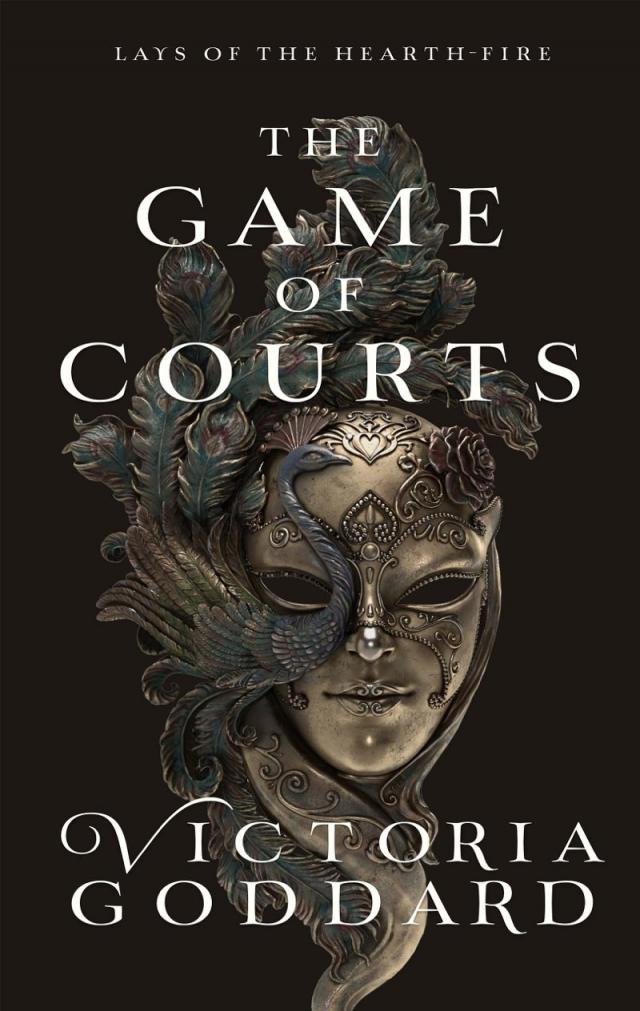
LAYS OF THE HEARTH-FIRE
THE HANDS OF THE EMPEROR
AT THE FEET OF THE SUN
The Game of Courts
Petty Treasons
Those Who Hold the Fire
Portrait of a Wide Seas Islander
THE GAME OF COURTS
VICTORIA GODDARD
Copyright © 2023 by Victoria Goddard
All rights reserved.
No part of this book may be reproduced in any form or by any electronic or mechanical means, including information storage and retrieval systems, without written permission from the author, except for the use of brief quotations in a book review.
CONTENTS
Chapter 1
Chapter 2
Chapter 3
Chapter 4
Chapter 5
Chapter 6
Chapter 7
Author’s Note
1
The Cavalier Conju enazo Argellian an Vilius, last of his name, hummed softly as he sorted through the bottles and pyxes laid out on his worktable. The containers were closed, but fragrances ghosted around them, spirits wafting up to strike his memory.
Here a set of crystal flasks, each containing the pure distilled alcohol used for as the base for perfumes. Conju’s fingers trembled a little as he checked that each was sealed, that their contents were there, neither stolen nor evaporated over time.
He had never been that desperate, he reassured himself. He had never lost sight of his art, for all that it had been a long time after the Fall that he could find the inner peace requisite to sitting down at his worktable and creating something new from a few drops of this, a few drops of that, base notes and middle and top, silent chords to wind through the air or linger, close and intimate as a kiss, on the skin.
Here a tiny pyx of enamelled glass, no larger than a walnut, the colours bright as if sunlight shone within; the pyx contained yrvalen, the distilled essence of a summer morning. No one made that any longer: the wizards had other concerns, more grave and important, than such fripperies as distilling the essences of a moment or a mood. They still made the potions and ingredients of their magics, but the fripperies (or what they called the fripperies) were become rare.
It had been a while since Conju could bear to even look at that pyx. Each time he considered the enamel, red like a poppy in a green field, white daisies, blue sky, yellow sun—oh, how could he not but remember the gentle summers of his youth? Laughing with his beloved friend, dreaming of futures bright as the sun through a summer canopy of green leaves, their hearts wide and free as those red poppies, those white daisies, the warm breeze with the scent of hay from the tenant fields below the pastures—
All gone now, with the wizards who had distilled such. But he still had the pyx, and the precious yrvalen, and the memory.
Bitter and sweet, rich and strange. Here were a dozen phials filled with a dozen variants of rosewater, which his mother had once distilled in her own stillroom. Conju set them into their places, next to the indigo chamomile, the mossy-green vetiver, the pale yellow petitgrain. All in the many-sized pigeonholes, the velvet-lined drawers, the inset cases of the worktable, gift from his older brother when Conju first went to the capital.
His next-younger brother and sister had both joined the Imperial Army. They had sent him the most exotic ingredients they could find on their postings: some of them had never made it into general circulation before the Empire Fell. Musk glands from the creatures of half a score of wildernesses, including one his brother had sworn had come from a male gryphon in northern Voonra.
A lump of waxy ambergris nearly the size of his head, which his sister had found washed up on the shore of a distant continent, the other side of Colhélhé. Conju set it into the large drawer in the bottom of the table.
Other men might have desks or vanities for their passions. Conju had a worktable with pigeonholes and slots above, a hundred drawers below. It was made of oak, with the characteristic dark grains of the wood cut from his family’s land, cured in his family’s lumber room. His four-times-great-grandmother had planted the oaks; his father had cut them.
He set the next phials into velvet-lined drawers. Oils of fifteen species of lily; extracts of other flowers and herbs; the seedpods of various plants he himself had learned to distill or extract with wax or solvent. Spices from five worlds. He tilted the jar of nutmeg, the nuts rattling against the silver, tiny perforations in the jar emitting tiny bursts of scent from a few remnant curls of shaved spice.
The miniature nutmeg rasp his eldest sister had once given him as something of a joke went in the drawer next to the jar, his fingers lingering for a moment on the crest, the Vilius snake coiling through a branch of oak leaves and acorns.
It had been well known amongst his family that he did not really have a sense of humour. He was too persnickety, too precise: his sister had meant for the rasp to be a joke, for him to laugh at how absurd and specific a thing it was, the lengths she had gone to commission it specially. Instead he had received it with satisfaction and delight, immediately thinking how pleasing it would be to use the correct tool for the task. He had used it, making potpourri, preparing the nutmegs and other hard seeds for extracting their scents.
He smiled at the memory, closing the drawer with a soft, decisive click. All these gifts: each time he sat down at this desk he was surrounded by his family, their ghosts in the scents captured by the wood. He had their images here as well, small portraits painted by his father whose hobby it had been.
It was some years since the Fall of Astandalas, and this was all there was left to them.
The desk organized to his liking, Conju hesitated a moment, then pulled down a heavy glass dish. It was not large—one did not make large quantities of experimental perfumes—but it was perfect. The clear glass caught light of the oil lantern hanging above him. (Once it would have been magic that illuminated his workspace. But that was something else that had failed with the Fall.) He ran the shaft of an eyedropper around the inner rim of the vessel until the glass caught the resonance and emitted a low thrummmm.
As he always did, he said a prayer for the one who had given him the bowl, that friend of the summer mornings whom he had loved, who had run away from the Empire long before it Fell; and for all his family who had perished that terrible night two days before Conju was supposed to go home.
He did not believe in the gods, but he could—well, he could hope, in his own way, that there was some power to hear.
He poured in a measure of the distilled alcohol, readied his notebook, and began, as one must, once more from the beginning. A base note; a fixative.
He hesitated, but for once he did not feel the need to begin with the dark, the resinous, the vicious, the intense. Sandalwood, he decided, examining the pale yellow viscous oil, inhaling the scent, imagining the soft, powdery, gentle dryout as the perfume-to-be lingered on the skin.
Sandalwood, and he lost himself in his mind, trying a drop of this, four drops of that, ten of this other, three of that …
This was the Cavalier Conju enazo Argellian an Vilius at his worktable in his room, three floors down and a shameful number halls out along the Ystharian Wing from the Imperial Apartments in the heart of the Palace of Stars.
He had been all of twenty-eight when Astandalas fell, and was now either thirty-one or one hundred and thirty, depending on whether one counted the year the Last Emperor of Astandalas had spent in an enchanted coma as one or one hundred.
Like most of those who had been trapped in the Palace during the Fall, Conju did not recall that year well at all.
He had spent the majority of it drunk, working his way through the stashes he and his friends found in the empty rooms. It was the only time in his life he had ever been able to let go of his desire for order. There had been no order outside, and for a while none to be found inside as well.
He called them friends, but they had mostly been courtiers of his own age and situation: not rich or titled enough to be recognized for their own merits, nor poor or common enough to need to work. They had appointments and positions; were attached the households of great lords as secretaries and tutors, stewards and masters of horses and hounds, or as companions to the scions of princes their own ages.
Conju had been one of them; his current small apartment had been given to him by his former patron. He was a younger son, and though his parents had grand titles indeed, his father’s was not inheritable and his mother’s was entailed to the female line. Thus he had spent his youth dreaming of respectable service together with his friend of the summer mornings and the winter evenings, but when Terec, his friend, had left, run away from his own wild magic and the weight of the Empire pressing down on him, Conju had been left behind.
(Why was it so hard to call him anything else in his mind? But they had been friends since childhood, a friendship that had slowly blossomed into something more; a friendship he had thought would endure for the rest of their lives, together.)
Conju would have gone with him, would have left all he knew behind for love of his friend.
Terec had not given him that choice, had instead gone in secret and in deceit, so that by the time Conju or anyone else knew that he had truly gone, he was far out of their reach.
It had taken him a long time to pick up the pieces Terec had broken in his leaving.
In a hidden compartment of his worktable there was a drawer in which he kept his most precious items. The one last letter from Terec, apologizing for not giving him that choice; th
He blended his oils together, deep green and pale gold, indigo and just barely tinted red. Sandalwood, vetiver, chamomile, rose, a few final drops of pepper. His mother had had a passion for her stillroom, for distilling the essence of her gardens into perfumes. She had been interested in how scent affected mood. Conju had been fascinated by her activities as a boy, a young man, and spent many hours learning from her. He had moved from the distillation to what you could make with the perfumes, learning to blend scents.
(The nutmeg still made him think of the perfume he had made for Terec, warm and woodsy and with just a hint of clear, cool, mint. Terec had fought against his inner fire, wild magic that he could not control, inimical to the structures of Imperial magic, and was forever seeking the pale, the cool, the soft, the damp; but Conju had loved it, that wild part of him, that fire that sometimes flared when they were making love.
The Fall had taught him what Terec had feared.
Yet Conju still loved nutmeg, and sometimes he opened the small wooden box Terec had given him for his twelfth birthday, inexpertly carved by his friend himself, and breathed in the raw materials of Terec’s perfume, and let himself remember the bright summer mornings and the cozy winter afternoons, and all the whispered promises that would never be fulfilled.)
He considered the blend at hand, added a drop of Voonran dyrfil, which usually added a bright coppery note. Then he grimaced as the scent skewed to something odd and unpleasant. Not at all what he’d intended.
He poured the mixture into a stoppered phial, knowing from past experimentation that sometimes letting the ingredients sit for a few hours or days or even months would cause some alchemical magic to blend them. He finished his notes of what he’d done in one of the leather notebooks his mother had given him, then slid the book back into its place in the vertical slats of the back of the table.
He wiped off his desk, using a fine chamois leather to polish the surface clean, and then leaned back in his chair, stretching out his neck and shoulders. The Palace bells rang the third quarter of the fourth hour of the afternoon. He had a quarter-hour but that was not enough time to start another experiment before he was expected down in the lower halls.
After the Fall, the Last Emperor spent that year, or that hundred years, in an enchanted coma.
Conju spent that same period wildly debauched and increasingly regretful of his life choices, but unable to see any way forward. He had no useful skills to offer to those who were trying to build something out of the ruins of Astandalas. Nor did he have any hope that what they were doing would be of any use.
He had lost everything in the Fall but for a half-dozen acquaintances and one great-aunt who had died subsequently of a fever. The Palace was not even in the same place: the world itself was different. He had heard people say it had been moved from Ysthar to Zunidh, and that those were the Grey Mountains one could now see to the west, the Eastern Ocean to the east.
He had never been to Zunidh before. His family had all lived a hundred miles away from Astandalas, far enough to be rural, close enough he saw them often. He had never, hitherto, had any interest whatsoever in Zunidh.
Conju and his friends had ventured out a few times into the gardens, until they discovered that straying off the paths often meant the person never came back at all.
He still sometimes went out along what everyone tentatively reckoned was the safe path, the wide road bisecting the old gardens—all dead now, the temperate-climate trees and plants of Astandalas unable to take the equatorial heat of wherever they were—and stared at the encroaching jungle greenery.
It was tempting to imagine stepping off the main path and just … disappearing.
Except he would not disappear to himself, would he? He would just be … somewhere else, with even less useful knowledge and even more troubles at his head. At least in the Palace he had food and clothing and the drink and drugs his friends found in the ruined and abandoned rooms.
He did not ask himself where the food came from. There had always been servants to look after that sort of thing, and he had not ever become someone’s steward: he had been a companion to the daughter of the Grand Duke of Eldizorka, a young woman wild and merry.
Conju had found her madcap energy difficult, and she had derided him relentlessly for his persnicketiness, but her father the Grand Duke had liked his rank, his steady, precise temperament, and the fact that he was entirely disinterested in romance with young women, and had therefore given him a very generous stipend to attempt to rein in Lasara’s more impossible tendencies.
Lasara and her father had both been at the Prince of Katharmoon’s famous Silverheart party down in the city, along with the majority of the upper aristocrats normally resident in the Palace, the night Astandalas fell.
Conju had been invited—hence his delay returning to his own home—but then had fallen horribly sick that afternoon and been unable to attend; and thus had he survived.
A year or a hundred years after the Fall of the empire, the Last Emperor woke up, and the entire tenor of the Palace changed.
Conju felt it, waking himself that afternoon from some debauched stupor to the sound of the Palace bells ringing thunderously.
He had, at the time, hated them. No one with the sort of constitution he had at that point—already nervous and prone to anxiety, compounded with a year of careless indulgence—could possibly have liked the sound of the bells. He could just about ignore the hour bells, and certainly no one who was not deliberately attuned to them really cared about the quarter-chimes, but the bells of the four quarters were audible everywhere.
Someone was thundering the noon bell, and he did not like it. His head was throbbing and his mouth was dry and tasted of old wine. They had run out of laudanum and even Conju at his worst did not want to try some of the more mysterious substances his friends had found in the Collian ambassadors’ old rooms.
He was also aware, even if he refused to let himself think the thought clearly, of how shameful his behaviour was.
There was that line in Fitzroy Angursell’s Aurora that his friends were forever quoting, about ‘Prince Peter, who was in the far northern regions, being debauched’.
Conju did not like Fitzroy Angursell’s poetry and had never read Aurora; he thought that if the Imperial Censors had banned it they must have a good reason; the stories of the Red Company irritated him for how topsy-turvy and irregular they wanted society.
But no one could escape the stories and songs entirely, and so he knew of Prince Peter and his endless debauchery, and now he knew why that was a poor idea.
He dunked his head in a basin of cold water. He still wore his hair shaved. Terec had always said he had a lovely shape to his skull, and Conju himself felt that he needed all possible assistance to feel somewhat like the nobleman he was.
And still the bells kept thundering. People were shouting now, calling incomprehensibly. He could not help but feel his heart race with concern. What could possibly have happened now? The air was not that same dead, desolate coldness of the first morning after the Fall. Rather, it seemed almost … effervescent.
He dressed in the studied dishevelment that was the style in his set—they might not be anything more than stupid young fools partying while the world burned, but at least, the more vocal amongst them said, they looked as if they were doing so on purpose—and went out to find all the Palace abuzz with the rumours that the Last Emperor had awoken at last, and things were going to be all right.
2
He tried to clean himself up, but a year’s debauchery was not so easily sloughed off.
Prince Peter of Aurora, according to Conju’s set, had taken six months and relapsed twice. Conju grit his teeth and refused to accept that he would follow the model set by Fitzroy Angursell in anything. It still took him six months but he was proud there was only one relapse.


