The President Shop, page 1


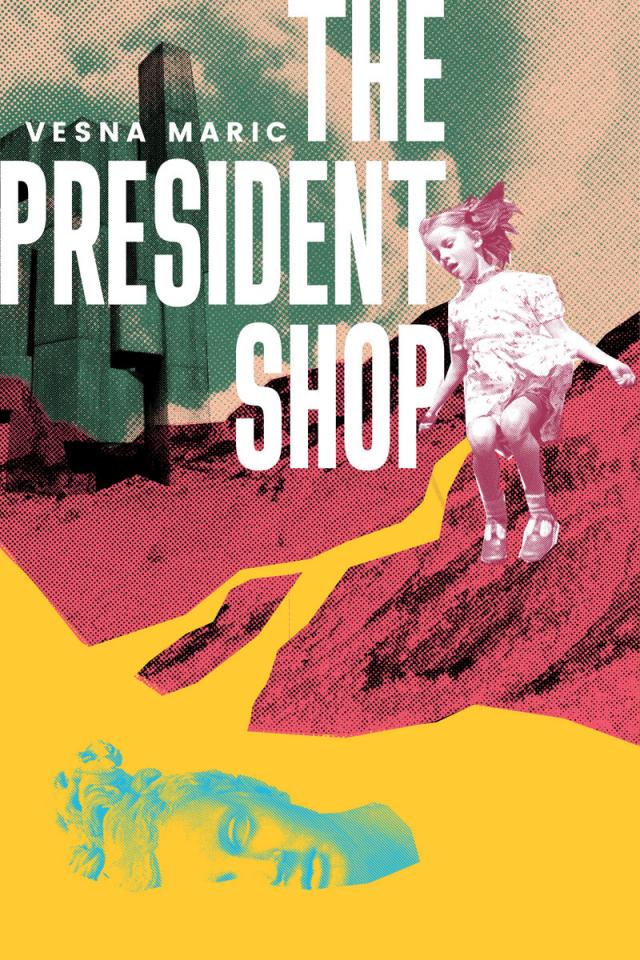
MONA COULD NOT have taken in the details of the President Shop on the day of her birth but if she had, she would have seen a display of the President’s portrait from all sides. Profile, semi-profile, front facing; young, middle-aged, old; wartime, post war; military clothing—fatigues and dress uniforms—and crisp civilian suits. There were pictures of the President driving one of his limousines in a white suit, decorated with military honors, his hands gloved in white silk; the President’s wife beside him, wearing a bouffant hairstyle like a dark medieval crown. But Mona, her newborn soul still mindless and full of stars, grasped that birth was suffering and love, and that the outside world was filled with odors and sensations she could not resist or pull away from. She discovered that she could cry, and that most of the time, if she cried, she would be filled with sweet breast milk and embraced by Rosa into a softness and fluidity that closed around her like tulip petals.
COPYRIGHT © 2021 Vesna Maric
DESING & LAYOUT Nikša Eršek
PUBLISHED BY Sandorf Passage
South Portland, Maine, United States
IMPRINT OF Sandorf
Severinska 30, Zagreb, Croatia
sandorf.hr | contact@sandorf.hr
PRINTED BY Tiskara Zrinski, Čakovec
Sandorf Passage books are available to the trade through Independent Publishers Group: ipgbook.com | (800) 888-4741.
Library of Congress Control Number: 2020944409
National and University Library Zagreb
Control Number: 001077020
ISBN: 978-9-53351-295-2
sandorfpassage.org
for Elena
Chapter 1
ROSA PUSHED MONA into the world on a December evening. And as the infant emerged from the soft, pink chamber of the womb at 7:13pm, under the luminous neon line of light on the ceiling, it was his countenance that Mona saw first: the President, as rendered in a black-and-white portrait in an ornately flowery gilded frame. It was as if the picture, or the picture frame, was the President’s cell, and his figure the cell’s silent nucleus, floating around the country’s interiors, watching all. The President was handsome, with high cheekbones that held his face taut like pegs pull a tent or wind yanks a flag. Mostly the pictures of him were black and white, from his youth. Later, when Mona was nearing the first decade of her life, firm on her legs and lean in her body, the pictures of the President were in color, his aged countenance now full, sporting dark sunglasses, liver spots, and a military cap. Often, in his autumn years, a Cuban cigar poked stiffly from between his canines.
The doctor rushed in, perspiring and smelling of cigarettes and alcohol. He had been drinking and smoking in a bar moments before being summoned by the panicked Diogen, Ruben’s younger brother, who had been helping Rosa in the shop. Rosa’s waters broke across the floor like in the movies, propelling her into the fastest labor known to womankind, as if Mona insisted she be born right there in the President Shop.
The doctor, Gypsy songs still pounding in his head, arrived at the shop and found Rosa stretched out across the floor on top of the national flag, the five-pointed star beneath her. The baby was delivered upon it, curled like a wreath. The red star crowned her like an aura, a celestial body around the newborn, delivered from the heavens. Rosa was swollen and red and the many globes of her body—the belly a vast sun behind which nestled the aureole of the breasts—radiated like circular echoes. Tears ran down Rosa’s face. She looked down at the baby and smiled with her beautiful mouth. The umbilical cord pulsated between them.
Thereafter, whenever they saw the doctor in the street Rosa would say to Mona “This is the man who birthed you,” as if only the doctor had been the one to do the work of labor. The doctor always smelled of alcohol and cigarettes, and glimmered with sweat, like a silver birch in the wind.
Chapter 2
MONA COULD NOT have taken in the details of the President Shop on the day of her birth but if she had, she would have seen a display of the President’s portrait from all sides. Profile, semi-profile, front facing; young, middle-aged, old; wartime, post war; military clothing—fatigues and dress uniforms—and crisp civilian suits. There were pictures of the President driving one of his limousines in a white suit, decorated with military honors, his hands gloved in white silk; the President’s wife beside him, wearing a bouffant hairstyle like a dark medieval crown.
But Mona, her newborn soul still mindless and full of stars, grasped that birth was suffering and love, and that the outside world was filled with odors and sensations she could not resist or pull away from. She discovered that she could cry, and that most of the time, if she cried, she would be filled with sweet breast milk and embraced by Rosa into a softness and fluidity that closed around her like tulip petals.
People came to see Mona. They put their faces into the cot, made noises. The first people, the ones whose sounds she recognized, their voices vibrating to her through the walls of the womb months before, were those of Rosa, Ruben, Diogen, and, of course, the President. Ruben was a boom. Her father’s voice made the air shake, but when he held Mona he trembled with tenderness. Diogen always sang. Rosa spoke softly and laughed like a storm. When Ruben spoke of the President his voice became something of a whisper. The newborn Mona could fit inside the palm of his hand, and sometimes he carried her around like a loaf of bread, to soothe her wailing.
The President’s voice mostly came from the radio or off a vinyl record, when Ruben would play one of the President’s speeches. He had a clipped way of speaking, a soft accent, and sometimes he made jokes that made Ruben and Rosa laugh. But mostly he was serious. “What are the phenomena of nationalism? Here are some of them. One. National egoism, from which many other negative traits of nationalism are derived, as for example—a desire for foreign conquest, a desire to oppress other nations, a desire to impose economic exploitation upon other nations, and so on.”
“Yes!” Ruben would shout. “That’s right!”
“Two. National chauvinism, which is also a source of many other negative traits of nationalism, as for example national hatred, the disparagement of other nations, the disparagement of their history, culture, and scientific activities and scientific achievements, and so on, the glorification of developments in their own history that were negative and which from our Marxist point of view is considered negative.”
“Exactly, said Ruben. “That’s exactly right. Who can think that is not right? You don’t even have to be a Marxist to find that is the way things are.”
Diogen said nothing. Rosa nodded as she wiped the dust off the President’s many busts, cast in copper, silver, bronze and kept in various glass cases in the shop. But there was a single one in gold, locked up in a shatterproof glass cabinet. This was the pride and joy of the President Shop.
Chapter 3
THE LOCKED UP shatterproof, fireproof glass cabinet was purchased abroad and manufactured to protect expensive artwork. The state had offered Ruben half of the money to acquire it and protect the bust; the bust, apart from being gold, was made by the country’s most renowned sculptor. There was no possibility of putting a price on its immense value, which was both material and sentimental, for the Nation and for Ruben. The bust was not for sale; Ruben was its steward. The Nation had rewarded him and Rosa with this gesture, for their service to the country as Partisans, and the hard work they’d been doing for decades, promoting and keeping alive the President’s work and image, after Ruben had injured his back once and for all, lifting the heavy tools in the factory, where he had worked as a machinist.
The President Shop was wood paneled, honey-colored and light poured in through large windows. The long counter had a glass top; beneath sat pins and badges adorned with the President’s signature and various interpretations of his likeness. There were miniature flags of the Nation, flecked with small red stars. Customers came in, purchased them, and stuck them into the lapels of their jackets, or pierced the sides of their hats. Women pinned their silk scarves with them. Ruben explained to his customers how the President signed in Cyrillic in order to show that both the Latin and Cyrillic alphabet belonged to the Nation’s people, that he loved both with equal merit. “Our people must always stick together,” Ruben would never fail to add. But most people came in to take a look at the gold bust. It sat behind the counter and most of the time was covered with a cloth the color of moss. Mona often thought it was as if the bust was a secret, set deep in the north of the woods of the shop, a mysterious, radiating spot.
In the afternoons, the hot ball of the sun bounced against the windows and landed inside the shop, turning the apples in the bowl into globes of gold. The afternoons were when Ruben used to pick up one of his books and read out important quotations. Rosa and Mona knew that this was the time to be quiet and listen.
Ruben would cough and enunciate as he read from The Art of Being by Erich Fromm: “If the blue-and white-collar workers in an industrial enterprise or the nurses and employees in the hospital once they cease to be ‘employed’ participated in managing the institutions by themselves, if they could build a community together with all who work in the same institution, they would have a task set before them that can achieve excellence and the rationality of organization and the quality of human relations. In such productive work each would also work productively on his own life. Aside from the place of work as a social organization, the optimal organization of society as a whole gives everyone the possibility to contribute with his whole heart. However, to achieve this would require that society and its political representative,
If Diogen happened to come by at this time, he would invariably turn away when he saw Ruben with the book, or go in the back and bang the dishes, and Ruben would look toward the door with irritation.
Rosa was in charge of the shop’s appearance for the most part, but it was Ruben who would often stay behind and clean the special protective box with a special cloth. When the shop closed and the blinds crashed down, Ruben would open the case with the key that hung on a golden chain around his neck. When he took out the bust it weighed down his hand beautifully. He’d run his fingers over the sculptor’s shapes and strokes; he’d put his soft fingertips inside the golden President’s eyes, run them across the cheekbones, across the neck and down the shoulders. It was a small bust; the President’s head fit inside Ruben’s palm. He’d clean it with a velvet cloth, making sure every crevice was covered.
At night, when the shop and the town were purring under the inky caresses of darkness, and when there was the possibility of oblivion, as well as restless remembrance, Ruben would carry the golden bust, inside its case, down to the fallout shelter. The President had ordered that fallout shelters be planned within the structure of all new buildings and apartment blocks, and that old buildings have their storage basements fortified in case of a nuclear attack, which for a time, and if one were to trust the news, seemed imminent. The Nation had to be ready for any type of attack, especially for nuclear war, and the citizens, including women, had to go on monthly emergency exercises. So, Ruben reasoned, although unlikely right now, while the slow-paced town they inhabited was in the depths of its sleep, one never knew where danger might come from, and if nuclear warfare were to erupt all of a sudden, it would be immoral of him to take care of the gold bust first, before his wife and child and brother, of course. They would be his priority, but he could also never forgive himself if something were to happen to the bust, if it were stolen—God forbid—or worse, became radioactive so that no one could touch it and dust would gather on it and Ruben would have to hand it over to the authorities, who would then prod it with those measuring sticks that tell you how toxic any individual thing is, and they’d keep it under observation, this beautiful statue, possibly never give it back. That wouldn’t do. Ruben wouldn’t survive such an injustice, so he did what he thought was best, and he carried the box and the statue, which must have weighed as much as a small child, he carried them downstairs, into the shelter, and deposited them in the safe box inside the shelter, to which only Ruben and Rosa knew the code. And in the morning, when the President’s golden head and the hot ball of the sun looked as if they belonged to kindred tribes, Ruben would carry it back up to the shop.
Chapter 4
THE STORIES OF the President’s childhood and early life were known to all throughout the Nation. Mona particularly liked them. The President was born poor in a small village in the north of the country, the eldest of five children, all of them barely educated. He was always smart, prudent, hard working, and had a love of—and a longing for—fine clothes. He narrated his life stories to the Nation, via books and speeches. He told of his strict, yet gentle and loving, mother, who had to ration food for her children, locking up the daily bread in the larder, the occasion of a visit from unexpected guests an opportunity for the children to ask her for a piece, for she could not refuse them bread in front of others, her pride would not allow it; but after the guests left, the children were scolded for their brazenness. Mona’s favorite story was that of the President being left in charge of his siblings, while his parents were off at a multiday wedding celebration. Spurred on by a mean old aunt, who had assured him his parents, full from the wedding food, would not mind if he boiled up a piece of the pig’s head that had been left aside by his mother for feasts and family celebrations, the boy did just that. His siblings were very hungry. He went in the larder; the pig’s head sat on the shelf, eyes closed as if in prayer. The President sawed off a piece from the neck, boiled it up for a soup, which gave them all a terrible stomachache—the fat was too strong for them. Upon his parents’ return, the little President incurred his mother’s disapproval. Yet his mother did not punish him, for she could tell the difference between the boy’s gullibility and her sister’s vexing meddling. The President ruled over the Nation, Mona thought, the same way his mother had ruled over her children—with a firm yet fair hand. He rationed the Nation’s goods with prudence and wisdom, and if someone did err, the President acted justly, thought Mona. Everyone also knew the story of the President’s adolescent apprenticeship as a locksmith, and his wandering around from one mentor to another, where he learned the skills of a machinist, fixing various engines and agricultural machines, walking to Trieste in search of work, and returning home, empty-handed; this is how he also learned his most useful skill of all—that of survival.
Mona was fascinated by the origin and shaping of the President’s revolutionary character through his service in the Austro-Hungarian Army; the country that was not yet the Nation was part of that glamorous and expansive empire at the time. Having gone to work in Germany and Austria for various automobile factories, where he had already been involved with workers’ unions, earning himself a reputation as a socialist agitator, the President was drafted into military service, and since he found himself feeling lonely amid foreigners, he applied for a transfer to a town near his family home. This he achieved, but soon regretted. Upon arriving at his new station with his blond mane intact—since the Austrians had not deemed it necessary that new soldiers’ heads be shaven—a local commander with a panache for sadism took a shaver to the President’s head and made a cross in his locks, thus humiliating the President and making him regret his decision to transfer; his hair was thoroughly shaved off thereafter. The young man, who was a keen and skilful fencer, also won various fencing competitions. Yet his dexterity was met with disapproval by the commanders, who did not like seeing a peasant boy excel at anything above his station. Thus the President learned that humiliation was inherent inside hierarchical systems.
World War I broke out while the President was in the army. He wished to surrender himself to the Bolshevik Russians, but found that difficult, since the local police arrested him on various occasions; his political views were becoming more widely known. Despite this, wherever he went, the President took up with the local workers, organizing them into unions and helping the peasants. Through various military operations and wartime arrests, the President ended up in Siberia, as a prisoner of war. He escaped and hid for several months in Kazakh villages, working as a machinist and living inside caves, keeping up with the progress of the Bolsheviks through meetings with local workers. He illegally boarded trains in attempts to escape, was arrested again, spent weeks in rat-infested cells, was sick to the point of dying, shared meager food with his fellow prisoners, until he finally reached the borders of his country again. Throughout this time, he learned that he hated war and that the spirit of the revolution had to be strengthened at all costs, and that the upper class was exploiting the workers for its own gains and for the preservation of its wealth, and that this had to stop. During his time in Russia, he had also managed to marry and have a son, all by the age of twenty-two. Mona had cut out a picture of the President’s first wife and little son, and kept it pinned to her bedroom wall.
Upon returning to his native land, the President took to organizing the Communist Party, and trying to bridge the various factions that appeared amongst the unions, and he emerged as the strongest candidate for a unified party leader. He worked as a machinist again, at shipbuilding yards in various parts of the country, but was always fired because of his revolutionary activities. He was again persecuted and arrested, and again he escaped prison—once by way of filing down the iron cell bars and breaking them, like in the old cartoons—but then was arrested once more and served a six-year sentence in the decade preceding World War II. Upon his arrest, the President did not want to deny being a communist, even though the Communist party had been declared illegal. “Why should I denounce such a strong idea, one that I believed in and for which I was ready to give my life?” he said in his later retellings of his biography. In prison, he was tortured and he went on a hunger strike, and even the President’s first wife was arrested. All this had been told to a series of writers once the Nation was formed, and published in various collected volumes that most people inside the country had on their bookshelves. The Maric family of course had several collections, and, sometimes after dinner, Ruben read aloud from the books to Mona and to snoozing Rosa.