

Laura, page 12
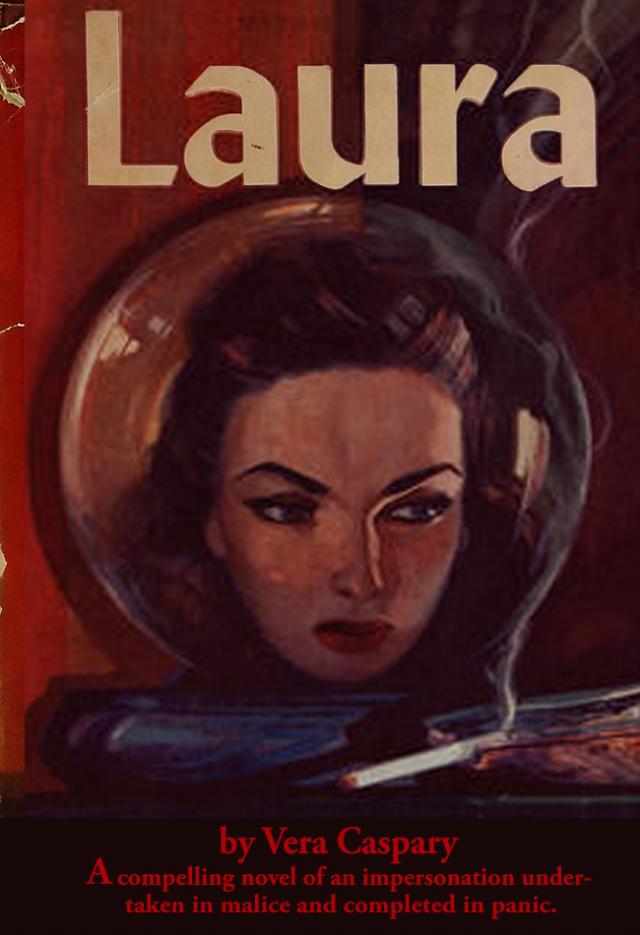


Laura’s apartment must have seemed like a studio setting to Jennie Swobodo, who hadn’t been so long away from Paterson and the silk mills. Laura’s Upper East Side friends must have been posing all the time in her eyes, like models before a camera. And Shelby . . .
I saw it all then.
I knew why Shelby was so familiar.
I’d never met him while I was pursuing crooks. He’d never mixed with the gents I’d encountered in my professional life. I’d seen him in the advertisements.
Maybe it wasn’t Shelby himself. There was no record of his ever actually having been a photographer’s model. But the young men who drove Packards and wore Arrow shirts, smoked Chesterfields, and paid their insurance premiums and clipped coupons were Shelby. What had Waldo said? The hero she could love forever immaturely, the mould of perfection whose flawlessness made no demands upon her sympathies or her intelligence.
I was sore. First, at myself for having believed that I’d find a real clue in a man who wasn’t real. I’d been thinking of Shelby as I had always thought of common killers, shysters, finks, goons, and hopheads. The king of the artichoke racket had been real; the pinball gang had been flesh-and-blood men with hands that could pull triggers; even the Associated Dairymen had been living profiteers. But Shelby was a dream walking. He was God’s gift to women. I hated him for it and I hated the women for falling for the romance racket. I didn’t stop to think that men aren’t much different, that I had wasted a lot of adult time on the strictly twelve-year-old dream of getting back to the old neighborhood with the world’s championship and Hedy Lamarr beside me on the seat of a five-grand roadster.
But I had expected Laura to be above that sort of nonsense. I thought I had found a woman who would know a real man when she saw one; a woman whose bright eyes would go right through the mask and tell her that the man underneath was Lincoln and Columbus and Thomas A. Edison. And Tarzan, too.
I felt cheated.
There was still a job to be done. Sitting on a bed and figuring out the philosophy of love was not solving a murder. I had discovered the dream world of Jennie-Swobodo-Diane-Redfern, and so what? Not a shred of evidence that she might also have been playing around with the kind of pals who used sawed-off shotguns.
The trail led back to Laura’s apartment and Shelby. I found evidence in Diane’s green pocketbook.
Before I left the house, I checked with the landlady, who told me that Diane had carried the green pocket-book on Friday. But I knew without being told. She had respected her clothes; she had put her dresses on hangers and stuffed shoe-trees into twenty pairs of slippers. Even at Laura’s, she had hung her dress away and put her hat on the shelf and her pocketbook in the drawer. So I knew she had dressed in a hurry for her date on Friday night. Green hat, gloves, and pocketbook had been left on the bed. Her shoes had been kicked under a chair. I had seen the same thing happen at home. When my sister used to get ready for a date with her boss, she always left stockings curled over the backs of chairs and pink step-ins on the bathroom floor.
I picked up the green pocketbook. It was heavy. I knew it should have been empty because Laura had showed me the black purse she had found in her drawer, the purse into which Diane had put her compact, her lipstick, her keys, her money, and a torn straw cigarette case.
There was a cigarette case in the green pocketbook. It was made of gold and it was initialed with the letters S.J.C.
( XI )
Twenty minutes later I was sitting in Laura’s living-room. The cigarette case was in my pocket.
Laura and Shelby were together on the couch. She had been crying. They had been together since Waldo and I left them at five o’clock. It was about ten. Bessie had gone home.
I wondered what they had been talking about for five hours.
I was business-like. I was crisp and efficient. I sounded like a detective in a detective story. ‘I am going to be direct,’ I said. ‘There are several facts in this case which need explaining. If you two will help me clear away these contradictions, I’ll know you’re as anxious as I am to solve this murder. Otherwise I’ll be forced to believe you have some private reason for not wanting the murderer to be found.’
Laura sat with her hands folded in her lap like a schoolgirl in the principal’s office. I was the principal. She was afraid of me. Shelby wore a death mask. The clock ticked like a man’s heart beating. I took out the gold cigarette case.
The muscles tightened around Shelby’s eyes. Nobody spoke.
I held it toward Laura. ‘You knew where this was, didn’t you? She had the green pocketbook with her at lunch Friday, didn’t she? Tell me, Laura, did you invite her to use your apartment before or after you discovered the cigarette case?’
The tears began to roll down Laura’s cheeks.
Shelby said: ‘Why don’t you tell him what you just told me, Laura. It was before.’
She nodded like a Sunday-School kid. ‘Yes, it was before.’
They didn’t look at each other, but I felt a swift interchange of some sort. Shelby had begun to whistle out of tune. Laura took off her gold earrings and rested her head against the back of the couch.
I said: ‘ Laura was feeling bad because she had been rude to Diane on Wednesday. So she invited her to lunch, and then, because Diane complained about her uncomfortable room, Laura offered her the use of this apartment. Later, probably when they were having coffee, Diane pulled out this cigarette case. Forgetting who she was with, maybe
Laura said, ‘ How did you know?’
‘Isn’t that what you want me to know?’ I asked her. ‘Isn’t that the easiest way to explain the situation?’
‘But it’s true,’ she said. ‘It’s . . .’
Shelby interrupted. ‘See here, McPherson, I won’t have you talking to her like that.’ He didn’t wear the death mask any longer. The plaster had cracked. His eyes were narrow and mean, his mouth a tight line.
‘Shelby,’ said Laura; ‘Please, Shelby.’
He stood in front of her. His legs were apart, his fists clenched as if I had been threatening her. ‘I refuse to let this go on, McPherson. These insinuations
‘Shelby, Shelby darling,’ Laura said. She pulled at his hands.
‘I don’t know what you assume that I’m insinuating, Carpenter,’ I said. ‘ I asked Miss Hunt a question. Then I reconstructed a scene which she tells me is accurate. What’s making you so nervous?’
The scene was unreal again. I was talking detective-story language. Shelby made it impossible for a person to be himself.
‘You see, darling,’ Laura said, ‘ You’re only making it worse by getting so excited.’
They sat down again, her hand resting on his coat-sleeve. You could see that he didn’t want her to control him. He squirmed. He looked at her bitterly. Then he pulled his arm away and moved to the end of the couch.
He spoke like a man who wants to show authority. ‘Look here, if you insult Miss Hunt again, I’ll have to lodge a complaint against you.’
‘Have I been insulting you, Miss Hunt?’
She started to speak but he interrupted. ‘ If she has anything to tell, her lawyer will make a statement.’
Laura said: ‘ You’re making it worse, dear. There’s no need to be so nervous.’
It seemed to me that words were printed on a page or rolling off a sound-track. A gallant hero protecting a helpless female against a crude minion of the law.
I lit my pipe, giving him time to recover from the attack of gallantry. Laura reached for a cigarette. He sprang to light it. She looked in the other direction.
‘All I’m asking from you at this moment,’ I told him, ‘is the low-down on that bottle of Bourbon. Why have you told one story and Mosconi another?’
She slanted a look in his direction. Shelby gave no sign that he had noticed, but he could see her without moving his eyes. It struck me that these two were clinging together, not so much out of love as in desperation. But I couldn’t trust my own judgment. Personal feelings were involved. I had got beyond the point where I cared to look at faces. Fact was all that I wanted now. It had to be black or white, direct question, simple answer. Yes or no, Mr. Carpenter, were you in the apartment with Diane Redfern on Wednesday night? Yes or no, Miss Hunt, did you know he was going to meet her in your house?
Laura began to speak. Shelby coughed. She glanced frankly in his direction, but she might have looked at a worm that way. ‘I’m going to tell the truth, Shelby.’
He seized her hands. ‘Laura, you’re crazy. Don’t you see that he’s trying to get a confession? Anything we say . . . will be . . . they’ll misinterpret . . . don’t talk unless you’ve consulted a lawyer . . . you can’t hope
She said: ‘Don’t be so frightened, Shelby. Since you didn’t do it, you have nothing to fear.’ She looked up at me and said: ‘Shelby thinks I killed Diane. That’s why he told those lies. He’s been trying to protect me.’
She might have been talking about the rain or a dress or a book she had read. Frankness was her role now. She put it on like a coat. ‘Mark,’ she said, in a gentle voice—‘do you believe I killed her, Mark?’
There it lay in the lamplight, solid gold, fourteen-karat evidence of Shelby’s treachery. Laura had bought it for him at Christmas, a gift she had to charge to her aunt’s account. He had told her he lost it, and on Friday, when she was trying to make up for her rudeness to Diane, she had seen it in the green pocketbook.
She had got a sudden headache at lunch that day. She hadn’t waited to take off her hat to telephone Waldo and tell him she couldn’t keep her dinner date. She hadn’t mentioned her change of plans because she hated having people ask her questions.
It was still Thursday. Thursday, ten-fourteen p.m. They were to have been married by this time and on their way to Nova Scotia. This was the bridal night.
The lamp shone on her face. Her voice was gentle. ‘ Do you believe I killed her, Mark? Do you believe it, too?’
PART THREE
A STENOGRAPHIC report of the statement made by Shelby J. Carpenter to Lieutenant McPherson on Friday at 3.45 P.M., August 2.7, 1941.
Present:
Shelby J. Carpenter
Lieutenant McPherson
N.T. Salsbury, Jr.
Mr. Carpenter: I, Shelby John Carpenter, do hereby swear that the following is a true statement of the facts known to me concerning the death of Diane Redfern. At times this will contradict certain statements I’ve made before, but . . .
Mr. Salsbury: You are to take into consideration, Lieutenant McPherson, that any conflict between this and previous statements made by my client is due to the fact that he felt it his moral duty to protect another person.
Lieutenant McPherson: We’ve promised your client immunity.
Mr. Salsbury: Go on, tell me what happened, Carpenter.
Mr. Carpenter: As you know, Miss Hunt wished a few days’ rest before the wedding. She had worked exceedingly hard on a campaign for the Lady Lilith cosmetic account, and I did not blame her for requesting that we postpone the wedding until she had time to recover from the strain. I have often protested at her arduous and unflagging devotion to her career, since I believe that women are highly strung and delicate, so that the burden of her position, in addition to her social duties and personal obligations, had a definite effect upon her nerves. For this reason I have always tried to understand and sympathize with her temperamental vagaries.
On that Friday morning, just a week ago, I went into her office to consult her about a piece of copy which I had written the day before. Although I had come into the business several years after she was established as an important copy-writer, she had great respect for my judgment. More than anyone knew, we depended upon each other. It was as usual for her to come to me for help in planning and presenting a campaign or merchandising idea as it was for me to seek her advice about the wording of a piece of copy. Since I was to take over the Lady Lilith account, I naturally asked her criticism. She was enthusiastic about my headline, which read, as I remember, ‘Is yours just another face in a crowd? Or is it the radiant, magnetic countenance that men admire and women envy?’ She suggested the word ‘magnetic.’
Lieutenant McPherson: Let’s get down to facts. You can explain the advertising business later.
Mr. Carpenter: I just wanted you to understand our relationship.
Lieutenant McPherson: Did she tell you she was going to have lunch with Diane?
Mr. Carpenter: That was a subject we had agreed not to discuss.
Lieutenant McPherson: Lunch?
Mr. Carpenter: Diane Redfern. As a matter of fact,
I did ask her if she’d lunch with me, but she told me she had some errands. Naturally I asked no questions. I went out with some men in the office, and later our chief, Mr. Rose, joined us for coffee. At about two-fifteen, we went back to the office and I worked steadily until about three-thirty, when the telephone rang. It was Diane.
Lieutenant McPherson: Did she tell you she’d had lunch with Laura?
Mr. Carpenter: The poor child was quite distraught. You didn’t know her, McPherson, but she was one of the most feminine creatures I have ever met. Like my own mother, although she was a girl of very different background and breeding. Yet she always felt the need of turning to a man when anything distressed her. It was unfortunate that I happened to be the man of her choice. Women—I hope you don’t mind my saying this, McPherson, but I’m trying to be as frank as possible—have more than once attached themselves to me quite without encouragement. As Miss Hunt herself remarked, Diane had not been bred among gentlefolk. What we considered merely good manners she took as evidence of . . . shall we call it love? Her emotions were wild and undisciplined. Although she knew that I was engaged to marry Miss Hunt, she declared herself madly in love with me and, I must say, often embarrassed me with her declarations. Perhaps you’ve known young girls like this, McPherson, who love so violently that nothing exists for them except their passion and the man upon whom it is fixed.
Lieutenant McPherson: You didn’t exactly discourage her, did you?
Mr. Salsbury: The question is irrelevant. You needn’t answer it, Mr. Carpenter.
Mr. Carpenter: I tried not to be unkind. She was young and very sensitive.
Lieutenant McPherson: Did she say anything to you about having had lunch with Laura?
Mr. Carpenter: She told me she was desperate. At first I thought her fears were nothing more than hysteria. ‘Don’t dramatize yourself,’ I told her, but there was something about her voice, a wild, frightened tone, that distressed me. I knew her to be both impulsive and courageous. I was afraid she might . . . you know what I mean, McPherson. So I said I’d take her to dinner, as a sort of farewell, you understand. I meant to talk some sense into her. We agreed to meet at Montagnino’s.
Lieutenant McPherson: Montagnino’s.
Mr. Carpenter: I felt that Diane’s morale needed a stimulant. And since Miss Hunt had often mentioned Montagnino’s as a favorite restaurant, Diane considered the place quite glamorous. You have no idea of the child’s devotion to Miss Hunt.
Lieutenant McPherson: You didn’t mention this to Laura, did you?
Mr. Carpenter: It would only have distressed her. She had been quite unhappy about having been so rude to Diane, you know. Although I did intend to tell her about it later. And besides she was dining with Waldo Lydecker . . . or at least that’s what I thought.
Lieutenant McPherson: When you had cocktails with Miss Hunt at the Tropicale Bar, what did you talk about?
Mr. Carpenter: What did we talk about? Oh . . . well . . . our plans, of course. She seemed cold and rather listless, but I attributed this to her nervous condition. I begged her to have a good rest and not to worry. Miss Hunt, you know, is a very intelligent young woman, but sometimes her emotions get the better of her, and she becomes almost hysterical about world conditions. She suffers a sort of guilt complex, and sometimes declares that we, innocent people of our sort, share the responsibility for the horror and suffering that one reads about in the newspapers. This, added to a certain cynicism about the work she does, gives her an emotional instability which, I thought, I might help to correct. And so I begged her not to read newspapers or listen to news broadcasts during this week of rest, and she was rather charming about it, unusually submissive and quiet. When we parted, she allowed me to kiss her, but there was little warmth in her response. I gave the taxi-driver Waldo Lydecker’s address, since she had said nothing to me of a change in her plans. Then I went back to the hotel, changed my clothes, and went on down to Montagnino’s. I must tell you that I was disappointed in the place.
Lieutenant McPherson: You’d never been there before?
Mr. Carpenter: Mr. Lydecker had always taken Miss Hunt there. They were quite exclusive about it. We’d only known it by hearsay.
Lieutenant McPherson: Did Diane tell you about having had lunch with Laura and bringing out the cigarette case?
Mr. Carpenter: Yes, she did. And I was most unhappy.
Lieutenant McPherson: I suppose you and she tried to think of some excuse which you could give Laura.
Mr. Carpenter: I decided to tell my fiancée the truth.
Lieutenant McPherson: Before or after the wedding?
Mr. Salsbury: You needn’t answer that, Mr. Carpenter.
Mr. Carpenter: You seem to think, McPherson, that there was something clandestine in my relationship with Diane.
Lieutenant McPherson: There were only two ways for her to have got hold of that cigarette case. Either she stole it or you gave it to her.
Mr. Carpenter: I admit that the incident looks very shabby, but if you knew the circumstances that brought about this . . . this . . . this gesture, I’m sure you’d understand.
Lieutenant McPherson: Diane was desperate, I suppose.
Mr. Carpenter: I don’t like your tone, McPherson. What you imply was not the situation.


