

The Master's Muse, page 26


I had to do a lot of research, but I like research. What was hardest was digesting the research. In a novel, you don’t want the research to stick out. So I’d read my facts over and over, pretty much memorizing them. That way, the facts came through organically in the story. Or I hope they do.
Did you ever consider writing from someone else’s perspective or alternating perspectives for The Master’s Muse? Why or why not?
I never thought of using any perspective other than Tanny’s. She was the person who originally drew me to the story, and I learned that she never wrote a memoir. So I wanted this to be her story. I tried to write the book of her life she never wrote.
How did you go about your research for this novel? Are there any parts of The Master’s Muse that aren’t true, or required more creativity and imagination than research?
Because there was no memoir or biography about Tanny, the facts were scattered over many resources. It was quite a job connecting the dots! That’s where my imagination came in. So much is written about Balanchine that recreating what their relationship must have been like wasn’t that difficult. Harder were the parts in the novel when Tanny is alone. Carl, for instance, is an invented character.
Was there ever a time in the course of writing this book that you wished you could change the facts? Did you find that history or truth ever got in the way of good storytelling?
I became so fond of my main characters that I wished Tanny and George would have gotten back together. But in terms of storytelling, the fact that they didn’t get back together probably makes a better story. It’s more complicated that way, there’s more suspense, and it challenged my inventiveness as a writer. I had to find ways to make the facts work dramatically.
How did you decide where to begin and end Tanny’s story?
I knew very early in the process where it would begin and end. For me, the polio was a sort of refining fire for both Le Clercq and Balanchine. It reshaped them in many ways, as individuals and as a couple. And it had a huge impact on Balanchine’s work. So I knew I’d start with the polio, that great terrible challenge. As for the end, I saw Balanchine’s final illness as in some ways parallel to Le Clercq’s polio. He helped her through her illness, and she helped him through his.
What kind of ending might you have given George and Tanny if you could have written their real story?
I have no idea. It took such belief and commitment to write the book as it is, that at this point I can’t imagine it happening any other way.
What are you working on next? Do you have any new projects coming up?
I’ve started research on a new novel. It’s again based on a true story. There are two main characters, a young girl and a woman. It also involves illness and fame. And, at least for the woman character in the story, it is also driven by romantic passion.
If you could ask Tanaquil Le Clercq one question, what would it be?
I hope she would like the novel. Perhaps that’s what I’d ask her. I did everything in my power to write a book true to her essence and her world.
Varley O’Connor, the daughter of a polio survivor, came across the facts of Tanaquil Le Clercq’s life while researching polio for another book. Unable to get the story out of her mind, she dug deeper, completing hundreds of hours of research to capture Le Clercq’s essence. O’Connor is the author of three novels. She teaches fiction and creative nonfiction writing at Kent State University and for the Northeast Ohio Universities Consortium MFA Program.
Photograph of Tanaquil Le Clercq taken in 1953 for Cosmopolitan magazine
MEET THE AUTHORS, WATCH VIDEOS AND MORE AT
SimonandSchuster.com
• THE SOURCE FOR READING GROUPS •
JACKET DESIGN BY LAURIE CARKEET
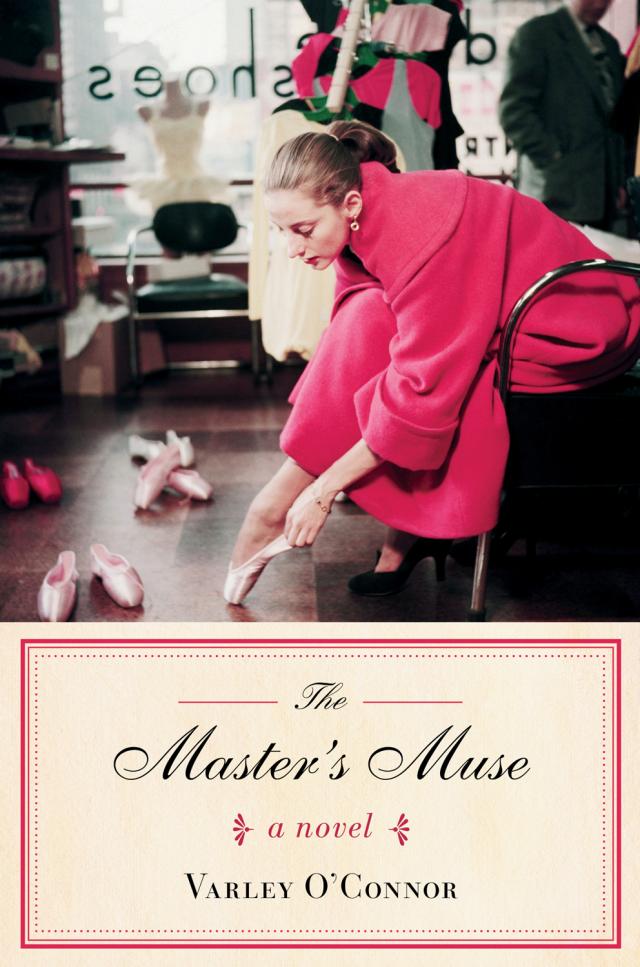
JACKET PHOTOGRAPH © GENEVIEVE NAYLOR/CORBIS
Also by Varley O’Connor
Like China
A Company of Three
The Cure
We hope you enjoyed reading this Scribner eBook.
* * *
Join our mailing list and get updates on new releases, deals, bonus content and other great books from Scribner and Simon & Schuster.
CLICK HERE TO SIGN UP
or visit us online to sign up at
eBookNews.SimonandSchuster.com
SCRIBNER
A Division of Simon & Schuster, Inc.
1230 Avenue of the Americas
New York, NY 10020
www.SimonandSchuster.com
This book is a work of fiction. Any references to historical events, real people, or real locales are used fictitiously. Other names, characters, places, and incidents are products of the author’s imagination, and any resemblance to actual events or locales or persons, living or dead, is entirely coincidental.
Copyright © 2012 by Varley O’Connor
All rights reserved, including the right to reproduce this book or portions thereof in any form whatsoever. For information address Scribner Subsidiary Rights Department, 1230 Avenue of the Americas, New York, NY 10020.
First Scribner hardcover edition May 2012
SCRIBNER and design are registered trademarks of The Gale Group, Inc., used under license by Simon & Schuster, Inc., the publisher of this work.
The Simon & Schuster Speakers Bureau can bring authors to your live event. For more information or to book an event contact the Simon & Schuster Speakers Bureau at 1-866-248-3049 or visit our website at www.simonspeakers.com.
Designed by Carla Jayne Jones
Library of Congress Control Number: 2011045011
ISBN 978-1-4516-5538-4
ISBN 978-1-4516-5776-0 (ebook)
Excerpt from “Tortures” in VIEW WITH A GRAIN OF SAND, copyright © 1993 by Wisława Szymborska, English translation by Stanisław Barańczak and Clare Cavanagh, copyright © 1995 by Houghton Mifflin Harcourt Publishing Company, reprinted by permission of the publisher.
Varley O'Connor, The Master's Muse


