Murder in Highbury, page 1


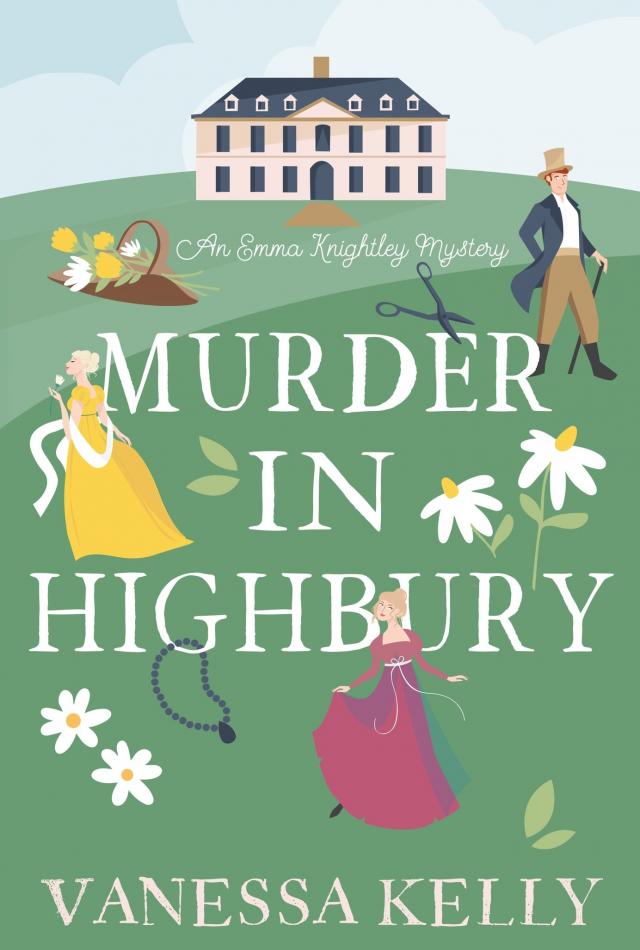
MURDER IN HIGHBURY
VANESSA TELLY
www.kensingtonbooks.com
Table of Contents
Title Page
Copyright Page
Dedication
ACKNOWLEDGMENTS
CHAPTER 1
CHAPTER 2
CHAPTER 3
CHAPTER 4
CHAPTER 5
CHAPTER 6
CHAPTER 7
CHAPTER 8
CHAPTER 9
CHAPTER 10
CHAPTER 11
CHAPTER 12
CHAPTER 13
CHAPTER 14
CHAPTER 15
CHAPTER 16
CHAPTER 17
CHAPTER 18
CHAPTER 19
CHAPTER 20
CHAPTER 21
CHAPTER 22
CHAPTER 23
CHAPTER 24
CHAPTER 25
CHAPTER 26
CHAPTER 27
CHAPTER 28
This book is a work of fiction. Names, characters, businesses, organizations, places, events, and incidents either are the product of the author’s imagination or are used fictitiously. Any resemblance to actual persons, living or dead, events, or locales is entirely coincidental.
To the extent that the image or images on the cover of this book depict a person or persons, such person or persons are merely models, and are not intended to portray any character or characters featured in the book.
KENSINGTON BOOKS are published by
Kensington Publishing Corp.
900 Third Avenue
New York, NY 10022
Copyright © 2024 by Vanessa Kelly
All rights reserved. No part of this book may be reproduced in any form or by any means without the prior written consent of the Publisher, excepting brief quotes used in reviews.
The K with book logo Reg. US Pat. & TM Off.
Library of Congress Card Catalogue Number: 2024939439
ISBN: 978-1-4967-4597-2
First Kensington Hardcover Edition: November 2024
ISBN: 978-1-4967-4599-6 (ebook)
This one is for Laurie and Anne, who have been with me every step of the way. No one could ask for better (or funnier) friends. Love you—and don’t forget the snacks!
ACKNOWLEDGMENTS
When my editor asked if I would be interested in writing a mystery series based on the character of Emma Woodhouse, I might have literally shrieked for joy. Emma is not only my favorite Austen novel but is probably THE book I would choose in the event that I was marooned on a deserted island. So, it is with deep gratitude that I thank my editor, John Scognamiglio, for supporting me throughout my career and giving me this opportunity. To say that I enjoyed writing this book is a massive understatement.
Evan Marshall, my agent, also played a huge role in bringing this book to fruition, and I am deeply grateful for his advice and support. I doubt I could have survived this business without him.
I am also grateful to Larissa Ackerman, Alex Nicolajsen, Vida Engstrand, Lauren Jernigan, and the marketing and social media teams at Kensington. Thank you so much for your support for Murder in Highbury, and for your kindness over the years. Many thanks are also proffered to the Kensington art department (the best in the business, IMHO), to Rosemary Silva for her eagle eye, and to the Kensington production department.
As a bit of hermit, I have a tendency to live too much in my head (an occupational hazard), so I’m grateful to the family who keep me grounded in the real world, especially my sister Trish, my stepmother Anne, my brother Brian, along with Liz Sykes and Wendy Durante. I’m also fortunate to have wonderful friends who encouraged me at various stages in the writing process, including Debbie Mason, Minerva Spencer, Terri Brisbin, Digby Ricci, Teresa Wilde, Sharon Page, and Moze Mossa-nen. As Ted Lasso would say . . . I appreciate you!
And a special shout-out goes to Nick Rudman, my uber-talented nephew, who created the awesome book trailer for Murder in Highbury.
I would also like to thank Louisa Cornell, whose knowledge of all things criminal in the Regency period is truly gobsmacking. Louisa, you saved me from more than one spectacular bungle, and any mistakes in the book are certainly mine! I’m also grateful to the Regency Fiction Writers group, whose collective wisdom has been so helpful.
It’s no exaggeration to say that I would have given up writing years ago without the steadfast love and encouragement of my husband. He not only cheers me on, he reads every word I write, plugging up plot holes and rescuing me from any number of grammatical and lexical mishaps. He not only does the laundry, he remains calm whenever I have a computer/technology /writing-related breakdown. And then usually fixes the problem. Randy, you are the best thing that ever happened to me, and I love you more than mere words can express.
Finally (and rightfully), my deepest thanks go to Jane Austen for creating such an iconic character. It has been a privilege to spend time in Highbury with Emma, and I add my voice to the legions of readers who rightly adore Austen for the novels she gifted to the world.
CHAPTER 1
Highbury, England
Summer 1815
Emma Knightley fancied herself quite adept at managing awkward social situations. Murder, however, was not one of them, especially murder in their village church. Those circumstances struck her as particularly awkward.
“Is she dead?” Harriet Martin asked in a horrified whisper.
Emma took a hesitant step toward the crumpled heap lying on the shallow steps that led up to the chancel. Steeling herself, she leaned down to press two fingers to the woman’s exposed wrist and felt for a pulse.
Hastily straightening up, she had to swallow twice before she could answer. “I’m afraid she is dead, Harriet. I cannot feel a pulse, and you can see there is quite a lot of blood.”
Mrs. Elton’s blond ringlets were dark with the sticky substance. A fair amount of blood was congealed beneath her head, and there was also something odd about the angle of her neck. As for her bonnet, the over-trimmed hat was decidedly askew.
Harriet dropped her wicker basket, spilling an assortment of roses and larkspur onto the gray stone floor of the nave. “Mrs. Knightley, how can this be? Poor Mrs. Elton!”
“Indeed,” Emma replied, staring at the corpse of the vicar’s wife. “Poor Mrs. Elton.”
Never could she have imagined herself referring to her social nemesis as poor anything. Such, however, was the awful magnitude of the scene before them.
Harriet, wide-eyed and pale, pressed a trembling hand to her bodice. “How . . . how can you be so calm, Mrs. Knightley? I feel terribly sick and lightheaded.”
Emma didn’t feel the slightest bit calm. In fact, she wanted either to shriek so loud it would shake the old bell tower to its foundations or to cast up her crumpets. But since neither reaction would be helpful, she ordered her stomach back in place and tried to collect her scattered wits.
“No fainting, Harriet. I cannot manage two bodies at once.”
When her friend let out a curdled moan, Emma took her by the elbow and steered her to a pew. “Put your head down and breathe slowly, dear. You’ll feel better in a moment.”
Biddable girl that she was, Harriet sank into the pew and rested her bonneted head on her knees. Emma was very fond of her young friend, but Harriet often displayed an unfortunate excess of emotion when distressed as well as a tendency to faint. Neither characteristic was welcome under the circumstances.
With Harriet sorted for the moment, Emma could gather her thoughts and determine what must be done next. As mistress of Hartfield, her father’s manor house, and of Donwell Abbey since her marriage to George, she was used to making decisions. Still, while Emma generally trusted her judgment and intellect, a dead Mrs. Elton was a challenge that taxed even her ability to think clearly.
She glanced around the church—a cool, silent refuge on a bright summer’s day. Or, at least, it would have been a refuge without a corpse lying in the middle of it.
Yet she saw no other signs of disturbance. All was as it should be on a quiet Saturday, the day she and Harriet always brought flowers from Hartfield’s gardens to refresh the floral arrangements for Sunday services. As usual, the caretaker had left the main door in the south porch unlocked for them. Emma doubted anyone else was expected in the church, and certainly not Mrs. Elton. The vicar’s wife set foot in the place only for the Sunday service or the rare meeting of the altar guild, where decisions were made about the state of the linens and vestments. Even then, she usually left the details to others, deeming such tasks beneath a woman of her dignity. It had been so since her arrival in Highbury as Philip Elton’s bride early last year. Mrs. Elton had possessed a highly elevated sense of superiority and so had believed that parish business was merely an irritation best ignored.
So why was she here on a Saturday afternoon, and who could have possibly . . .?
Murdered her.
Emma finally allowed that horrible thought to fully sink in. She dearly hoped she was wrong, but only a fool wouldn’t consider the possibility of foul play, given the odd disposition of the body and the distressing amount of blood. Perhaps she was overly imaginative, though. George had accused her of that particular flaw more than once in the past, and with some degree of merit, she was sorry to say.
She pressed a hand to her forehead, trying to think. Should she send for Mr. Elton? While this was his church, seeing his wife in so dreadful a state would be too great a shock. He might even descend into hysterics, and Emma was quite certain she couldn’t manage Mr. Elton in a state of hysteria. Managing Harriet was challenge enough.
You need George.
Emma’s still-racing heart started to settle. Her husband was the most intelligent and levelheaded person she’d ever met, and he always knew exactly how to proceed. As the local magistrate, George would be responsible for managing this horrid situation, including breaking the news to Mr. Elton.
With that decision made, her mind turned in a more orderly direction. Death had come to their quiet corner of Surrey, and in a most unexpected fashion. It would be up to Mr. and Mrs. Knightley, as the first family of the parish, to see that all legal and social matters were conducted with as much care and delicacy as possible. The residents of Highbury would depend upon them for guidance and support, and Emma was determined not to fail them.
Looking away from the body because, really, it was easier to think without Mrs. Elton’s hideously blank gaze staring up at her, Emma turned to her friend.
“Harriet, are you feeling better? Do you think you might be able to exert yourself?”
With a shuddering breath, the girl pulled herself upright, her normally placid features taut with distress. Even though Mrs. Elton had always been rather cruel to her, Harriet possessed a sensitive nature easily overpowered by such a scene.
Mrs. Elton’s unkind behavior had stemmed from the fact that Harriet had been in love with the vicar while he was still a bachelor. Once apprised of that fact by her new husband—a most uncharitable deed, as far as Emma was concerned—Mrs. Elton had never passed up an opportunity to snub the poor girl. But kindhearted Harriet had rarely held it against her tormenter, which was a tribute to her sweet temperament.
Emma was forced to admit that she was neither as sweet nor as sensitive as Harriet, since she was already getting used to the fact that they’d stumbled upon a bloody corpse.
“But, Miss Woodhouse . . . , I mean, Mrs. Knightley,” Harriet said, her voice breathy with distress. “What is to be done?”
“First, we must fetch Mr. Knightley. He will take charge of this unfortunate scene.”
“Of course,” Harriet replied with immediate relief. “Mr. Knightley always knows what to do.”
Emma gave her an encouraging smile. “He is the magistrate, after all.”
“Should we fetch Robert, too? He would be happy to help.”
“We should leave that decision up to Mr. Knightley, dear.”
Harriet looked disappointed. No doubt she was longing for her husband’s support. And while Robert Martin was a very sensible young man and Donwell Abbey’s best tenant farmer, Emma was reluctant to involve others without her husband’s knowledge—especially if foul play had been involved.
“But we should fetch Dr. Hughes, as well,” Emma added.
Harriet blinked. “But you said Mrs. Elton was . . .” She swallowed. “Dead. How can Dr. Hughes be of any help?”
Emma repressed an impulse to sigh and reminded herself that Harriet was still very rattled. “Dr. Hughes will know what to do with the . . . er, Mrs. Elton, since he is also our local coroner.”
She didn’t know Dr. Hughes very well, because her family had always relied on Mr. Perry, the village apothecary, for their doctoring. But George had consulted with Highbury’s physician on a few legal matters over the years, when a coroner’s opinion was needed.
“Would it not be better to fetch Mr. Perry?” Harriet asked. “That’s who Mr. Elton always relied on for health matters, I think.”
“The coroner will need to determine the cause of death.”
Harriet frowned, obviously confused. “Surely she must have slipped on the steps and hit her head.”
Emma turned again to peruse the body, ignoring the squeamish sensation in the pit of her stomach. “If Mrs. Elton simply slipped, she might certainly have received a nasty knock to the head. But a fatal injury? I think not.”
The fact that Mrs. Elton’s neck was at such an angle seemed too odd for a simple slip and fall on the chancel steps. She also looked quite disheveled, and for all her bad sartorial taste, she would never dream of stepping out her door without every frivolous bow and too-large button firmly in place.
Emma frowned and took a step forward to get a closer look. Mrs. Elton was garbed in a bright blue gown and matching spencer, the top button undone so her neck was partially exposed. Normally, the woman wore a necklace or some sort of choker, but today her throat was bare.
She crouched down a bit. “Are those marks on her neck?” she asked, more to herself than to Harriet.
Her friend crept up beside her. “What did you say, Mrs. Knightley?”
Emma pointed. “Look at her throat, Harriet.” She hadn’t initially noticed any bruises there, but now the marks were quite evident on a closer inspection.
Harriet clutched Emma’s arm. “Why would she have bruises on her throat?”
“Mrs. Elton usually wore a necklace. Perhaps someone took it and injured her in the process.”
“Mrs. Knightley, I do think I’m about to be sick!”
“You most certainly will not,” Emma said in a firm voice. “We have too much to do.”
She took Harriet by the arm and steered her back down the nave.
“Harriet, you need to find Dr. Hughes and tell him to come to the church. Then go to the Crown Inn and ask one of the stable boys to run for Mr. Knightley. Simply say that I need to see my husband as soon as possible on a matter of urgent church business.”
“But what do I tell Dr. Hughes?”
“Simply say there’s been an accident, and that he’s needed at the church immediately.”
“So you do think it’s an accident?” Harriet asked in a hopeful voice.
Unlikely.
Emma hesitated. “I don’t know, Harriet.”
In the past, she’d too often let her imagination run away with her. It had resulted in a number of unhappy misunderstandings, including the belief that Mr. Elton returned Harriet’s affections. But in this fraught situation, she was determined to rely on reason over imagination. After all, what did she know about murder? There might be a perfectly rational explanation for Mrs. Elton’s unfortunate demise.
Firmly ignoring her mind’s efforts to conjure up lurid scenarios, she escorted Harriet to the vestibule. The door was still open, and sunlight streamed into the old stone porch that sheltered the entrance. Birds flitted between the majestic oaks that stood guard over the tombstones in the graveyard, and a marbled white butterfly danced past, then landed on a lavender bush. Outside, all appeared ordinary and peaceful in Highbury.
For a moment, she was tempted to march out of the church and into the sunlight. Inside lurked a nightmare and a hideous intrusion into the tranquility of daily life. If she tried very hard, perhaps she could pretend it hadn’t happened at all. Pretend that Mrs. Elton was alive and well, her usual supercilious self, snubbing Emma the first chance she got.
“Mrs. Knightley? Are you unwell?” Harriet asked.
Emma had never thought of herself as a coward or someone unequal to dealing with even the most vexing of challenges, including a possible murder. She would indulge in a bout of nerves later, alone in the privacy of her bedroom.
“I’m well, Harriet. Now, you’d best be off. First to Dr. Hughes and then to the Crown.”
Harriet nodded and started down the path toward the street. Then she stopped and spun around.
“But, Mrs. Knightley, what are you going to do while I’m gone?” Her eyes had grown as round as tea saucers. “Surely you cannot stay here by yourself, with the . . . with Mrs. Elton.”
“I cannot leave her alone, Harriet.”
Harriet rushed back and grabbed Emma’s hands. “But you cannot! It would be simply too dreadful.”
While Emma did not relish the notion of sitting alone with a corpse—possibly a murdered one at that—she knew George would wish her to keep people out of the church until he arrived. Besides, if Mr. Elton were to come, she must try to prevent him from entering. He must not be allowed to see his wife without adequate preparation.