

Mary Whitcombe, page 1


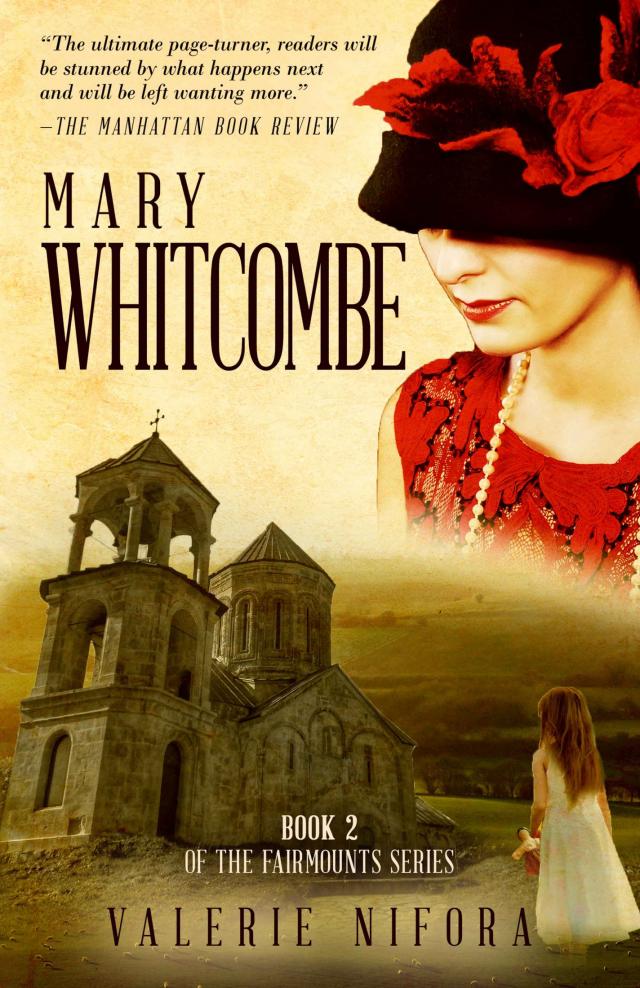
“Readers will be captivated by the nonstop action in Mary Whitcombe. Nifora’s story of a young, orphaned girl includes murder, deceit, greed, romance, love, and hope. The ultimate page-turner, readers will be stunned by what happens next and will be left wanting more.”—Hannah Stutz, Manhattan Book Review
Other books by Valerie Nifora
I Asked the Wind: A Collection of Romantic Poetry
The Fairmounts (Book 1)
Unleash the Power of You: A Step-by-Step Guide to Creating and Sustaining Your Own Personal Brand
Mary Whitcombe
Valerie Nifora
Mary Whitcombe © 2023 by Valerie Nifora. All rights reserved.
Published by Author Academy Elite
PO Box 43, Powell, OH 43065
www.AuthorAcademyElite.com
All rights reserved. No part of this publication may be reproduced, stored in a retrieval system, or transmitted in any form or any means—for example, electronic, photocopy, recording—without the prior written permission of the publisher. The only exception is brief quotations in printed reviews.
This is a work of fiction. All of the characters, organizations, and events portrayed in this novel are either products of the author’s imagination or are used fictitiously.
Identifiers:
Library of Congress Control Number: 2023918635
979-8-88583-268-7 (paperback)
979-8-88583-269-4 (hardback)
979-8-88583-270-0 (ebook)
Available in hardcover, softcover and e-book.
To Alan—
my North Star,
my always.
To love is to will the good of the other.
—St. Thomas Aquinas
Chapter 1
I remember very little of my childhood. I was so young when my world was torn apart. It hardly seems possible even now that I live and breathe.
I have a singular image in my mind of this woman laughing. The sound is warm and inviting. I love her smile; it brightens my heart. Her eyes are a lovely emerald green, and her dark hair is pulled up with little curls falling down the side of her face. She’s wearing a green ribbon in her hair. I see it as the wind has blown off her hat. She is a Gibson Girl in my memory.
And there’s a man. He has a kind face. I see him chasing after the hat, laughing. His voice is calm. “I’ll catch that for you, Grace! The wind will not defeat me. I am above it all. I will fly like Hermes!” And he’s off—in his brown trousers, suspenders and white button shirt with the sleeves rolled up to his elbows.
That is all I remember. That warm, sunny day with the wind blowing over the moors. And I can only suppose those were my parents, William and Grace Whitcombe.
It’s the memory I’ve held on to so tightly and dreamed of so fiercely even to this day. It is my happy memory, the one I visit when all the world is falling apart. My grounding. I’ve always believed there was an “other” life I should be living, another life that escaped me because I was too little to grasp and hold it.
I have few memories of my house and my nursery. My bed was soft and filled with frilly things. The blankets had lace on the edges. There was a stuffed rag doll and a small stuffed rabbit made of velvet. These were my companions.
I remember lots of light flowing into the nursery and a lovely fountain outside the window. If I close my eyes, I can almost hear it trickling.
I have no memory of my nanny, whether she was kind or not, lenient or severe. I remember a rocking horse. I remember liking my rocking horse. It was near a small table with porcelain teacups. I must have had tea with my toys.
I think I was a happy child. I must have been. They say the first few years of a person’s life determine her disposition, and I like to think I am happy, or I am capable of a condition that is referred to as “happy.” But I have spent the majority of my life as a castaway, something no one wants, handed from one person to another person and finally to myself. And who am I really? What did I owe the world? Was it more likely the world owed me?
I remember his face when he came for me. He wore his glasses at the tip of his nose and had a soft voice. He was my father’s friend. I would sit on his lap, and he would bounce me on his knee as I pretended to ride a horse in the races. Sometimes I would win. Sometimes not. He would do this as he and my father discussed things in my father’s study.
I remember the study having lots of lights and books and smelling of smoked pipe—a sweet and sticky smell. And when the window was left open, it also smelled of gardenias. Sometimes I would take my doll and hide under my father’s large mahogany desk. I remember it had carvings of little cherubs around the edges.
I don’t remember that day being different from any other when that man came into my nursery. I must have been about four or five at the time. “Hello, Mary,” he said.
“Hello,” I responded. “Father’s not here. He went away on a big ship, but I’m too little to go.” It was not unusual for him to visit me and play. I didn’t mind his visits.
He nodded. “Would it be all right, Mary, if I sit here and have some tea with you?”
I nodded and showed him where to sit. In retrospect, I don’t know how he managed to sit in that tiny chair. Perhaps he only pretended to sit in the chair and crouched, as I’ve seen my husband, Harry, do with our girls. It’s hard to say, really.
He cleared his throat. “Mary, I need to tell you something about your parents . . . ”
“Would you like one lump of sugar or two?” I asked.
“Two, please.”
“Milk?”
“Yes, please.”
After fixing his imaginary tea, I watched him stir the cup with my tiny silver spoon.
Taking a deep breath, he said, “Mary, your parents . . . ” A small tear fell down his face. “Mary, your father,” another deep breath, “your mother.” Full stop. A handkerchief emerged. “What I’m trying to say, Mary, is that your parents loved you very much. And they left specific instructions on how to care for you and your sister, should anything happen to them. And something has happened . . . I am to take you now.”
“Take me where, Uncle Thomas?”
Another tear fell.
“I am supposed to take you home with me now. And then to someplace else.”
“Uncle Thomas, I have a home, and I don’t need to go someplace else. You’re being very silly. Have some more tea.”
I remember his hands trembling as he tried to hold the teacup.
Uncle Thomas didn’t take me that day, but things were different in the house. It felt empty and quiet Uncle Thomas would come and go, and so would boxes. Large boxes of things on horse-drawn carriages I watched outside my window.
I ate mostly in my room. I saw few people. I’m sure one of them was my nanny. It was hard to tell with solemn faces. I didn’t play in the gardens anymore.
I’m not sure I fully understood that my parents weren’t returning. I think somewhere in my mind, I thought they were just gone for a while, and at some point, they would return. Death had little meaning for me then. It seemed an idea far too out of reach for me to comprehend.
I don’t remember my sister; I understand she was a few years older than I was, but I have no memory of her young. For years, I assumed she went with my parents, far away on that big ship. Then, a lifetime later, I learned that was not true. She was very much alive, but that would come much later in my complicated tale.
I remember I would hear the church bells in the distance on Sundays. I hadn’t been to church in what felt like years. Ever since my parents left on that big ship, no one cared to dress me and take me there.
It was a solitary life. I had my dolls and my window. I would look out my window for hours, just resting my head on my arm, looking out over the landscape of trees and small houses. I watched the seasons move from the warmth of the spring and summer to the sleepy mood of autumn. Out in the distance was the white steeple of the church. I could see it peeking from the leaves as they began to fall.
On this particular Sunday, I heard shouting. I ran and pressed my ear to the door.
“You can’t leave the girls!” a shrill man’s voice said.
“I can, sir, and I will. I have taken another position as a governess. With the Whitcombes
dead, sir, I can no longer stay here.”
“But I pay you!” the man’s voice said again. “The Whitcombes have left a fortune to care for the girls.”
“Nevertheless, a living employer is better than a dead one. I will be leaving by week’s end.”
“Week’s end! How am I to find a replacement by week’s end? And with Fiona’s condition. How in the world am I supposed to find someone in a week to care for that girl? You are absolutely in the wrong in this!”
“Nevertheless, sir, I have given you my notice,” she said coldly.
“Who is going to care for the girls?” he insisted.
“There is a family with other children whom Mr. Whitcombe would visit. Perhaps them.”
“I will not have the Wilkinses soil the girls’ reputations! William was never serious!”
“You can care for them yourself.”
“I am a bachelor! Are you mad? I don’t know the first thing about raising girls!”
“Then send them to the convent.” I could hear her retreating footsteps, followed by a large bang on the wall and sobbing, deep sobbing as if someone’s soul were being ripped apart. I was too frightened to open the door.
“Blast you, William.” He sobbed. “You leave me the impossible task of caring for your girls, and I am ill-equipped. Why did Grace go with you? You awful fool. Damn you both.”
Backing away quietly from the door as if I had intruded into the most private of conversations, I found my way to my bed and, placing the covers over my head, fell asleep.
I don’t know exactly what time it was when I awoke the next day, but I found a cup of milk, scrambled eggs, and some toast on the little table before me. At the washbasin, I cleaned my hands and face and settled my doll in the chair opposite me before sitting down to eat. Then there was a gentle rapping on the door. It opened, and there was Uncle Thomas. I was so delighted to see him that I ran and put my arms around his legs.
“I’ve hardly seen anyone since Papa and Mama left. I think there’s a magic fairy that comes and leaves me food. Come sit with me, Uncle Thomas. Come sit and share my eggs.” Leading him to the table, I had him sit and pushed my plate over to him, offering him a fork.
Again, a tear fell from his eye. “That is very kind of you, Mary. You have a good heart.” And pushing the plate and fork back to me, he said, “I ate my breakfast. It’s almost noon, and you’ll need to eat yours.”
Nodding, I began to eat the eggs. They were cold and a bit rubbery. “I think the cook forgot the salt,” I whispered.
He laughed. “Mary, when you are finished. I’d like you to put on your very best dress. You can dress yourself, can’t you?”
I nodded. “I still need help with the buttons.”
“I’ll find someone to help you with those. And then we’re going to take a trip. I’d like you to pack all the things you love most. We’re going to bring them with us.”
“Where are we going?” I asked, eating my last bit of toast.
“Just over the hill and a little way. There are some women I’d like you to meet.”
Nodding again, I finished my breakfast.
Chapter 2
I didn’t realize it then, but I would not again return to my home as a child. It was the last time I would sleep in a warm and comfortable bed with lace and pillows of down feathers until I was a grown woman. Little sun would creep into my bedroom from then on. The warmth and comfort of wooden panels painted in a lovely shade of pink would be replaced by the gray stone of the drab universe in which I would live my next seventeen years.
If I had known, I would have looked at the house a bit longer. I would have hugged my pillow or packed it. I might have taken the soft blanket of silk and cashmere. I would have brought along my velvet rabbit. Thinking I would see him again, I left him in charge of the teacups and asked him to take care of them until my return. I only brought the rag doll my mother had made me.
The ride did not seem terribly long, but we passed through a small brook and a forest with trees that hung overhead and blocked the sun like an omen of what was to come. Uncle Thomas held my hand in one of his and grasped a handkerchief in the other.
“It’s a nice ride, isn’t it, Mary?” he asked.
“I don’t remember the carriage being so bouncy, but it is good to get outside. I haven’t left my room, you know?”
At this, he seemed a bit startled. “What do you mean? You didn’t go out, child?”
Shrugging, I said, “No one would come for me. Except for your visits, Uncle Thomas, I haven’t played with anyone since Mama and Papa left.”
I remember a look of shock and anger quickly flashing upon his face. He murmured, “Perhaps it’s good she’s leaving.”
We started to ascend a steep hill, and the horses neighed at the weight of the carriage. “Easy!” the driver cautioned. “Almost there.”
I could smell the soft scent of the ocean nearby. Almost immediately I heard the sound of hooves on cobblestone, and, releasing Uncle Thomas’s hand, I kneeled on the seat trying to look out the window. The carriage made its way into a large courtyard. Before us was a gray stone building with a single story. It had a wooden door with nails and metal and a big brass knocker. There was a slight overhang that blocked the sun and small windows around the perimeter. If there was any cheer behind those walls, it was lost upon the façade of the building.
To the left of the building was a modest church. It was also made of stone and had a tall tower and a bell of dark metal. The windows of the church were in beautiful arches with colors that sparkled through. I thought of them as candy and wanted to run and touch them. The church and those beautiful windows would be the very first thing I ever painted.
Uncle Thomas opened the door and carried me out. Grabbing my hand, he took a deep breath and walked toward the door, but before he could grab the knocker, the door swung open. There stood five women in dark robes and funny white hats. I thought them beyond peculiar. Upon their robes, they wore massive crosses. The one who spoke had the largest cross; hers was speckled with stones.
“Welcome, Mr. Payne. And you must be Mary.” I don’t recall whether Mother Superior had joy in her tone or not. Perhaps it was just how I always remember it: strong, unemotional, matter- of-fact.
“Yes. Yes, this is the Mary Whitcombe of whom we spoke,” Uncle Thomas offered.
“Hello!” a friendlier voice came from behind Mother Superior. This woman had a kind face. She was younger and cheerful, and she knelt before me and looked me in the eye. “I am Sister Ann. Is this your doll?”
Clinging to my doll, I said, “Yes. I call her Dollie, and I love her very much. Would you like to hold her?” I’m not sure why I gave Sister Ann my doll. Perhaps it was just her manner. She was a gentle, pleasant, talented soul who only saw the good in all things.
Mother’s Superior’s voice was stern. “Sister Ann, why not take the child—”
“Mary,” Sister Ann corrected.
Undeterred, Mother Superior continued, “Why don’t you take the child, Mary, to the garden and show her our flowers? Mr. Payne and I have a few things to discuss. This way, Mr. Payne.”
Nodding, Sister Ann stood up and offered me her hand.
As gray and lifeless as the courtyard was, the garden was an entirely different world. There were roses and lavender and gardenias. There was a beautiful painted statue of the Virgin Mary in the center and small fountains on either side. Our feet crunched on the small stones and shells as we walked the path toward her.
“Are these shells?” I asked excitedly.
“Yes. They come from over there.” Sister Ann pointed to where the hill began to slope down.
“Is it far? Can we go see it?” I asked excitedly. Motioning for me to sit next to her on the bench, Sister Ann said, “It’s too far for today. Perhaps another time.”
The sun was warm, and butterflies flew and landed on different flowers. There were colored birds that bathed in the fountain. This would serve as my special spot forevermore. If you go there now, you’ll find my initials carved in the stone, “M. W.” I don’t know if Mother Superior ever noticed.
We sat there in silence for a while, and then Uncle Thomas found us. Holding his hat, he said, “Mary, I have to go now.” And hopping off the stone bench, I offered my hand. “No, dear. You’re going to stay here for a while with Sister . . . ”
“Ann,” Sister Ann said, smiling.
“Why?” I asked.
“Well, Mary, I think they’ll be able to care for you now.”
“For how long?” I asked.
“For a bit. Until . . . until things can be figured out. You don’t mind staying with Sister Ann, do you, dear? It’s beautiful here in the garden. And there are all these other sisters to care for you, play with you, read you stories, and help you grow up. Mary, I don’t know how to do those things.”
“But there aren’t other children,” I protested.
“I put your things in the room Mother Superior told me to put them in,” he finished, looking up at Sister Ann for approval.
“No. Uncle Thomas, I’d like to go home now.”
“This will be home for a while now, Mary,” Uncle Thomas said firmly.
“No, it is not!” I stamped my foot. “I want to go back to my window and my bed and my bunny. He’ll be very lonely watching my teacups!” And then I began to cry, my sobs so deep, I could not breathe.
“Mary. Mary, please. Please. I will bring you your bunny. I will be back with him tomorrow. Just stay one night with Sister Ann. Will you promise me you’ll stay one night with Sister Ann, and we will talk tomorrow?” Hugging me tightly, he kissed my head, turned and ran toward the gate and into the carriage, slumping down and trembling.


