

Mrs. Gulliver, page 1


Also by Valerie Martin
I Give It to You
Sea Lovers: Selected Stories
The Ghost of the Mary Celeste
The Confessions of Edward Day
Trespass
The Unfinished Novel and Other Stories
Property
Salvation: Scenes from the Life of St. Francis
Italian Fever
The Great Divorce
Mary Reilly
The Consolation of Nature and Other Stories
A Recent Martyr
Alexandra
Set in Motion
Love: Short Fiction
This is a work of fiction. Names, characters, places, and incidents either are the product of the author’s imagination or are used fictitiously. Any resemblance to actual persons, living or dead, events, or locales is entirely coincidental.
Copyright © 2024 by Valerie Martin
All rights reserved. Published in the United States by Doubleday, a division of Penguin Random House LLC, New York, and distributed in Canada by Penguin Random House Canada Limited, Toronto.
www.doubleday.com
doubleday and the portrayal of an anchor with a dolphin are registered trademarks of Penguin Random House LLC.
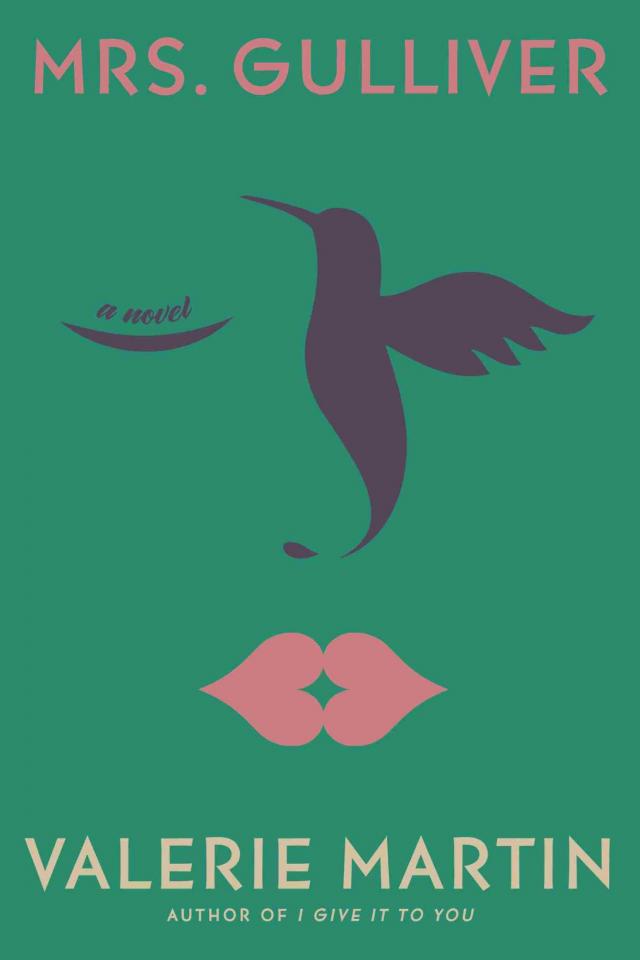
Cover illustrations: (hummingbird) by Vi-An Nguyen; (lips) by Finlandi/Shutterstock
Cover design by Emily Mahon
Library of Congress Cataloging-in-Publication Data
Names: Martin, Valerie, author.
Title: Mrs. Gulliver : a novel / Valerie Martin.
Description: First edition. | New York : Doubleday, [2024]
Identifiers: LCCN 2023009605 (print) | LCCN 2023009606 (ebook) | ISBN 9780385549950 (hardcover) | ISBN 9780593471210 (trade paperback) | ISBN 9780385549967 (ebook)
Subjects: LCGFT: Novels.
Classification: LCC PS3563.A7295 M77 2024 (print) | LCC PS3563.A7295 (ebook) | DDC 813/.54—dc23/eng/20230308
LC record available at https://lccn.loc.gov/2023009605
LC ebook record available at https://lccn.loc.gov/2023009606
Ebook ISBN 9780385549967
ep_prh_6.2_146228249_c0_r0
Contents
Cover
Also by Valerie Martin
Title Page
Copyright
Epigraph
Verona Island 1954
Author’s Note: On Marriage Vows
Acknowledgments
About the Author
_146228249_
So shall you share all that he doth possess,
By having him, making yourself no less.
*
Virtue itself turns vice, being misapplied,
And vice sometime by action dignified.
*
’Tis true, and therefore women, being the weaker vessels, are ever thrust to the wall….
Romeo and Juliet, William Shakespeare
Verona Island
1954
Our clients are professionals: doctors, lawyers, bankers, politicians (we’ve served a few mayors over the years), and, because our city is wrapped around the largest port on the island, a steady supply of seagoing men. My rule is: officers only. Discretion is what we offer. Except for the address in wrought-iron numbers, the front door is unmarked and never used; clients enter via a side door behind a tall hedge, so it can’t be seen from the street; a password is required at all times. As the password doesn’t change, this is the mildest of security measures. Our clients are encouraged to share it with interested friends or acquaintances. It creates a kind of network, with the charm of inclusion in a select society. Boys love passwords.
In the last few years, bad weather and blight have played havoc with the local economy, particularly among the rice farmers on the windward side of the island. A few of their prettier daughters have made their way to the city seeking honest labor and, failing that, turned up at my door. By that time, they are desperate, hungry, and frightened, and their best option is a charity organization run by nuns in a little town up in the hills. I refer them there. I’ve taken one or two to work, but they’re seldom up to my standard for the house. Occasionally, my sympathy overrules my judgment and I employ a girl who presents what I know will be a challenge. This may be shrewdness on my part, as I would not have been successful in my business were it not for a sixth sense I have about some quality in an applicant that will appeal to certain of my clients. Carità was such a girl.
That summer morning, a hot and humid day with rain, as usual, in the forecast, my majordomo, Brutus (aptly named), came to my office, which is also the kitchen, and planted himself squarely in the door frame. “There’s an odd couple asking to see you in the drawing room,” he announced. “I don’t know what they want. They look like beggars, but they know the password.”
“Did you tell them we don’t open until noon?”
“They’re country girls, Lila,” he said. “They’re looking for employment, is my guess.”
I rose from the table. “Then how did they get the password?” I mused. Brutus stepped aside and I sauntered down the hall.
They sat facing each other, one in a leather chair, the other perched on the edge of the red silk upholstered divan, her back straight and sandaled feet drawn in. They were dressed in plain cotton sleeveless shifts that came to the calf, worn but clean. Two destitute girls, one fair and portly, the other an elfin creature, small-boned, emaciated but not boyish. Even in her unflattering dress I could see she had a shapely figure: long waist, full breasts, excellent posture—that’s always the first thing I notice. Her hair was an uncombed thick black mop that fell to the center of her back and partially covered her face. The blonde looked up as I entered the room, her innocent face flushed with hope. Her friend didn’t move, her head slightly bowed and turned away from me.
“How do you come to know the password here?” I asked sharply.
“My uncle gave it to me,” she said. “His name was Peter Rizzo. He said you might not remember him, because he only came here once, with a friend.”
“Who was the friend?”
“I don’t know that,” the girl replied. “It was when he came to town. He was a rice farmer. Or he was until the blight came. Now he’s dead, and the bank took the farm.”
“Where are your parents?” I asked.
“Our parents are dead,” she said candidly, with no more emphasis than you might use to make a trivial factual observation—for example, That door is closed.
“So…you’re sisters,” I observed. “And you’ve come to the city looking for work.”
“That’s right,” she said. “My name is Bessie Bercy, and this is Carità. I’ve already got a job. I’m signed up to shuck oysters at the market restaurant on the wharf. The man there showed me how it’s done and then gave me a test, and right off he said I was faster than the two boys he’s already got put together.”
“Good for you,” I said. “That shows enterprise.”
“Yes, ma’am,” she said. “But Carità won’t do that kind of work, so now I need to find a place for her, because I can’t leave her on her own and I won’t make enough for us both. My uncle said he thought she might be useful to you.”
At this her dark sister chuckled. “That’s not exactly how he put it, Bessie,” she said. Her voice, deep and breathy, vibrated through my chest like a cat purring in my lap. As she spoke, she turned toward me, and I could make out through the screen of her hair that her eyes, half closed, were very light. “What he said,” she continued, “was that I’d be better off here than with the goddamned lesbian nuns.”
How can I describe the rich velvet of her voice? She could have been a countess or an actress, delivering a scene-clinching line. There was an archness as well, distant and amused, deflecting the crudeness of the information she had just so succinctly passed along. She made me smile in spite of myself.
“Carità,” her sister said, “don’t talk like that.”
“I don’t think Mrs. Gulliver is shocked,” the girl replied. Again, the deep vibration and archness of tone caressed my ears.
“Would you push your hair back so I can see your face?” I said.
She pressed her palms against her temples, pulling back the curtain of hair.
I caught my breath. Her face was beautiful, a creamy complexion with a natural blush, like an English beauty, her nose straight, her lips full and soft, her chin squarish and firm. But it was her eyes that startled me, heavy-lidded and half closed, with thick dark lashes, and irises like blue glass, the perfectly translucent blue of a glacier. Beneath the dark bird-wings of her brows, her eyes glittered enchantingly. I studied her. Something was very odd about those eyes.
“She’s nineteen years old,” Bessie said. Carità inclined her head toward her sister’s voice, but the eyes didn’t move. “She’s blind from birth.”
I raised my hand to my heart; my brain was racing. A blind prostitute, I thought. What would my clients think? I gazed at Carità, who appeared perfectly comfortable perched on the settee, with her straight spine and her hands folded in her lap. There was something pert, almost willful about her. She listened attentively while her sister sang her praises, as if she might make a correction or addition if some asset was overlooked.
“She’s real smart,” B
“If smart alecks don’t put sugar in the saltshaker,” Carità said. Then she laughed, revealing her teeth.
Two missing on the top right, behind the canine. Businesswoman that I am, my brain begin running a cost analysis of potential revenue versus dental outlay. I gave my dentist so much traffic I had a standing discount.
“We’d have to do something about those teeth,” I said. Carità closed her lips tightly and shook her hair back over her face.
“Yes, ma’am,” Bessie said.
The fact was, I’d lost a girl a few weeks earlier. Her name was Lottie, and she’d been with me full-time at the house for two years. She was popular, blonde and blowsy, an easygoing good-time girl as simple as a post and lazy as sin. She had a poor sick son who lived with her mother; all her money went to support them. About a year after she came to me, the boy died, and she went right down the alcohol chute. She was weepy and hysterical by turns, the clients got sick of her, and she was draining my coffers. I was about to let her go when her mother showed up at the door to say a relative had died and left them a little money and a house, so she’d come to take Lottie home. A happy ending. My hands were shaking with relief as I helped them pack up Lottie’s things and get into the taxi.
So I had Lottie’s empty room, and I had the clients. Three of my girls lived out and worked evening shifts, from six until closing. But desire doesn’t sleep, and lunch appointments weren’t uncommon, so I needed two girls for the noon-to-four slot. At night, the in-house girls come on at seven or so. They also rotated Sundays off every other week. The house was closed on Mondays.
“She’d have to live here all the time,” I said to Bessie.
Bessie nodded. “Could I come on Sunday mornings to take her out? She likes to walk outdoors.”
This touched me, but it also made me think I was about to make a decision that required careful consideration. “I haven’t said she can stay,” I said.
“Yes, ma’am,” Bessie said, looking down at her rough hands, folded in her lap.
“I want to have my colleague advise me,” I said. “I’ll go ask him to join us.”
“Yes, ma’am,” Bessie said again. I glanced at Carità, who was silent, sitting very still, her chin slightly lifted, listening closely.
“I’ll only be a moment,” I said to Bessie. “Mr. Ruby is in the office.” Then I went out—leaving the door ajar—and down the hall to the kitchen, where Brutus sat at the table, perusing the racing pages.
“I want you to come take a closer look at this girl,” I said.
He folded the paper. “Is it those beggar girls?”
“Yes.” I said nothing to him about Carità’s blindness. I wanted to see an honest male reaction to the surprise.
He followed me down the hall into the room where the two women sat. As we entered, Bessie looked up, her plain face aglow with hope. Carità had not moved. “Ladies,” I said, “I want to introduce you to Mr. Ruby, who is my trusted colleague.” I motioned Brutus toward Bessie. “This is Bessie,” I said.
Bessie stood up, her hand outstretched. “Pleased to meet you,” she said confidently.
Brutus closed her hand in his own and nodded. “Likewise,” he said.
I turned to Carità. She rose to her feet in that slow and curiously regal way I would come to know, proffering her hand palm-down, as if expecting a soft press of lips. “And this is Carità,” I said.
Brutus took her hand, casting a quick questioning glance at me.
“A pleasure,” Carità said, leaning away from him as if he’d caught her unawares.
“The gentleman can’t see your face,” I said. “Please pull your hair aside.”
She smiled, keeping her lips carefully closed, swept her hair back with one hand, and held it in place so that her hairline was exposed. She had a shallow widow’s peak, a smooth, unlined forehead. Her strange jewellike eyes seemed to contemplate the lapel of Brutus’s jacket. I studied the effect upon him. His brow lifted; his nostrils inflated over a quick intake of air. An expression of pleasant mystification pursed his lips. He was a confident man, big enough to look down on his fellow humans, and, I knew from experience, capable of both cruelty and sympathy. He had a rough, often lewd sense of humor, which suited his profession. His eyes searched Carità’s face, shifting between pleasure and calculation, just as I had done. “Your face is your fortune,” he said, releasing her hand.
What about the rest of her? I thought. That’s money in the bank, too.
“My uncle used to say that,” Carità said, giving him the benefit of her caressing voice.
“That’s true,” Bessie put in. “He did say that. But her face didn’t keep her from being as poor as a dog in the street, and just as much abused.”
Carità stretched one hand behind her until her fingers grazed the sofa cushion, lowered herself to the seat, and drew her feet in beneath her. She performed this action smoothly; no one who didn’t know why she’d made that swift probing gesture with her hand would have noticed. “We weren’t always poor,” Carità reminded her sister.
Brutus stood gazing down at our applicant, who sat on the edge of the cushion, leaning forward with her hands resting on her thighs. He brought his palm to the side of her face, near her right ear but not touching her. She turned her head toward the hand; her eyes didn’t move.
“She’s blind,” Brutus said flatly.
“Yes,” I said.
He drew his hand away and wrapped his fingers around his chin, rubbing the heavy stubble in a gesture of wonderment. His eyes met mine, and we exchanged a look charged with our knowledge of each other and the exigencies of our mutual endeavor.
I turned to Bessie. “I’ll just need to have a few words in private with Mr. Ruby,” I said.
“Sure,” Bessie replied. “We’re not expected anywhere.”
Brutus followed me to the kitchen. “What do you think?” I asked, closing the door behind us.
“She’s totally blind?” he said.
“From birth. But she can take care of herself.”
“Does she know what she’d be doing here?” he asked.
“It seems her uncle told her what to expect.”
Brutus wrinkled his brows, pulling in his chin. “He sent her here?”
“He was here once as a client, and, evidently, he liked the operation. When he went broke, he thought this would be as good a place as any for his niece.”
“What a bastard!”
“Maybe,” I said. “But think about it. What are her options? She could wind up begging in the streets, or in some government home, half starved and neglected. Her sister is shucking oysters for a living; she won’t be able to look after her. She’d be safe here, and she’d earn money to put away.”
“A blind prostitute,” Brutus said. “I never heard of such a thing.”
“That’s what I’m thinking. Not you or any man on this island has heard of such a thing.”
“But can she do the work?” Brutus said.
I knew what he meant. It takes a strong personality to do the kind of work our girls do, day in and day out. My prices are high, and the men who avail themselves of our services expect to be treated with interest, even enthusiasm. Personally, I think it’s a gift to be able to do this. It’s like acting; you must throw your heart and soul—and, especially, your body—into a role that keeps changing and has little to do with your ordinary life.
“I think you should give her a trial run,” I said. “Then we’ll know what we’ve got.”
He laughed. “I surely wouldn’t mind that,” he said. “Would she be willing?”
“I don’t know why not. I’ll pay her, of course. I’ll go ask her.”
“You mean right now?”





