Binder1, page 26
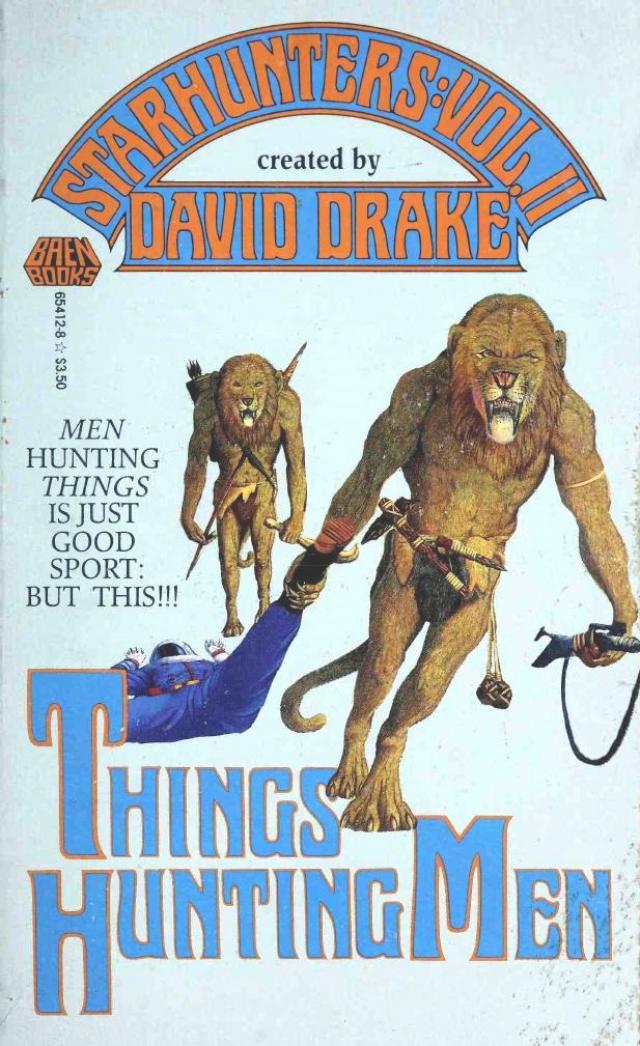


He stopped suddenly and laughed. It was really very simple, when one applied oneself. Why should he come into direct and dangerous contact with the Mirash? The time had come to use his brain, his understanding of animal psychology, his knowledge of Lures and Snares.
Instead of tracking the Mirash, he would go to their den.
And there he would set a trap.
* * *
Their temporary camp was in a cave, and by the time they arrived there it was sunset. Every crag and pinnacle of rock threw a precise and sharp-edged shadow. The ship lay five miles below them on the valley floor, its metallic hide glistening red and silver. In their packs were a dozen emeralds, small, but of an excellent color.
At an hour like this, Paxton thought of a small Ohio town, a soda fountain, a girl with bright hair. Herrera smiled to himself, contemplating certain gaudy ways of spending a million dollars before settling down to the serious business of ranching. And Stellman was already phrasing his Ph.D. thesis on extraterrestrial mineral deposits.
They were all in a pleasant, relaxed mood. Paxton had recovered completely from his earlier attack of nerves. Now he wished an alien monster would show up—a green one, by preference—chasing a lovely, scantily clad woman.
“Home again,” Stellman said as they approached the entrance of the cave. “Want beef stew tonight?” It was , his turn to cook.
“Maybe there are natives here,” Stellman said. ‘Very i timid ones. This might be their goodwill offering.” | “Sure,” Herrera said. “They sent to Terra for a bottle I of Old Space Ranger just for us.”
“What are we going to do?” Paxton asked.
“Stand clear,” Herrera said. “Move ’way back.” He broke off a long branch from a nearby tree and poked gingerly at the diamonds.
“Nothing’s happening,” Paxton said.
The long grass Herrera was standing on whipped tightly around his ankles. The ground beneath him surged, broke into a neat disc fifteen feet in diameter and, trailing root-ends, began to lift itself into the air. Herrera tried to jump free, but the grass held him like a thousand green tentacles.
“Hang on!” Paxton yelled idiotically, rushed forward and grabbed a corner of the rising disc of earth. It dipped steeply, stopped for a moment, and began to rise again. By then Herrera had his knife out, and was slashing the grass around his ankles. Stellman came unfrozen when he saw Paxton rising past his head.
Stellman seized him by the ankles, arresting the flight of the disc once more. Herrera wrenched one foot free and threw himself over the edge. The other ankle was held for a moment, then the tough grass parted under his weight. He dropped head-first to the ground, at the last moment ducking his head and landing on his shoulders. Paxton let go of the disc and fell, landing on Stellman’s stomach.
The disc of earth, with its cargo of roast beef, whiskey and diamonds, continued to rise until it was out of sight.
The sun had set. Without speaking, the three men entered their cave, blasters drawn. They built a roaring fire at the mouth and moved back into the cave’s interior.
“We’ll guard in shifts tonight,” Herrera said.
Paxton and Stellman nodded.
Herrera said, “I think you’re right, Paxton. We’ve stayed here long enough.”
“Too long,” Paxton said.
Herrera shrugged his shoulders. “As soon as it’s light, we return to the ship and get out of here.”
“If,” Stellman said, “we are able to reach the ship.”
* * *
Drog was quite discouraged.
With a winking heart he had watched the premature springing of his trap, the struggle, and the escape of the Mirash. It had been such a splendid Mirash, too. The biggest of the three!
He knew now what he had done wrong. In his eagerness, he had overbaited his trap. Just the minerals would have been sufficient, for Mirash were notoriously mineral-tropic. But no, he had to improve on pioneer methods, he had to use food stimuli as well. No wonder they had reacted suspiciously, with their senses so overburdened.
Now they were enraged, alert, and decidedly dangerous.
And a thoroughly aroused Mirash was one of the most fearsome sights in the Galaxy.
Drog felt very much alone as Elbonai’s twin moons rose in the western sky. He could see the Mirash campfire blazing in the mouth of their cave. And by direct perception he could see the Mirash crouched within, every sense alert, weapons ready.
Was a Mirash hide really worth all this trouble?
Drog decided that he would much rather be floating at the five-thousand-foot level, sculpturing cloud formations and dreaming. He wanted to sop up radiation instead of eating nasty old solid food. And what use was all this hunting and trapping, anyhow? Worthless skills that his people had outgrown.
For a moment he almost had himself convinced. And then, in a flash of pure perception, he understood what it was all about.
True, the Elbonaians had outgrown their competition, developed past all danger of competition. But the Universe was wide, and capable of many surprises. Who could foresee what would come, what new dangers the race might have to face? And how could they meet them if the hunting instinct was lost?
No, the old ways had to be preserved, to serve as patterns; as reminders that peaceable, intelligent life was an unstable entity in an unfriendly Universe.
He was going to get that Mirash hide, or die trying!
The most important thing was to get them out of that cave. Now his hunting knowledge had returned to him.
Quickly, skillfully, he shaped a Mirash horn.
“Did you hear that?” Paxton asked.
“I thought I heard something,” Stellman said, and they all listened intently.
The sound came again. It was a voice crying. “Oh, help, help me!”
“It’s a girl!” Paxton jumped to his feet.
“It sounds like a girl,” Stellman said.
“Please, help me,” the girl’s voice wailed. “I can’t hold out much longer. Is there anyone who can help me?”
Blood rushed to Paxton’s face. In a flash he saw her, small, exquisite, standing beside her wrecked sports-spacer (what a fool-hardy trip it had been!) with monsters, green and slimy, closing in on her. And then he arrived, a foul alien beast.
Paxton picked up a spare blaster. “I’m going out there,” he said coolly.
“Sit down, you moron!” Herrera ordered.
“But you heard her, didn’t you?”
“That can’t be a girl,” Herrera said. “What would a girl be doing on this planet?”
“I’m going to find out,” Paxton said, brandishing two blasters. “Maybe a spaceliner crashed, or she could have been out joyriding, and—”
“Siddown!” Herrera yelled.
“He’s right,” Stellman tried to reason with Paxton. “Even if a girl is out there, which I doubt, there’s nothing we can do.”
“Oh, help, help, it’s coming after me!” the girl’s voice screamed.
“Get out of my way,” Paxton said, his voice low and dangerous.
"You’re really going?” Herrera asked incredulously.
“Yes! Are you going to stop me?”
“Go ahead.” Herrera gestured at the entrance of the cave.
“We can’t let him!” Stellman gasped.
“Why not? His funeral,” Herrera said lazily.
“Don’t worry about me,” Paxton said.“I’ll be back in fifteen minutes—with her!” He turned on his heel and started toward the entrance. Herrera leaned forward and, with considerable precision, clubbed Paxton behind the ear with a stick of firewood. Stellman caught him as he fell.
They stretched Paxton out in the rear of the cave and returned to their vigil. The lady in distress moaned and pleaded for the next five hours. Much too long, as Paxton had to agree, even for a movie serial.
A gloomy, rain-splattered daybreak found Drog still camped a hundred yards from the cave. He saw the Mirash emerge in a tight group, weapons ready, eyes watching warily for any movement.
Why had the Mirash horn failed? The Scouter Manual said it was an infallible means of attracting the bull Mirash. But perhaps this wasn’t mating season.
They were moving in the direction of a metallic ovoid which Drog recognized as a primitive spatial conveyance. It was crude, but once inside it the Mirash were safe from him.
He could simply trevest them, and that would end it. But it wouldn’t be very humane. Above all, the ancient Elbonaians had been gentle and merciful, and a Young Scouter tried to be like them. Besides, trevestment wasn’t a true pioneering method.
That left illitrocy. It was the oldest trick in the book, and he’d have to get close to work it. But he had nothing to lose.
And luckily, climatic conditions were perfect for it.
* * *
It started as a thin groundmist. But, as the watery sun climbed the gray sky, fog began forming,
Herrera cursed angrily as it grew more dense. “Keep close together now. Of all the luck!”
Soon they were walking with their hands on each others’ shoulders, blasters ready, peering into the impenetrable fog.
“Herrera?”
“Yeah?”
“Are you sure we’re going in the right direction?” “Sure. I took a compass course before the fog closed in.”
“Suppose your compass is off?”
“Don’t even think about it.”
They walked on, picking their way carefully over the rockstrewn ground.
“I think I see the ship,” Paxton said.
“No, not yet,” Herrera said.
Stellman stumbled over a rock, dropped his blaster, picked it up again and fumbled around for Herrera’s shoulder. He found it and walked on.
“I think we’re almost there,” Herrera said.
“I sure hope so,” Paxton said. “I’ve had enough.” “Think your girl friend’s waiting for you at the ship?” “Don’t rub it in.”
“Okay,” Herrera said. “Hey, Stellman, you better grab hold of my shoulder again. No sense getting separated.”
“I am holding your shoulder,” Stellman said.
“You’re not.”
“I am, I tell you!”
“Look, I guess I know if someone’s holding my shoulder or not.”
“Am I holding your shoulder, Paxton?”
“No,” Paxton said.
“That’s bad,” Stellman said, very slowly. “That’s bad, indeed.”
“Why?”
“Because I’m definitely holding some one’s shoulder.”
Herrera yelled, “Get down, get down quick, give me room to shoot!” But it was too late. A sweet-sour odor was in the air. Stellman and Paxton smelled it and collapsed. Herrera ran forward blindly, trying to hold his breath. He stumbled and fell over a rock, tried to get back on his feet—
And everything went black.
The fog lifted suddenly and Drog was standing alone, smiling triumphantly. He pulled out a long-bladed skinning knife ana bent over the nearest Mirash.
The spaceship hurtled toward Terra at a velocity which threatened momentarily to burn out the overdrive. Herrera, hunched over the controls, finally regained his self-control and cut the speed down to normal. His usually tan face was still ashen, and his hands shook on the instruments.
Stellman came in from the bunkroom and flopped wearily in the co-pilot’s seat.
“How’s Paxton?” Herrera asked.
“I dosed him with Drona-3,” Stellman said. “He’s going to be all right.”
“He’s a good kid,” Herrera said.
“It’s just shock, for the most part,” Stellman said. “When he comes to, I’m going to put him to work counting diamonds. Counting diamonds is the best of therapies, I understand.”
Herrera grinned, and his face began to regain its normal color. “I feel like doing a little diamond-counting myself, now that it’s all turned out okay.” Then his long face became serious. “But I ask you, Stellman, who could figure it? I still don’t understand!”
The Scouter Jamboree was a glorious spectacle. The Soaring Falcon Patrol, number 22, gave a short pantomime showing the clearing of the land on Elbonai.
The Brave Bisons, number 31, were in full pioneer dress.
And at the head of Patrol 19, the Charging Mirash Patrol, was Drog, a first-class Scouter now, wearing a glittering achievement badge. He was carrying the Patrol flag—the position of honor—and everyone cheered to see it.
Because waving proudly from the flagpole was the firm, fine-textured, characteristic skin of an adult Mirash, its zippers, tubes, gauges, buttons and holsters flashing merrily in the sunshine.
I was in Viet-Nam—more precisely, Viet-Nam and Cambodia-—for less than a year. I’m not a hero, and nothing bad happened to me.
After I got back to the World and had a chance to think about things, I decided that the closest I’d come ;to dying in Nam had nothing to do with enemy action. ;We were on a Medcap. I have no idea what the acronym ;actually means, but medical and civil affairs patrol ;adequately describes what was involved.
Basically, a few armored vehicles from the squadron’s headquarters troop drove into a friendly village. They carried the unit medic; the civil affairs officer ;(S-5, for those of you who care); and a couple of interrogators like me to talk informally with the villagers about ;the local situation while the medic dispensed pills and ;changed dressings.
I don’t know that Medcaps did an enormous amount of good, either in the military sense (bringing first ;warning of planned enemy attacks, say) or for the ;villagers with real medical problems. It bothers me to ;remember the man with elephantiasis of the scrotum, ;waiting patiently in line for what help the medic could ;give him.
But the Medcaps weren’t a bad thing. We didn’t cause his elephantiasis, and maybe the changed dressings showed a few of the villagers that at least our ;intentions were good.
They had enough evidence of problems with our results. A conversation with a village headman sticks in my mind, though I couldn’t tell you whether it occurred ;that afternoon or another one. We were supposed to get ;an idea of the community’s economic base, so I asked ;what crops his village grew.
“Peanuts,” he said. “All peanuts.”
I don’t know exactly what I’d expected, but it wasn’t peanuts. “Why do you grow peanuts?” I asked.
“Well, three years ago the planes came over and sprayed all the rubber trees. They died, so we put ;in peanuts because it takes too long to grow rubber trees.”
We left the village and drove back toward the fire-base. We’d waited too long; it started to rain long before we got to the road. Big drops, then a real ;cloudburst. The dust was powdery and white when we ;started, but it turned into glistening, charcoal-gray mud ;within a minute.
Lightning started to hit all around us.
I was riding on a Zippo, an armored personnel carrier converted into a mechanized flame-thrower. The drivers hatch was in front. Behind him was the track ;commanders cupola, mounting a machinegun and the ;short, broad nozzle of the flame-thrower. 1 sat on the ;back deck, over the two hundred gallons of napalm ;filling the vehicle’s cargo compartment. Ten feet over ;my head waved the whip antennas for the radios.
We moved onto the dike between two paddies. It was raining as hard as I’ve ever seen it come down. Across ;the field to the left was a line of low trees, probably on ;another dike. They were barely visible through the ;downpour. Lightning struck one of the trees, blasting it ;in a sizzling yellow flash.
Because of the antennas and the height of the Zippo itself, we were taller than any of those trees in the near ;distance. I expected to die any moment. If the lightning ;didn’t do the job directly, the explosion of two hundred ;gallons of gasoline and plasticizer certainly would.
It didn’t happen, of course. The edge of the storm moved off; the lightning bolts grew more distant. I’d ;gotten wet and spattered with mud thrown up by the ;tracks. Don’t mean nothin’.
It didn’t seem like a big thing afterwards, either, but it was only very recently that I figured out why.
Every waking minute of my tour in Nam, I expected to die. You can’t live like that and stay sane. I wasn’t ;sane. I did the jobs they told me to do, and I got back ;to the World. That one particular moment, I really was ;very near death, but I’d been living in that moment for months already and for months to come.
Don’t mean nothin’.
The character in “The Hunting Ground” isn’t me. He lives in the house in Durham where we rented an ;apartment after I got back. The stump in the yard is the ;one I sat on, and the hydrangeas are the ones that grew ;beside the house next door; but Lome isn’t me.
I wouldn’t say there was nothing of me in him, though.
THE HUNTING GROUND
David Drake
The patrol car's tires hissed on the warm asphalt as it pulled to the curb beside Lome. “What you up to, ;snake?” asked the square-bodied policeman. The car’s ;rumbling idle and the whirr of its air conditioner through ;the open window filled the evening.
Lome smiled and nodded the lighted tip of his cigarette. "Sitting on a stump in my yard, watching cops park on the wrong side of the street. What’re you up to, Ben?”
Instead of answering, the policeman looked hard at his friend. They were both in their late twenties; the ;man in the car stocky and dark with a close-cropped ;moustache; Lome slender, his hair sand-colored and ;falling across his neck brace. “Hurting, snake?” Ben ;asked softly.
“Shit, four years is enough to get used to anything,” the thinner man said. Though Lome’s eyes were on the ;chime tower of the abandoned Baptist church a block ;down Rankin Street, his mind was lost in the far past. ;“You know, some nights I sit out here for a while ;instead of going to bed.”