Contdown to Midnight vers 2, page 1


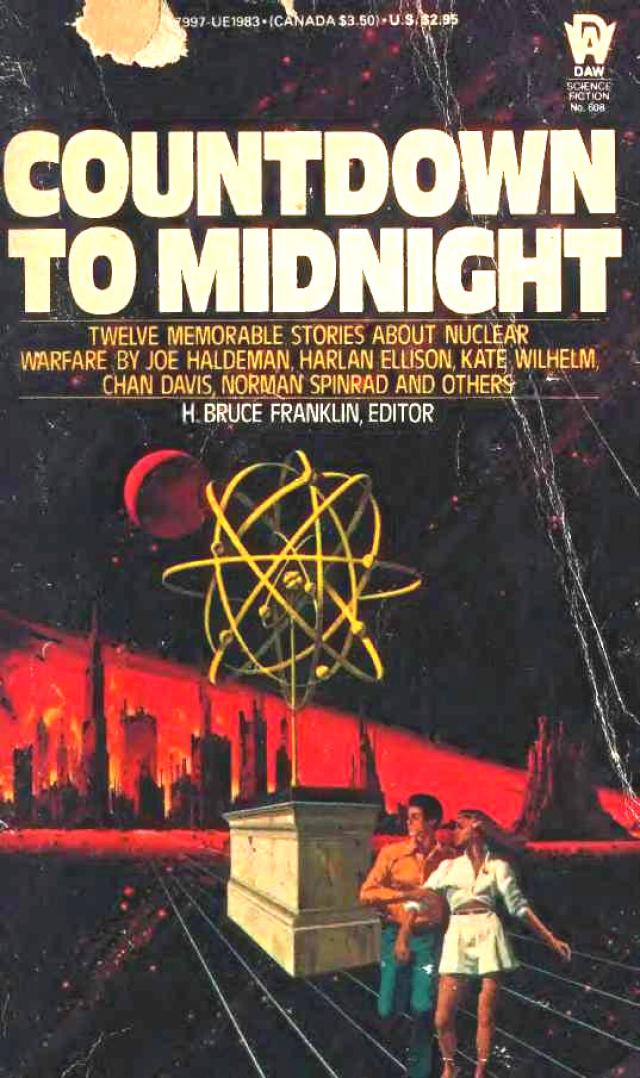
The Bulletin of Atomic Scientists carries a small clock on its masthead. Its hands are set according to the world situation of the date of issue—to show how close the scientists believe the world may be to nuclear war. We understand that lately these hands read two minutes to twelve.
What happens at midnight?
This anthology, containing some powerful stories by some brilliant writers, attempts to depict through the medium of science fiction the possibilities that may open for humanity at that unspeakable moment. They are not all downbeat; they are not all despairing. Science fiction predicted the Bomb; science fiction has also predicted ways out. Read and see for yourself.
H. BRUCE FRANKLIN, Distinguished Professor of English at Rutgers University was recently presented with The Pilgrim Award by the Science Fiction Research Association. In the presentation speech, this was said (among others): “He has taught at Stanford, Rutgers, Collection Wesleyan, Yale, Venceremos College, the Free University of Paris, John Hopkins and San Jose’s Department of Adult Education, and he’s refereed for some twenty-five university and scholarly presses; his articles have appeared in over sixty learned journals, anthologies, and news publications … He’s made over a hundred public presentations at more than fifty colleges and universities and an uncountable number of television and radio appearances … and made three films including A History of Science Fiction for NET in 1966. Fellowships, grants in aid, awards have come his way and continue to come…
COUNTDOWN
TO
MIDNIGHT
Twelve Great Stories About
Nuclear War
Edited, with an Historical
Introduction by
H. BRUCE FRANKLIN
DAW BOOKS, INC.
DONALD A. WOLLHEIM, PUBLISHER
1633 Broadway, New York, NY 10019
Copyright ©. 1984. by H. Bruce Franklin.
All Rights Reserved.
Cover art by Vincent DiFate.
Permissions and copyrights for the contents will found on following page.
DAW Collectors’ Book No. 600
First Printing. December 1984
1 2 3 4 5 6 7 8 9
Printed in U. S. A.
ACKNOWLEGEMENTS
“To Still the Drums” by Chandler Davis, Copyright © 1946, 1974, 1977 by Chandler Davis; first published in Astounding Science Fiction. Reprinted by permission of the author and his agent, Virginia Kidd.
“Thunder and Roses” by Theodore Sturgeon, Copyright © 1947 by Street & Smith Publications. Reprinted by permission of the author’s agent, Kirby McCauley, Ltd.
“That Only a Mother” by Judith Merril, Copyright © 1948 by Street & Smith Publications; Copyright © 1954 by Judith Merril; Copyright © renewed by the Condi Nasi Publications, Inc. Reprinted by permission of the author and the author’s agent, Virginia Kidd.
“Lot” by Ward Moore, Copyright © 1953 by Fantasy House, Inc.; Copyright © renewed 1981 by Mercury Press, Inc.; first appeared in The Magazine of Fantasy and Science Fiction.Reprinted by permission of Raylyn Moore and Virginia Kidd on behalf of the estate of Ward Moore.
“I Kill Myself” by Julian Kawalec, from The Modern Polish Mind, edited by Maria Kuncewicz, Copyright © 1962 by Little, Brown and Co. Reprinted by permission of Maxwell Aley Associates.
“The Neutrino Bomb” by Ralph S. Cooper reprinted by permission of the Los Alamos Scientific Laboratory News.
“Akua Nuten” by Yves Theriault, translated by Howard Roiter, from Stories from Quebec. edited by Philip Stratford; Copyright © 1974 by Van Nostrand Reinhold, Ltd. , Toronto. Reprinted by permission of Yves Theriault and Howard Roiter.
“I Have No Mouth, and I Must Scream” by Harlan Ellison, Copyright © 1968 by Harlan Ellison. Reprinted by arrange-ment with, and permission of, the author and the author’s agent, Robert P. Mills, Ltd., New York. All rights reserved.
“Countdown” by Kate Wilhelm, Copyright © 1968 by Kate Wilhelm. Reprinted by permission of the author.
“The Big Rash” by Norman Spinrad, Copyright © 1969 by Damon Knight. Reprinted by permission of the author.
“Everything But Love” by Mikhail Yemstev and Ereraei Pamov, from Everything But Love(Moscow: Mir Publishers, 1973). Copyright © 1973 by Mir Publishers, Moscow, U.S.S.R. Reprinted by permission of VAAP, the Copyright Agency of the U.S.S.R.
“To Howard Hughes: A Modest Proposal” by Joe Haldeman, from The Magazine of Fantasy and Science Fiction, Copyright © 1974 by Mercury Press, Inc. Reprinted by permission of the author.
Contents:-
INTRODUCTION - NUCLEAR WAR AND SCIENCE FICTION
TO STILL THE DRUMS
Chandler Davis
THUNDER AND ROSES
Theodore Sturgeon
THAT ONLY A MOTHER
Judith Merril
LOT
Ward Moore
AFTERWORD TO LOT
I KILL MYSELF
Julian Kawalec
THE NEUTRINO BOMB
Ralph S. Cooper
AKUA NUTEN (THE SOUTH WIND)
Yves Thériault
I HAVE NO MOUTH, AND I MUST SCREAM
Harlan Ellison
COUNTDOWN
Kate Wilhelm
THE BIG FLASH
Norman Spinrad
EVERYTHING BUT LOVE
Mikhael Yemstev and Eremei Pamov
TO HOWARD HUGHES: A MODEST PROPOSAL
Joe Haldeman
COUNTDOWN
TO
MIDNIGHT
NUCLEAR WAR AND
SCIENCE FICTION
H. Bruce Franklin
We who live on our planet today share a new experience. It is something entirely unfamiliar to our billions of ancestors whose lives passed in the millions of years prior to the twentieth century. Out of the very forces that constitute matter, we have created weapons that can wipe out the human species. So we conduct our daily lives under the ever-present threat of being annihilated by our own weapons. H the possibility of nuclear war is not the most important and distinctive feature of today’s world, what is?
We call upon imaginative literature to help us explore and cope with this overwhelming fact. Only science fiction can respond. For any imaginative literature projecting either nuclear war or an end to the nuclear threat is by definition science fiction.
Nuclear weapons and nuclear war are major themes in modem science fiction, producing some of its supreme achievements. Choosing stories for this collection was therefore remarkably difficult, because there was room for so few among many superb works. Yet even science fiction, which attempts to expand the boundaries of our imagination, may have trouble grasping thermonuclear war, which presents the unimaginable, a dead planet without human consciousness. Moreover, the history of nuclear weapons is inextricably intertwined with the imagination of science fiction.
After all, it is science fiction that must take the dubious credit for inventing nuclear weapons and nuclear war. In fact, for about four decades these existed nowhere but in science fiction.
The discovery, in the late nineteenth century, of radioactivity led to dizzying breakthroughs in the understanding of matter. In the first decade of the twentieth century, scientists quantified the amount of energy associated with radioactivity, began to comprehend the actual structure of atoms, and developed precise theoretical models of the convertibility of mass and energy. In 1905, Albert Einstein expressed this in his seminal formula E«MC2, in which the amount of energy (E) represented by matter is the product of its mass (m) multiplied by the almost inconceivably vast number of the speed of light squared (c2).
Science fiction was meanwhile beginning to dramatize the terrify-potential of technology to unleash awesome quantities of energy from atoms, in 1906, George C. Griffith finished his novel The Lord of Labour (published in 1911 after his death) in which a bazooka-like radium gun fires radioactive guided missiles capable of annihilating targets near their detonation. A nuclear-powered spaceship appears in Garret P. Serviss’ novel A Columbus of Space, serialized in 1909. But it was H. G. Wells who brought us our first *‘atomic bombs.”
In 1914, just prior to World War I, Wells published The World Set Free, in which the major cities of the world are destroyed by small “atomic bombs” dropped by airplanes. These are true nuclear weapons, converting mass into fiery and explosive energy in a chain reaction induced by a triggering device. The old civilization collapses, as hordes of * survivors, many scarred by radioactivity, wander desolate landscapes in scenes now conventional in science-fiction novels and films. From the ruins of industrial capitalism, which Wells brands as a “barbaric” form of social organization, emerges “the Republic of Mankind” directed by a handful of farsighted elite minds who establish “science” as “the new king of the world.”
The World Set Free may be considered the beginning, in imagination, of the atomic age. Despite the Wellsian fantasy of a scientific utopia created by a tiny technocratic elite and such comical anachronisms as Worid-War-l-vintage airplanes banking so that the man in the rear seat can drop an atomic bomb with his hands, the novel is astonishingly modem. In fact, we are still trapped in its central dilemma.
Wells imagines the harnessing of “atomic energy” in the early 1950s. The scientist who first discovers the process, realizing that there is no possibility of suppressing this knowledge, nevertheless “felt like an imbecile who has presented a box of loaded revolvers to a crèche.” At first, the technological breakthrough merely exacerbates all the contradictio
Looking backward from the future society that has emerged after the resulting nuclear holocaust, “it seems now that nothing could have been more obvious” than the fact that “war was becoming impossible.” But governments and peoples remained “invincibly blind to the obvious.” Then comes this chilling passage, far more relevant today than when it was penned in the days just before the First World War:
They did not see it until the atomic bombs burst in their > fumbling hands. Yet the broad facts must have glared upon any intelligent mind. All through the nineteenth iand twentieth centuries the amount of energy that men were able to command was continually increasing. Applied to warfare that meant that the power to inflict a blow, the power to destroy, was continually increasing. There was no increase whatever in the ability to escape. Every sort of passive defence, armour, fortifications, and so forth, was being out mastered by this tremendous increase on the destructive side… . These facts were before the minds of everybody; the children in the streets knew them. And yet the world still, as the Americans used to phrase it, “fooled around’* with the paraphernalia and pretensions of war.
The actual schedule of events turned out to be surprisingly close to Wells* forecast. He projected the artificial induction of atomic disintegration in a minute amount of heavy metal in 1933, with the first industrial harnessing of nuclear power in 1953. In fact, Frédéric Joliot and Irène Curie first observed artificial radio-activity in 1933, the uranium atom was split in 1938 in Berlin, and the first commercial application of nuclear power began in late 1957. Wells, however, did not foresee atomic bombs coming even before atomic power.
Atomic bombs were actually used as weapons just seven years after the first experimental splitting of the atom. During these seven years, practically nobody, besides a handful of scientists and government leaders, glimpsed any of the implication of atomic energy in war and peace—except for writers and readers of science fiction.
One of these readers, however, was the physicist Leo Szilard. Szilard attributes his 1934 patent on a chain reaction to the influence of The World Set Free.*
*The influence of Wells’ novel is discussed by Szilard in Volume D of his memoirs, Leo Szilard: His Version of the Facts, edited by Gertrude Weiss Szilard and Stephen R. Wear! Dr. Wean’s suggestions have been very helpful to me.
Thanks also to Wells’ novel, Szilard later saw that the splitting of the atom in Berlin might lead to atomic weapons in the hands of the Nazis. So his reading of The World Set Freeled him to help induce the U.S. government to set up the Manhattan Project, designed to produce atomic weapons that would deter any use by the Nazis.
Soon appeared one of the most bizarre feature of our times: the attempt to transform the most important forms of human knowledge into state secrets whose existence is to be 4‘classified** by the government and kept inviolate by the secret police. Until this time, hardly anybody paid any serious attention to the frequent appearance of atomic weapons in science fiction, which was generally considered a subliterary ghetto inhabited by kids and kooks. But as science fiction was losing its monopoly on the bomb to the Manhattan Project, every science-fiction atomic bomb became a deadly serious matter for the government and its agents.
In early 1945, Philip Wylie submitted to the American Magazine his novella The Paradise Crater, which imagined the Nazis after their defeat in World War II attempting to conquer the United States with an atomic bomb utilizing Uranium-237. American Magazine rejected the story as too implausible, so it was then submitted to Blue Book, which promptly asked for government approval. Wylie was suddenly placed under house arrest, and then informed by an Army intelligence major that he was personally prepared to kill Wylie if necessary to keep the weapon secret. But numerous atomic bombs had already appeared in the science fiction of the early 1940s.
The most famous government attempt to suppress atomic bombs in science fiction came in response to Cleve Cartmill's “Deadline,” which appeared in the March 1944 Astounding Science-Fiction. The story imagines the Axis powers of World War 11 developing a nuclear bomb based on Uranium-235. (The setting is thinly veiled by such devices as spelling backward the two warring alliances, the "Sixa” and the “Seilla.”) “Deadline” is an action adventure describing how a lone intelligence agent, aided by the underground, manages to defuse the bomb just before the “Sixa” can use it.
Cartmill was promptly visited and grilled by military intelligence, which also descended on the editor of Astounding. John Campbell. When Campbell was told to cease publishing stories about atomic bombs, he refused on the grounds that these weapons appeared so frequently in Astounding that their sudden disappearance would be a clear signal to the Axis that they were close to being produced, thus prodding the Nazis to redouble their already frantic nuclear-weapons research.
“Deadline,” using information already widely available, imagines the atomic bomb working like this: a “trigger” breaks through metal shields, releasing sufficient radioactivity to drive blocks of Uranium-235 above critical mass, leading to an explosive chain reaction. This is about as close to the actual mechanism of early atomic bombs as the rough sketch which Julius and Ethel Rosenberg allegedly conspired to transmit to the Soviet Union, for which they were executed in 1953.
“Deadline” contains some assumptions that reveal the innocent world before the Bomb. Cartmill’s anti-fascist Allies rule out the use of the atomic bomb because they are already winning the war, and thus have no overriding reason to unleash such a terrible force upon the world. For they realize the possibility with which we now live: that nuclear weapons could threaten the existence of “the entire race.” With the obliteration of all consciousness, even time itself, which “exists only in consciousness,” might be annihilated: “There won’t be any time, unless dust and rocks are aware of it.”
During the three decades between The World Set Free and Hiroshima, very little attention was paid to what was for Wells the central problem: How could a primitive human race with such deadly anachronisms as nation states possibly coexist with nuclear weapons? About the only answer to the dilemma was aptly titled “Solution Unsatisfactory,” a story published in May 1941 by Robert A. Heinlein. Instead of Wells’ world government formed by visionary statesmen and technocrats* Heinlein sees the only solution, albeit unsatisfactory, as a total monopoly of nuclear weapons wielded by a single, benevolent “undisputed military dictator of the world.”
Many of the scientists working on the Manhattan Project shared the apprehension of science fiction writers. As they pondered the consequences of actually using the atomic bomb, they too began to imagine what it might be like to live in the resulting world of the future. On July 17, 1945, Leo Szilard and sixty-nine of the other scientists who had just developed and tested the atomic bomb dispatched a petition to President Truman. They pointed out that the bomb had been developed mainly as a counterweapon to potential German nuclear weapons, that since Germany had surrendered no such threat any longer existed, and that Japan was already on the brink of surrender. In a farsighted passage that might be considered incisive science fiction, the atomic physicists wrote: