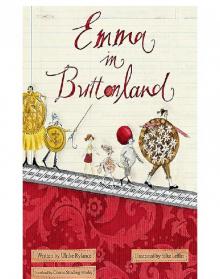
Emma in Buttonland, page 2


With that, Isolde gathered her bouffant skirt and scurried away with unexpected speed.
“Hey!” yelled Emma, frightened. Under no circumstances did she want to stay here alone. “I really was big once! Come back!”
“Be polite!” yelled Isolde without turning around. “That’s: Come back, please, your ladyship!” Hastily, the button lady turned the corner at the end of the blue street and was gone.
Emma felt like crying. But at that moment she realized why she recognized the pattern on the road. Aunt Mechthild owned a skirt that had the very same blue braid sewn on the bottom edge.
She looked up. Right above her hung a beautifully decorated street sign. It looked crocheted. Braid Street, it read. That’s exactly what Isolde had said. That meant . . .
That meant that this was the same braid, the one on Aunt Mechthild’s skirt! The buttons had used it to build a road. She would continue along Braid Street and would surely get back to the button room soon.
And somehow she would also get big again.
That’s what Emma hoped anyway.
A CHILD, NOT A BUTTON
For a while Emma ran along the road. It was comfortably soft, like an expensive rug; there was no other way to describe it. Only now she noticed that the colorful houses on the edge of the road were apparently sewing boxes. In the little front yards, pincushions shaped like flowers and mushrooms were growing; out of their tops colorful pinheads stuck up like little blossoms. Astonished, Emma noticed that the pins had faces. One of them winked at her; another yawned. Next to them were soft scraps of wool arranged like little sitting areas, and spools of thread were standing up straight like trees, letting their colorful threads flutter cheerfully in the wind. When a thread got loose and threatened to blow away, one of the spools would snatch at it lickety-split and tack it back down. Then the spool would doze off again. The gardens were really pretty. But where were the residents? Emma stood still and looked around her. Behind a house she saw something sparkle briefly; then it disappeared. Somebody was there.
“Hello?” called Emma. No one answered. She went farther, came to a screeching halt, and turned around with a jerk. That was an old gangster trick that she had seen once on television.
There! A little bit behind her stood a small silver thing wearing a gigantic red hat.
“Wait, please!” pleaded Emma. “I won’t hurt you!” The thing stood still. Emma debated how she should address it.
“What a pretty button you are,” she said cautiously. “And how stylish your hat is!”
“Isn’t it!” said the thing, relieved. “I’m an original, the only one of my kind in the whole land!” It lowered its voice a little. “I believe I’m valuable, but I can’t prove it. By the way, my name is Louise.” Taking tiny little steps, Louise came closer.
“My name is Emma.”
Louise extended her cold little hand toward Emma. Emma felt as though she were taking hold of a silver spoon.
“If I only knew how much I was worth,” Louise continued. She sighed. Then she eyed Emma with interest. “You’re not particularly valuable, are you?” she asked with sympathy.
“I don’t know,” said Emma, taken aback. Her mother always called her “my precious darling,” but did that mean she was valuable?
“You don’t look like a button either,” Louise went on. “Or, are you something ultramodern? Where do you get fastened?”
“I don’t get fastened.” Emma almost laughed, but she managed to hold it back.
“You don’t get fastened?” Louise’s silvery eyes widened in amazement. “How can that be? I’ve never seen anything like you before. Are you sure you’re not a button?”
Emma took a deep breath.
“I am not a button,” she said quickly. “I’m a child.”
“Not a button?” Louise’s silvery mouth hung open. She swallowed. “And children don’t have any hooks or loops or any holes in their stomachs? How odd!” She shook her head in bewilderment so that her heavy hat almost fell off.
“It’s not good, not being a button,” murmured Louise.
“Not good?” Emma felt a pang of anxiety. From a distance they heard a loud ruckus. Somebody was blowing a shrill whistle; a voice shouted, “She has to be here; I just saw her!”
Isolde! With icy fear Emma remembered that Isolde had intended to report her.
“Please, could you help me?” Emma reached for Louise’s cool little hand. “I absolutely have to go back to where I came from. But I don’t know how. And besides,” she gulped in panic, “besides that, somebody’s following me. Do you know where I could hide quickly?”
Louise nibbled on her silvery lower lip. Her little eyes darted back and forth uneasily.
“You’re not a button; that’s not good,” she repeated softly, as if to herself. “You’re a child without holes in your stomach. Whether that’s good or not, I can’t say. It’s such a difficult question. You also seem to be made of a very strange material. Maybe you are valuable. Who knows?”
The ruckus kept coming closer. Apparently it involved a whole lot of buttons, because the pitter-patter of countless little feet could be heard.
At that moment, Emma had an idea. “If you help me, I’ll find out how much you’re worth!” she said, looking around anxiously.
“Oh, really?” Louise’s mood improved suddenly. “You would do that?”
“Yes, of course!” Emma fidgeted with impatience. “But, we’d better get out of here, please.”
“That goes without saying!”
Louise began to run so suddenly that Emma had trouble keeping up with her speedy legs. Moreover, Louise seemed to roll more than run.
They scurried along the blue path where they happened to meet a pair of tiny snap fasteners that were clearing fluff off the route.
“Out of the way!” shouted Louise. With a horrible clacking sound, the snap fasteners fell to the side. Emma tripped over one of them. Angrily, it shook its little fist.
Louise had already turned down an alley. There the road was made out of yellow velvet, and Emma would have liked to feel it, but there was no time. They ran and ran, and just as Emma thought she couldn’t possibly take another step, Louise came to a sudden stop at a little house with a wooden bench in front.
A big, round, intricately carved button from a traditional German costume was sitting on it, eating a sausage sandwich. He looked at her in amazement.
“Gustav,” called Louise. “This is Emma. If you help her hide, she’ll find out if I’m valuable.”
“Good day, ladies!” Gustav said, surprised. A few breadcrumbs were hanging on his mustache. He was a stag horn button, and whereas Louise’s stomach was smooth, he was covered with white flowers.
“Edelweiss,” he noted proudly, pointing to the flowers.
“Pretty,” sputtered Emma. The ruckus made by the buttons was audible again. The carved button put his lunch aside and stood up.
“Then you’d better come in,” he said, and opened the door. His hands were made out of smooth, white antler.
Emma darted inside Gustav’s house.
And not one second too soon, because at that moment a throng of all kinds of buttons appeared—led by two uniform buttons and big golden Isolde. Emma looked cautiously out the window. The pack stopped short and seemed to deliberate. Then they ran on. Louise pressed her little silvery nose on the window next to Emma.
“Now, will you tell me how much I’m worth?” she whispered.
GUSTAV’S STORY
“Why is it so important to you to know how much you’re worth?” Gustav asked, shaking his head at Louise. He pointed at a sofa, and Emma sat down. Amazed, Emma noticed that the sofa was sewn together from the oddest assortment of fabric scraps.
“It’s important,” Louise answered, stomping her foot. “Because that would show what my purpose is. If I belong on an exquisite princess’s dress, perhaps, or . . . ” She stopped.
“Or not,” Gustav finished her sentence. Then he held up a finger. “The life’s work of a button is to close something. Everything else is just frills. Right?” He turned abruptly to Emma.
“Frills,” Emma repeated obediently. Then something occurred to her. “But you must know where you come from,” she said, turning back to Louise. “I mean, you must have been on a dress or a jacket at one time?”
Louise hung her head.
“No, I never was,” she whispered, and her silvery lips quivered a little. “I was always a spare button.”
“Oh,” said Emma, embarrassed.
Gustav cleared his throat.
“Not every button is as lucky as I am,” he said. “I had the chance to live on one of the most splendid pieces of clothing in the world, to see the world, to fall in love . . . ” He looked off wistfully into the distance.
Emma felt a little uneasy. She had the feeling that at any moment both buttons could burst into tears. As for herself, she wanted nothing more than to get big again.
“What kind of clothing was it?” she asked politely.
Gustav sniffled a little and stroked his flower carvings with pride.
“Lederhosen,” he said. You could see that the question had pleased him.
“I was on a pair of lederhosen made out of the finest goat leather, with suspenders and embroidery.” He smiled at the memory. “As everyone knows, landing on lederhosen is the best of luck for a button. They’re almost indestructible. I had my spot on the left suspender for thirty-four years. It was a wonderful time.”
“How lovely,” said Emma. Neither she nor her mother had ever owned a pair of lederhosen. In the meantime, Louise had climbed up on the couch next to Emma and nestled up coolly against her.
“We lived on a farm in the mountains,” continued Gustav. “It smelled like meadow, woods, and sometimes like cows too.
The man who wore us liked to sing while he worked. We buttons sang along. That’s when I first noticed her. The exquisite carved button on the right suspender. She had the loveliest voice in the world. One night I got up all my courage and spoke to her. Her name was Constance. We became a couple. For years we told each other the most beautiful stories, enjoyed life until . . . until . . . ”
Gustav’s voice failed.
“Until?” asked Emma and Louise in unison.
Gustav took a deep breath. “Our owner got older and older and didn’t go out as much. Most of the time we just hung in the closet, but it wasn’t so bad. It was comfortable and warm. However, one day he took the lederhosen out again and put them on. This time we took the train into a big city. It was unbelievably exciting, but awfully crowded too. There was always somebody bumping into our poor owner, and all of a sudden I noticed something horrible.”
Emma held her breath.
“I felt that I couldn’t hold on tight anymore. With every step I got looser. And then, in the middle of the market square, I got light-headed and dizzy, and I fell off. Constance was still shouting my name; then she was gone. The owner of the lederhosen simply went on and didn’t even notice that I had fallen off. He was just too old.” Big tears were running down Gustav’s face now.
“That’s just awful,” said Emma, clearly distressed. She hadn’t known until now how tragic it was to lose a button!
“The rest was quick. I lay for a while in the dirt in the street, until a big man picked me up, took me with him, and brought me here.”
“Uncle Hubert!” Emma shouted at once.
“Since then I’ve lived here, and although it’s not a bad existence, I still yearn for an active life. Smelling the woods and meadows again! Seeing Constance once again!”
“I envy you anyway, Gustav. You’ve experienced so much. I haven’t experienced anything; I’m just waiting.” Louise sighed.
“I’m waiting too,” Emma said. “For my mother.”
“Oh?” asked Gustav. “Is that your owner?”
“No, she’s my mother. I’m a child. My mother is in Africa.”
Louise looked at her blankly. “Are there buttons in Africa?” she asked.
Emma didn’t know if there were buttons in Africa. “There are lions there,” she answered, unsure.
Gustav observed her thoughtfully.
“So, you’re not a button?” he asked at last.
Emma shook her head.
“Can’t you help me get big again?” she asked. “Or show me the way back to the big room? Maybe I can help you find Constance again?”
Gustav seemed to think it over. Lost in thought, he scratched his head.
“Perhaps,” he began, “there is somebody who can help us.”
“Oh, really?” Emma felt extremely relieved.
“I don’t know if he can make you big again, but he has a bunch of strange guests. Also lots of,” Gustav lowered his voice, “non-buttons.” He opened the door a crack. “The coast is clear,” he said. “Come on, we’ll give it a try. I’ve already sat around here far too long doing nothing. That won’t bring Constance back.”
“Thank you so much, dear Gustav!” Emma wanted to give him a hug. “And I promise you, when I get big again, I’ll find a new pair of lederhosen for you, word of honor!”
Gustav smiled a little sadly. “That’s nice of you. But without my Constance, it wouldn’t be the same.”
He pushed Emma out the door.
“I’m coming too!” said Louise firmly. “You still haven’t told me if I’m valuable!”
WITH THE HIPPIES
Gustav, Louise, and Emma ran for a while along a road; this time, the road was green as grass and silky, and rustled with every step. Dusk was falling already, and all around them streetlights were turning on. Emma noticed that the lights were upside-down thimbles.
“Where are we going?” she whispered. Gustav didn’t answer. He ran ahead with sure steps, his white antler feet in thick, practical hiking shoes. He was almost racing. Louise was rolling effortlessly behind; it was just Emma who could barely keep up.
“Are we almost there?” Emma gasped, as they finally came to a stop. Gustav nodded.
“Just down Tape Measure Road,” he said quietly. Sure enough, instead of a fence on their right, there was an un-rolled tape measure, reaching as far as the eye could see. And then, just as Emma was thinking that she would have to spend the rest of her life with these two, tramping along this road, Gustav stopped. They had reached their goal, a gray box building.
It wasn’t a particularly beautiful house. Actually, Emma noticed now, it wasn’t even a regular house, just an old shoebox where you throw all your junk that doesn’t belong anywhere else. Gustav gave the door three quick raps. It wobbled alarmingly. Emma would have preferred to back away. If the house collapsed, golden Isolde would turn up here in no time with her police guards. Then the door opened, and an oblong wooden button stood before them. He was wearing a poncho and had a headband around his head.
“Peace, man!” he said to them.
“Evening, sir,” replied Gustav with dignity. “We need to ask for your help. I’m looking for my fiancée, Constance. Louise, here, would like to find out if she’s valuable. And Emma is an extremely special case. Not a button. Definitely not a button. Says she’s a child. Now that, of course, can’t be. Children are normally bigger. However, there is a certain similarity to a child.”
The wooden button looked Emma over kindly. “Welcome to our commune, strange thing. I’m Woody!” he greeted her. A funny smell, a little bit like the smell from incense burners, wafted out of the house. Somebody was playing guitar and singing.
“Commune?” Emma had never heard the word before.
“Here at our place everybody’s equal,” he explained. “Buttons, nonbuttons, it’s all the same to us. We’re hippies. I was personally there at Woodstock; that explains my name. Peace. Flower Power and so on.”
“What?” Emma asked, baffled.
“Woodstock,” said Woody. “The music festival! Duh, you’ve never heard of it?”
Emma shook her head. Was that something you were supposed to know?
“What’s your name again, thingy?” asked Woody. He sounded a little offended.
“Emma,” said Emma.
Woody clapped his hands enthusiastically. “That was the name of the owner of the cardigan I used to live on! She played a terrific harmonica. Come in!” With that, he pushed her into the house. Emma found herself in a huge room, which was decorated from top to bottom with colorful fabric ribbons. All over the place the strangest figures were sitting on soft pillows; some were even lying on the floor. Candles were burning, and from the ceiling somebody had hung silvery threads, which were turning to and fro.
“How pretty!” said Emma, impressed.
“Are those valuable?” asked Louise breathlessly, pointing to the silver threads.
“As if that were important!” said somebody next to them. Emma looked up in surprise. What was standing in front of her was definitely not a button. It was a wiry little man.
“What are you?” Emma asked curiously. The little man gasped for breath. The entire room became silent. Emma noticed that every eye was on her.
“What am I?” The little man stretched and became almost twice as tall. His voice almost cracked. “Dear Emma-thing, if I knew that, I would not be here, would I? At any rate, I’m not a button!” He burst out in a short, bitter laugh.
Woody waved his hands soothingly. “Peace, love, harmony, friends!” he exclaimed. “Maybe the Emma-thing can help us after all.”
Emma examined the little man. Something about him looked familiar. Of course! “I think,” she said in a firm voice, “you’re a paper clip.”
Somebody dropped a glass, which broke with a shatter.
“A what?” whispered the little man.
“A paper clip. You know, you use it to hold papers together. In offices. Or when you’re doing crafts.” Emma thought it would have been easier to grab him and use him to hold something or other together in order to explain it to him better. But to her dismay, she saw that tears were running down the little man’s thin, wiry face.