Black Static #74 (March-April 2020), page 1


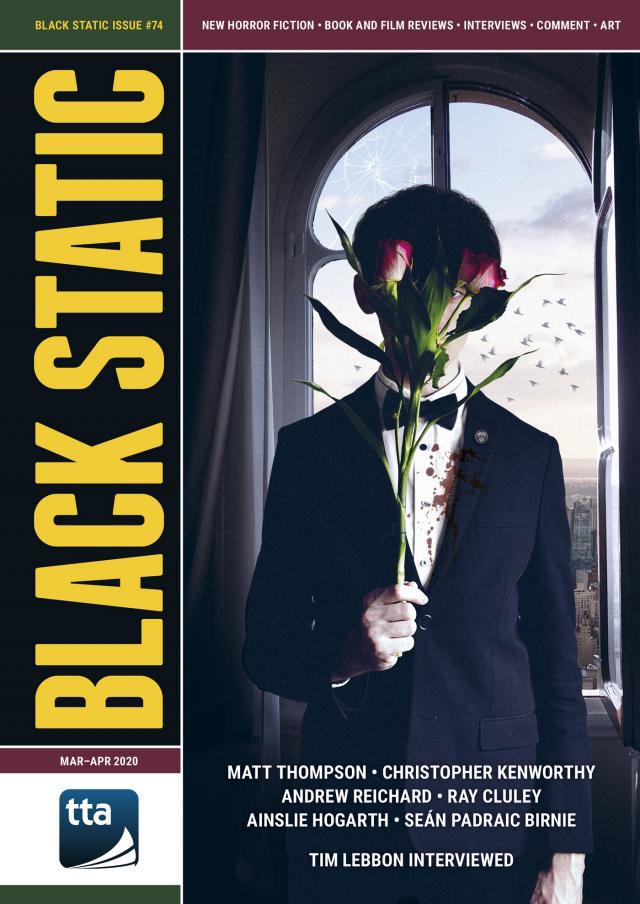
BLACK STATIC 74
MARCH–APRIL 2020
© 2020 Black Static and its contributors
PUBLISHER
TTA Press, 5 Martins Lane, Witcham, Ely, Cambs CB6 2LB, UK
website: ttapress.com
email: blackstatic@ttapress.com
shop: shop.ttapress.com
Books and films for review are always welcome and should be sent to the above address
EDITOR
Andy Cox
andy@ttapress.com
FILMS
Gary Couzens
gary@ttapress.com
STORY PROOFREADER
Peter Tennant
SHOP
New subscriptions, subscription renewals, back issues, special offers
shop.ttapress.com
SUBMISSIONS
Unsolicited submissions of short stories are always very welcome
tta.submittable.com/submit
SMASHWORDS REQUESTS THAT WE ADD THE FOLLOWING:
LICENSE NOTE: THIS EMAGAZINE IS LICENSED FOR YOUR PERSONAL USE/ENJOYMENT ONLY. IT MAY NOT BE RE-SOLD OR GIVEN AWAY TO OTHER PEOPLE. IF YOU WOULD LIKE TO SHARE THIS MAGAZINE WITH OTHERS PLEASE PURCHASE AN ADDITIONAL COPY FOR EACH RECIPIENT. IF YOU POSSESS THIS MAGAZINE AND DID NOT PURCHASE IT, OR IT WAS NOT PURCHASED FOR YOUR USE ONLY, THEN PLEASE GO TO SMASHWORDS.COM AND OBTAIN YOUR OWN COPY. THANK YOU FOR RESPECTING THE HARD WORK OF THE CONTRIBUTORS AND EDITORS.
BLACK STATIC 74 MARCH-APRIL 2020
TTA PRESS
COPYRIGHT TTA PRESS AND CONTRIBUTORS 2020
PUBLISHED BY TTA PRESS AT SMASHWORDS
CONTENTS
COVER ART
UNTITLED
RICHARD WAGNER
OUTSIDE OF SOCIETY
NOTES FROM THE BORDERLAND
LYNDA E. RUCKER
DISAPPOINTED!!!
INTO THE WOODS
RALPH ROBERT MOORE
STORY ILLUSTRATED BY RICHARD WAGNER
MEMORIES OF THE OCCUPATION
MATT THOMPSON
STORY
SHATTERING
CHRISTOPHER KENWORTHY
STORY
THE NEW YOU
AINSLIE HOGARTH
STORY
IN THE WAKE OF MY FATHER
RAY CLULEY
STORY
THE TURN
SEÁN PADRAIC BIRNIE
STORY ILLUSTRATED BY JOACHIM LUETKE
WHITE CEDAR, WHITE BIRCH
ANDREW REICHARD
BOOK REVIEWS
CASE NOTES
TIM LEBBON INTERVIEWED
FILM REVIEWS
BLOOD SPECTRUM
GARY COUZENS
NOTES FROM THE BORDERLAND
LYNDA E. RUCKER
OUTSIDE OF SOCIETY
“Stories should be dangerous. Or they’re useless.”
— Caitlin R. Kiernan
Earlier this year, I took a social media break. I’m still on it. Mediums that had once made the world feel more open to me than ever before had instead begun to make it feel small, crabbed, claustrophobic. I know every argument that exists about staying online for writers because I’ve made them all myself.
And then I quit and oh god, you know what? It’s so quiet. I can hear my own thoughts again. It’s bliss.
***
At a 2017 appearance in New York, novelist Zadie Smith talked about eschewing social media, and how it was necessary for her writing. “I want to have my feeling, even if it’s wrong, even if it’s inappropriate, express it to myself in the privacy of my heart and my mind.”
This was the opposite of how just skimming through social media had begun to feel to me – as though I were always browbeaten, like I was in an argument with someone who wouldn’t stop, who followed me from room to room, who wouldn’t give me a minute’s peace to just stop and think. Social media had started to feel like a really, really shitty relationship.
Online, everything is an emergency.
But I think the worst of it was the repetitiveness. That’s what made it relentless, the sense of being able to predict and recite every argument, every rebuttal, the point at which it would go bad, except that nearly every time, I underestimated the degree of bad faith with which so much is read online.
***
The 1948 publication in The New Yorker of Shirley Jackson’s story ‘The Lottery’ was famously contentious. Readers were outraged, cancelling their subscriptions in droves, writing angry letters to the magazine and to Jackson herself. Like many of us, Jackson had imagined a very different sort of reception to her work. In a 1960 speech she delivered called ‘Biography of a Story’, posthumously reprinted in the 1968 collection Come Along With Me, she wrote: “I had of course in my imagination dwelt lovingly upon the thought of the millions and millions of people who were going to be uplifted and enriched and delighted by the stories I wrote.”
The truth, as we all learn eventually, is somewhat different: “It had simply never occurred to me that these millions and millions of people might be so far from being uplifted that they would sit down and write me letters I was downright scared to open; of the three-hundred-odd letters that I received that summer I can count only thirteen that spoke kindly to me, and they were mostly from friends.” Even her own mother wrote to tell her how much she disliked the story. A friend reported that she heard a man on the bus talking about the story and was going to say she knew the author until “after I heard what he was saying I decided I better not”.
Jackson went on: “I will not try now to say what I think of people who write nasty letters to other people who just write stories.” Instead, she said, she would simply share responses, which included an admonition to “stay out of Canada” and a demand for a “personal apology from the author”. Jackson’s biographer Ruth Franklin reports that one called her “perverted”. In all, Jackson described the responses she received as a mix of “bewilderment, speculation and good old-fashioned abuse”.
There’s a deliberate disingenuousness and comedic exaggeration in her accounting of the incident. Most of her fiction was anything but “uplifting”, and in particular, her insistence that it was “just a story” belies the seriousness with which she went at work.
Stories are everything, stories are nothing. Both of these things can be true at the same time.
***
In 1892, Charlotte Perkins Gilman’s classic feminist horror tale of madness and oppression ‘The Yellow Wallpaper’ appeared in New England Magazine 5. Some praised the story; others were not so sure. An anonymous letter to the daily afternoon paper the Boston Transcript thought it must be a story that could only “bring the keenest pain” to anyone whose life had been affected by mental illness, and could even be the source of “deadly peril”. It questioned whether stories like ‘The Yellow Wallpaper’ should “be allowed to pass without the severest censure”.
Harm reduction, the importance of reducing the possibility of causing pain or upset, particularly to the vulnerable, and a deference to the greater good, has always been a factor in suppressing art seen as dangerous for any reason. The librarian at my small-town, rural high school was famous for drawing clothes onto naked people in anatomy books, or so the rumor went, and generally disapproving of anything that might be considered not improving to young minds. One day, my favorite teacher, one whose approach to education was very much in the Socratic mode – and with an approach to vulnerable young minds about as far from the librarian’s as it could be, as the assigned reading list that year included A Clockwork Orange and Crime and Punishment – had her come and chat to our class about censorship, or, as she preferred to put it, “selection”. Because let’s face it, nobody wants to be a censor.
Honestly, she acquitted herself very well. It was one of the first times I can remember finding myself exposed to a bad argument that nonetheless was delivered in a way that sounded so reasonable on the face of it that it was difficult to know where to begin with a rebuttal. This wasn’t some unhinged religious loony telling me that if I listened to heavy metal music or played video games then the devil would take my soul. Of course she didn’t believe in censorship. What reasonable person does? But a careful and responsibly curated selection of reading material that would both entertain and illuminate? Who could find fault with such an approach? I found I came away thinking, “Huh, I mean I guess maybe she has a point?” There was something wrong still that I couldn’t put my finger on, but the way she’d explained it, it all made sense, and I didn’t know what to do with that. Except that I still felt in my gut that there was something fishy about this “selection” business.
***
There’s a thing most writers have to overcome at some point, although it’s so far in my past I had forgotten it until very recently, and it’s the fear of what will people think. Not strangers, but the people you know: what will your friends, your family think when you put pen to paper – or fingers to keyboard – and all the weird transgressive shit you don’t dare share with anyone comes spilling out. Making art that matters requires you to be both extraordinarily vulnerable and extraordinarily impervious.
You couldn’t do it if you listened to other people all the time. You especially couldn’t do it if you were expected to answer to them day and night, on command.
So much of good storytelling is about trying to find your way in the dark, and existing in a constant state of, at best, half-certainty. If you could say it in 280 characters, you wouldn’t need to write 6,000 or 60,000 or 600,
So don’t: publish, and be damned.
With thanks to Simon Bestwick for pointing me toward the Charlotte Perkins Gilman material.
INTO THE WOODS
RALPH ROBERT MOORE
DISAPPOINTED!!!
In the second episode of The Sopranos, ‘46 Long’, there’s a scene where Christopher Moltisanti, cousin to Tony Soprano, is in the noisy sidewalk crowd at a movie premiere in NYC. A black limousine pulls up to the curb, and out steps Martin Scorsese (or at least an actor playing Scorsese in the episode), with a tall brunette. As Scorsese gives a head-down wave to the crowd, Chris shouts out, “Marty! Kundun! I liked it!”
It’s a brilliant moment in an often brilliant show. Chris, who’s a mobster but has dreams of becoming a screenwriter, is trying to get Scorsese’s attention. Maybe shake his hand, perhaps even get his phone number. So he doesn’t mention Taxi Driver, or Raging Bull, but instead a movie that is generally considered to be one of Scorsese’s lesser films. As if the fact Chris ‘liked’ (and note he didn’t say he ‘loved’) Kundun might ingratiate him with the director. (Much like Norman Mailer later found out that the reason John F. Kennedy, who he met at a party, mentioned how much he enjoyed reading Mailer’s Deer Park, was because Kennedy’s advisors told him that novel’s poor critical reception was a sore spot with Mailer, and Kennedy’s praise of it was an easy way to get Mailer’s support.)
I was driving through the dark back roads of southern Connecticut, moon high in the sky’s blackness, yellow headlights from the front of my green VW illuminating, sliding across, tree trunks, when a song came on my car’s radio. ‘Space Oddity’ by David Bowie. I had read about Bowie before, in Rolling Stone, but I had never heard any of his music. That’s the way it was back then. I just knew him, as most people did, as a man who wore a dress while he sang onstage. So it was a real treat to finally hear one of his songs, negotiating with my steering wheel different curves in the asphalt road twisting through the woods.
I loved the song. It was different. And different means a lot. Especially when you’re young. I started buying his albums. You grow up with singers as your guardian angels, we have for generations, and like a lot of you, I grew up with Bowie. And he kept getting better. It was an extraordinary trajectory. Station to Station. The Berlin trilogy (Low, Heroes, Lodger). Scary Monsters. Then he left RCA and started recording for EMI. His first release was Let’s Dance, which really propelled him onto the world stage as a superstar.
His follow-up album for EMI? After the stunning success of Let’s Dance? Tonight. Which…was not that good. His next album for EMI was what turned out to be the ironically-named Never Let Me Down.
In the 1988 film A Fish Called Wanda, Kevin Kline’s character, Otto, who refers to dogs as ‘insects’, crouches on the floor in front of a safe, stethoscope flowing from his ears to the safe’s front door, twirls the numbers of the safe’s circular combination lock left, right; after each click he hears in his ears in order to swing that door open getting more excited, and when he is finally able to push the safe’s lever down, and look inside, he sees the steel interior of the safe is, in fact, empty. Rears his head back. Forcefully exhales twice. “Okay. Okay. DISAPPOINTED!!!”
That’s the thing about creativity. We write a great story, one we’re really proud of, this is me at the top of my form, my knuckles are lifting and lowering over the keyboard, smiling starlets dancing in silvery mermaid costumes, but then the next story we write? Not quite so good.
And that’s what creativity is all about. It’s not like every story you write is going to be better than your prior stories. Often, it isn’t. Creativity isn’t a rightwards line on a graph climbing higher and higher story by story. Our creative output is a city we build over the course of our lifetimes, and like every city, it has a skyline whose building heights rise and fall against the sky. Creativity is a moody, unpredictable beast, where sometimes everything comes together and you produce great work, and sometimes you produce…acceptable work.
But that’s okay.
There are stories that are going to get you talked about, and then there are stories that you want to write, even though you know they aren’t going to excite readers as much. Write them anyway. Accept that writing is not always about tapping out that perfect story. Often, it’s about creating a story only you can tell.
When you start writing a new story, it’s like a first date. You and your fingers sitting across from each other at a small, square table amidst the elbows and candlelit faces of other diners, the waiter lowering two white porcelain plates of orange-banded shrimp to your white linen tablecloth. And sometimes that first date goes really well. You have a lot in common. You talk to each other in rushes of agreement, reaching forward for the slim stems of your wine glasses. You finish each other’s sentences. And that’s so sweet, so useful, to have the end of a sentence given to you, effortlessly, over the steam of the al dente pasta course.
One of the nice things about writing is the fact that it’s really not that physical of an activity, you can continue to write well into old age. It’s not like ditch-digging, where after a while it might be hard for a senior to balance on his crutches while he’s swinging that pick axe. And unless you’re Thomas Wolfe, you probably write while sitting down.
But because it is so relatively easy to do physically, there can be an embarrassment, even shame, when a writer can no longer write. Hemingway wrote Across the River and Into the Trees to keep as a secret weapon when he ran out of ideas.
In the late Nineties I wrote a story, ‘When the Big One Thaws’, which has consistently received praise in the years since from critics. It’s one of my most-liked stories from readers. After that, I wrote ‘Elephants on the Moon’, which no one wanted to publish, because it was so weird, but it did eventually find a home at Contemporary Literary Review: India. But I don’t regret I wrote it. I love that little story.
Throughout the latter part of his career, Bowie went through a period where each succeeding album was compared to Scary Monsters, and found to be inferior. Which, in fairness, they were. But then at the end of his life, in his late sixties, he went back to the studio and came out with Blackstar, which to my ears is one of the best albums he ever created.
Not everything you write is going to be a ‘Let’s Dance’. A lot of it’s going to be the aptly named ‘Day In, Day Out’.
And that’s something every writer has to learn to accept at some point in their careers. Sometimes you’re going to open that safe, look inside and see that the steel cubicle is empty, and feel DISAPPOINTED!!!
I salute Scorsese for filming Kundun, Mailer for writing Deer Park, Bowie for releasing the albums he did between Scary Monsters and Blackstar, me for all the ragamuffin stories I’ve written over the decades, you for all the tales you’ve penned that you knew might never get published, or if they did, would only appear in story collections of yours alongside their more successful cousins.
Some of what we write is going to be bought drinks at a crowded bar and grill; some is going to be appreciated by a much smaller audience than we usually garner.
But that’s okay. Who knows what you’ll find next time your fingers twirl that combination lock, then excitedly start tapping on your keyboard?