

The Daughter of Auschwitz, page 1


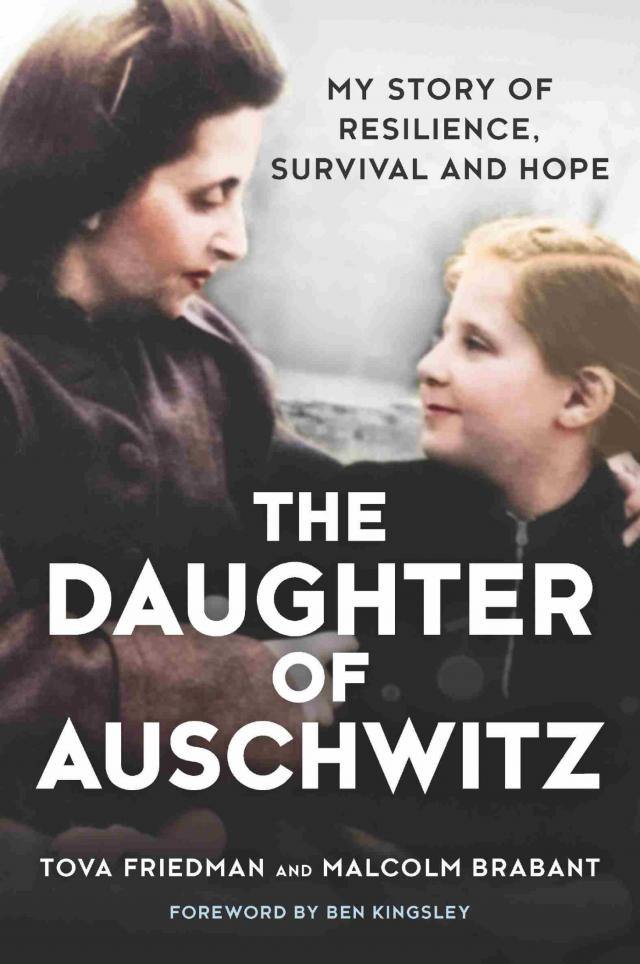
The Daughter of Auschwitz
My Story of Resilience, Survival and Hope
Tova Friedman
and
Malcolm Brabant
To my amazing parents, Reizel and Machel, who saved us all. And to my children and grandchildren who will always remember.
Tova Friedman is eighty-four years old and lives in Highland Park, NJ. She is one of the youngest survivors of Auschwitz and uses her vivid memories to write and speak against anti-Semitism and prejudice. She was the director of a nonprofit social service agency for twenty-five years and continues to work as a therapist.
Malcolm Brabant is an award-winning British former war correspondent who witnessed genocide in Bosnia. His evocative writing style and forensic probing of Tova’s memories remind readers of the horrors of the Holocaust at a time when hate is on the rise around the world and history’s worst crime is fading from memory. He is now a foreign correspondent for PBS, with several accolades to his name.
Contents
Foreword
Prologue
Chapter One
Chapter Two
Chapter Three
Chapter Four
Chapter Five
Chapter Six
Chapter Seven
Chapter Eight
Chapter Nine
Chapter Ten
Chapter Eleven
Chapter Twelve
Chapter Thirteen
Chapter Fourteen
Chapter Fifteen
Chapter Sixteen
Chapter Seventeen
Chapter Eighteen
Chapter Nineteen
Chapter Twenty
Chapter Twenty-One
Chapter Twenty-Two
Tova’s Acknowledgments
Malcolm’s Acknowledgments
Photos
FOREWORD
On driving away from my morning with Tova, the closing lines of Shakespeare’s King Lear came to mind:
The oldest hath borne most; we that are young
Shall never see so much, nor live so long.
Elie Wiesel would, I’m sure, allow us to use his phrase when we cite Tova Friedman as a heroine of truth and memory.
Sir Ben Kingsley, February 2022
PROLOGUE
My name is Tova Friedman. I’m one of the youngest survivors of the Nazi extermination camp known as Auschwitz-Birkenau. For much of my adult life, I’ve been speaking about the Holocaust to ensure people never forget.
I was born Tola Grossman in Gdynia, Poland, in 1938, a year before the Second World War began. After living through every stage of the Nazis’ attempt to wipe out the Jewish people, I eventually moved to America, married Maier Friedman and later began calling myself Tova.
No matter how much the last few remaining survivors and I share our stories, it seems that people are forgetting. Personally, I was horrified to learn about the levels of ignorance revealed in a survey of young Americans that was commissioned by the Conference on Jewish Material Claims Against Germany and published in September 2020.
Two-thirds of the people who were interviewed had no idea how many Jews died in the Holocaust. Almost half couldn’t name a single concentration camp or ghetto. Twenty-three percent believed the Holocaust was a myth or had been exaggerated. Seventeen percent said it was acceptable to hold neo-Nazi views. A similar survey in Europe in 2018 showed that a third of all Europeans knew just as little or hadn’t even heard of the Holocaust. It also showed that 20 percent thought that Jewish people had too much influence in the worlds of business and finance.
Those astonishing, alarming numbers point to just one thing: anti-Semitism, or hatred of the Jews, is on the rise again in the United States and across Europe. I find it very hard to believe, after everything we endured in the ghettos and the extermination camps during the Second World War, that the insidious attitudes of the 1920s and 1930s are resurfacing. The Holocaust, the worst crime in the history of mankind, happened less than eighty years ago, and it’s fading from memory already? That, quite frankly, is appalling.
I’m now eighty-three years old, and with this book, I am trying to immortalize what happened, to ensure that those who died are not forgotten. Nor the methods that were used to exterminate them.
Many people wonder whether the world we inhabit now is similar to Europe of the 1930s, when Nazism and Fascism were on the rise in the run-up to the Second World War. Back then, anti-Semitism was the official state policy of Adolf Hitler’s Germany. It’s true that no government in the world today has such a doctrine enshrined in law and supported by the population at large. Nevertheless, we all know countries where discrimination is prevalent and perhaps even tolerated.
Hatred is one of the fastest-growing phenomena today. Hate of every kind, especially toward minorities. Wherever you are in the world, I implore you, do not repeat the history to which I was subjected.
Remember, the Holocaust began less than twenty years after Adolf Hitler wrote Mein Kampf, his master plan for eradicating the Jews. In the age of warp-speed internet, change can happen much faster than it did eighty years ago. We need to be constantly vigilant and brave enough to speak out.
On that note, just as we were putting the finishing touches to this book, President Vladimir Putin ordered Russian troops to invade neighboring Ukraine, imperiling world peace in the process. The images were so familiar to me. Terrorized children and adults, destruction of homes and families, war crimes, millions of people displaced, hunger, bomb shelters and communal graves. And I hope that after nearly eight decades of reflection on man’s inhumanity during the Holocaust, Ukraine reminds us of the importance of helping those affected by the ravages of war.
As you read on, I want you to taste and feel and smell what it was like to live as a child during the Holocaust. I want you to take a walk in my shoes and in the footsteps of my family, even though, in the worst of times, we didn’t have shoes. I want you to understand the dilemmas that faced us and the impossible choices we had to make. I hope you get angry. Because if you are angry, there’s a chance you’ll share your outrage, and that increases the chances of preventing another genocide.
I come from a long tradition of oral history. I consider myself more of a narrator and storyteller than a writer, which is why my friend Malcolm Brabant has been helping me. He has a way with words and images.
We met in Poland in January 2020, as the world commemorated the seventy-fifth anniversary of the liberation of Auschwitz, which took place on January 27, 1945.
Malcolm has been a war reporter. He witnessed ethnic cleansing close at hand in Bosnia-Herzegovina in the 1990s. He knows the stench of genocide. He’s had some narrow escapes and painful experiences that are different to mine. What we have in common is that we are both survivors.
He has delved into the Nazi occupation of Poland to try to place my childhood in the right context.
As we worked together to revive the sounds, smells and tastes of the Holocaust, I found that hidden memories came flooding back. Sometimes they kept me awake all night. Everything that happened to me and the people around me is buried somewhere deep in the recesses of my subconscious. As a practicing therapist, I must accept the possibility that age and time have blurred my worst memories. The human brain and body are extraordinary instruments, and they have survival mechanisms that we may never fully comprehend.
Some details of my story may not precisely align with other accounts of the Holocaust. After the war, my mother talked to me incessantly about what happened to us, to make sure I didn’t forget. The conversations I recall in this book are not verbatim. The content, tone and nature, however, are an honest representation of what was said at the time. We all have different memories and versions of the truth. This is my truth.
I don’t believe I suffer from survivor’s guilt, which is one component of what psychiatrists call “survivor’s syndrome.” Those who experience this condition punish themselves for surviving, even though they are blameless. I don’t think the 6 million Jews who died in the Holocaust would want me to feel guilty. Instead, I have chosen to embrace a new term—“survivor’s growth”—through which I actively use my experiences to build a meaningful life in honor of those who died in the Holocaust. I will remember them.
I have channeled the trauma into what I call “undoing Hitler’s plan.” He wanted to stamp out our faith by murdering our children. I have spent most of my adult life doing the opposite by ensuring my own family is steeped in our culture. My eight grandchildren are testament to our continuity.
In this memoir I will be referring to this genocide as the Holocaust, however the ancient biblical term for utter destruction, Shoah, is more accurate in expressing this uniquely Jewish tragedy.
Auschwitz imprinted itself in my DNA. Almost everything I have done in my postwar life, every decision I have made, has been shaped by my experiences during the Holocaust.
I am a survivor. That comes with a survivor’s obligation—to represent 1.5 million Jewish children murdered by the Nazis. They cannot speak. So, above all, I must speak on their behalf.
Tova Friedman
Highland Park, New Jersey
April 2022
CHAPTER ONE
RUNNING FOR OUR LIVES
Auschwitz II, aka Birkenau extermination camp,
German-oc
January 25, 1945
Age 6
I didn’t know what to do. None of the other children in my barrack knew what to do. The noise outside was horrifying. I had never heard anything like it before. So much shooting. Volleys and single shots. A pistol and a rifle made different sounds. I’d seen and heard both in action up close. Rifles cracked and pistols popped. The result was the same. People fell down and bled. Sometimes they cried out. Sometimes it happened too fast for them to make a sound. Like when they were popped in the back of the head or neck. Other times, they just rattled and rasped and gurgled. That was the worst. The gurgling. My ears hated it. I wanted the gurgling to stop. For them and for me.
Somewhere outside the barrack, there were cracks and pops and rat-a-tata, rat-a-tata-tata. The fast sounds were machine guns. I’d seen them in action as well. I knew the damage they caused. And they terrified me.
Glass rattled in the window frames that ran the length of each wall, about ten to fifteen feet above my head in the eaves. Normally, the glass shook from the wind. This was different. It was like a storm without lightning. What sounded like thunder rumbled in the distance. Although the wooden walls muffled the din outside, it seemed as if all the people in all the barracks were moaning or screaming at once. All the dogs in the camp were growling and barking with more malice than usual. Those dogs. Those fearsome, wicked dogs.
I could hear the German guards yelling at the tops of their voices. I despised their guttural language. I was gripped with fear whenever the Germans opened their mouths.
I never heard German spoken softly. It was always harsh, alien and, more often than not, accompanied by violence. Formed in the back of their throats, so many words burst forth, snarling and spitting and hissing. Like the high-voltage barbed-wire fence that kept us caged in and sometimes electrocuted any of us who had managed to die on our own terms, not in a manner dictated by the Nazis. Many prisoners were shot before they reached the wire.
The German voices seemed angrier than usual. Was this what the end of the world sounded like? The war was closer than it had ever been. For once, a war with soldiers fighting each other. Not the war that I had witnessed, where well-fed brutes in gray and black uniforms trampled starving women and the elderly to the ground and then shot them in the back or in the head. Where children were dispatched to gas chambers and flew out of chimneys in tiny, charred flakes.
I couldn’t tell what lay behind the tension seeping through the timber-planked walls. I glanced up at the long windows. Viewed from an acute angle, through the slits of glass above, the sky seemed strange. Of course, it was gloomy because it was deep winter. But it seemed darker than it should have been. Was that smoke in the air? Were those particles dropping to the ground? They were not the usual ones. These seemed bigger. Was there fire outside? Were flames getting closer? All it would take was one spark and our barrack would be a funeral pyre. I had knots in my empty stomach. I felt more trapped than ever.
I did what I habitually did when I needed solace. I climbed onto the wall of red bricks that ran the length of the barrack. The bricks were about two feet above the ground. They acted as a divider between rows of three-decker bunks on either side and absorbed heat from an oven in the center of the room. Although the fire was dying out, there was a little warmth still in the bricks. I sat on my haunches, wiggling my toes on them to extract the maximum amount of comfort.
There were so many children in my block, I couldn’t count them. Forty, fifty, sixty, maybe. The oldest were nearly teenagers. I was one of the youngest and smallest. We all had smudged, dirty faces and sunken eyes, ringed black from sleeplessness and starvation. We were mostly clad in rags that hung from our bones. Some of the children wore striped uniforms.
None of us knew what was going on. There hadn’t been the morning Appell—roll call. The numbers on my left forearm suddenly felt itchy. For the first time since they were carved into my flesh, they had been ignored. A-27633. The identity imposed on me by the Nazis. I hadn’t heard it being called out. Our routine had been broken. Something strange was definitely taking place.
We hadn’t been fed and were ravenous. We should have lined up for a crust of dry bread and a bowl of lukewarm gruel containing, if we were lucky, traces of indeterminate vegetables. Hunger pangs punched us all in the gut.
How long had we been left like this? I had no means of measuring time, apart from watching daylight lifting the shadows inside the barrack and then watching them return. It couldn’t be long before the sun, wherever that was, would sink beneath the level of the windows, and we’d soon be in total darkness again.
Coughing, sniffing and whimpering rippled around the bunks. Despite the arctic temperature, the block reeked of urine-soaked blankets and of feces from overflowing bedpans. Some children were mewling or trying to suppress their tears. Crying was contagious. It made us all miserable. Once you started, you felt even sadder than usual. You began thinking about how dreadful life was and then you couldn’t stop. I didn’t succumb. I never cried. Although I felt like sobbing, I set my jaw and rose above it.
Mama taught me never to cry, no matter how frail or scared I felt. For someone so young, I’m proud to say, I had a strong will.
“Where has the Blokälteste gone?”
“I haven’t seen her today.”
“I haven’t seen her since yesterday.”
“She’s not here. Let’s go outside.”
“No, we mustn’t go outside.”
“If she catches us, she’ll beat us, and she’ll report us to the Germans.”
The Blokälteste was the woman in charge, or block elder, who carried out the Germans’ orders. Like us, she was Jewish. The Germans rewarded her with extra food and a space of her own. She had quite an appetite. I thought she was sturdy. But then, to a child, everyone was big. In return for carrying out the Nazis’ dirty work, the block elder could stretch out and sleep in peace without someone else stealing the blanket or jabbing her in the back with their knees or elbows.
Although the block elder used fear to control us, her presence provided a sense of Ordnung muss sein (“There must be order”), as the Germans never tired of saying. I don’t mind admitting I was afraid of the woman. But without her, there was chaos. And, worst of all, no food.
Normally, all the barracks were locked and bolted. The block elder must have been in such a hurry to leave, whenever that was, that she hadn’t bothered to count us or secure the door. I was tempted to sneak outside, but the noise was too scary. None of the children dared cross the threshold. It was as if a force field was restraining us. We had been conditioned to obey commands and couldn’t move without them.
Suddenly, the door opened. We all jumped.
In walked a woman I didn’t recognize. She looked terrible. Her features were distorted by malnutrition. Her face was little more than a skull covered in parchment-thin skin. Her eyes had retreated into their sockets. But her body was puffy. Starvation did that to a person. It made their flesh swell. Tufts of dark brown hair sprouted from beneath a piece of cloth fashioned into a scarf in a futile attempt to seal in some warmth.
The woman looked at me.
“Tola!” she exclaimed. “There you are, my child!”
Relief swept over her face. Her taut cheek muscles relaxed, and her eyes sparkled. The voice was weak but familiar. So were her sad green eyes, as well as her faint smile. I stood up on the bricks, confused. She looked more like a scarecrow than a human being. She sounded like my mama, but was it really her?
And what was she doing in my barrack? She was supposed to be in the women’s section. I had been taken away from her five months earlier in the high summer after I fell sick. I had heard her voice close by when we walked to the gas chamber and when we walked back again. But I hadn’t seen her. In fact, I hadn’t seen Mama’s face for so long that I had forgotten what she looked like. I had become accustomed to not having a mother or father. I had forgotten that I had anybody on this earth. I thought I was all alone. But now maybe I wasn’t? I was confused. The woman noticed my hesitation.


