

Zorba's Taverna: The Trouble With Goats and Mayors, page 41


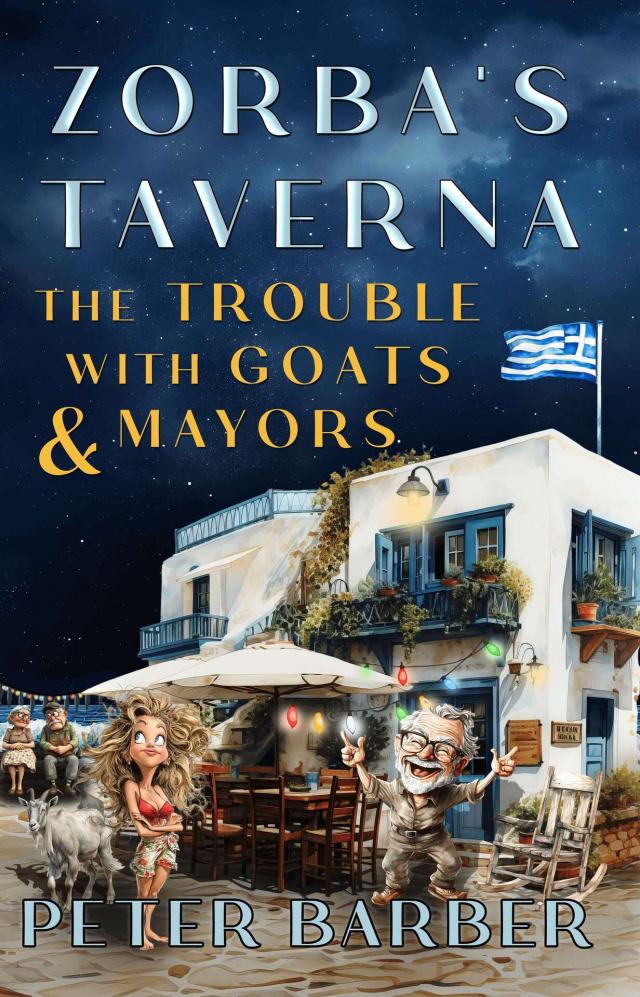
Zorba’s Taverna: The Trouble with Goats and Mayors
First published in 2025
Copyright © Peter Barber, 2025
The moral right of Peter Barber to be identified as the author of this work has been asserted in accordance with the Copyright, Designs and Patents Act of 1988.
All rights reserved. No part of this publication may be reproduced, stored in a retrieval system, or transmitted in any form or by any means, electronic, mechanical, photocopying, recording, or otherwise, without the prior permission of the copyright owner.
Paperback ISBN: 978-1-916574-25-0
Hardback ISBN: 978-1-916574-26-7
Cover Design and Formatting by Kathleen Harryman
https://www.kathleenharryman.co.uk
Scan the QR Code for more
information about
Peter Barber and his books.
Books by Peter Barber
The Zorba’s Taverna Series:
Zorba’s Parthenon: A Taverna by the Sea
The Parthenon Series:
A Parthenon on our Roof
A Parthenon in Pefki
The Parthenon Paradox
The Musings Series:
Musings from a Greek Village
Musings from a Pandemic
Contents
Books by Peter Barber
Introduction: Dramatis Personae (and One Goat)
Chapter One: Zorba’s Taverna, Take Two
Chapter Two: A View, a Goat, and a Hint of Trouble
Chapter Three: The Invasion of the Spoon-Wielding Matriarchs
Chapter Four: The Five-Metre Menace
Chapter: Five The Man Who Would Govern by Accident
Chapter Six: The Hour of the Olive Shadow
Chapter Seven: Alex: The Reluctant Co-Conspirator
Chapter Eight: The Proposal (and the Goat’s Approval)
Chapter Nine: When the Grill Went Quiet
Chapter Ten: Zorba’s Foundations – A Memory of Marble and Mud
Chapter Eleven: A Wedding and a Scandal
Chapter Twelve: The Dry Run (and How We Almost Didn’t Survive It)
Chapter Thirteen: Courting and Campaigns
Chapter Fourteen: The Battle over Sea-Facing Chairs
Chapter Fifteen: The Scouts Have Landed
Chapter Sixteen: Mary’s Counterattack (with Cake)
Chapter Seventeen: The Old Man and the Sea
Chapter Eighteen: The Paper Trail and the Persistent Whisper
Chapter Nineteen: The Reluctant Messiah of Municipal Chaos
Chapter Twenty: The Reluctant Candidate
Chapter Twenty-One: Father Evangelos
Chapter Twenty-Two: Katerina the Conqueror
Chapter Twenty-Three: A Debate by the Bench
Chapter Twenty-Four: The Arrival That Hadn’t Arrived
Chapter Twenty-Five: A Collective Challenge
Chapter Twenty-Six: Mary Makes a Move
Chapter Twenty-Seven: The Manifesto That Wrote Itself
Chapter Twenty-Eight: The Cheese-Shed Incident
Chapter Twenty-Nine: The Almost Candidate and the Almost Bride
Chapter Thirty: Between the Tsipouro and the Storm
Chapter Thirty-One: The Trouble with Perfection, and Something New
Chapter Thirty-Two: The Reset
Chapter Thirty-Three: Mary’s Disappearing Act
Chapter Thirty-Four: Posters, Politics, and a Problem Called Nichos
Chapter Thirty-Five: The Creature Feature Special
Chapter Thirty-Six: Stars, Scandals, and a Man Named Philippe
Chapter Thirty-Seven: The Man Who Wouldn’t Campaign
Chapter Thirty-Eight: Zorba Returns (God Help Us)
Chapter Thirty-Nine: The Goat Who Needed a Hug
Chapter Forty: Accidental Icons
Chapter Forty-One: Theodora’s Last Hope
Chapter Forty-Two: Welcome to the Resistance (Table for Two?)
Chapter Forty-Three: The Night the Taverna Forgot to Sit Down
Chapter Forty-Four: The Final Week of Not Campaigning
Chapter Forty-Five: Election Day, or The Day the Village Held Its Breath
Chapter Forty-Sis: The Man Who Mistook Rejection for a Retreat
Chapter Forty-Seven: The Day the Taverna Cooked Itself
Chapter Forty-Eight: A Mayor’s Manifesto (of Doing Absolutely Nothing)
Chapter Forty-Nine: The Quiet Approval
Chapter Fifty: The Swearing-In
Chapter Fifty-One: One Last Night at the Taverna
Chapter Fifty-Two: Zorba’s at Midnight: Or “How We Accidentally Became a Metaphor”
Zorba’s Embrace: Love, Lies & Lemon Groves
Chapter Two: The Warmth You Can’t Order Off the Menu
Acknowledgements
About the Author
Introduction
Dramatis Personae (and One Goat)
A refresher for new readers, and a tribute for old ones.
As the sun sets over Telios and the whispers of the lemon grove curl into the night, much has changed at our little taverna by the sea since we first pulled up a wobbly chair in Zorba’s Parthenon. We’ve reopened shuttered doors, hosted more crises than weddings, burned things both intentional and unintentional, and, somehow, served lunch.
What follows is a completely accurate, utterly subjective list of the usual suspects who populate this village of well-meaning madness. They are poised (whether they know it or not) for new adventures in Zorba’s Taverna: The Trouble with Goats and Mayors.
Alex – The undisputed queen of chaos and the solar system around which all village drama orbits. When Alex enters the taverna, conversations stop, wine glasses pause mid-air, and even the goat takes a respectful step back. Armed with charm, sunglasses that double as weapons, and a rolling pin that is only occasionally metaphorical, she is the spark behind every rebellion, reconciliation, and emergency menu redesign. Alex doesn’t only believe anything is possible; she announces it like a royal decree, repeats it until it becomes prophecy, and then adds oregano until it tastes like destiny.
Peter (me) – Narrator, husband, reluctant participant, and note-taker of nonsense. Goal: to observe the village from a safe distance with a glass of wine in hand. Instead, he finds himself stuck in philosophical debates with fishermen, chased down the road by goats with a grudge, press-ganged into hauling chairs for weddings, and forced to rewrite the menu at midnight because someone decided “fish of the day” wasn’t actually a fish. He writes it all down so nobody can later claim it was exaggerated. (It wasn’t. If anything, he leaves out the worst bits.)
Mary – The taverna’s front-of-house hurricane. As beautiful as she is blunt, she once turned down a marriage proposal that came with a penthouse apartment because it clashed with her Thursday shift. She moves like a woman who owns the ground she walks on, knows every order before it’s spoken, and can deliver a tray of saganaki while dismantling a man’s ego with a single eyebrow.
Theodora – Mary’s mother, and culinary high priestess of the kitchen. She doesn’t shout – she radiates expectation. Her food is divine, her standards terrifying, and her opinions on parsley non-negotiable. Soft only for George, and only if he brings her cheese and keeps quiet.
George – Theodora’s husband, cheesemaker, and the human embodiment of “it’ll be fine”. He speaks rarely, but when he does, entire conversations pause to listen. He moves at a pace that makes glaciers look rushed, yet somehow always gets things done, usually before anyone notices. He creates dairy miracles in a shed that smells faintly of eternity and oregano, and he knows where everything is: the spare keys, the missing corkscrew, the goat’s dignity after last week’s incident… George is never confused. He’s waiting for the rest of us to stop panicking and catch up.
Spiros – Philosopher-bench-dweller. Nobody remembers what Spiros did before retiring, including Spiros. He holds court from his bench like a sceptical oracle, offering wisdom disguised as insult and commentary steeped in cigarette smoke. Occasionally confused for being in charge, which he discourages by remaining absolutely still.
Zorba – The taverna’s founder; retired; forever lurking. He returned for one dramatic week of kitchen warfare that became legend, a week in which no tourist dared ask for ketchup twice. His presence is still felt in the menu, in the walls, and in the occasional scent of grilled octopus and fear.
Claude – Artist, idealist, and professional hazard to logistics. Claude believes in beauty, truth, and creative expression, especially during peak service. His ideas are always “only one detail away from brilliance”, which is how we ended up with an indoor kite festival during lunch. We still haven’t recovered the spanakopita.
Maria – The village’s walking newspaper. She knows everything, even things that haven’t happened yet. Her gossip sheets – The Telios Tribune – are read religiously by locals, tourists, and the occasional tax inspector. She sees all, hears all, and reports most.
Dimitri – Fisherman, philosopher, and unintentional agent of chaos. He supplies the fish, brews the tsipouro, and frequently causes existential confusion. He once accidentally invented a new religion while trying to explain how octopus works. Will cook if left unsupervised, which we’ve learned to avoid.
Eleni – Bureaucracy-tamer, form-wrangler, and keeper of the sacred stamp. She understands the system, fears no office, and has reduced grown men to tears with her mastery of
Father Evangelos – Village priest and part-time therapist. He blesses livestock, pastries, and occasionally the internet. Known for his compassion, confusion, and gentle attempts to shepherd his flock away from metaphysical cliff edges.
Vassiliki – Baker of dreams and bringer of peace. Her koulourakia can solve family feuds. Her honey puffs once silenced a visiting politician. She is the village’s pastry-based conflict-resolution service, and no one argues with her – at least not with a full mouth.
Stamos – Builder, fixer, breaker. Stamos believes everything can be improved with either concrete or fire. He is almost always wrong. His innovations include the wine fridge sauna, the self-dimming toilet, and the world’s only collapsible pergola.
Katerina (the goat) – Terrorist. Mascot. Orphan rescuer. Serial menu-eater. Katerina is the only creature in the village with complete immunity. She has chewed through three extension cords, one health inspector’s shoe, and a highly sensitive EU funding application. Also, she recently adopted five kittens.
These are our people. Our chaos. Our village.
Let the madness begin – again.
Chapter One
Zorba’s Taverna, Take Two
We didn’t mean to take over the taverna.
Honestly.
We just wanted a bit of peace. A view of the sea. Maybe the odd grilled sardine and a decent sunset.
But in Greece, things rarely go to plan. And even when they do, it’s never your plan.
My wife Alex and I arrived in Telios looking for calm. Serenity. Possibly early retirement. What we found was a fishing village clinging to the edge of Evia with more stories than street names (street names didn’t actually exist) and more opinions than road signs (they didn’t exist either).
We were outsiders. Briefly. Then we met Zorba. Then we joined a village meeting.
Then we accidentally adopted a goat, survived a flood, and found ourselves in the centre of a whirlpool of bureaucracy, olive oil, the wrong kind of feta, and unsolicited advice.
And then, when Zorba finally closed his taverna – not for lack of customers, but because someone in Athens decided tables near the sea were now “a threat to coastal harmony” – the whole village mourned.
The chairs were stacked. The octopus line came down. The tsipouro stopped flowing.
The soul of Telios went quiet. Zorba never spoke about it. He didn’t need to.
The morning after the closure, he sat by the empty grill, coffee in hand, watching the sea with the kind of quiet that it hurts to interrupt.
He didn’t swear. He didn’t rage.
He looked at the place where the tables used to be, where they had been for decades, and shook his head once, like he’d heard an old joke retold badly.
“I built this so people could sit, eat, and listen to the sea,” he said eventually. “Now they say the sea is dangerous.”
Then he turned his chair away from the view. And for a while, that was worse than any argument.
The rule, in theory, was simple. No more beach bars. No more beachfront discos with neon signs offering “Mykonos Mojitos” and basslines that could be heard from space. It was meant to save the Aegean from becoming one long, sunburnt playlist with overpriced cocktails.
But the thing about bureaucracy, especially the Greek kind, soaked in paperwork and sealed with stamps that haven’t changed since the Ottoman Empire, is that it rarely stops where it should. Once the rule left the ministry office in Athens, it took on a life of its own. Somewhere between the third signature and the fourth coffee break, it transformed from a sensible regulation into an indiscriminate purge.
Suddenly, it wasn’t only the thumping monstrosities of Mykonos under threat, the beach clubs with foam cannons and sunbeds more expensive than rent.
No.
Now it applied everywhere.
Even here. In Telios. Where the loudest thing on the beach was the goat. Where the closest thing to a beach party was Dimitri falling asleep next to a lantern and a plate of sardines.
Zorba’s Taverna had existed in quiet defiance of modernity for decades. Same tables. Same recipes. Same view. On the beach, close enough to taste the salt in your wine glass. Nobody raved. Nobody played house music.
But the rule was blind. It cared not that Zorba had fed three generations of villagers. Or that people came not for noise, but for peace. The file said no seaside operations. Full stop.
And so, a man in a shirt too clean for local life arrived with a measuring tape and an attitude, declaring Zorba’s chairs illegal by precisely four and a half metres.
“This is to protect the coastline,” he explained.
Zorba, to his credit, didn’t throw him into the sea. He just looked at the tape measure, then at the waves, then back at the man and said, “The coastline has been fine protecting itself for the last thousand years.”
But reason doesn’t fill out forms. And so, the taverna, the heart of the village was closed.
Not because of music. Not because of crowds. But because someone, somewhere, couldn’t tell the difference between a disco and a dream.
But if there’s one thing you should know about Greeks, especially the rural kind, the sun-baked, olive-fed, thoroughly-suspicious-of-authority kind, it’s this: they do not accept silence for long.
Which is why we, a strange mix of locals, misfits, and one particularly persuasive Athenian (Alex) decided to do the impossible:
Reopen Zorba’s Taverna.
Not as a business, but as a cooperative. Which, in Greek, roughly translates to: “an agreement to argue loudly, ignore structure, and feed everyone anyway.”
So we did. We reopened the taverna. Together. As a village. As a family. As a half-legal experiment in how many people can run a restaurant while refusing to follow the same recipe.
We have no formal hierarchy at Zorba’s. We have no titles. No uniforms. No real rules, unless you count “Don’t let the goat near the kitchen,” and “Don’t argue with Theodora about the menu unless you’ve lost the will to live.”
But if we did have a chain of command, Alex would be in charge. She simply is. She orbits the taverna like a moon goddess with caffeine for blood. She runs on instinct, volume, and a psychic sense for trouble. Alex is a storm disguised as a woman. Fire-hearted, razor-eyed, and powered by sheer will. She doesn’t enter rooms so much as take control of them. The wind changes when she’s annoyed. Fruit ripens faster when she laughs. If the homemade tsipouro stops flowing, she kicks the still, and if that doesn’t work, she looks at it with a disapproving look. That always works. Her temper is legendary. It arrives like lightning, sets fire to everything in its path, and is gone before you’ve finished your coffee. Then she brings you a pastry and tells you she loves you. And you do. You always love her back. Fiercely loyal and allergic to stupidity, she’s why anything works around here. And heaven help the man who tells her otherwise.
The kitchen is Theodora’s realm. Part chef, part oracle, part 12-bore shotgun, she doesn’t need recipes – she is the recipe. Her eyebrows alone have more culinary authority than most food critics. Parsley in moussaka? Blasphemy.
Her daughter Mary, meanwhile, serves like someone born in a perfume ad and raised in a thunderstorm. Where Alex commands, Mary suggests. Alex demands order; Mary creates chaos that somehow functions. She doesn’t carry plates; she dances with them. One moment she’s balancing two overflowing trays, the next she’s flirting, translating, and dodging Dimitri, all without spilling a drop. She once fixed the lights, rewrote the specials board, danced with a tourist named Gary, and called a plumber with one hand while garnishing the moussaka with the other.
Alex is the fire.
Mary is the smoke.
Together, they’re unstoppable.
Then there’s Vassiliki, baker of miracles, whisperer of dough, and unofficial Minister for Peacekeeping via Pastry.
It was the morning the Great Menu War broke out: Theodora wanted to serve lamb, Maria insisted it was a fish day, and Claude had rewritten the entire menu in French with a quill although no one had asked him to.
The shouting started in the kitchen, migrated to the terrace, and by midday, half the village had taken sides. Tourists were hiding behind wine lists. The cat had left in protest.


