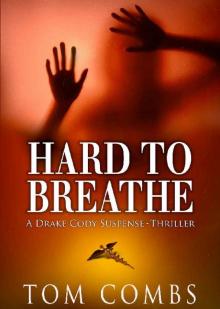
Hard To Breathe, page 18
part #2 of Drake Cody Series


“I can block the trucks with the van.” Vang nodded toward the lot's entrance. “They don’t get out until you say.”
Rizz looked at the man anew. There was some gray in his hair and deep lines around his eyes—he was older than Rizz had initially thought.
Few remembered that the Hmong people had earned their entry to the U.S. through their fierce fighting in support of Americans in the jungles ofSoutheast Asia. Could Vang be old enough to have been one of those fearless allies?
“Thanks, Vang, but no. I don't want you to get in trouble,” Rizz said
“Now you say.” Vang wore an anxious look. “I in much big trouble already. Ten-minute trip to hospital that I never finish. Boss-man be big angry with Vang.” His accent had tripled. He held the scared expression for a moment before his face broke and he laughed.
“I'm bullshitting you.” The accent dropped to a trace. He held up his cell phone, still wearing a grin. “I texted dispatch that I have engine trouble and canceled my next pick-up. No worries.”
“Nice—you had me.” Rizz smiled. Normally he would have laughed but the situation was too grim. His best chance for regaining his life was under threat. “Good stuff, Vang. I love a smart-ass. And thanks for offering to help.”
“You tell me to stop them and I'll make it happen. Whatever it takes.” The lean man spoke matter of factly, without a hint of fear.
“Stay ready, sir.” Rizz met the surprising man's unflinching eyes. “I might need to take you up on your offer to help.”
Five minutes passed and the loading dock door lifted. Two guys stood on the dock, one short and old, the other tall and young, both wearing work pants and heavy coats. The younger guy hopped off the dock and moved to the door of the idling truck.
“Okay, Vang. Pull in the lot and nose me up alongside that truck. And put down the window please.”
Vang pulled the van close alongside. The young guy looked over, then walked to the van's passenger window. Long hair and no hat or gloves. A Minnesota Wild hockey sweatshirt showed beneath his unzipped jacket.
“Can I help you?” he said looking at Vang then focusing on Rizz. His eyes scanned the wheelchair then looked away.
“I'm Dr. Michael Rizzini. My laboratory is on the second floor,” Rizz said. He spied cages on a cart just inside the loading dock. “Those cages are my property. What the hell are you doing?”
The guy made a face and shrugged. “We were told to pick up these animals and the other stuff and transport it. Just a minute.” He turned toward the older guy on the dock and yelled, “This guy is a doctor. He says these cages and cats are theirs. You sure you got this right?”
“The university guy upstairs pointed these out. Said he was a lawyer and he seemed sure,” the older guy yelled back.
“Go get him, will ya?” the younger man hollered. “This is messed up.” The kid turned back to Rizz. He shrugged again. “We're getting the guy.”
“You have animals in the kennels?”
“Well, yeah. There's five cats. We're supposed to bring them and the other gear over to the St. Paul campus. There's another crew coming for some of the other stuff. The lawyer-guy said it's all going.”
“Vang, do me a favor. Hop up on the dock and see if there's a little black-and-white cat in one of those cages.”
Vang climbed out of the van and mounted the steps to the dock. He glanced in, then raised a hand with a thumb up.
“Buddy,” Rizz said to the kid, “those are all my cats, but the black-and-white one is my pet.” He raised his voice. “Vang, please bring the cage with the black-and-white cat to the van.” Hell, if he'd let the bastards take Flo-Jo.
The young guy shook his head. “Gee, I don't know—”
“Believe me,” said Rizz. “I do know.”
Vang slid the cage on the floor behind Rizz.
“Hey, what are you doing?” A tall, heavy-set guy in black-framed glasses and a corduroy sport-coat with elbow patches hollered from the loading dock.
Before Rizz could respond, a red Escalade bucked through the driveway and pulled to a sliding stop alongside the van. Lloyd hopped out of the driver side door, coatless in a jet-black suit with a flame-orange tie.
He took a look, then addressed the elbow-patched dude.
“Any effort to remove items from this facility constitutes robbery and intellectual property theft, and in addition may be prosecutable as corporate espionage.”
He raised his smart-phone camera and panned the area. “Please identify yourself, sir. Do you have any documents supporting your seizure of my clients' property? If you remove anything, I will call the police.”
The guy reached into his pocket and pulled out an envelope. “I have here the deed, the rental agreement, a copy documenting the status of the renters as part of a university medical training program, and the intellectual property waiver that applies. I have an order of seizure signed by the Dean of the Medical School, the university president, and the chief university counsel. We are entirely within our rights to remove university property and materials of research performed by university-affiliated persons.” He paused looking smug. “I'm attorney Afton P. Tait, and I'm overseeing this lawful transfer of university holdings. Call the police if you must, but it will accomplish nothing.”
“Your assertions are categorically errant, although we will not resolve that in this parking lot. Let me consult with my client.” Lloyd moved to the side door of the van then leaned his head in.
“Rizz, I'm afraid getting the police involved right now may hurt our cause. We may look better if we play victim.”
“Okay. No cops, but you need to get a few things. He handed Lloyd the list he'd written in the minutes while waiting. “Lloyd, this is Vang.” Rizz nodded to the driver. “He's willing to help. Take him with you and get everything on this list.”
Lloyd scanned the list then frowned. “This looks like junk.”
“Just do it, Lloyd.” Stay calm, Rizz. Do not flip out.
“Come on, Rizz.” Lloyd read from the list, “Bottle of Wild Turkey, iPad player, two plastic drums, one with wood chips, and one with cat food—”
Rizz's patience disappeared. He clamped a hand on Lloyd's forearm hard enough to draw a surprised look. He snatched the list and pushed it again to Lloyd's chest.
“I'm not asking your opinion, Lloyd. I don't have time to explain. Do whatever you need to, but get this stuff.”
Chapter 40
The fluorescent orange Humvee with its “IC-DEAD” custom plates sat idling in the “Police Only” zone under the ER canopy. As Drake climbed out of the ER wheelchair and approached the vehicle, he heard the driving beat of Tom Petty's “Won't Back Down” throbbing at high volume from within the vehicle.
As Drake passed near the front bumper, the horn sounded, causing him to flinch. Medical examiner Kip Dronen’s wild hair and wireless glasses tipped back as the man behind the wheel laughed like a junior high smart ass. Drake shook his head. Referring to forensic pathologist Kip Dronen as eccentric was like saying Genghis Khan was assertive.
The forever “assistant chief” medical examiner and national authority on death was one of the very few people that Drake could come up with to call for a ride.
During his last several hours in the ER, Drake had maintained good vitals as his swelling and other signs of anaphylaxis abated. Laura had removed the breathing tube an hour earlier. Drake's throat hurt and his voice rasped, but his airway remained open. Care for anaphylaxis would typically include admission or at least observation for a longer time, as Drake’s traumatic intubation could cause swelling of the vocal cords later. Laura recommended admission, but Drake refused. She protested, but Drake could tell she understood. He could take care of himself.
They provided him an epinephrine injection kit to replace his old ampule and hypodermic. He promised to seek help immediately if he had any recurrent symptoms.
“Don't let the epi freeze, and try to avoid the need to intubate yourself again—okay?” She'd winked.
Drake had called the morgue and been connected with Kip.
“Shit, ER. Yesterday you're calling me ‘friend,’ and today I'm supposed to drop everything because you need a ride. If I become a ‘good friend,’ would that mean I get to give you money?” Kip spoke in his usual whine, but Drake was learning half of it was an act.
“I'm imposing on you again, Kip. If you pick me up, you’d be really helping me out. You're a good man.”
Those words had briefly left the pathologist speechless.
Drake opened the illegally parked, gaudy vehicle's door. Kip turned down the tunes.
“Shit, ER, get your ass in here and close that door. It's effing freezing.”
Drake did so, though he was not moving like his usual self.
Kip glanced at him, then did a double-take. “Hell, man. You said you needed a ride—it looks like you need an ambulance. What happened to you?”
“Anaphylactic shock.” His tongue still felt thick and the words came out a bit slurred.
“When?”
“This morning.”
“Wow! The only time I've seen a face like yours is at autopsy. Post-edema dermal redundancy. It's a good look—if you're a Shar-Pei.” His teen-girl shrill laugh grated. “And your voice sounds like you’ve been gargling broken glass.”
Drake felt his face. The swelling had receded, and his skin felt slack and loose.
“Yeah. I'm glad I'm okay, too.”
“Oh, flog me.” Kip clutched his hands to his chest. “Another violation of ER guy and Oprah's touchy-feely laws.” He held his wrists extended. “Call the sensitivity police. Cuff me. I confess.” He dropped his hands, then frowned. “On second thought, how about just getting over yourself?” He shrugged. “You're alive.”
Drake's laugh sprang so fast he startled himself. He'd been playing the tiny violin of self-pity. Anyone other than Kip would have been cooing in sympathy.
Kip had slashed through Drake's whining. Was there anyone else on the planet who would respond like Kip?
Kip looked surprised at Drake's reaction, then smiled.
“That's it, ER. You can't go getting all pissy about a little thing like nearly dying. Shit, we're all drunks on a greasy tightrope in a killer wind. None of us get out of here alive.”
Drake laughed even harder despite the pain in his throat. How bent had he become? Kip Dronen, possibly the most inappropriate and cynical guy ever—a laugh riot.
Drake fought to stifle his mirth. Am I high?
He regained control.
Kip asked for the details of Drake's anaphylactic shock. Drake recounted the morning's events from the time he'd climbed into his frozen car until he was in the back of the ambulance.
“Very cool.” Kip sounded envious.
Drake shook his head. Throat raw, face deformed, overall weak, and the memory of the endless, indescribably horrific inability to breathe—at one point he'd been certain he would die. Nothing about it seemed cool.
A hand shook his shoulder. “Hello, earth to ER guy. Hello?”
“Huh? What?”
“Damn, you were gone there for a bit.” Kip sighed. “I think your near-death trick left you a bit cloudy.”
Drake thought of his laugh attack. And he did feel scattered. Maybe the antihistamines or the steroids? Hell, he’d been in shock. He had good reason to be foggy.
“You're right. I'm a bit slow right now. What did I miss?”
“I asked what you reacted to. What triggered the anaphylaxis?”
“I have no idea. In the past I almost died after exposure to penicillin. Today is a mystery.”
“Not good. Maybe you developed an allergy to something in the ER?”
“Probably, but strange that I didn't develop symptoms until I was on my way to the lab.”
Kip remained silent.
“They brought my car back to my lot. Can you drop me there?”
“Has anybody checked your car?”
“Security retrieved it. No mention of troubles.”
Kip blew out a big breath, then stared at Drake.
“Damn, dude, who are you and what did you do with that reasonably bright ER guy, Drake Cody?” He shook his head.
“Huh?” Drake's thoughts were still sluggish.
“Shit, man. Lucky for you, your special, bestest friend ever is on the scene. You're not firing on all cylinders. Which lot is your car in?”
“Chicago Avenue. Assigned parking.” As he answered he recognized two things.
He’d been subjected to shock and low oxygen and received antihistamines and high-dose steroids. The after-effects had left him spacey and giddy.
The second realization—his car.
Kip's thoughts had been ahead of Drake's.
He might owe the social misfit and brilliant pathologist for much more than just a ride.
Chapter 41
Town house, late afternoon
Rachelle pushed down and twisted the child-proof cap.
The kids were downstairs watching a Disney video. The outer doors were bolted and the alarm system on. The middle of the afternoon—all secure. Except nothing was.
Dr. Laura had said Drake's allergic reaction was serious. Rachelle knew what emergency doctors considered serious. It meant Drake had almost died. Somehow she hadn't fallen apart. She'd responded well—at first. But as the minutes and hours passed, her fear grew.
Yesterday she'd been worried about Drake losing the job that meant so much to him. Today brought the threat of him dying. Earlier, if not for the kids, she could have become hysterical.
Now it seemed Drake was doing better. She'd called the ER five minutes ago and Dr. Laura said she was surprised how quickly he was improving. Rachelle could tell he'd been bad. Even Dr. Laura said it had been a scary thing. The doctors that worked with Drake did not scare easily.
Rachelle hugged herself tight. I do.
She rolled one of the shiny red capsules around the palm of her hand. She could already imagine the drug slipping her into a warm bath of chemical numbness. A place where her head did not writhe with worry and the relentless images of past and possible nightmares were temporarily hidden in fog.
She’d first felt the escape chemicals offered as a child, starting in the hospital with the medications prescribed by doctors trying to help her deal with the physical and emotional trauma she’d suffered.
Medications had been a big part of her childhood and teen years. Concern had developed about her use of some meds. When she was thirteen years old, one doctor had said, “The drugs we give to help can also harm.” She’d gone on to share, “Too much use causes dependence and stops people’s emotional growth.”
It became more and more important to Rachelle to have the medications. By her fifteenth birthday, her caregivers had recognized that dependence for her was more than a possibility. After meetings, counseling, and finally threats, the medical people had cut her off from the escape she craved.
After that, she used marijuana and street drugs every day for over three years while still working to scam prescriptions. A chance meeting leading to her first job—as a personal health caretaker for a patient with Down’s syndrome—had ended her use of street drugs.
She still used prescription medications, but only occasionally and guiltily so. She knew that, for her, they were unhealthy. The doctors had warned her that the sedative medications she’d become dependent on did not cure anything. They only treated symptoms. Other than when she experienced a full-blown panic attack, they were an escape—a way to avoid her issues. They didn’t help. The drugs prevented her from getting stronger and, when they wore off, they left her more messed up than before.
But sometimes, in the moment, the urge for escape could be overwhelming. Like now, when it felt as if worry and dread were holding her under water, drowning her. She needed air. Her nerves were a rubber band twisted to near the breaking point. God, I am such a mess.
The label of her only remaining prescription read, “Take one capsule each 6 hours as needed for anxiety/panic.” Wouldn't anyone in her spot feel anxious? Her husband recovering from a near-fatal reaction and all the other issues they faced.
Wouldn't that be enough to justify anxiety even without the horrors of her recent and distant past?
This bottle had lasted much longer than those in the past. For the first weeks after the kidnapping, she'd been in the hospital dealing with her burns and skin grafts. She'd done well. Then they'd found Kaye. She'd stayed with them whenever Drake was gone—which was almost always.
The kids loved her. She laughed at things that would have had Rachelle hyperventilating. Kaye's competence and spare-the-drama attitude had been a gift—for Rachelle most of all.
Four days earlier, Kaye had been called out-of-state to care for a sick relative. Rachelle missed her.
Why can’t I face things on my own?
In the last few days, her worries had grown. Despite recognizing much of what she faced was bad luck and misfortune, she felt she'd somehow brought it on herself. Karma? Did she deserve to suffer?
She'd done terrible things. And the way she'd manipulated Drake was the most calculated and deceitful of all.
Her husband, the father of their children—the best thing in her life—and their relationship was borne of a lie.
Her guilt, Drake's record, the threat to his career, his near-death reaction, their still-recovering kids, her egg-shell fragile emotions—the escape the medication offered called out to her. But she reminded herself it was not a true escape. It only allowed her to hide for a while with the fears returning, even more debilitating.
She had lots of experience playing the excuse game—her childhood, the recent traumatic events, her diagnoses of PTSD and anxiety, her virtual single parenthood, and more. She'd shared some of her litany with Kaye one day. The older woman had given her a quick hug. “Look at what you have—wonderful children and a good man. Focus on the good, honey. Keep busy and try not to worry so much.”
Rachelle and Drake had not discussed any further what they'd shared after Faith's murder and the kidnapping. Maybe it was best he didn’t know more. Things had been good between them. It seemed that for both of them the intimacy and release of lovemaking communicated something beyond what they could share otherwise.
Rizz looked at the man anew. There was some gray in his hair and deep lines around his eyes—he was older than Rizz had initially thought.
Few remembered that the Hmong people had earned their entry to the U.S. through their fierce fighting in support of Americans in the jungles ofSoutheast Asia. Could Vang be old enough to have been one of those fearless allies?
“Thanks, Vang, but no. I don't want you to get in trouble,” Rizz said
“Now you say.” Vang wore an anxious look. “I in much big trouble already. Ten-minute trip to hospital that I never finish. Boss-man be big angry with Vang.” His accent had tripled. He held the scared expression for a moment before his face broke and he laughed.
“I'm bullshitting you.” The accent dropped to a trace. He held up his cell phone, still wearing a grin. “I texted dispatch that I have engine trouble and canceled my next pick-up. No worries.”
“Nice—you had me.” Rizz smiled. Normally he would have laughed but the situation was too grim. His best chance for regaining his life was under threat. “Good stuff, Vang. I love a smart-ass. And thanks for offering to help.”
“You tell me to stop them and I'll make it happen. Whatever it takes.” The lean man spoke matter of factly, without a hint of fear.
“Stay ready, sir.” Rizz met the surprising man's unflinching eyes. “I might need to take you up on your offer to help.”
Five minutes passed and the loading dock door lifted. Two guys stood on the dock, one short and old, the other tall and young, both wearing work pants and heavy coats. The younger guy hopped off the dock and moved to the door of the idling truck.
“Okay, Vang. Pull in the lot and nose me up alongside that truck. And put down the window please.”
Vang pulled the van close alongside. The young guy looked over, then walked to the van's passenger window. Long hair and no hat or gloves. A Minnesota Wild hockey sweatshirt showed beneath his unzipped jacket.
“Can I help you?” he said looking at Vang then focusing on Rizz. His eyes scanned the wheelchair then looked away.
“I'm Dr. Michael Rizzini. My laboratory is on the second floor,” Rizz said. He spied cages on a cart just inside the loading dock. “Those cages are my property. What the hell are you doing?”
The guy made a face and shrugged. “We were told to pick up these animals and the other stuff and transport it. Just a minute.” He turned toward the older guy on the dock and yelled, “This guy is a doctor. He says these cages and cats are theirs. You sure you got this right?”
“The university guy upstairs pointed these out. Said he was a lawyer and he seemed sure,” the older guy yelled back.
“Go get him, will ya?” the younger man hollered. “This is messed up.” The kid turned back to Rizz. He shrugged again. “We're getting the guy.”
“You have animals in the kennels?”
“Well, yeah. There's five cats. We're supposed to bring them and the other gear over to the St. Paul campus. There's another crew coming for some of the other stuff. The lawyer-guy said it's all going.”
“Vang, do me a favor. Hop up on the dock and see if there's a little black-and-white cat in one of those cages.”
Vang climbed out of the van and mounted the steps to the dock. He glanced in, then raised a hand with a thumb up.
“Buddy,” Rizz said to the kid, “those are all my cats, but the black-and-white one is my pet.” He raised his voice. “Vang, please bring the cage with the black-and-white cat to the van.” Hell, if he'd let the bastards take Flo-Jo.
The young guy shook his head. “Gee, I don't know—”
“Believe me,” said Rizz. “I do know.”
Vang slid the cage on the floor behind Rizz.
“Hey, what are you doing?” A tall, heavy-set guy in black-framed glasses and a corduroy sport-coat with elbow patches hollered from the loading dock.
Before Rizz could respond, a red Escalade bucked through the driveway and pulled to a sliding stop alongside the van. Lloyd hopped out of the driver side door, coatless in a jet-black suit with a flame-orange tie.
He took a look, then addressed the elbow-patched dude.
“Any effort to remove items from this facility constitutes robbery and intellectual property theft, and in addition may be prosecutable as corporate espionage.”
He raised his smart-phone camera and panned the area. “Please identify yourself, sir. Do you have any documents supporting your seizure of my clients' property? If you remove anything, I will call the police.”
The guy reached into his pocket and pulled out an envelope. “I have here the deed, the rental agreement, a copy documenting the status of the renters as part of a university medical training program, and the intellectual property waiver that applies. I have an order of seizure signed by the Dean of the Medical School, the university president, and the chief university counsel. We are entirely within our rights to remove university property and materials of research performed by university-affiliated persons.” He paused looking smug. “I'm attorney Afton P. Tait, and I'm overseeing this lawful transfer of university holdings. Call the police if you must, but it will accomplish nothing.”
“Your assertions are categorically errant, although we will not resolve that in this parking lot. Let me consult with my client.” Lloyd moved to the side door of the van then leaned his head in.
“Rizz, I'm afraid getting the police involved right now may hurt our cause. We may look better if we play victim.”
“Okay. No cops, but you need to get a few things. He handed Lloyd the list he'd written in the minutes while waiting. “Lloyd, this is Vang.” Rizz nodded to the driver. “He's willing to help. Take him with you and get everything on this list.”
Lloyd scanned the list then frowned. “This looks like junk.”
“Just do it, Lloyd.” Stay calm, Rizz. Do not flip out.
“Come on, Rizz.” Lloyd read from the list, “Bottle of Wild Turkey, iPad player, two plastic drums, one with wood chips, and one with cat food—”
Rizz's patience disappeared. He clamped a hand on Lloyd's forearm hard enough to draw a surprised look. He snatched the list and pushed it again to Lloyd's chest.
“I'm not asking your opinion, Lloyd. I don't have time to explain. Do whatever you need to, but get this stuff.”
Chapter 40
The fluorescent orange Humvee with its “IC-DEAD” custom plates sat idling in the “Police Only” zone under the ER canopy. As Drake climbed out of the ER wheelchair and approached the vehicle, he heard the driving beat of Tom Petty's “Won't Back Down” throbbing at high volume from within the vehicle.
As Drake passed near the front bumper, the horn sounded, causing him to flinch. Medical examiner Kip Dronen’s wild hair and wireless glasses tipped back as the man behind the wheel laughed like a junior high smart ass. Drake shook his head. Referring to forensic pathologist Kip Dronen as eccentric was like saying Genghis Khan was assertive.
The forever “assistant chief” medical examiner and national authority on death was one of the very few people that Drake could come up with to call for a ride.
During his last several hours in the ER, Drake had maintained good vitals as his swelling and other signs of anaphylaxis abated. Laura had removed the breathing tube an hour earlier. Drake's throat hurt and his voice rasped, but his airway remained open. Care for anaphylaxis would typically include admission or at least observation for a longer time, as Drake’s traumatic intubation could cause swelling of the vocal cords later. Laura recommended admission, but Drake refused. She protested, but Drake could tell she understood. He could take care of himself.
They provided him an epinephrine injection kit to replace his old ampule and hypodermic. He promised to seek help immediately if he had any recurrent symptoms.
“Don't let the epi freeze, and try to avoid the need to intubate yourself again—okay?” She'd winked.
Drake had called the morgue and been connected with Kip.
“Shit, ER. Yesterday you're calling me ‘friend,’ and today I'm supposed to drop everything because you need a ride. If I become a ‘good friend,’ would that mean I get to give you money?” Kip spoke in his usual whine, but Drake was learning half of it was an act.
“I'm imposing on you again, Kip. If you pick me up, you’d be really helping me out. You're a good man.”
Those words had briefly left the pathologist speechless.
Drake opened the illegally parked, gaudy vehicle's door. Kip turned down the tunes.
“Shit, ER, get your ass in here and close that door. It's effing freezing.”
Drake did so, though he was not moving like his usual self.
Kip glanced at him, then did a double-take. “Hell, man. You said you needed a ride—it looks like you need an ambulance. What happened to you?”
“Anaphylactic shock.” His tongue still felt thick and the words came out a bit slurred.
“When?”
“This morning.”
“Wow! The only time I've seen a face like yours is at autopsy. Post-edema dermal redundancy. It's a good look—if you're a Shar-Pei.” His teen-girl shrill laugh grated. “And your voice sounds like you’ve been gargling broken glass.”
Drake felt his face. The swelling had receded, and his skin felt slack and loose.
“Yeah. I'm glad I'm okay, too.”
“Oh, flog me.” Kip clutched his hands to his chest. “Another violation of ER guy and Oprah's touchy-feely laws.” He held his wrists extended. “Call the sensitivity police. Cuff me. I confess.” He dropped his hands, then frowned. “On second thought, how about just getting over yourself?” He shrugged. “You're alive.”
Drake's laugh sprang so fast he startled himself. He'd been playing the tiny violin of self-pity. Anyone other than Kip would have been cooing in sympathy.
Kip had slashed through Drake's whining. Was there anyone else on the planet who would respond like Kip?
Kip looked surprised at Drake's reaction, then smiled.
“That's it, ER. You can't go getting all pissy about a little thing like nearly dying. Shit, we're all drunks on a greasy tightrope in a killer wind. None of us get out of here alive.”
Drake laughed even harder despite the pain in his throat. How bent had he become? Kip Dronen, possibly the most inappropriate and cynical guy ever—a laugh riot.
Drake fought to stifle his mirth. Am I high?
He regained control.
Kip asked for the details of Drake's anaphylactic shock. Drake recounted the morning's events from the time he'd climbed into his frozen car until he was in the back of the ambulance.
“Very cool.” Kip sounded envious.
Drake shook his head. Throat raw, face deformed, overall weak, and the memory of the endless, indescribably horrific inability to breathe—at one point he'd been certain he would die. Nothing about it seemed cool.
A hand shook his shoulder. “Hello, earth to ER guy. Hello?”
“Huh? What?”
“Damn, you were gone there for a bit.” Kip sighed. “I think your near-death trick left you a bit cloudy.”
Drake thought of his laugh attack. And he did feel scattered. Maybe the antihistamines or the steroids? Hell, he’d been in shock. He had good reason to be foggy.
“You're right. I'm a bit slow right now. What did I miss?”
“I asked what you reacted to. What triggered the anaphylaxis?”
“I have no idea. In the past I almost died after exposure to penicillin. Today is a mystery.”
“Not good. Maybe you developed an allergy to something in the ER?”
“Probably, but strange that I didn't develop symptoms until I was on my way to the lab.”
Kip remained silent.
“They brought my car back to my lot. Can you drop me there?”
“Has anybody checked your car?”
“Security retrieved it. No mention of troubles.”
Kip blew out a big breath, then stared at Drake.
“Damn, dude, who are you and what did you do with that reasonably bright ER guy, Drake Cody?” He shook his head.
“Huh?” Drake's thoughts were still sluggish.
“Shit, man. Lucky for you, your special, bestest friend ever is on the scene. You're not firing on all cylinders. Which lot is your car in?”
“Chicago Avenue. Assigned parking.” As he answered he recognized two things.
He’d been subjected to shock and low oxygen and received antihistamines and high-dose steroids. The after-effects had left him spacey and giddy.
The second realization—his car.
Kip's thoughts had been ahead of Drake's.
He might owe the social misfit and brilliant pathologist for much more than just a ride.
Chapter 41
Town house, late afternoon
Rachelle pushed down and twisted the child-proof cap.
The kids were downstairs watching a Disney video. The outer doors were bolted and the alarm system on. The middle of the afternoon—all secure. Except nothing was.
Dr. Laura had said Drake's allergic reaction was serious. Rachelle knew what emergency doctors considered serious. It meant Drake had almost died. Somehow she hadn't fallen apart. She'd responded well—at first. But as the minutes and hours passed, her fear grew.
Yesterday she'd been worried about Drake losing the job that meant so much to him. Today brought the threat of him dying. Earlier, if not for the kids, she could have become hysterical.
Now it seemed Drake was doing better. She'd called the ER five minutes ago and Dr. Laura said she was surprised how quickly he was improving. Rachelle could tell he'd been bad. Even Dr. Laura said it had been a scary thing. The doctors that worked with Drake did not scare easily.
Rachelle hugged herself tight. I do.
She rolled one of the shiny red capsules around the palm of her hand. She could already imagine the drug slipping her into a warm bath of chemical numbness. A place where her head did not writhe with worry and the relentless images of past and possible nightmares were temporarily hidden in fog.
She’d first felt the escape chemicals offered as a child, starting in the hospital with the medications prescribed by doctors trying to help her deal with the physical and emotional trauma she’d suffered.
Medications had been a big part of her childhood and teen years. Concern had developed about her use of some meds. When she was thirteen years old, one doctor had said, “The drugs we give to help can also harm.” She’d gone on to share, “Too much use causes dependence and stops people’s emotional growth.”
It became more and more important to Rachelle to have the medications. By her fifteenth birthday, her caregivers had recognized that dependence for her was more than a possibility. After meetings, counseling, and finally threats, the medical people had cut her off from the escape she craved.
After that, she used marijuana and street drugs every day for over three years while still working to scam prescriptions. A chance meeting leading to her first job—as a personal health caretaker for a patient with Down’s syndrome—had ended her use of street drugs.
She still used prescription medications, but only occasionally and guiltily so. She knew that, for her, they were unhealthy. The doctors had warned her that the sedative medications she’d become dependent on did not cure anything. They only treated symptoms. Other than when she experienced a full-blown panic attack, they were an escape—a way to avoid her issues. They didn’t help. The drugs prevented her from getting stronger and, when they wore off, they left her more messed up than before.
But sometimes, in the moment, the urge for escape could be overwhelming. Like now, when it felt as if worry and dread were holding her under water, drowning her. She needed air. Her nerves were a rubber band twisted to near the breaking point. God, I am such a mess.
The label of her only remaining prescription read, “Take one capsule each 6 hours as needed for anxiety/panic.” Wouldn't anyone in her spot feel anxious? Her husband recovering from a near-fatal reaction and all the other issues they faced.
Wouldn't that be enough to justify anxiety even without the horrors of her recent and distant past?
This bottle had lasted much longer than those in the past. For the first weeks after the kidnapping, she'd been in the hospital dealing with her burns and skin grafts. She'd done well. Then they'd found Kaye. She'd stayed with them whenever Drake was gone—which was almost always.
The kids loved her. She laughed at things that would have had Rachelle hyperventilating. Kaye's competence and spare-the-drama attitude had been a gift—for Rachelle most of all.
Four days earlier, Kaye had been called out-of-state to care for a sick relative. Rachelle missed her.
Why can’t I face things on my own?
In the last few days, her worries had grown. Despite recognizing much of what she faced was bad luck and misfortune, she felt she'd somehow brought it on herself. Karma? Did she deserve to suffer?
She'd done terrible things. And the way she'd manipulated Drake was the most calculated and deceitful of all.
Her husband, the father of their children—the best thing in her life—and their relationship was borne of a lie.
Her guilt, Drake's record, the threat to his career, his near-death reaction, their still-recovering kids, her egg-shell fragile emotions—the escape the medication offered called out to her. But she reminded herself it was not a true escape. It only allowed her to hide for a while with the fears returning, even more debilitating.
She had lots of experience playing the excuse game—her childhood, the recent traumatic events, her diagnoses of PTSD and anxiety, her virtual single parenthood, and more. She'd shared some of her litany with Kaye one day. The older woman had given her a quick hug. “Look at what you have—wonderful children and a good man. Focus on the good, honey. Keep busy and try not to worry so much.”
Rachelle and Drake had not discussed any further what they'd shared after Faith's murder and the kidnapping. Maybe it was best he didn’t know more. Things had been good between them. It seemed that for both of them the intimacy and release of lovemaking communicated something beyond what they could share otherwise.