

The Steam Walker (Steam World Book 1), page 1


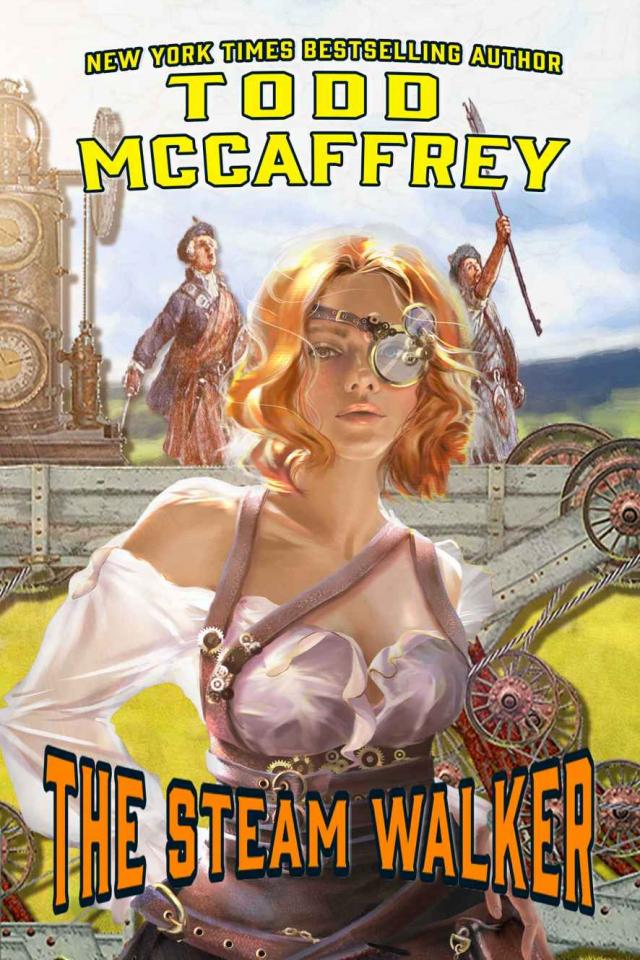
The Steam Walker
Todd J. McCaffrey
A Foxxe Frey Book
THE STEAM WALKER
Copyright © 2019 Todd J. McCaffrey
All rights reserved. No part of this book may be reproduced or transmitted in any form or by any electronic or mechanical means, including photocopying, recording or by any information storage and retrieval system, without the express written permission of the copyright holder, except where permitted by law. This novel is a work of fiction. Names, characters, places and incidents are either the product of the author’s imagination, or, if real, used fictitiously.
Synopsis: A young girl changes the course of history.
“Steampunk Girl” artwork Copyright © 2019 Olga A. Panfilova
Steamwalker artwork Copyright © 2019 Jeff Winner
Cover Layout: Todd McCaffrey
Books by Todd McCaffrey
Science fiction
Ellay
The Jupiter Game
Collections
The One Tree of Luna (And Other Stories)
Dragonriders of Pern® Series
Dragon’s Kin
Dragon’s Fire
Dragon Harper
Dragonsblood
Dragonheart
Dragongirl
Dragon’s Time
Sky Dragons
Non-fiction
Dragonholder: The Life And Times (so far) of Anne McCaffrey
Dragonwriter: A tribute to Anne McCaffrey and Pern
Books by The Winner Twins and Todd McCaffrey
Nonfiction:
The Write Path: World Building
Books by McCaffrey-Winner
Twin Soul Series:
Winter Wyvern
Cloud Conqueror
Frozen Sky
Wyvern’s Fate
Wyvern’s Wrath
Ophidian’s Oath
Snow Serpent
Iron Air
Ophidian’s Honor
To see the full list, scan the QR Code below!
Dedication
For the faculty and staff, past, present, and future of the
College of Technology, Bolton Street,
Dublin, Ireland
Contents
Chapter One 9
Chapter Two 23
Chapter Three 29
Chapter Four 38
Chapter Five 45
Chapter Six 60
Chapter Seven 78
Chapter Eight 92
Chapter Nine 105
Chapter Ten 113
Chapter Eleven 125
Chapter Twelve 151
Chapter Thirteen 171
Chapter Fourteen 194
Chapter Fifteen 207
Chapter Sixteen 217
Chapter Seventeen 231
About the Author 235
Chapter One
It was a dark and grey day, cold with the first of what promised to be a bitter spring, just a fortnight after the New Year. It was the 14th day of January, in the year of Our Lord 1745.
“Bessie,” I nudged the girl in bed beside me. “Bessie, get up! The cock didn’t crow!”
Bessie mumbled and tried to move away from me. I shoved her. “Bessie, get up now! Father will be wanting his tea.”
Behind me Jamie rumbled in his sleep and I elbowed him in the ribs.
I pushed Bessie out of the bed, following her into the cold morning air, my breath misting as I said, “You get the fires and the candles, I’ll see to the forge.”
“But —“ Bessie protested, even as she pulled on her dress and apron.
“Go!” There was no time for subterfuge, father would be waking soon and if there wasn’t something warm in front of him and a hot forge afterwards, there’d be sore backsides for certain.
Bessie ducked her head in submission and took off down the narrow staircase to the kitchen to start the fire and put on the kettle.
In the distance I could hear the horses in the far fields neighing and whinnying to each other. Belatedly one of the dratted cocks crowed with a desultory, almost abashed noise.
“Foul rooster!” I muttered to myself as I turned to the back door and rushed across the yard to the forge, thinking that that particular bird was soon for the pot. Probably, I thought, it’d turn out gamey.
I was delighted to see a burst of flame in front of me.
“We just put the coals on now Bess —“ a young boy’s voice piped up only to cut short as the child was elbowed into silence by another hissing, “That’s not Bessie!”
“No, it isn’t,” I said, “now get going.” I moved away from the voices even as the urchins scattered and closer to the forge. Looking at it, I decided that they’d done a good job getting the fire going again. I glanced at the pile of coal I’d left for feed and saw that they’d been good — they hadn’t pilfered any or used it up during the night.
“That was a girl!” a boy’s voice hissed loudly under the archway as the urchins scarpered. That remark was answered by muffled guffaws from the others.
My secret was safe, I could tell. Not that anyone would ever listen to a homeless orphan nor would any orphan be foolish enough to speak where the wrong ears might hear. Still — it wouldn’t be out of place reminding Bessie that her “boyfriends” — I always said it to see her blush — had best keep their mouths shut if they wanted to stay warm this winter.
And it looked to be a bitter, cold winter. Maybe every bit as bad as the year before, when I’d found little Bessie, cold, feverish and near death’s door, shivering and tucked as close as she could get to the warmth of our forge.
It had taken more work on father than on the child to get him to agree to take her on as a chambermaid.
“Taking on airs, are we?” he’d taunted. “Hoping to be a great lady, our Danni coal-face?”
I’d let him rant and tease as much as he wanted just to be certain that he agreed to keep her.
“She’s to pull her weight,” he’d said finally. “No shirking her duties —“ he’d wagged a finger at me warningly “— or taking airs —“ he’d said that to see me blush again “— she’s to work hard, like she was a proper Scotswoman and not one of those English toffs.”
“Yes, father,” I’d said. “I’ll beat her daily, if it’ll help.”
He scowled at me. My father had sworn nearly every day to beat either me or Jamie — and while he’d done it more than once it’d never been without more than good reason.
“Just don’t go making her bottom as red as your hair or we’ll get no work out of her at all,” he’d said finally, teasing me once more for my hair. His was black, just like Jamie’s — blast them both.
So we kept Bessie. And I did beat her, hard when she wouldn’t let me cut her hair to rid her of the lice, and again when she’d refused her first bath — “I’ll die, miss, I’ll die in the cold!”
She didn’t die in the cold, her hair was growing back — as was mine, casualty to the same foul lice — and she kept my front warm as Jamie kept my back from freezing. I did have airs; I hoped to set her up as a proper maid, in a big house with a good mistress and stern master and a life without freezing at night or crying from an empty belly in the day.
It was all part of my plans for the future.
I suppose it was fitting justice that none of them turned out right. What gall has a fourteen year-old girl, red-haired and Scottish, to think that she can plan her future in the Year of Our Lord, 1745?
#
“She’s a wicked one, you can tell from the hair!” they’d say when they thought I didn’t hear. Often as not, though, another would mutter in my defense:
“Ach, it’s no more than most have, and the lass has no mother, not since her wee brother came into the world!”
“She has no breeding, her father’s a smith, what more can you expect?”
“She’ll end up in someone’s bed before too long!”
“Her? She’s too scrawny! No, it’s the poorhouse for her, you can be certain of that. Her father’s not long for this world and then it’ll be all over. She’s no proper respect for the Lord, so I’ve been told.”
The old wags and witches of the Grassmarket had been discussing my fate since I was ten and taken on by Mr. Pugh.
“And he’s mad, just mad to have her in his shop!”
“Aye, but he’s the best watchmaker in all Edinburgh, that’s got to count for something.”
“If he weren’t you could be certain the Deacon would be saying something.”
After that pronouncement there was a lengthy silence. It wasn’t all that long ago that a lad just eighteen had been hanged for heresy simply on an idle jest that he’d prefer the fires of Hell to the cold of Edinburgh. People still talked of it, shaking their heads.
#
This day, I’d taken precautions against their mutterings. And so now, instead they said: “Oh, look! It’s young master Jamie!”
I hurried on, pulling my hat tightly over my head, striding boldly in trousers that Jamie had just outgrown.
“Jamie, how are you this morning?” someone called after me. I lowered my head, raised an arm in a wave, and hurried on, looking as busy as any apprentice.
I was bound for the university and no one knew about it. Edinburgh University wasn’t so much a place as a group of buildings with students of various talents and degrees of sobriety. Some were the second sons of lairds destined either for the clergy or the military; some were bright lads of rich shopkeepers.
I was neither but today I did my best to look the part. I had a satchel over one shoulder with a sketchpad and some nice charcoals, freshly made — a sideline I’d convinced father to take on two years back when I’d needed the materials myself. It didn’t make us much money but it set us apart from other smiths in the town and our clientele improved, much to the disgust of MacAllister, the nearest smith and father’s greatest rival.
Hamish MacAllister was a devil of a man, all agreed. He worked hard, fought hard, and drank hard. There was nothing enjoyable about him. He did his work, got paid and that was that. He hated my father with a passion, spat at Jamie’s shadow and gazed at me with lidded eyes when he thought I couldn’t see. Just the thought of him made me shiver. Still, he had a good livery, apprentices and all — and was considered by many to be a man of property, more so than my father. His was the first smithy on the way into town; he got a lot of work from those leading in a horse with a thrown shoe.
While our forge was nestled in the shadows of Edinburgh Castle, his was two miles further west in an area that was more outlier than town proper. Two miles is only half an hour on foot for a lazy person and nothing at all on horse, so he and his apprentices were seen a lot in the town, particularly in the bawdier taverns on the nights.
The distance between MacAllister’s forge and Edinburgh University was measured less in miles than in learning. I’d heard from Mr. Pugh that they had just got one of the Newcomen Steam Engines and I was going to draw it.
Mr. Pugh knew and let me; father did not and would have forbidden me had he known. I could imagine him saying, “You’ve enough foolish notions in your head, girl, without adding anymore!”
Mr. Pugh was English, a watchmaker by way of the Germanys or perhaps Holland — his story seemed to change every month. He was old now and didn’t have the hands for the delicate brass castings sometimes needed to replace worn cogs and gears. So he convinced my father to loan me to him — how, I’ll never quite know.
If you’ve ever made a mold, ever etched the light teeth of gears into fine sand, if you’ve ever watched the molten brass or bronze puddle and set into a shape of your own forming, then you understand the magic of casting. I was enraptured the very first time.
From then on, father had added precision casting to his offerings and Walker forge had profited nicely, building tackle, gearings, and other iron castings for the fort and the ships in the harbor at Leith even though we weren’t the nearest smithy by half a dozen.
But the casting of the pieces, the gears, the tackle, all were a special secret to the family. Because however hard father and Jamie tried, they never quite had the same feel for metal as I did.
Father and Jamie could shoe a horse, make swords, cut nails all in half the time I could — but neither could make a better casting, could build a mold, or complete a pour.
“It’s almost as if you’ve got a Faerie gift there, Danni,” Jamie had said one day as he’d watched me pour our largest iron casting.
“Faeries can’t use iron!”
“Then some other gift, from a darker master,” Jamie had said heavily. I’d looked over at him and saw the seriousness in his eyes. He’d looked away, in shame or fear — I don’t know, but still he said, “A girl’s not supposed to know such things.”
But this girl did, and now she was taking herself, dressed as her brother without either his or her father’s knowledge, off to the University to draw the steam engine there. I felt neither ruled by Faerie nor a darker master but rather drawn by the impulse to see more, learn more, know more. I couldn’t see how that was a terrible thing.
#
“Steam engine? Oh, do you mean that thing they’ve got at the docks?” the porter said when I asked him. “It’s on its way to the mines, I’m told.” He gave me a wink as he added, “I hear that some beer was involved in stopping it for a bit.”
“The docks, you say?” I asked, starting off again.
“Ye’d best hurry, if you want to see it!” the porter cried after me.
It was only a half an hour to the docks of Leith, and I was pretty certain that the beer would last that long. As I walked, I thought about how it must work.
The principle of its action dates back to the Magdeburg hemispheres developed in the last century and, even earlier, to the aeolipile described by Hero of Alexandria. The Magdeburg hemispheres were built by Herr Guericke to demonstrate the power of his vacuum pump. The two copper halves were sealed with grease and the pump sucked out the air so well that not even thirty horses could separate them. I’d seen a demonstration at the university and wondered how such strength could be used.
The Englishman Thomas Newcomen adapted steam to produce the steam engine I was going to draw. The steam engine worked by allowing hot steam into a cylinder which pushed a free moving piston upwards. Then cold water was introduced to the cylinder, cooling the steam and causing it to condense. The condensed steam produced a vacuum which caused the air above the piston to push it back down. After that, the cold water and the condensed steam were drained off and the cycle repeated with more live steam. A trained boy, called a plugman, operated the plugs which turned to allow the steam, water, and condensate to enter or leave the cylinder as required. I’d heard it said that a good plugman could get the engine to make twenty cycles a minute but I wasn’t sure I believed it.
The engine was set up so that the piston was connected to a lever and the far side of the lever was connected to a pump as the Newcomen engine was usually used to pump water from coal mines.
I imagined that the up and down motion could be used for other things and, as I trotted on the way to the port, I idly considered some possibilities.
I remembered how, at fair over the summer, my brother had been entranced by a man on stilts. I thought the whole motion rather ungainly but I agreed that being that much taller could provide an advantage.
“It makes you half a giant!” Jamie had exclaimed resentfully. “Why you could walk up to the walls of the castle and over them in one stride!”
Well, really, that was impossible but I could see his point. Later I fashioned a pair of low stilts for him and he spent many hours tramping about our yard. I even managed to coax Bessie into them but she lost her footing and landed rather hard on the ground and we could get her to try them no more.
But with a steam engine, wouldn’t it be possible to lift stilts? I wondered idly. I built this image in my head. Naturally two stilts wouldn’t be enough — four would be needed like the legs of a large steam horse.
A steam horse! The notion stopped me in my tracks. Someone knocked into me and cursed me for stupidity. I numbly apologized even as the idea burst full-blown in my head.
A steam horse. What could it do? Well, to hear tell about the Newcomen engine, it could run nigh on forever, given enough coal. It would never rest.
Make it big enough — and suddenly I recalled the ancient Trojan Horse — and you could scale castle walls.
Make it a wagon, instead or rather a wagon on stilts and you could mount guns and musketeers and it would be unstoppable, being taller than any cavalryman and more powerful.
Suddenly, I had to see that engine!
I started forward again and quickly broke from my steady walk into a long, slow trot.
#
“A steam horse?” Jamie said to me when I showed him my sketches. I had spent all my spare hours from January to August working on the idea — now I was finally ready to show them. He rolled his eyes skyward. “Danni, you’re mad! You’re more of a loon than any loon has a right to be!”
“It wouldn’t be a steam horse,” I said, “it’d be more like a wagon on stilts.”
“A wagon on stilts? And what would be the purpose of that?”
“It could go for as long as it had steam,” I told him. “It would be up high and it could carry heavy loads.”
“So? A wagon does all that already.”


