In the Lives of Puppets, page 1


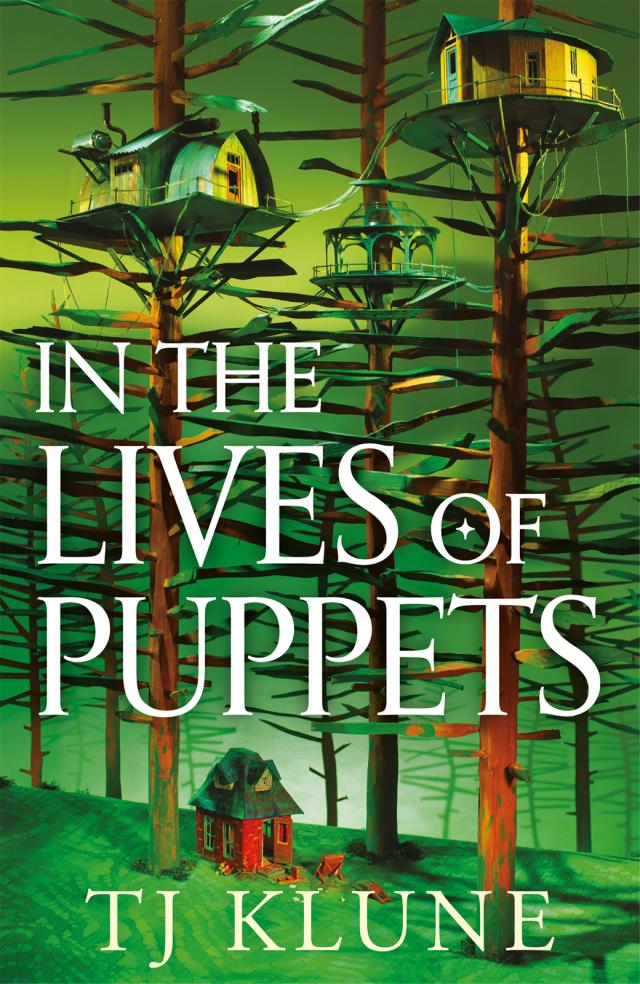
IN THE
LIVES OF
PUPPETS
TJ KLUNE
Contents
In an old . . .
PART 1: THE FOREST
CHAPTER 1
CHAPTER 2
CHAPTER 3
CHAPTER 4
CHAPTER 5
CHAPTER 6
CHAPTER 7
CHAPTER 8
CHAPTER 9
CHAPTER 10
CHAPTER 11
CHAPTER 12
PART 2: THE JOURNEY
CHAPTER 13
CHAPTER 14
CHAPTER 15
CHAPTER 16
CHAPTER 17
PART 3: THE CITY
CHAPTER 18
CHAPTER 19
CHAPTER 20
CHAPTER 21
CHAPTER 22
CHAPTER 23
CHAPTER 24
PART 4: YOU START AGAIN FROM THE BEGINNING
In an old . . .
ACKNOWLEDGMENTS
FOR HUMANITY:
You kinda suck, but you invented books and music, so the universe will probably keep you around for a little bit longer.
You got lucky.
This time.
In an old and lonely forest, far away from almost everything, sat a curious dwelling.
At the base of a grove of massive trees was a small, square building made of brick, overtaken by ivy and moss. Who it belonged to was anyone’s guess, but from the looks of it, it had been abandoned long ago. It wasn’t until a man named Giovanni Lawson (who wasn’t actually a man at all) came across it while making his way through the forest that it was remembered with any purpose.
He stood in front of his strange find, listening as the birds sang in the branches high above. “What’s this?” he asked. “Where did you come from?”
He went inside, passing carefully through the door hanging off its hinges. The windows were shattered. Grass and weeds grew up through the warped wooden floor. The roof had partially collapsed, and the sun shone through on a pile of leaves that almost reached the ceiling. At the top of the leaf pile, a golden flower had bloomed, stretching toward the sunlight streaming through the exposed rafters.
“It’s perfect,” he said aloud, although he was very much alone. “Yes, this will do just fine. How strange. How wonderful.”
Giovanni returned bright and early the next morning, his sleeves pushed up his forearms. He knocked down the walls inside the solitary building to create one large room, carrying plaster and wood out piece by piece and piling them on the forest floor. By the time he finished, his face and hair were coated with dust and his joints creaked and groaned, but he was satisfied. There was merit to hard work.
“There,” he said to the birds in the trees as he wiped his face. “Much better. A first step to a new beginning.”
The little building soon became a home for all manner of things: sheets of metal and lengths of wires and cords, batteries of all shapes and sizes, circuit boards and microchips in glass mason jars. Other jars held hundreds of seeds of various shapes, sizes, and colors. There were old music boxes that sang little songs that ached, and silent record players without any records. Televisions, both great and small, their screens dark. And books! So many books on a variety of topics from plant life to whaling, from animals of the forest to complex diagrams of nuclear cores. They lined the new floor-to-ceiling shelving he’d made from the remains of what he’d torn down. It wasn’t until he placed the last book on the last shelf that he realized he himself had nowhere to stay. The room was too full.
It wouldn’t take much to expand the building, adding a room or two. But Giovanni Lawson wasn’t one to take the easy route. He saw the world in complex shapes and designs, and when he looked up at the trees around him, he knew what he would do.
He wouldn’t build outward.
He’d build upward.
It took time, as these things do. Many years passed. It needed to be perfect. There was safety among the trees and away from the harsh, blinding lights and cacophony of the city he’d left behind.
Up in the branches of the trees above the house, he constructed a new little building around the solid trunk of the tallest fir tree, the undisputed king of the forest. From there, he built several more rooms into the trees, all connected by rope bridges—a laboratory and a sunroom, the ceiling made of foggy and scratched glass, the floor of shining oak panels, and no walls. Later this sunroom would become something different.
The forest was vast and wild. He doubted they’d ever be able to find him there.
On sunny days, a herd of deer would graze on the grass below him, and the birds would sing above him. He hummed along with their song. Giovanni was at peace.
At peace until the day his chest began to hurt.
“Oh my,” he said. “What an interesting sensation. It burns.”
In his lab he ran calculations. He typed on his keyboard, the clack, clack, clack echoing flatly around him.
“I see,” he said on the fifty-second day after he’d first felt the ache in his chest. He stared at the screen, checking his numbers. It was loneliness, pure and simple. Numbers never lied.
Three more years went by. Three years of the ache in his chest only growing stronger. Three years of quiet, of longing to hear a voice aside from his own. He would look out the window of his laboratory to see that it was snowing, when just yesterday the forest had been caught in the throes of summer.
On a day that began no differently than all the ones that had come before, two people burst from the trees, their eyes wide in fright, their skin slick with sweat. A man and a woman. The woman clutched a bundle of rags against her chest.
Giovanni startled.
“Help us!” the woman cried. “Please, you must take him. Take him and hide him away. It’s not safe.”
And then she held out the bundle of rags.
Except it wasn’t just rags.
Swaddled tightly inside was a child.
A boy who blinked slowly up at Giovanni before he scrunched up his face and cried.
“What has happened?” Giovanni asked, looking back up at the woman in alarm. “Come, come. I will keep you safe. All of you.”
But the woman shook her head. “They will find us.” Tears trickled down her cheeks as she stepped forward, kissing the baby on the forehead. “I love you. I’ll return when I’m able.”
The man said, “Hurry. They’re coming.”
The woman laughed bitterly. “I know. I know. They always do, in the end.”
The man grabbed her by the hand and pulled her away, away, away.
“Wait!” Giovanni called after them. “His name!”
But they were gone.
He never saw anyone else. No one ever came looking for the man and the woman. Or the child. And he never saw the man and woman again.
Later, much later when the boy was grown, Giovanni would tell the boy that the woman—his mother—hadn’t wanted to leave him. “She will come back,” Giovanni would tell him. “One day, when all is well, she will return.”
Until then, he had desired a child, and now here one was. Oh, how fortuitous! How wonderful!
Giovanni took his time in deciding a designation for the baby. It was when the leaves were changing from green to red and gold that he found the perfect one.
“Victor,” he told his son. “Your name shall be Victor. Victor Lawson. What do you think?”
The loneliness he’d felt—massive and profound—was chased away as if it’d never existed at all.
Giovanni worried when Victor grew and grew and grew, but still didn’t speak. He knew Victor listened to him when he spoke, could see the way the boy understood.
“Is there a fault in your coding?” Giovanni asked him when the boy was four years old. “Did I make a mistake?”
Victor didn’t respond. Instead, he lifted his arms, opening and closing his hands, his little fingers tapping against his palms.
Giovanni did as he was asked. He lifted Victor, hugging him gently against his chest. Victor made a small noise that Giovanni took as happiness, his small face pressed against the man’s chest. “No,” Giovanni said. “You are as you’re supposed to be. I shouldn’t have questioned that. If there was ever perfection in this world, it would be you.” His chest ached once more, but it was for entirely different reasons. Giovanni didn’t need to calculate what he felt now. He knew what it was.
It was love.
And although Giovanni wished more than anything that Victor would speak to him, he let it go. If it was meant to be, it would happen.
It was another two years before Victor spoke for the first time.
They were in the laboratory. Victor was sitting on the floor. Laid out around him were small metal rods. It took Giovanni a moment to recognize the shape Victor had made them into. Two stick figures, one big, one small, their hands joined together. Grunting once, he reached out to fiddle with the legs of the stick figures.
And then the boy—Victor Lawson, son of Giovanni Lawson—said, “You.” He pointed toward the bigger stick figure. “Me.” The smaller stick figure. His voice was quiet, rough from lack of use. But it was there all the same.
“Yes,” Giovanni said quietly. “You and me. Always.”
PART 1
THE FOREST
A conscience is that still small voice that people won’t listen to.
—Pinocchio (1940 film)
CHAPTER 1
Atiny vacuum robot screamed as it spun in concentric circles, spindly arms that ended in pincers waving wildly in the air. “Oh my god, oh my god, we’re going to die. I will cease to exist, and there will be nothing but darkness!”
A much larger robot stood still next to the vacuum, watching it have a meltdown for the millionth time. This other robot did not have arms, legs, or feet. Instead, the former Medical Nurse Model Six-Ten-JQN Series Alpha was a long metal rectangle, five feet tall and two feet wide, and her old and worn tires had been replaced by toothed metal treads, not unlike a tank’s. Two metal hatches on either side of her base opened to reveal a dozen metal tentacles ending in various medical tools should the need to operate arise. A monitor on the front flashed a green frowning face. Nurse Registered Automaton To Care, Heal, Educate, and Drill (Nurse Ratched for short) was not impressed with the vacuum. In a flat, mechanical voice, she said, “If you were to die, I would play with your corpse. There is much I would be able to learn. I would drill you until there was nothing left.”
This—as Nurse Ratched had undoubtedly planned—set the vacuum off once more. “Oh no,” it whimpered. “Oh no, no, no, this will not do. Victor! Victor. Come back before I die and Nurse Ratched plays with my corpse! She’s going to drill me! You know how I feel about being drilled.”
Above them in the Scrap Yards, halfway up a pile of discarded metal at least twenty feet high, came the quiet sound of laughter. “I won’t let her do that, Rambo,” Victor Lawson said. He glanced down at them, hanging on to the pile of scrap via a pulley system he’d constructed with a harness around his waist. It wasn’t safe by any stretch of the imagination, but Vic had been doing this for years and hadn’t fallen yet. Well, once, but the less said about that the better. The shriek he’d let out at the bone protruding wetly from his arm had been louder than any sound he’d made before. His father wasn’t happy about it, telling him that a twelve-year-old had no reason to be in the Scrap Yards. Victor had promised not to return. He’d gone back the next week. And now, at the age of twenty-one, he knew the Scrap Yards like the back of his hand.
Rambo didn’t seem to believe him. He squealed, pincers opening and closing, his circular body shaking as his all-terrain tires rolled over pieces of metal that had fallen from the scrap heap. Across the top, in faded markings that had never been clear, were the letter R and a circle that could have been an O or a lowercase a, followed by what was clearly an M (possibly) and a B before ending in another O or a. He’d found the little thing years before, repairing it himself with metal and care until the machine had come back to life, demanding to be allowed to clean—it needed to clean because if it didn’t, it had no purpose, it had nothing. It’d taken Vic a long time to calm the machine down, fiddling with its circuits until the vacuum had sighed in relief. It was a short-term fix. Rambo worried about most things, such as the dirt on the floor, the dirt on Vic’s hands, and death in all manner of ways.
Nurse Ratched, Vic’s first robot, had asked if she could kill the vacuum.
Vic said she could not.
Nurse Ratched asked why.
Vic said it was because they didn’t kill their new friends.
“I would,” Nurse Ratched had said in that flat voice of hers. “I would kill him quite easily. Euthanasia does not have to be painful. But it can, if you want it to be.” She rode on her continuous track toward the vacuum, drill extended.
Rambo screamed.
Five years later, not much had changed. Rambo was still anxious. Nurse Ratched still threatened to play with his corpse. Vic was used to it by now.
Vic squinted up at the top of the metal heap, his shoulder-length dark hair pulled back and tied off with a leather strap. He tested the weight of the rope. He wasn’t heavy, but he had to be careful, his father’s voice a constant in his head, even if he worried too much. After all, Victor was rail thin, Dad constantly after him to eat more, You’re too skinny, Victor, put more food in your mouth and chew, chew, chew.
The magnetic camming device seemed to be holding against the top of the heap. He brushed his forehead with the back of his gloved hand to keep the sweat from his eyes. Summer was on its way out, but it still held on with dying bursts of wet heat.
“All right,” he muttered to himself. “Just a little higher. No time like the present. You need the part.” He looked down to test his foothold.
“If you fall and die, I will perform the autopsy,” Nurse Ratched called up to him. “The final autopsy report should be available within three to five business days, depending upon whether you are dismembered or not. But, as a courtesy, I can tell you that your death will most likely be caused by impact trauma.”
“Oh no,” Rambo moaned, his sensors flashing red. “Vic. Vic. Don’t get dismembered. You know I can’t clean up blood very well. It gets in my gears and mucks everything up!”
“Engaging Empathy Protocol,” Nurse Ratched said, the monitor switching to a smiley face, eyes and mouth black, the rest of the screen yellow. The hatch on her lower right side slid up, and one of her tentacle-like arms extended, patting the top of Rambo’s casing. “There, there. It is all right. I will clean up the blood and whatever other fluids come from his weak and fragile body. He will most likely void his bowels too.”
“He will?” Rambo whispered.
“Yes. The human sphincter is a muscle, and upon death, it relaxes, allowing waste to vacate the body in a spectacular fashion, especially if there is impact trauma.”
Vic shook his head. They were his best friends in all the world. He didn’t know what that said about him. Probably nothing good. But they were like him, in a way, even though he was flesh and blood and the others were wires and metal. Regardless of what they were made of, all had their wires crossed, or so Vic chose to believe.
He looked up again. Near the top of the scrap heap he could see what appeared to be a multi-layer PCB in good condition. Circuit boards were a rare find these days, and though he’d wanted to pull it out when he first saw it a few weeks before, he hadn’t dared. This particular scrap heap was one of the most hazardous and was already swaying as he climbed. He’d take his time, working out scrap around the circuit board, letting it fall to the ground. Such effort required patience. The alternative was death.
“Vic!” Rambo cried. “Don’t go. I love you. You’re going to make me an orphan!”
“I’m not going to die.” He took a deep breath before climbing slowly up the rope, squeezing and locking the carabiner at each stage. The thin muscles in his arms burned with the exertion.
The higher he got, the more the heap shifted. Bits of metal glinted in the sun as they fell around him, landing with a crash on the ground below. Rambo was deliriously distracted from his panic now that he had something to clean. Vic glanced down to see him picking up the fallen pieces of scrap and moving them to the base of the pile. He beeped happily, a noise that almost sounded like he was humming.
“Your existence is pointless,” Nurse Ratched told him.
“I have no idea what you’re talking about,” Rambo said cheerfully as his sensors blinked blue and green. He dropped another piece of metal at the bottom before celebrating and spinning around.
It was near the top of the metal heap that Vic paused to rest, turning his head to look beyond the Scrap Yards. The woodlands stretched as far as he could see. It took him a moment to find the trees that held their home, the main fir rising above all others.
He leaned back as far as he dared to peer around the side of the heap. In the distance, smoke rose from a stack atop a great, lumbering machine. The machine was at least forty feet high, the crane on its back moving deftly between the piles of metal and debris as it lifted even more scrap from its hopper and dropped it in a never-ending cycle. Vic marked the location in his head, wondering if there was anything new being brought in worth salvaging.
The other Old Ones were farther away.
He was safe.
He looked back up at the circuit board. “I’m coming for you,” he told it.
It took him ten more minutes to come within reach of the circuit board. Stopping to make sure his footing was solid, he gave himself a moment to clear his head. He didn’t look down; heights didn’t bother him, not really, but it was easier to focus on the task at hand. Less vertigo that way.
Leaning back against the harness, he shook out his arms and hands. “Okay,” he muttered. “I got this.” Reaching up toward the circuit board, he gritted his teeth as he gripped the edge gingerly. He tugged on it, hoping that something had happened since he’d last been here, and it’d wiggle loose with ease.