

The Orchid and the Emerald, page 1


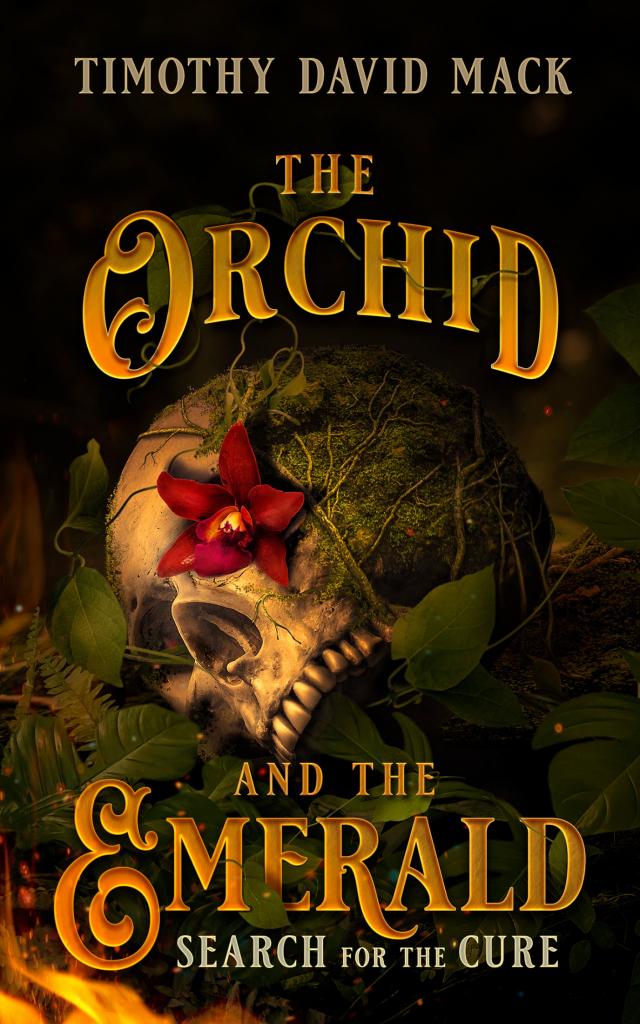
praise for
Orchid and the Emerald
“The Orchid and the Emerald drew me in from the first page. Timothy David Mack has crafted a meaty, majestic adventure, spanning continents and offering a glimpse into the grand game of espionage and intrigues between empires. Dive in and enjoy!”
—james r. benn,
author of the Billy Boyle WWII mystery series
“Timothy David Mack has captured the essence of these disparate worlds and transported us there through the eyes of two very different men, following different paths to the same destination. A rousing tale!”
—brian o’neill,
author of City of Destiny
Copyright © 2022 by Kevin P. McNeill, David B. McNeill, and Timothy A. Wendland
E-book published in 2022 by Blackstone Publishing
Cover, illustrations, and book design by Kathryn Galloway English
Scripture quotations taken from the (NASB®) New American Standard Bible®,
Copyright © 1995 by The Lockman Foundation. Used by permission.
All rights reserved. www.lockman.org
All rights reserved. This book or any portion thereof may not be reproduced
or used in any manner whatsoever without the express written permission of the
publisher except for the use of brief quotations in a book review.
TIMOTHY DAVID MACK, WILLIAM GUNN, and NATHANIAL BIDWELL,
a.k.a. NATE BIDWELL, are registered trademarks of David McNeill, Kevin McNeill,
and Tim Wendland.
This is a work of fiction. Space and time have been rearranged to suit the convenience
of the book, and with the exception of public figures, any resemblance to persons
living or dead is coincidental. The opinions expressed are those of the characters
and should not be confused with the authors’.
Trade e-book ISBN 978-1-6650-4681-7
Library e-book ISBN 978-1-6650-4680-0
Fiction / Historical / General
CIP data for this book is available from the Library of Congress
Blackstone Publishing
31 Mistletoe Rd.
Ashland, OR 97520
www.BlackstonePublishing.com
For my wife, my best friend and faithful inspiration,
without whom this would not be possible,
and with whom all things are possible.
I drink to Life, I drink to Death,
And smack my lips with song,
For when I die, another “I” shall pass the cup along.
—Jack London, The Iron Heel
preface
It was late summer 1992. Outside Puerto Berrío, at the edge of the forest on the high bank overlooking the river, the Englishman was buried.
We had just concluded partnership arrangements with several South American ecotour companies (one of my firms is an adventure travel agency) and were unwinding by kayaking down the Magdalena River. The river flows almost a thousand miles north through the western half of Colombia and is navigable for much of its length by kayak.
We came across the grave not far from the place described by the guide. Obscured by tangled vines and over a hundred years of jungle detritus, the small stone marker was scarcely visible in the dusk.
We approached close enough to discern the carved letters: j. h. chesterton.
No stranger to harm’s way, I was familiar with the final resting places of many unknown men. But the grave of J. H. Chesterton—a man buried far from his native land in a lone, almost unmarked grave—struck me. How had he died? And why had he come here, when it took months to sail from Europe, then weeks to travel by foot through the trackless jungle? Was he a soldier of fortune or a lone adventurer on an unknown quest?
Little did I know this small diversion would eventually consume years of my life. A more practical man would have passed by the place altogether. I had to probe further.
Finding a hotel with a fax machine, I sent a brief message to my stateside agent and was returned a thirty-page document the next day. What I read stunned me. Chesterton was a hunter. Not of dangerous animals, but of a single remarkable plant: the orchid.
I already knew the hunt for these singular plants went on for almost a century, ending only with the First World War. Among wealthy Victorians, an orchid atrium was a requirement, a place of illumination where one could converse over high tea while flaunting the latest exotic specimens from the far-off jungles of Borneo. The newspapers and journals of the day heralded each new shipment. This was the great “orchid fever.”
Some searchers were motivated by greed. At one time, an orchid sold for a thousand times its weight in gold, a single specimen bringing enough at auction for a man to retire comfortably. Others sought scientific discovery, not unlike the hapless, real-life Joseph Jussieu of our tale.
Of all the adventurers, orchid hunters were the hardiest, the most daring, and quite possibly, the most mad. While today a hybrid orchid can be found at any corner grocery store, the orchid hunters of that day had to search in fever-plagued jungles for the most prized specimens. They were resourceful: the very best could live like the natives, speak obscure dialects, and survive for months in the most inhospitable places on earth.
But in spite of his considerable abilities, the life of an orchid hunter was in constant jeopardy. These men faced a host of dangers, not the least from one another.
An orchid hunter of the late Victorian era, Albert Millican, made a detailed list of his supplies before entering the jungle: “a stock of knives, cutlasses, revolvers, rifle.” A mid-nineteenth-century expedition of eight orchid hunters went to the Philippines in search of rare orchids. Within a month one was eaten by a tiger, another was drenched with oil and burned alive, five vanished and were never seen again, and one walked out of the forest with seven thousand orchid specimens.
The peerless British navy combined with the industrial revolution led to an empire of plunder—an empire rooted in the bones of men like J. H. Chesterton. I followed his story to remote trails, sites of forgotten battles, long-abandoned gem mines, and places lit by the glow of phosphorescent orchids.
I had my own share of misadventures. I was lucky to survive a dicey moment outside a cantina in the mining town of Muzo, the very place where the intrepid Millican found his end at the tip of a fourteen-inch shiv over a century ago.
As I followed the footsteps of these bold explorers, my quest seemed to mirror their own, and I realized a strict historical account could never do justice to their thrilling lives. Instead, to better bring to life the incomparable tales of the Victorian orchid hunters, I present the nineteenth-century world through the eyes of two fictional young men, very different in origin and purpose, who face the dangers the actual orchid hunters might have confronted those many years ago.
And perhaps this story can serve as an epitaph, in some way, for our friend who still rests under his small stone by the side of the river.
Rest in peace, J. H. Chesterton.
Timothy Mack
Gozo, September 2004
characters
french
Joseph de Jussieu, French naturalist
north american
Simon Bidwell, New England shipowner
Nathanial “Yankee” Bidwell, woodsman
british crown
William Cavendish, sixth Duke of Devonshire
Viscount Henry Palmerston, secretary at war
William Gunn, orchid hunter
Sergeant Angus MacPherson, soldier
Darius Acton, naval captain
spanish crown
Lieutenant Rodriquez, commander, Barranquilla barracks
Captain Ernesto Rodrigo Marquez, king’s agent / inquisitor
dutch east india company
Abel Veeborlay, Dutch businessman
Harold Hull, businessman
colombia
Jaci, member of the Tupi tribe
Robert and Theresa Sheridan, Bucaramanga hoteliers
Pax, William Gunn’s dog
south american rebel patriots
General Simón Bolívar, commander of all rebel forces in New Granada
General Santander, Bolívar’s general
Captain Daniel O’Leary, Irishman on Bolívar’s staff
amazon
Cauã, Native American child
brazil
John VI, king of the United Kingdom of Portugal, Brazil, and the Algarves
Carlota Joaquina, queen of Portugal and wife of
John VI
Lady Julia Mendoza, bodyguard and companion to Queen Carlota
duke’s household
Dr. Ferguson, physician
Mrs. Hudson, assistant gardener’s wife
the Orchid
I have discovered a forgotten treasure. Following a trail of clues hidden in ciphered texts, I was led to the corner of a Spanish library where I uncovered the lost chronicle of a Jesuit priest who traveled through South America over one hundred years ago. The priest makes a detailed account of sights that beggar belief: cities the size of Paris, carved from a wild jungle; tribes of fighting women, who are both beautiful and cruel; a river without end. Chief among these marvels is a natural elixir, what the priest calls, “the black orchid.” It is a most rare flower, a genuine Holy Grail with
—Joseph de Jussieu, 1735 diary entry
1771: spanish empire of south america
Joseph de Jussieu wasn’t going to leave South America alive. It was a suspicion he’d felt from the moment he’d stepped beneath the forbidding canopy that marked the entrance to the Sacred Land in his search for the black orchid. Now, with his hands tied to the reins of his donkey, her hind legs dangling off the side of the narrow mountain path as his own feet scrabbled for purchase, his suspicion had become a certainty.
“Help me, damn you!” Jussieu cursed the porter who stood back, leery of approaching the side of the path that seemed a touch away from disintegrating in the torrential downpour. The donkey brayed. The stupid, insistent honking competed with the noise of the storm and made it impossible for Jussieu to make himself heard. The servant hesitated, unable to decide whether the donkey or the Frenchman was the bigger ass.
The servant had been with Jussieu for over two and a half decades, ever since the Frenchman’s colleagues had returned to Europe and the naturalist remained behind to continue his explorations. The two men had lugged the Frenchman’s crates over mountains and down valleys, through swollen rivers and endless forests.
However, when they came to the cursed jungle, the servant had declined to enter. He waited on the border, expecting to never see the Frenchman and his donkeys again.
But Joseph de Jussieu did return from that land, a little paler, eyes a little wilder. Since his return, he had developed the habit of looking over one shoulder and rubbing the small of his back. He carried a canteen that he sipped from, the potion making him visibly more relaxed, the panic in his eyes ebbing for a few hours.
He drove them out of the jungle with a haste that bordered on recklessness. The porter warned Jussieu to wait until the weather cleared—one month, maybe two at the most—but the Frenchman had refused. He insisted on pushing ahead despite the danger of traveling over the Andes in the rainy season. After so many years idling in South America, Joseph de Jussieu was pressing for the coast, for a boat back to Europe, like a man possessed.
Lightning cracked directly overhead, immediately followed by growling thunder. The donkey’s hooves pedaled madly, searching for traction. The narrow path crumbled beneath the animal, rocks and clay falling to the bottom of the ravine a thousand feet below. Digging his own feet into the mud of the rain-drenched path, Jussieu felt himself slide toward the edge.
“Grab that rope! Quickly, you fool!” Jussieu yelled after the thunderclap.
Coming to the realization he would be unable to plunder Jussieu’s corpse if it were at the bottom of a ravine, the porter rushed to the European’s aid.
The wind hurled pea-sized hail against their exposed flesh. Pulling together, they finally managed to haul the flailing animal onto the path. The servant pressed against the cliff face, but Jussieu grabbed the animal’s halter. An unquenchable fire burned in the Frenchman’s bloodshot eyes.
“Get your beast!” he yelled above the squall. He put his head down and pushed forward. The donkey advanced with hesitant, unsure steps.
But the Frenchman wasn’t focused on the treacherous path—he was not afraid of the way ahead. He was gripped by an unrelenting terror, knowing what pursued them from the unknown land. He again sipped the elixir from his canteen to muffle the cackle of unearthly voices.
As they struggled onward, the porter’s sole thought was of the treasure Jussieu had obviously found in the Sacred Land. The squall intensified, the lashing rain blotting out all but the trail at their feet. A flash of lightning abruptly revealed a glade.
The Frenchman stopped. “Yes, yes, I know this place,” he muttered to himself, rubbing the small of his back. “Stop!” he cried, whipping around toward the porter. He hastily took a draft from the flask, then pressed his palms to his eyes. When he let his hands fall, his face was calm, his eyes clear.
How could he secure passage home without exposing his invaluable trunks to the thieves in every port? He would have to push his fear aside. “I shall be gone a couple of days,” he told the servant. “Wait here for me. Guard the trunks with your life.”
As soon as Jussieu disappeared in the driving rain, the servant examined the trunks by the unremitting flashes of lightning. Every box was locked. They must surely contain the most precious of treasures, he thought. Why else would the Frenchman risk so much? He even sleeps with them.
At the port, Jussieu secured passage aboard a ship bound for Europe. He anxiously awaited the conclusion of the transaction, wishing every moment that he could hurry back to the glade and retrieve his precious trunks. When his business concluded early, Jussieu returned to the glade at last, thanking his good luck. When he entered the clearing, however, he froze, ignoring the rainwater that streamed down his back.
The clearing on the mountainside was empty. The trusted servant, the donkeys, and the trunks that contained his diary and an irreplaceable trove of scientific specimens gathered over the previous decades—all were gone.
He darted from one end of the clearing to the other, circling back again and again until he fell to the ground in frustrated exhaustion. He tore at his hair and wept.
Neither the servant nor the trunks were ever seen again.
Jussieu returned to France from the wilderness where he had just wasted thirty years of his life. Shortly after his arrival, he was committed to an insane asylum on the outskirts of Paris. He would never leave. He died eight years later, alone, trapped in his cell with the memories of his precious trunks, lost somewhere in that impassive green jungle on the far side of the world.
chapter 1
a Fresh Start
april 1818: derbyshire, england
William Gunn gaped as the estate of the sixth Duke of Devonshire crept into view of their private coach. Even from across the river and its arched stone bridge, Chatsworth “House” appeared impossibly grand. It could have easily encompassed William’s regimental training grounds and housed his entire former regiment, with enough room left over for the servants’ quarters, stables, and hunting lodge.
William smiled as he watched his daughter, Sarah, caress the drapery inside the coach, finer than any fabric she’d ever felt. She was so absorbed that she hadn’t yet noticed the castle looming outside her window. The look on his four-year-old daughter’s face when the duke’s luxurious carriage had trundled up to their grimy South London flat—appearing like some kind of inner-city mirage—reassured William he’d done the right thing.
After the war ended, the only lodging they could afford was a flat in a run-down section of London populated mostly by former soldiers and unemployed factory workers. With the English victory at Waterloo and the end of the Napoleonic Wars, thousands of former soldiers returned to England, where they drifted to the larger cities seeking work in the new factories. But many factory jobs had already disappeared, and soldiers found themselves unemployed, injured, and forgotten as they barely survived in the dangerous and squalid slums of every large city.
William was no exception. Endless months of fruitless job hunting had depleted his family’s meager savings. He had promised his wife, Miriam, he would never give up Sarah to an orphanage. With a young child and winter fast approaching, William had resorted to his last, desperate measure: he had petitioned his former commanding officer, Arthur Wellesley, the Duke of Wellington and field marshal of the combined European armies, for his assistance in securing a position.
Even though the Duke of Wellington had enthusiastically agreed to help his young aide-de-camp transition back into civilian life, William couldn’t help feeling vaguely ashamed that he’d begged his former commander for help; not only that, but he still didn’t have the slightest idea of what he’d been called to Chatsworth House to do for the Duke of Devonshire. He’d known only the military life since he was a boy: long marches and searching for a spare bit of dry ground to make camp. He wondered what possible use he would be on an estate. Was he here only as an act of charity? To settle a debt between dukes?


