The Shadow at the Door, page 1


Tim Weaver
* * *
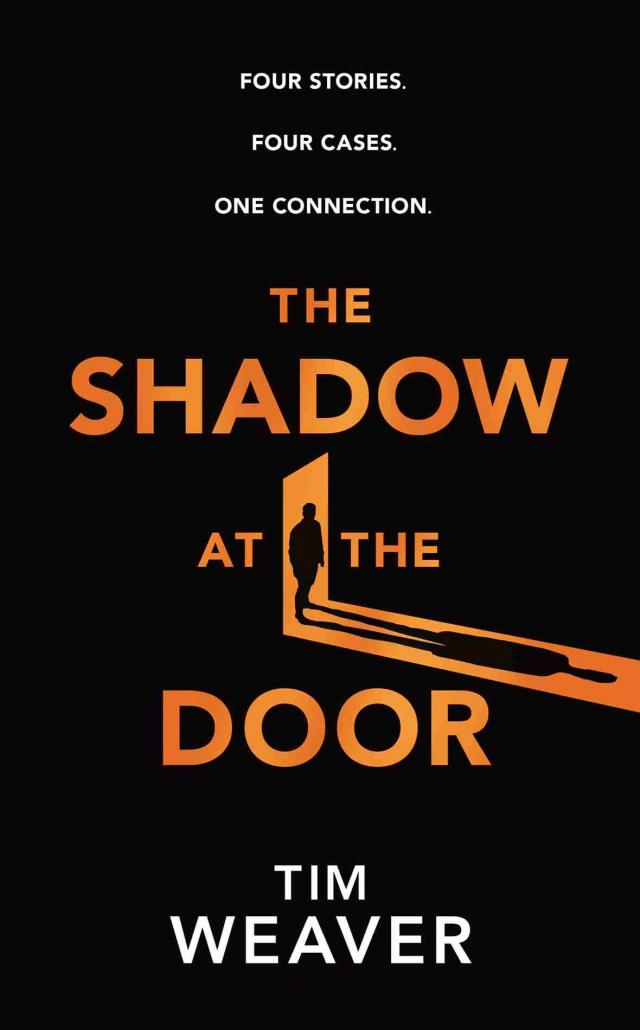
THE SHADOW AT THE DOOR
Four
Stories
Four
Cases
One
Connection
Contents
Dear Reader
Case #1
The Shadow at the Door
Case #2
Bags
Case #3
The Red Woman
Case #4
Sleeper
Epilogue
Ghosts
Appendix
Acknowledgements
About the Author
Tim Weaver is the Sunday Times bestselling author of eleven thrillers, including No One Home and You Were Gone. He has been nominated for a National Book Award, twice selected for the Richard and Judy Book Club, and shortlisted for the Ian Fleming Steel Dagger Award. He is also the host and producer of the chart-topping Missing podcast, which features experts in the field discussing missing persons investigations from every angle. A former journalist and magazine editor, he lives near Bath with his wife and daughter.
This book is dedicated to you …
Because without readers, a writer is nothing
Dear Reader …
Believe it or not, this book was never part of the plan.
I’d been thinking for a while about the idea of someone going missing inside their own house. And, of course, I knew who would investigate the case. After all, when it comes to missing persons mysteries, there’s really only one guy you can count on.
The problem was, I also knew that, although this would definitely have all the trappings of my usual David Raker stories, there wasn’t quite enough in the idea for a full-length novel. So, while I considered it very briefly for a subplot in both You Were Gone and No One Home, in the end I couldn’t make it work in either of those books and the idea quickly returned to the backburner.
And then two big things happened.
I finished my first ever standalone novel, Missing Pieces, and – as I nervously awaited my editor’s verdict – found myself with a little downtime. Usually, in between novels, I try to take a complete break from writing and get out and do some of the things I haven’t been able to do in the last months before a book’s deadline (like seeing real people and breathing fresh air). But, within weeks of my sending the standalone to Penguin, an even bigger thing happened: a global pandemic shut the world down.
As frightening, stress-inducing and weird as the first coronavirus lockdown was, it also meant I had no choice but to return to my desk. There was literally nothing else to do. And because I wasn’t due to start The Blackbird, aka David Raker 11, for a while – and, more importantly, hadn’t completed the research for it – I went back to the idea about someone going missing inside their own house. And as I started writing, as the idea became bigger and more ambitious than I’d first imagined, but still only about half the size of one of my full-length novels, another idea came to me. What if it wasn’t one case, but four of them, all different, all featuring different characters from the Raker series, and each a self-contained, standalone story in its own right – and yet with plot lines tethering all four together? What if, despite each of the stories having a clear beginning, middle and end, there were underlying connections in each that echoed from one investigation to the next? It would mean that the events you read about in Case #1 could reverberate all the way through to the events of Case #4. It would also mean that, unlike in other story collections, these stories would have to be read in order, starting from Case #1, otherwise – just like with any other novel – you wouldn’t be able to follow the plot. (Oh, and in case you’re interested, and talking of chronology and connections, this book acts as a handy bridge between the events at the end of No One Home, via one particular chapter of Missing Pieces, to the opening chapters of next year’s The Blackbird.) Finally, there was perhaps the most important question I asked myself: what if David Raker was in each of the stories, sometimes centrally (as in Case #1: ‘The Shadow at the Door’), sometimes in the background (Case #2: ‘Bags’) and sometimes actively helping and interacting with characters he’s worked with before (Case #3: ‘The Red Woman’ and Case #4: ‘Sleeper’)?
So, welcome to what I imagine will be a true one-off.
As always, I’m so grateful for your support. Thank you for buying my books, talking about them, sharing them and posting about them – without this, I would never get the chance to try things like the book you’re holding now. I so hope you enjoy what you read here, that this special, limited-edition collection looks good on your shelves, and that The Shadow at the Door fills a David Raker-sized hole in your life until he returns in a few short months in an all-new, full-length missing persons search.
Tim Weaver, November 2021
CASE #1
The Shadow at the Door
1
When I was thirteen, I discovered an old house in the woods behind my parents’ farm. I’d been down there countless times before, into that knot of branches, but I’d never come across the building before. It was like it appeared there one day, emerging from the earth, shaking the dirt from its roots and forming like a tree.
I headed back to the farm, buzzing with excitement, and told my dad everything. He said he would come and see once he was done for the day, but I couldn’t wait for him – I had to go and find the house again – so I went into the village and grabbed my friend Lee instead, and for the next couple of days, he and I claimed the house as our little secret. Then, as time wore on, we got bored of just the two of us knowing, so we brought other friends to see it, and the more of us there were, the braver we got.
Eventually, after a week of standing outside, staring at the memory of what it had been – its windows gone, its stone walls blistered and broken – we decided we’d go inside.
There were seven of us in all. We passed through the gaping mouth at its front – no longer a door, just a hole in the brickwork – and found ourselves in a hallway. Most of the wallpaper had been ripped away, the plaster too, exposing the old bones of the structure – its warped wooden struts, its decaying cavities – and as we moved into what would once have been a living room, the whole place seemed to darken. Shadows grew longer. The sounds of the woods disappeared behind us.
We were teenagers, knowing nothing of the world, its strangeness and danger, but all of us felt something change then: a gentle shift we couldn’t put into words. Instinctively, we looked at each other – and then, a second later, we bolted. We ran as fast as we could out of the woods and didn’t stop until we made it to the farm.
Four years later, six weeks before I left south Devon for London and university, I was out with Dad, shooting air rifles at targets he set up in the woods, and I stumbled across the house again, completely by accident. It was the only other time growing up that I ever came into contact with it. By then, it was barely visible any more, nature having claimed it back. Its roof had begun to collapse and thin, crooked branches were inching through its façade like skeletal fingers.
Dad watched me stop, seeing that something had caught my attention, and then he moved closer to me, rifle at his side, head turned in the direction of the house. We both stood there in silence, watching it, as if it were coming alive. After a while, when he said nothing, I looked at him. He was staring at me.
‘That’s the Montgomery place,’ he said quietly.
‘Who were the Montgomerys?’
‘They used to live here – back in the fifties.’
‘Why did they leave?’
His eyes flicked to me. They didn’t.
‘Are they dead?’
He still didn’t reply, but I knew I was right. They were all dead. In his face, I could see that he was trying to work out how I’d known. But I hadn’t. All I recalled was the inside of that building years before and how it had felt to us as kids – its long shadows, its hush, as if the memory of the family were still lingering.
‘Dad? Did the Montgomery family all die?’
‘Yes.’
‘How?’
My father’s mouth flattened, his lips blanching, and I saw the conflict in him. Did he tell me the truth, or did he sugar-coat it? Eventually, his eyes came back to me, taking me in: the boy he’d brought up, just weeks away from becoming a man.
‘He shot himself,’ Dad said.
‘Who?’
‘William Montgomery. The husband.’ A pause. ‘The father. His wife and children died. They left this place one morning and never came home again.’
‘Why?’
‘A car accident.’
I frowned at him, unsure of exactly how it all fitted together. But then, suddenly, it snapped into focus and I understood, and it was maybe the first time in my life that I’d ever felt that pull; that emotional connection to the tragedy of others.
‘Was William Montgomery the one driving the car?’
Dad’s eyes moved back to the house.
‘Yes,’ he replied. ‘His wife and kids all died. He survived.’
I’m not sure I ever gave a single thought to that moment in the decades that followed, not until our final conversation. By then, Mum had been gone for nearly a year, and – because it was clear he’d be unable to cope on his own – I’d helped Dad sell the farm and moved him into an old fisherman’s cottage, perched in the hills overlooking the beach in the next village. Dad had been up and down health-wise, heart-sore about Mum’s passing, but that day had been one of his better ones. The three of us – me, m
‘Do you believe in ghosts, son?’
Dad had asked it without looking at me, and when I turned to Derryn, she gave a gentle nod of the head and started to get up, as if glimpsing the intimacy of this moment. Once we were alone, I touched Dad on the arm. He flinched, his bones so small against my fingers, his skin so meagre.
‘Are you okay, Dad?’
He turned to me.
‘Can I get you anything?’
‘Do you?’
‘Do I what?’
‘Do you believe in ghosts?’
I smiled at him, but he didn’t smile back. His eyes returned to the window, to the sea, evening moving in, the sky beginning to look like it was sketched in charcoal.
‘You remember that house?’ he asked. ‘The Montgomery place.’
It took me a few moments to catch up.
‘The place in the woods?’
He looked back at me, his eyes milky.
‘The reason Montgomery put a gun in his mouth was because he was haunted by the memories of what had happened to his family.’ He stopped and stared into his empty coffee mug, as if searching for the words in there. ‘I guess what I’m saying is, you’ll realize as you get older that ghosts aren’t things that go bump in the night. They’re not apparitions. They’re feelings. They’re things you can’t let go of. They’re fear, and heartache, and regret. Ghosts, they’re just things you’ve done – or haven’t.’
I studied him, confused, a little stunned. ‘Dad, I … uh … I don’t …’ I stopped again, unsure what to say. I’d never heard him talk like this in my entire life.
‘Ghosts, the ones you should be really scared of, they’re not haunting the rooms of your house, son.’ He took a long, abrasive breath. ‘They’re haunting the rooms of your head.’
Part One
* * *
THE WATCHER
2
The house was tucked away in a narrow cul-de-sac about a quarter of a mile south of Wimbledon Common. It was a modest two-storey, three-bedroom home, but it was set behind a brick wall that separated the property from the pavement and hid most of it from view, unless you were seven feet tall. A wooden door – locked, with a letterbox cut into it – filled a space at the far end of the wall, and at the other end was a set of double gates with an intercom mounted to the side. I knew the house was modest because it had been on the market four years ago and I’d tracked down some photos of the interior in an image search, but from this side of the wall, and with an attractive gabled roof visible, it would have been easy to believe it was larger and grander, and owned by a family much wealthier than the Conisters.
I parked on the street, grabbed my notebook, and then paused as I locked the car. I started thinking about my dad again, about the final conversation I’d had with him at the kitchen table in his home in south Devon, and about the things he’d said to me at the end. Ghosts aren’t haunting the rooms of your house, son. They’re haunting the rooms of your head. I wasn’t sure if his voice had resurfaced after so much time because of what I’d found out about the Conister family over the last few days, or if it was still residue from the pain and distress of a case I’d had three years ago and could never forget. But, whichever it was, as I approached the gates, I could suddenly picture my father clearly, light painting one side of a gaunt, exhausted face.
I pushed the buzzer.
After a moment, a female voice said, ‘Hello?’
‘Mrs Conister? It’s David Raker.’
Another short buzz and then one of the gates slowly fanned back to reveal a small, oval-shaped driveway. I stepped through and pushed the gate shut behind me. A five-year-old Astra was parked next to a metal stand to which a couple of bicycles were chained. Beyond that was the front door, shadowed under a first floor that pushed outward from the house and rested on top of two white pillars.
Margaret Conister was standing in the doorway, dressed in a pair of leggings and a vest top. It was a warm day at the start of July and she was a little flushed, but almost as soon as she saw me she started to apologize for the sheen of sweat on her face and arms: ‘I went for a run,’ she explained, ‘and the time just got away from me. I started to panic that I was going to be late.’ We shook hands and I told her she needn’t have worried. ‘That’s kind of you,’ she said, smiling, ‘but it isn’t a great first impression.’
‘I don’t judge people on their timekeeping.’
She smiled again. She was an attractive woman: forty-seven, petite and slim, her dark hair scraped back into a ponytail, her cheeks rouged, her eyes dark as chocolate. ‘Come in,’ she said, gesturing to the hallway. From the front step, I could see it ran all the way through to a big living room at the back that extended into a conservatory; to the left was a kitchen with an oak table at one end; to the right was some kind of office – poky, dark, cluttered.
‘Have you been running long?’ I asked, trying to put her at ease. This was always how the families started: a little nervous, a little worried about how every tiny thing they said or did might impact on my attitude, or how hard I worked for them.
‘Yes, since I was teenager,’ she said.
‘I’ve just started to pick it up in the last couple of years,’ I told her. ‘I like the way it clears your head.’ In the living room, I glimpsed someone on one of the sofas, partially obscured by the door frame: a pair of crossed legs, female. ‘That’s why I said not to worry about being late. I can’t tell you how many times I’ve gone out for an hour – and got home after two.’ She smiled again in response: she’d finally begun to relax.
‘Can I get you something to drink, Mr Raker?’
‘David,’ I said. ‘Some tea would be great.’
I followed her into the kitchen and, as we talked politely while the kettle boiled, I spotted a series of photos in a collage on the wall. The one in the centre was of Margaret Conister, her two children and her husband: they were on holiday somewhere, the skies blue, a white wall at one edge of the picture, a palm tree at the other. Her children – Seb, who Margaret had told me on the phone was fifteen, and Katie, who was twenty – were both five or six years younger in the photo; her husband, Paul, who was the same age as his wife, was such a tall man – his upper arms like the spidering limbs of a tree – that his hand rested easily on Seb’s shoulder, despite both Margaret and Katie being between them. The other photos were of the same ilk, snapshots of a family’s life, of kids growing up, of holidays. There was one from Paul and Margaret’s wedding day; one of the kids in school uniforms; another of Paul in the garden. I pointed to the picture in the centre.
‘Where was that taken?’ I asked.
‘Oh,’ she said. ‘Spain. Marbella.’ Her eyes lingered on the picture. ‘We had a couple of weeks in a villa down there. It belonged to Paul’s old boss.’ She paused, a flicker in her expression. ‘Beautiful place. We felt like we were royalty for a fortnight.’
It took a moment for her to tear her gaze away.
‘After you called me yesterday, I did a little digging around,’ I said to her, ‘and I was surprised to find that there wasn’t much reported in the media about Paul. Not the details of his disappearance, anyway. I guess it just … it struck me as a little odd.’
Margaret nodded. ‘Odd, because of what happened to him?’
‘Right.’
This time, she just shrugged. ‘I think people had a hard time believing what we were telling them. And, after a while, I think they believed we might be making it up.’
That was the impression I’d got from the stories in the media as well, and it was definitely the reaction that people had had on Internet forums, true-crime websites and social media threads: whatever had taken place in this house that night, three months ago, couldn’t possibly have happened the way Margaret or her kids had described it.