The Blackbird, page 1


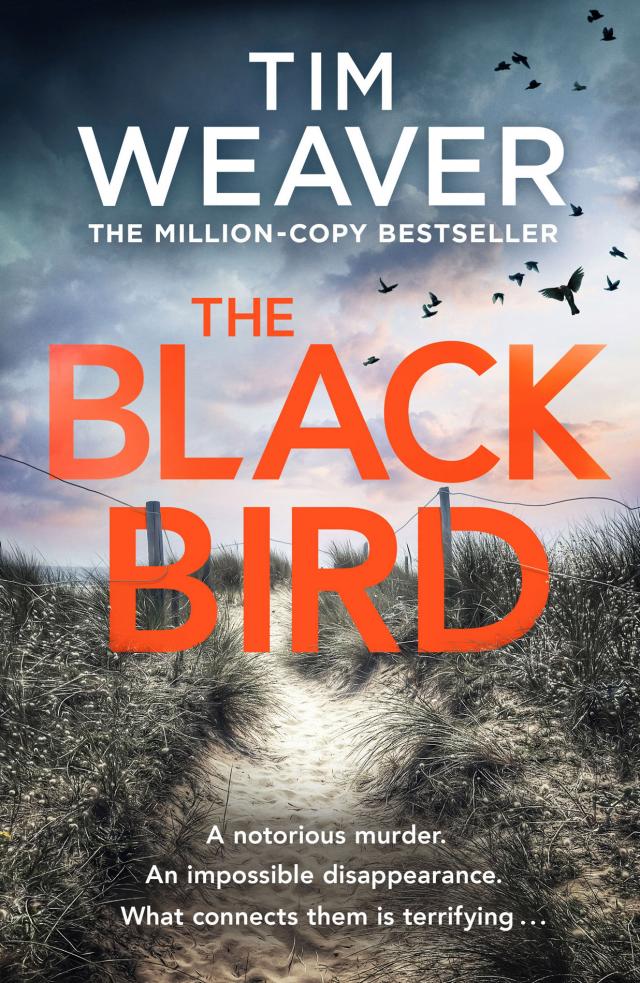
Tim Weaver
* * *
THE BLACKBIRD
Contents
Prologue
PART ONE: The Crash Chapter 1
Chapter 2
Chapter 3
Chapter 4
Chapter 5
Chapter 6
Chapter 7
Chapter 8
Chapter 9
Amelia
Chapter 10
Chapter 11
Chapter 12
Healy
Chapter 13
Chapter 14
Chapter 15
Dunes
Chapter 16
Questions
Chapter 17
Chapter 18
Chapter 19
PART TWO: The Witnesses Chapter 20
Chapter 21
Shelter
Chapter 22
Chapter 23
Chapter 24
Healy
Chapter 25
Chapter 26
The Phone Call
Chapter 27
Chapter 28
Captive: Part 1
Chapter 29
Captive: Part 2
Chapter 30
A New Memory
Chapter 31
Chapter 32
Search
Chapter 33
PART THREE: The Fugitive Chapter 34
Chapter 35
Chapter 36
Chapter 37
Chapter 38
Healy
Chapter 39
Chapter 40
Chapter 41
Names
PART FOUR: True Crime Chapter 42
Chapter 43
Chapter 44
Chapter 45
Chapter 46
Faces: Part 1
Chapter 47
Chapter 48
Faces: Part 2
Chapter 49
Chapter 50
Chapter 51
Faces: Part 3
Chapter 52
Chapter 53
Healy
Chapter 54
Chapter 55
Chapter 56
Chapter 57
Photograph
Chapter 58
PART FIVE: The Blackbird Chapter 59
Chapter 60
Chapter 61
Chapter 62
Chapter 63
Chapter 64
Chapter 65
Chapter 66
A Mum, Twice
Chapter 67
PART SIX: The Interview Chapter 68
Chapter 69
Chapter 70
Chapter 71
Chapter 72
Chapter 73
Chapter 74
Healy
PART SEVEN: The Silence Chapter 75
Chapter 76
Chapter 77
Author’s Note
Acknowledgements
About the Author
Tim Weaver is the Sunday Times bestselling author of twelve thrillers, including You Were Gone and No One Home. He has been nominated for a National Book Award, twice selected for the Richard and Judy Book Club, and shortlisted for the Ian Fleming Steel Dagger. He is the host and producer of the chart-topping Missing podcast and is currently developing an original TV series with the team behind Line of Duty. A former journalist and magazine editor, he lives near Bath with his wife and daughter.
For Jo and John
They should have been dead.
That was what people kept telling me in the days before I went out to see the scene for myself. I spoke to family and friends, to the medics and fire crews who were actually there on the night it happened, and they all said the same thing – there was no way Cate and Aiden Gascoigne should have been able to survive a crash like that.
On the morning I was due to drive down to what was left of the scene, I got up early and, over breakfast, used my laptop to repeatedly inch back and forth along the road where it had happened. It was on the eastern edges of the Surrey Hills and the route I saw online was a sloped two-lane stretch of tarmac, hemmed in by trees on both sides, with a ravine to the west – the Gascoignes’ right as they travelled down the hill – although the ravine wouldn’t have been visible from their vehicle. Top to bottom, the road was less than a mile long, with a junction for the M25 at one end and a village called Gatton at the other. There were two minor bends en route, the road itself was in good condition, and the night the Gascoignes had plunged ninety feet into the ravine, it had been a dry evening in early January. No frost, no ice, not a hint of rain.
So it wasn’t the weather that had caused the accident.
And it wasn’t the layout or the quality of the road either.
Their car had been a black Land Rover Discovery, two years old. The history on it showed no issues and it had only just been through its service, so everything – including the tyres – had been checked literally days beforehand. Yet three minutes after exiting the M25, and only ten seconds after a CCTV camera halfway down Gatton Hill captured the two of them on film – apparently untroubled inside the car – Aiden Gascoigne lost control of the vehicle and the Land Rover nose-dived off the road.
The photographs of the scene in the casework, taken by forensic techs in the aftermath, were certainly better than nothing, but the portrait they painted wasn’t as lucid as it could have been. The crash had happened at dusk, so a lot of the shots were too dark, even when I adjusted the levels on them, or they were the opposite: bleached by a flash, or oversaturated because of the big mobile lights that had been craned in and erected in the gully. Other pictures in the file were physical prints that had been pinned to a board somewhere in an office at Thames Valley Police. Overall, they were better quality but, by the time the case wrapped up – still unresolved – and the pictures were scanned in and then taken down from those boards, they’d accumulated a mesh of hairs, creases and pale coffee-coloured water damage.
There was, however, one clear shot.
It had been taken from the flank of the ravine, about twenty-five feet up from the crash, by an accident investigator. They had climbed part of the way up a sloping carpet of scree to try and get a better angle on the wreckage. There were a couple of trees in the way – both stripped to the bone by winter – and a very light spotting of frost at the foot of the chasm, although none around the Land Rover itself. Instead, there was only a pitch-black ring, the grass, ferns and overhanging branches all scorched by the fire that had started in the engine and ripped through the car.
The Land Rover – on its roof – barely looked like a car at all. It had been transformed into a ragged tangle of metal, the front concertinaed all the way into the dashboard, every single window smashed. Investigators had drawn an illustration of how they believed the descent had gone, the impact points on the slope of the ravine, but in the end, maybe it didn’t matter all that much. The damage was obvious from just a single photograph, its severity stark and brutal, and however many times the Land Rover had turned, whichever part of its chassis had crunched against the scree – however hard its roof had hit the floor of the gully at the end – there should only have been one outcome for the husband who’d been driving, and the wife beside him.
They should have been dead.
But that was the thing. That was why the photographs of the crushed, charred Land Rover had spent so long pinned to a board at Thames Valley Police. It was why the media began labelling it ‘The Mystery of Gatton Hill’ and why the CCTV footage of the Gascoignes had got over three million views on YouTube. Everyone knew they should have been dead, that the accident should have crushed them or broken them in half; it should have severed limbs, and arteries. It should have started turning their bodies to ash.
But it didn’t.
Because when members of the emergency services got to the bottom of the ravine ten minutes after the crash, there was something wrong with the Land Rover.
It was empty.
The Gascoignes had vanished.
Part One
* * *
THE CRASH
1
The family lived near Runnymede, in a house on the banks of the Thames.
It was half a mile from the motorway, less than three from Heathrow Airport, but it was easy to imagine that you were in the countryside somewhere, and London was a distant memory. The weather helped: it was the first Monday in July, searingly hot even this early, and as boats glided lazily past me, there was almost no traffic noise at all. All I could hear was birdsong and the sound of kids on their way to school as they played in the long grass that lined the fringes of the river.
I got out of my car and took in the house itself, a mock-Tudor mansion with a double garage and a black wrought-iron gate at the front. The gate had been left ajar and, in the middle of the gravel driveway, an old retriever was lying down, panting in the sun. The second I arrived at the gate, its gaze pinged to me.
‘Hey,’ I said, and got down on to my haunches.
It was a girl. She eyed me for a second, clearly wondering if I was worth getting up for, and then she must have decided that I was because she hauled herself to her feet, one of her legs stiff, and trotted across to me. I ran a hand through her hair, along her flank, and she rested her muzzle against my thigh.
‘She’s never been much of a guard dog.’ I looked up. A man in his late sixties was coming down the driveway towards me, a half-smile on his face. ‘But we still love her, don’t we, Jess?’ He was smartly dressed in a powder-blue button-down shirt and cream chinos. ‘I’m sure you’ve guessed th
He held out his hand to me.
‘David Raker,’ I said, standing. ‘But I’m sure you knew that too.’
We shook hands.
‘Thanks for coming, Mr Raker.’
‘David.’
He nodded. ‘Martin.’
I gave Jess another stroke and glanced at the river again. All that lay between the Clarks and the water on this side of the house was a band of long grass, a knot of oak trees and an old, rickety jetty at which a rowing boat bobbed gently. ‘This is a beautiful spot,’ I said.
He smiled. ‘We’ve always loved it.’
‘How long have you been here?’
‘We moved here from Islington when the girls were still young. It was a happy home for a long, long time …’ Something flickered in his expression. But not any more. He cleared his throat, forced a smile. ‘We used to take the girls out on the river a lot.’ He pointed to the rowing boat.
‘They must have loved it,’ I said.
‘They did. We all did. It takes on a bit of water now, so you can’t go very far, but back then, the four of us used to row miles.’ The four of them. Him, his wife Sue, and his two daughters: Georgia, who was the eldest by two years, and Catherine.
Cate, for short.
‘Why don’t you come in, David?’
I followed Martin into the house, Jess plodding along behind us. Immediately inside was a foyer with a staircase in the centre. It was lovely, made from glass and timber, and gently spiralled up to the first-floor landing. Circling the staircase like the spokes of a wheel were five doors. I could see a living room, a kitchen and an office from where I was. There was light pouring in from all directions thanks to a series of windows high up on the walls of the foyer.
He led me into the living room, which then opened out on to a deck elevated over a sloping garden. The garden was immaculate and hemmed in by perfectly sculpted laurel bushes. It only added to the sense of being somewhere remote. Even the soft drone of a plane, taking off from Heathrow, couldn’t tarnish the effect.
A woman was waiting for us out on the deck, standing to the side of some grey patio furniture, hands in front of her. She looked worried, or scared, or both.
‘Mrs Clark?’
She smiled. ‘Sue, please.’
‘David.’
We shook hands. Her skin was clammy.
‘Can I get you something to drink, David?’
‘Something cold would be lovely, thank you.’
Sue disappeared into the house and Martin gestured to one of the patio chairs. Above me, I saw that the deck had a cover, which appeared to be able to slide back and forth along its runners, depending on where the Clarks wanted their shade. It was another smart, expensive feature. But that, and the pristine house, and the flawless garden, were all just illusions. Everything here was near perfect on the surface but turbulent as a storm below. The house, the garden, it was all distraction.
‘I hope you don’t mind,’ Martin said, ‘but I did a little reading up about you. I saw some of the cases you’ve had. It seems like it can get pretty hairy at times.’
‘At times. But not always.’
‘I suppose there are all sorts of reasons why people go missing.’
‘No two cases are exactly the same.’
‘Do you ever get a gut feeling one way or another?’
‘About where a case is going to go?’
He nodded. ‘Do you ever sit down like this and hear the story from the family and then think to yourself, “This is going to be a difficult one to crack”?’
As Jess wandered out from the living room and slumped on to the decking, I turned Martin’s question over. In a disappearance, especially when it came to runaways, sometimes the object wasn’t to vanish, it was simply to break free. In those cases, I was usually employed by children’s homes, or councils, or foster families. Occasionally, you might get work from the biological family, but generally – by the time a teenager reached the stage when they were trying to escape – the biological family had long been erased from the picture. Those searches tended to stick to a rigid pattern, tended to involve doing the same things on repeat, so I suppose it was true that in those cases I’d get an idea right out of the gate of where things would go.
But it wasn’t always like that.
Sometimes you caught a case where there was no pattern and no recognizable shape to it, where the answers appeared unreliable or non-existent. And in almost all the investigations that I’d never had a gut feeling about – and which had hurt me the most – there was always a liar at the centre.
Liars were why cases were unpredictable.
Liars got you killed.
Looking at Martin, I said, ‘Sometimes you might get a feel for where a case is going to go, yes – but every case is different. I try not to prejudge them. And even if they are tricky to crack, it doesn’t mean I won’t.’
It was an attempt to reassure him because the catalyst for the question was obvious: he’d spent the last two and a half years facing down nothing but failure, of being tortured with dead ends and unanswered questions, and now he wasn’t sure if he’d made the right choice. What if my search just brought them more suffering?
What if I never found Cate and Aiden Gascoigne?
‘I guess you know a little about them already?’ he asked.
‘Only through what you told me on the phone and what’s been reported.’
He put a hand flat to the table that separated us and looked out at the garden. ‘The reports were pretty accurate. I probably read every single one of them – I suppose I was trying to find some sort of answer, some explanation of where Cate and Aiden might have gone. But what the media put out there matched what the police told us.’
He looked at me, a shimmer in his face.
The car was empty.
‘So, as I understand it,’ I said, ‘Cate and Aiden were heading to some friends in Reigate. A CCTV camera confirmed they exited the M25 at the Gatton Hill turn-off. From there, they crossed the roundabout and connected to Gatton Hill itself, and halfway down that, another surveillance camera filmed them again.’
‘That’s right.’
‘Ten seconds later, something happened.’
We looked at each other. Something happened. That made it sound minor: a mishap, not a sudden catastrophic event where a car plunged ninety feet into a gully.
‘No one saw them leave the road?’
‘No. The first witnesses arrived after.’
One, travelling south from the motorway, was a student called Zoe Simmons. She told police she saw tyre marks on the road and a piece of the Land Rover’s bumper; when she started to slow her Suzuki, she saw the spot where the car had exited the road. The other driver – heading north – was a 61-year-old retiree called Audrey Calvert. Even before Simmons had seen the tyre marks and the bumper, Calvert was already slowing her Fiat 500 because – for a few seconds, as she travelled up the hill – the layout of the road allowed her a brief, uninterrupted view down the slope of the ravine, into the foot of the gully.
There she could see a vehicle.
It was on its roof.
Both she and Simmons parked up, dialled 999 and, about two minutes after the crash, walked up to where the tyre marks bled off: some of the foliage had been torn, allowing them both to see down the slant of the ravine.
Soon after that, the Land Rover caught fire.
I’d requested a copy of the police investigation from a contact of mine in the Met, so I’d confirm all this for certain in the next twenty-four hours. But the details reported by the media did seem to be pretty accurate; as I continued to go back over the events of that day with Martin, he basically repeated what I already knew.
‘The witnesses never saw Cate and Aiden get out of the car?’
‘No,’ Martin said.
According to the media, in nine minutes, the witnesses never took their eyes off the car and at no time did they see the Gascoignes leave the vehicle. Both women had been upset because they believed Cate and Aiden were still inside and there was nothing either of them could do. It was too dangerous to go down the slope, so they just stood there the entire time, watching the car cremate.