Florida Roadkill, page 1
part #1 of Serge Storms Mystery Series
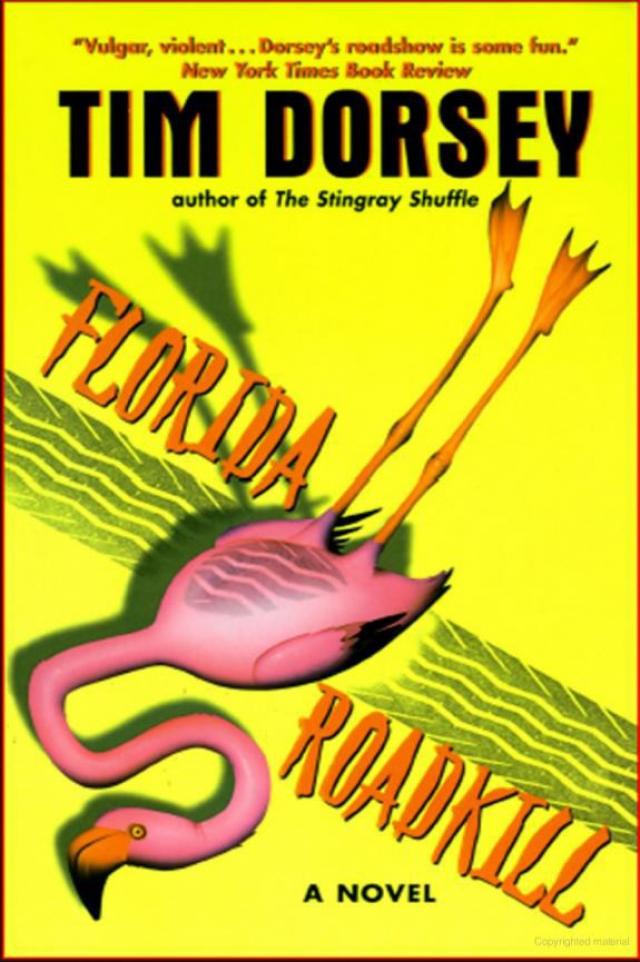


Florida Roadkill
Tim Dorsey
For Janine, Erin and Kelly
Acknowledgments
A respectful nod to my agent, Nat Sobel, and my editor, Paul Bresnick, two of the most dangerous men in the New York literary establishment.
The Sun will not rise, or set, without my notice and thanks.
Winslow Homer
Prologue
Florida even looks good collapsing.
From Loggerhead Key to Amelia Island to the Flora-Bama Lounge, the Land of Flowers has natives caught in seductive headlights.
Millions of residents stayed up past midnight one evening in October of 1997 to watch the south Florida baseball team win the seventh game of the World Series in extra innings.
The next day:
A full-figured maid from Rio ran in a circle in the parking lot, crying and screaming in Portuguese. The motel manager leaned against the office doorway, weary, a thin, bald Honduran, four foot eleven, sixty years. Brown slacks and ocher guayabera with a pink button on the pocket: “Play the Florida Lottery.” He had coppery, folded skin, and he rolled his eyes at the paroxysmal woman in the white cleaning uniform who he decided was being overcome either by religion or insects.
The 1960s-era Orbit Motel was a two-story box around a swimming pool. Its east side faced Cocoa Beach and the Atlantic Ocean, and its sign on Highway A1A was an illuminated globe circled by a mechanical space capsule. The Launch Pad Lounge next to the motel office was retrofitted into the Launch Pad Food Mart, which the manager tended without humor.
The maid’s hysterics were unbroachable for fifteen minutes, so the manager ate boiled peanuts. Through sobs, the maid eventually communicated her alarm.
Two police officers in a single squad car arrived four minutes after the manager’s phone call. Cocoa Beach has a genie and a bottle on the doors of its police cars. The manager led the officers around the ocean side of the motel and up the unpainted concrete stairs to the balcony. The day was hot and sticky, but the second floor brought wind and snatches of conversation from a tiki bar at the end of the Cocoa Beach Pier. As the manager sorted keys, the officers looked through mirror sunglasses at the lone surfer in a black wet suit. A cruise ship sailed for Nassau and Freeport in the Bahamas. Both cops thinking: We shouldn’t have gone out drinking after the World Series last night.
The manager turned the knob of room 214 and pushed the door open. He made a gesture into the room that said, “And you’ve won a brand-new car!”
Inside was an evidence theme park. A six-foot Rorschach pattern of blood and bone across the wall near the bathroom. Bound securely with braided rope and sitting upright in an uncomfortable motel chair was the late, luckless John Doe, his mouth covered with duct tape and eyes wide. The end of a shotgun was tied to his throat and the exit wound in the back of his neck could hold a croquet ball. His chin rested on the shotgun barrel, the only thing keeping his head propped up, and he wore a baseball cap with the Apollo 13 emblem.
The other end of the twelve-gauge Benelli automatic shotgun was wrapped to a sawhorse with more tape. A string attached the trigger to the shaft of an electric motor. From the side of the deceased’s chair hung a bare copper wire with a small model space shuttle dangling on the end. Circling the wire was a metal collar cut from a beer can. A wire ran from the collar to a car battery. Another wire ran from the shuttle to a solenoid switch and the motor.
The television was on the NASA channel. Live video of two astronauts spacewalking during their third day in orbit. The cops looked over the room, gave each other a high five, and burst out laughing. One radioed for the detectives and lab guys. The other grabbed the remote control, looking for something good on TV.
Clinton Ellrod painted white block letters in an arc across the front window of the Rapid Response convenience store. Back behind the cash register, he admired his handiwork through the glass, reading in reverse: “Congratulations, Marlins!”
With the efficiency of a casino worker, Ellrod pulled down two packs of Doral menthols, tore loose five scratch-off lottery tickets (the sand dollars game), rang up a twelve-pack of ice-brewed beer and set pump seven for eighteen dollars. A crew outside was taking down the Rapid Response sign and replacing it with one that read “Addiction World”; they left early for lunch.
During lulls, Ellrod studied notes from classes at Florida International University. When fried from an all-nighter, he daydreamed out the tinted windows and watched traffic on US 1 run through the asphalt badlands between Coconut Grove and Coral Gables. Fast food, anemic strip malls, check-cashing parlors with steel-reinforced pylons out front. There was a desperateness to the commerce, like a Mexican border town or a remote gold-mining settlement in Brazil. Except for weeds in the cracks, the pavement sealed everything up like an icecap. But Ellrod loved sunsets, even here. Soft, warm light glinting off the cars, and the concrete orange at the end. The day people, rushing through checklists of responsibility, giving way to this other group, hustling around after dark to accomplish everything they shouldn’t be doing at all.
Rapid Response stood a few blocks in from Biscayne Bay. Through the front door came construction workers filling forty-four-ounce Thirst Mutilators, schoolkids in baggy clothes shoplifting, registered nurses grabbing Evian from the glassed-in cooler, businessmen on cell phones unfolding maps they’d never buy. Nicaraguans, Germans, Tamil rebels, Sikh separatists, scag mules, prom-queens-turned-drug-trollops, armored car guards, escaped convicts, getaway drivers, siding salesmen, rabbis and assorted nonbathers. Ten times a day he gave directions to Monkey Jungle.
Ellrod, like all Florida convenience store clerks, had the Serengeti alertness of the tastiest gazelle in the herd. He studied customers for danger. He ruled out the pair at the chips rack, the tall, athletic guy and the shorter, bookish man exchanging playful punches, debating Chee-tos, puffy or crunchy.
Ellrod made change for a bookie on Rollerblades. A black Mercedes S420 limousine pulled up. Three Latin men slammed three doors. They wore identical white linen suits, shirts open at the collar, no chest hair or gold chains. Thick, trimmed mustaches. They entered the store in descending order of height and in the same order filled three Styrofoam cups at the soda spigot.
The athletic guy used a twenty to pay for two bags of Chee-tos and a tank of regular unleaded; they drove to the edge of the convenience store lot in a white Chrysler and waited for the stoplight at the corner to hold up traffic, then rejoined US 1 southbound.
The tallest Latin asked Ellrod for the servicio, and Ellrod pointed to the rear of the store. All three went inside the one-toilet restroom and closed the door. Ellrod turned to the beeping gas control panel. He pressed a button and leaned toward a grape-size microphone on a gooseneck. “Pump number four is on.”
“About fucking time,” said the speaker on the control panel. The pickup truck at pump four sat on tractor tires. It was red, spangled metallic, with a bank of eight amber fog lights over the cab. The sticker on the left side of the bumper read, “English only in the U.S.A.!” The one on the right had a drawing of the Stars and Stripes. It said, “Will the last American out of Miami please bring the flag?”
The driver walked into the store, and Ellrod saw he came to five-nine on the robber height guide running up the doorjamb. He had a crew cut midway between Sid Vicious and H. R. Haldeman, a Vandyke beard and a sunburnt face rounded out into a moon by the people at Pabst Blue Ribbon. He wore the official NFL jersey of the Dallas Cowboys.
“What took you so long, stupid!” said the driver.
“That’ll be nineteen dollars,” Ellrod said without interest. The man pulled bills from his wallet; his face had a dense patina of perspiration. Ellrod smelled whiskey, onions and BO.
“I asked you a question!” said the driver. He looked up from his wallet and saw Ellrod’s T-shirt. “FIU? What the fuck’s that? Some new shitty rap band?”
Ellrod, African American, picked up the drift of the conversation.
“Florida International University,” he said evenly.
“Oh, you and the homeboys now stealing college laundry.”
“I go to school there.”
“Don’t bullshit me, boy. You’re so smart, how come you workin’ here?” The man pointed to the employee parking space and Ellrod’s two-hundred-thousand-mile Datsun with a trash bag for a back window. “That’s your car, isn’t it? Shit, don’t go telling me you’re a college boy. I didn’t even graduate high school and look at my truck!”
Ellrod glanced out at pump number four and the rolling monument to pinheads everywhere. The store audio system piped in “Right Place, Wrong Time” and it was to the part about “refried confusion.”
“Now give me my fucking change, you stupid fucking…”
And he said it. The word. It hung in the air between them, an electrical cumulonimbus over the cash register.
The driver realized what he’d spoken and paused to flash back. He’d used the word once to criticize a bad parking job at a Wendy’s, and this little four-foot guy went Tasmanian devil on him. He’d received bruised ribs, a jaw wired shut and eight fog lights snapped off his truck.
He panicked. He jumped back from the counter and pulled a switchblade on Ellrod. “Don’t try anything! You know you guys call each other that all the time! Don’t go getting on me about slavery!”
The tallest Latin was next in line, fiddling with a point-of-purchase display, keychain flashlights in the shape of AK-47 bullets.
“Hey!” the Latin said to the pickup driver. “Apologize!”<
The driver turned the blade toward him. “Fuck off, Julio! You don’t even have a dog in this fight! Go back to your guacamole farm and those tropical monkeys you call the mothers of your children!”
The driver never saw it. A second Latin came from behind, holding a bottle of honey-mustard barbecue sauce the size of a bowling pin. He had it by the neck and swung it around into the driver’s nose, which exploded. Blood squirted everywhere like someone had stomped the heel of a boot down on a packet of ketchup.
Ellrod witnessed an entirely new league of violence. Everything in his experience up to now, even murder, was amateur softball. The driver was swarmed as he fell, and the Latins came up with makeshift convenience store weapons. Dry cell battery, meat tenderizer, Parrot Gardens car deodorizer. In ten seconds, they had pulverized both elbows, both kneecaps and both testicles.
The tallest Latin walked to the rotisserie next to the soda machine. A dozen hot dogs had turned on a circle of spits for six hours, and they were leathery and resistant to conventional forks and knives. He grabbed two of the spits and held one in each fist, pointing down, like daggers. The others saw him and cleared away from the pickup driver, now on his back. The tall one pounced and drove the spits into the driver’s chest, a bullfight banderillero setting the decorative spears. One spit pierced the right lung, and the other blew a ventricle. The driver torqued and shimmied on the floor and then fell into the death rattle, two shriveled-up hot dogs quivering on rabbit-ear antennas sticking out of his chest.
The tall Latin stepped over the driver and up to the cash register. He pulled a ten from an eelskin wallet and handed it to Ellrod. “Three Cokes and two Jumbo Meaty Dogs.”
Ellrod’s legs vibrated under the counter, but he managed to make change. After a half minute, he ran to the window and watched the limousine merge into southbound traffic on US 1. The windows were down and he could see three men sucking soda straws.
Sean Breen ran his finger down the triple-A map on his lap, a steady flow of crunchy Chee-tos going to his mouth with the free hand. In the driver’s seat, David Klein had a thing going with a bag of the puffies.
Fifteen miles south of Miami. Sean said, “Cutler Ridge.” He looked up from the map and out the window. “Can hardly tell Hurricane Andrew came through. You should have been here five years ago. That business tower there. You could see in all the offices. The east face was gone.”
Twelve more miles they hit Florida City. The turnpike came in from the northeast and dumped onto US 1. The end of civilization on the mainland. The peninsula had twenty more miles until the bridge to the Florida Keys, but the only thing left was a two-lane road south through the mangroves. The final building before the wilderness, the Last Chance Saloon, had a “Go Marlins!” banner over the door between the wagon wheels.
Sean and David thought professional wrestling in Florida wasn’t what it used to be.
“Jack Brisco was my favorite,” said Sean. “His trademark was the Figure-Four Leg-Lock.”
“Those were the days, when the fundamentals meant something.”
“Like the sleeper hold.”
“Remember you had to apply an antidote hold after the sleeper knocked the guy unconscious?”
“Yeah, and one time this masked wrestler wouldn’t let anyone in the ring to apply the antidote to his opponent, and Gordon Solie was going crazy in the announcer’s booth, yelling, ‘Brain damage is setting in!’ The guy went into a coma and came out of it the following week to win the battle royal.”
David’s face turned serious. Ahead, a dark lump sat in the lane. David winced as it passed under the car, and relaxed when it cleared the undercarriage.
He looked in the rearview. “Gopher tortoise,” he said. “Ain’t gonna make it.”
David pulled over and walked back toward the tortoise, which had reached the center line. He stood on the shoulder, waiting for opportunity. Heavy traffic blowing by, but a break coming up. One more car to go and he could run out and carry the tortoise to the other side.
Serge leaned forward in the passenger seat and tuned the radio in the canary-yellow ‘72 Corvette. His yellow beach shirt matched the car and was covered with palm trees; his two-dollar sunglasses had ruby frames and alligators at the corners. The first four radio stations were Spanish, then blues from Miami, then Serge found the frequency he wanted as they passed the Last Chance Saloon.
“I just want to celebrate… another day of living!…”
Serge talked over the radio. “And what was the deal with Coral Key State Park? The place was a deathtrap. If it wasn’t for Flipper, someone would have died there every week. Can’t believe nobody sued.”
“Dolphins like to wear hats,” said Coleman, a joint dangling from his lips as he drove. On his head was one of those afro wigs painted in a rainbow. He was wearing novelty sunglasses with slinky eyeballs, and they swung and clacked together when he turned to face Serge.
“…I just want to celebrate… yeah! yeah!…”
“What’s that in the road?” asked Serge.
“Don’t know,” said Coleman. “Looks like something fell out of a car and that guy’s trying to retrieve it. Some kind of case…. Well, not today, fella!”
Coleman swerved over the center line, like Jerry Lewis running over Spencer Tracy’s hat in It’s a Mad, Mad, Mad, Mad World.
“…I just want to celebrate another day of living!…”
And Coleman popped the turtle.
The pair turned around and saw a guy jumping up and down in the road, shaking his fists in the air.
“You sick fuck! Why’d you do that?!” Serge shouted. “You killed a living thing!”
“I thought it was a helmet,” Coleman said.
“A helmet? We’re in the Keys! This ain’t fuckin’ Rat Patrol!”
Serge plucked the joint from Coleman’s lips“Gimme that!”and flicked it out the window. He ripped the slinky-eyeball glasses off Coleman’s face and tossed them in the open gym bag at his feet. The glasses landed on the packs of hundred-dollar bills and next to the Smith & Wesson .38.
“Pull over,” said Serge. “I’m driving.”
Twenty miles west of Key West, mangrove islets scattered across jade shallows. Toward the Gulf Stream, the green gave way at once to a cold, ultramarine blue that ran to the horizon. It was noon, a soundless, cloudless day, and the sun broiled.
At the far end of the silence began a buzz, like a mosquito. It stayed low for a long time and then suddenly swelled into a high-precision, motorized thunder that prevented any train of thought, and a forty-foot cigarette boat slapped and crashed across the swells far closer to the flats than was smart.
Orange and aqua stripes ran the length of the speedboat, which had the logo of the Miami Dolphins on one side and a big number 13 on the other.
Behind the wheel was twenty-two-year-old Johnny Vegas, bronzed, built and smelling like a whorehouse. Because he was wearing Whorehouse Cologne, one hundred dollars an ounce on South Beach. Long black hair straight back in the wind, herringbone gold chain around his neck. His workout T-shirt had the sleeves cut off and a cartoon on the front that made a joke about his shlong being big. On the back was a drawing of a woman in a bikini with a bull’s-eye on her crotch. He wore the curved sunglasses of a downhill skier.
Johnny’s mouth alternated between a thousand-candlepower shit-eating grin and running his tongue over his gums with cocaine jitters. He kept the coke in a twenty-four-karat gold shark amulet he’d bought in a head shop on Key West, Southernmost Bong and Hookah. It now hung from the gold chain. He threw two toggles near the ignition and “Smoke on the Water” shook from sixteen waterproof speakers.
Johnny lived off a trust fund generated by a life-insurance-for-the-elderly program targeting anyone who had ever been, known, seen or heard about a military veteran. He exercised daily in his Bal Harbor condo, and it showednot muscle-bound but defined at six feet, one-ninety. On weekends he cruised for chicks in the boat, and he had the tan of a professional beach volleyball player.
Other people bought jerseys with the numbers of their favorite Miami Dolphins players. Johnny customized the cigarette boat for his favorite, future Hall of Fame quarterback Dan Marino. He soon found that people assumed it actually was Marino’s boat, and that Johnny was a tight friend. Johnny often said, yes, it was Marino’s boat. Would you like to come aboard, little girl?